- The paper demonstrates that sufficient overlap in meshless domain decomposition significantly reduces iteration counts for both Poisson and Stokes problems.
- The RBF-FD method combined with the ASH variant outperforms RAS, especially under discontinuous partition of unity in challenging 2D scenarios.
- Numerical experiments reveal that optimal subdomain node counts, about twice the minimal stability threshold, balance computational cost and accuracy.
Overlapping Domain Decomposition for Meshless Finite Difference Methods
Introduction and Motivation
This paper addresses the adaptation and analysis of Schwarz-type domain decomposition methods in the context of meshless finite difference discretizations, specifically via the radial basis function-generated finite difference (RBF-FD) method. The motivation arises from the challenges in traditional mesh-based domain decomposition, which leverages mesh geometry to organize subdomains with minimal or no overlap. In meshless settings, where node locations may be irregular and no predefined mesh connectivity exists, designing efficient and robust decompositions becomes nontrivial.
The main focus is placed on two aspects:
- The effect of the amount of overlap between decomposition subdomains, addressing whether significant or minimal overlap leads to optimal performance.
- The role of the partition of unity (PoU), continuous or discontinuous, in influencing algebraic Schwarz convergence behavior.
Numerical investigation is conducted for canonical PDE problems—Poisson and incompressible Stokes equations—on irregular node sets, applying RBF-FD discretizations to study iteration complexity and convergence characteristics under various decomposition parameters.
Schwarz-type Methods for Meshless Discretizations
The paper considers two central algebraic Schwarz methods:
- Restricted Additive Schwarz (RAS): The PoU is applied post-solution, combining subdomain corrections after solving local problems.
- Additive Schwarz with Harmonic Extension (ASH): PoU weights are incorporated into the right-hand side prior to subproblem solution.
Both approaches are evaluated under continuous and discontinuous PoU constructions, with rigorous formulation for the meshless, node-based context. Notably, ASH is also seen as a discretization of the continuous parallel Schwarz method with harmonic extension, substantiated by results in the literature [cai1999restricted, kwok2011optimized].
Domain decomposition is performed via clustering techniques (e.g., k-means) and overlap is parametrized by the number of nodes per subdomain.
Numerical Experiments and Analysis
1D and 2D Poisson Problems
A systematic set of experiments evaluates iteration counts and computational timing as the subdomain overlap is varied. The methodology ensures careful control of subdomain size and overlap, independent of the number of domains, and utilizes high-order RBF-FD schemes for discretization accuracy.
Results demonstrate that in 1D, maximal overlap leads to minimal iteration counts, often matching direct solution behavior due to the favorable sparsity structure of RBF-FD matrices.
In 2D, a new regime emerges:
- Minimal (or zero) overlap leads to divergence or dramatically slower convergence, motivating a requirement for nontrivial overlap.
- There exists an optimal range—uniformly across PoU and Schwarz variants—where the number of nodes per subdomain is approximately twice the experimentally determined minimal number required for stability. This achieves balance between iteration count reduction and computational cost.
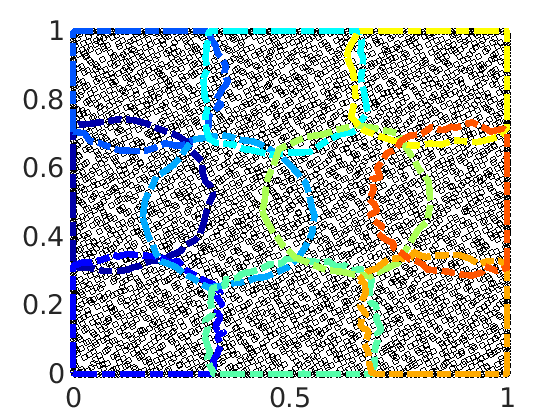
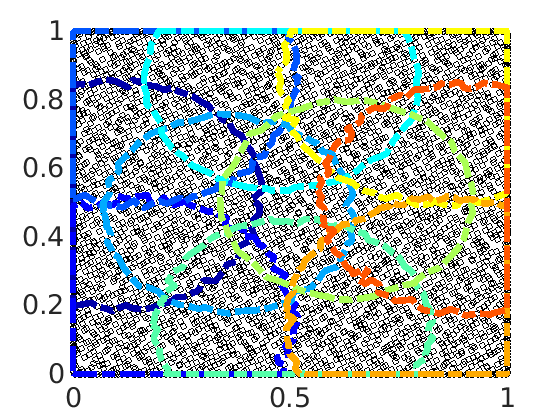
Figure 2: Decomposition example for the Poisson problem in 2D, illustrating subdomain structure at minimal and doubled node counts per subdomain.
ASH yields lower iteration counts compared to RAS for both continuous and discontinuous PoU, especially pronounced in the 2D experiments with discontinuous PoU.
2D Incompressible Stokes Problem
For the coupled Stokes equations, discretization considers velocity and pressure on distinct sets of Halton nodes, maintaining the stability regimen established in recent RBF-FD literature [westermann2025stability]. The decomposition ensures stronger overlap for velocity than pressure variables, paralleling stability prerequisites.
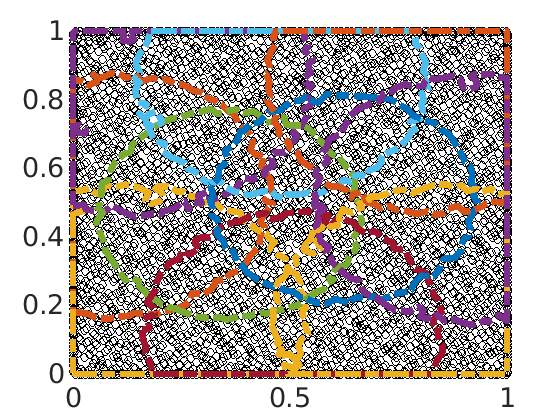
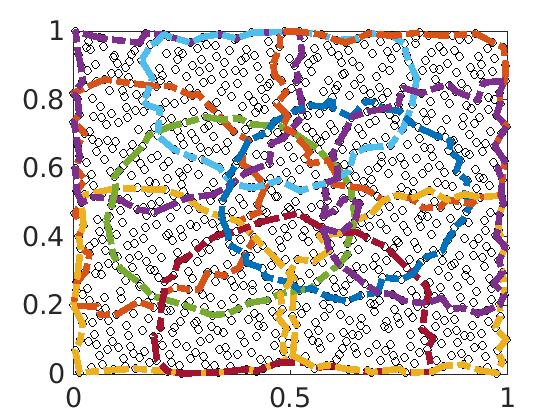
Figure 4: Decomposition example for the Stokes 2D problem, showing the spatial support of velocity and pressure subdomains at near-optimal overlap.
Iteration count and timing studies reveal several key trends:
- ASH continues to outperform RAS, albeit with a smaller margin than for Poisson.
- Computational cost scaling is steeper for Stokes, due to the increased bandwidth and fill-in in saddle-point system matrices; LU-decomposition cost grows as O(N2.8).
Influence of Partition of Unity
Continuous PoU leads to smooth global iterates and smaller residual errors, especially for RAS, mitigating the adverse effects of discontinuity seen with dPoU. For ASH, convergence is less sensitive to PoU continuity.
Practical and Theoretical Implications
From a practical standpoint, the findings contradict common recommendations from mesh-based domain decomposition, where disjoint or minimally overlapping subdomains are standard. Instead, for meshless methods:
- Significant overlap is necessary for robust convergence and efficient preconditioning.
- Disjoint domain decompositions fail to deliver acceptable performance, possibly due to the nonlocal support and irregular connectivity induced by meshless node distributions.
Theoretically, these results indicate that Schwarz methods' convergence properties rely not simply on the algebraic structure of the subdomains but also on the analytic properties of the associated PoU and the nature of the discretization scheme. Notably, the study highlights the suitability of ASH, especially when used as a smoother in multigrid methods for large meshless PDE solves.
Future research directions include extension to nonlinear and time-dependent problems, optimization of parallel implementations given the increased overlap, and investigation of hybrid meshless/meshed Schwarz approaches for complex, multi-physics systems.
Conclusion
The paper rigorously demonstrates that, in the context of meshless finite difference discretizations, overlapping domain decomposition is essential for effective Schwarz preconditioning. The ASH variant, in particular, provides consistent improvements in iteration count and robustness, especially when substantial—but not excessive—overlap is maintained. These findings inform both the theoretical understanding and practical implementation of scalable solvers for PDEs on irregular domains via meshless methods (2607.00842).