- The paper demonstrates that downwelling, rather than upwelling, underlies the rapid (0.5-year) colour shifts observed in Oval BA.
- It uses a one-dimensional model incorporating photochemical injection, eddy diffusion, and gravitational settling to replicate a 30–35% decrease in optical depth.
- The findings imply that weak secondary circulation modulates chromophore haze dynamics, refining our understanding of Jovian vortex microphysics.
Microphysical Modeling of Colour Changes in Jupiter's Oval BA
Introduction
The study investigates the physical mechanisms governing the recurrent colour changes observed in Jupiter's Oval BA, the planet's second-largest anticyclonic vortex. While the vortex’s annulus alternates between whitish and reddish states on sub-annual timescales, the underlying processes that drive these transitions have remained unresolved. This work utilizes a one-dimensional microphysical model, constrained by HST/WFC3 retrievals, to elucidate the microphysical and dynamical conditions responsible for such rapid optical changes. The research emphasizes the distinction between upwelling and downwelling scenarios in the chromophore-bearing haze and evaluates their suitability in explaining observed transition timescales and dynamical signatures.
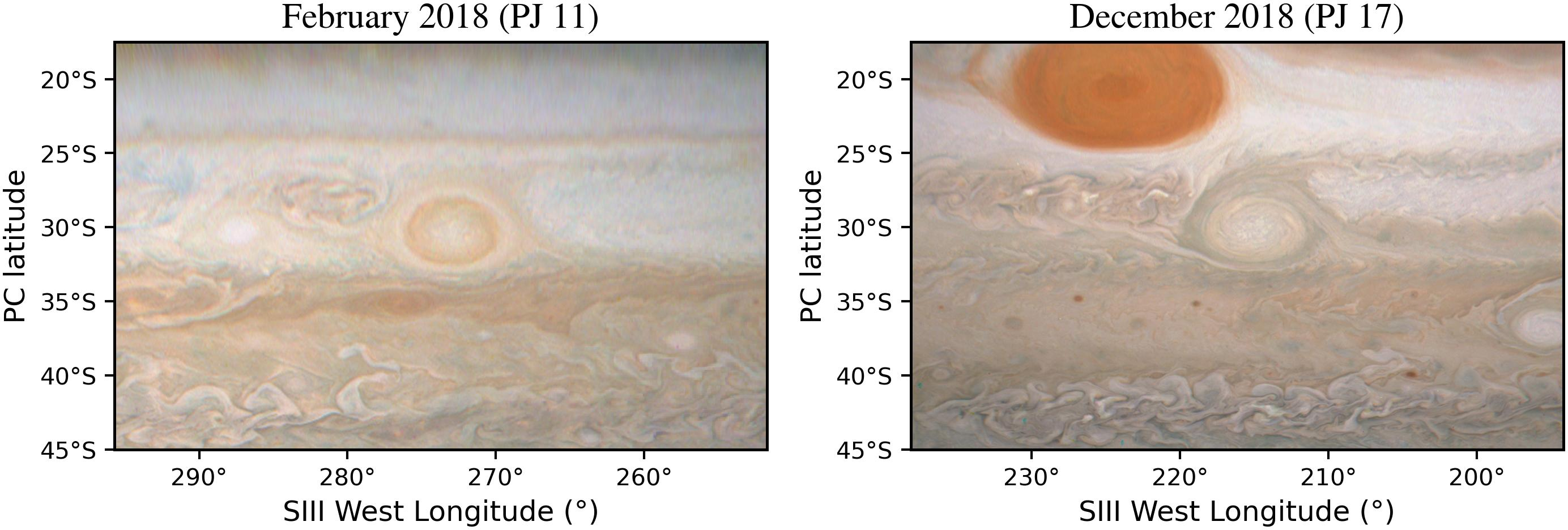
Figure 1: JunoCam views of Oval BA showing the annulus colour change from reddish (February 2018) to whitish (December 2018), illustrating the rapid transition in 2018.
Observational Constraints
Radiative transfer retrievals indicate that colour fluctuations in Oval BA predominately implicate the upper tropospheric chromophore haze around or above the 0.2-bar pressure level. The optical depth at 900 nm, τ(900 nm), decreased by 30–35% during whitening episodes, while the effective particle radius remained stable in the 0.2–0.3 μm range. Temporal analyses of imaging and spectra show that the whitening events unfold typically within 0.5-0.6 years. No significant changes in haze altitude or morphology have been detected, reinforcing the conclusion that colour variation is mainly driven by optical depth modification.
Microphysical Modeling Framework
A one-dimensional microphysical model simulates the time-dependent evolution of the chromophore haze, following the computational scheme originally proposed by Toon et al. and adapted for Jupiter’s Great Red Spot haze. The model solves a particle continuity equation incorporating sources (photochemical injection), eddy diffusion, gravitational settling, advective vertical transport, and coagulation with charge-regulated sticking efficiency. The key control parameter is the background vertical velocity (wtrop), distinguishing between upwelling and downwelling regimes at chromophore-relevant pressures.
Parameter sweeps were performed for injection magnitude (Cinj), pressure of maximum injection (Pinj), vertical transport velocity (wtrop), and particle charge-per-radius (Q). Steady-state solutions matching 2016 (reddish state) observations were identified, and abrupt parameter changes were introduced to mimic rapid transitions—thus probing the dynamical response timescales in both upwelling and downwelling scenarios.
Results: Timescales and Dynamical Drivers
Simulations demonstrate that while both upwelling (Scenario A) and downwelling (Scenario B) can reach the correct steady-state optical depths and particle sizes, only downwelling scenarios reproduce the rapid (∼0.5 year) observed colour transition timescales. In the upwelling regime, the minimum modelled transition time is ∼3 years, falling outside observational constraints. Modifying source terms or particle charge affects optical depth and size but either produces excessive lag or leads to particle sizes that contradict retrievals.
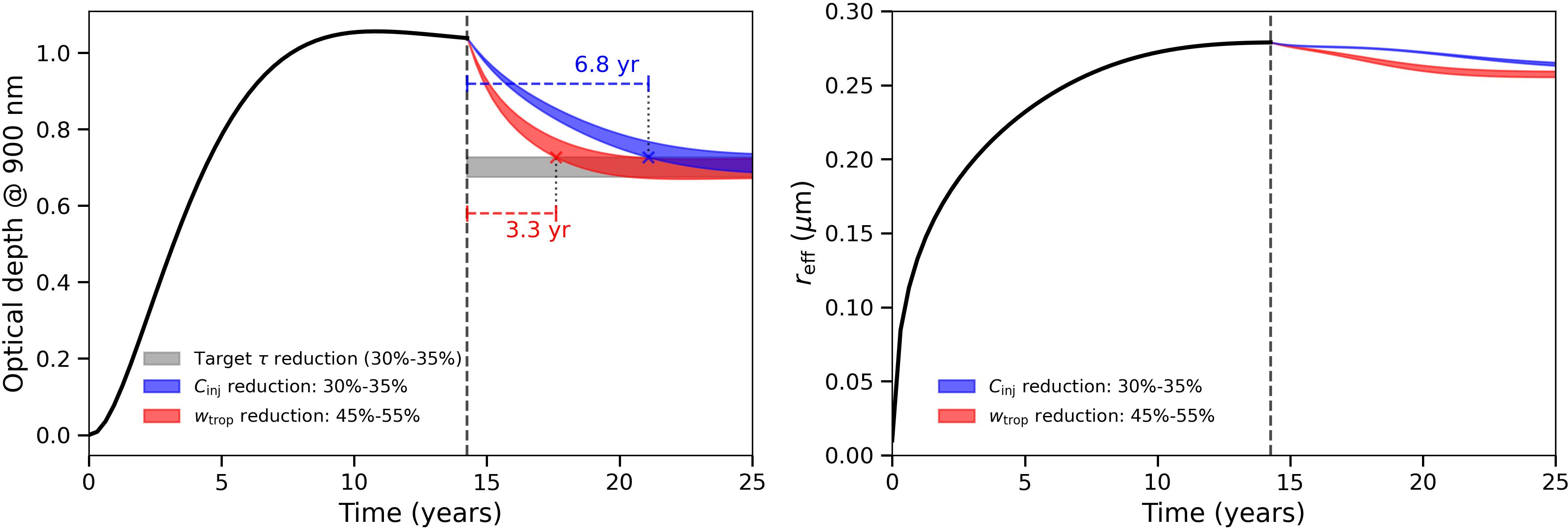
Figure 2: Response of τ(900 nm) and reff to imposed upwelling-parameter changes; optical depth transitions lag observations by several years.
By contrast, increasing downward velocity (wtrop0) at chromophore levels in the downwelling regime can decrease wtrop1 by 30–35% within wtrop20.5 years, with little change to wtrop3 or haze altitude.
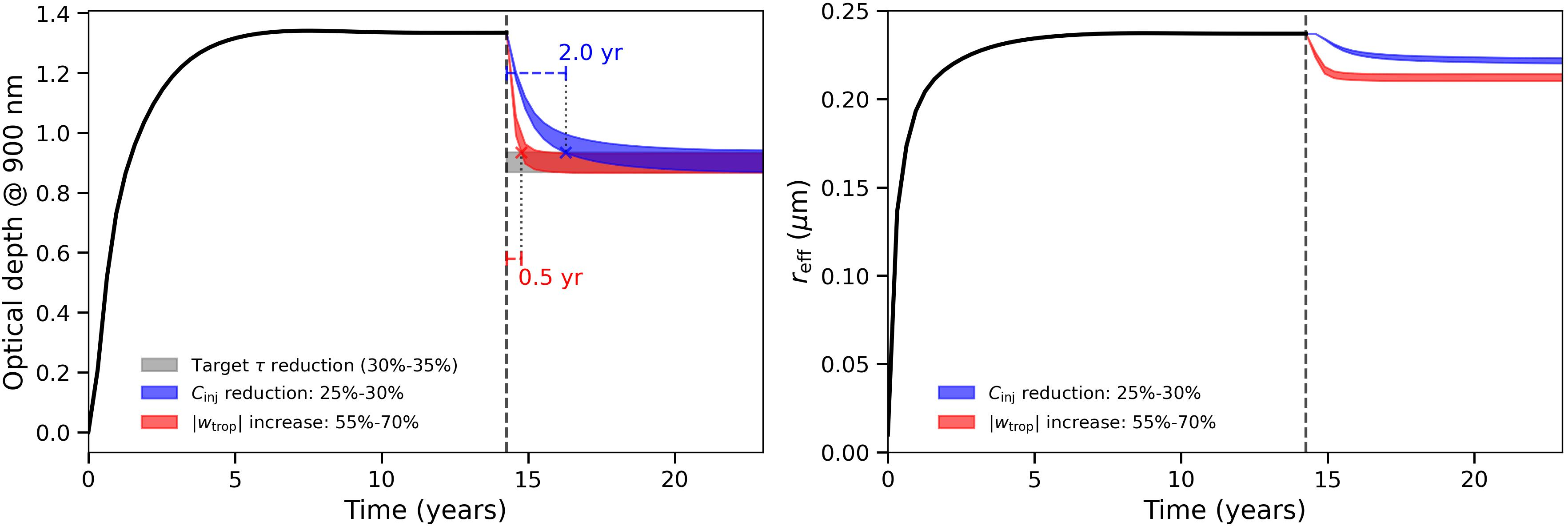
Figure 3: Response of wtrop4 and wtrop5 to imposed downwelling-parameter changes; target optical depth range reached within wtrop60.5 years, matching observed whitening timescales.
The preferred solution constrains local vertical velocities to wtrop7 of wtrop8 to wtrop9 m sCinj0, considerably lower than large-scale overturning estimates but consistent with weak secondary circulation at these altitudes. Notably, such low amplitudes help explain the absence of sharp cloud-top dynamical signatures during transitions.
Implications for Jovian Vortex Dynamics and Chromophore Cycling
The results provide robust microphysical evidence supporting the prevailing dynamical model in which the annulus of Oval BA constitutes a region of subsidence, fed by secondary circulation rising over the anticyclonic core and descending in the annulus. Observed colour changes are linked to modulations of weak, local downwelling velocities near the tropopause, rather than convective upwelling or variation in chromophore supply.
This downwelling-focused scenario aligns with prior upper-tropospheric studies of Jupiter’s major vortices and synthesizes retrieval-based and theoretical insight into the chromophore transport and optical depth modulation mechanism. The inferred mass fluxes required for haze maintenance exceed those predicted from the local photochemical production of the favored chromophore, suggesting the potential involvement of additional non-chromophoric material and advocating further research into the compositional heterogeneity of haze particles.
The absence of analogous rapid colour transitions in the Great Red Spot precludes direct extrapolation, but the present model framework is directly applicable to high-altitude Jovian anticyclones and analogous exoplanetary phenomena. The findings also suggest that monitoring colour transitions can serve as a diagnostic of subtle dynamical changes in chemically predominant stratified layers, even in the absence of overt cloud-field or temperature anomalies.
Future Directions
Further development of this approach should involve coupling microphysical models to full-3D dynamical simulations of vortex secondary circulation, as well as refining temporal constraints through high-cadence multispectral monitoring. Additionally, improved in situ and laboratory constraints on chromophore particle formation, coagulation, and compositional mixing could inform mass flux estimates and photochemical pathways.
Conclusion
This study establishes that rapid chromophore optical depth transitions, and consequently colour changes, in Jupiter's Oval BA are best explained by dynamical modulation of weak downwelling at chromophore-relevant altitudes, rather than variations in upwelling or particle source rates. The characteristic vertical velocities required are low enough to evade detection by standard cloud-tracking methods, elucidating the lack of observable dynamical anomalies during whitening and reddening events. These results refine our understanding of Jovian anticyclonic microphysics and endorse secondary circulation modulation as the principal mechanism for colour transitions in high-altitude vortices.
(2607.00801)

