Exploring the neutron momentum distribution in nuclei through γn→π−p at an electron-positron collider
Published 1 Jul 2026 in hep-ph | (2607.00783v1)
Abstract: The neutron momentum distribution is essential both for reliably extracting fundamental free neutron observables from nuclear measurements and for probing the tensor force via the high-momentum neutron fraction, which is crucial to the theoretical understanding of short-range correlations (SRCs). In this work, we investigate this distribution by studying the γn→π<sup>−</sup>p process at an electron-positron collider, proposing to utilize the beryllium beam pipe at the Beijing Spectrometer III (BESIII). The cross sections for this process on both deuteron and beryllium targets are calculated within the impulse approximation framework. We also evaluate the effective luminosity of the photon flux from radiative Bhabha scattering, taking into account the distribution of target materials within the BESIII experimental setup. Our results show that tens of thousands of events can be generated at BESIII, offering the potential for precise measurements of the neutron momentum distribution. These findings suggest that electron-positron colliders could play a valuable role in elucidating nuclear structure and advancing our understanding of nonperturbative QCD, offering promising new avenues for both particle and nuclear physics.
The paper demonstrates that pion photoproduction via γn→π⁻p provides high-statistics access to neutron momentum distributions in nuclei.
It applies an impulse approximation framework with ab initio and MAID model inputs to quantify nuclear modifications and SRC contributions.
The analysis predicts robust event rates at BESIII and future STCF facilities, promising significant advances in nuclear structure studies.
Investigating Neutron Momentum Distributions in Nuclei via γn→π−p at Electron-Positron Colliders
Introduction
Precise characterization of the neutron momentum distribution in nuclei is critical for extracting neutron-specific observables from nuclear measurements and for elucidating the dynamics of short-range correlations (SRCs), especially those driven by tensor forces in nucleon-nucleon interactions. The absence of free neutron targets makes such determinations dependent on complex nuclear corrections, intensifying the need for experimental methodologies that provide high-statistics and model-independent access to bound neutron dynamics.
This work proposes and quantitatively examines the use of pion photoproduction via the γn→π−p channel, leveraging the beryllium (9Be) beam pipe at BESIII as a quasi-free neutron target, with photon beams sourced from radiative Bhabha scattering in e+e− collisions. The analysis employs an impulse approximation (IA) formalism, ab initio input for deuteron and beryllium momentum distributions, and the MAID model for the elementary photoproduction cross section. The feasibility study includes high-statistics event rate calculations for the BESIII and (prospectively) STCF facilities.
Impulse Approximation Framework and Cross Section Calculation
The employed formalism treats the photon interaction as a quasi-free process with a single bound neutron, with other nucleons acting as spectators. The total cross section for γn→π−p from bound neutrons is modeled as a convolution of the free photoproduction cross section with the neutron momentum distribution, integrated over the relevant kinematic variables and material geometry.
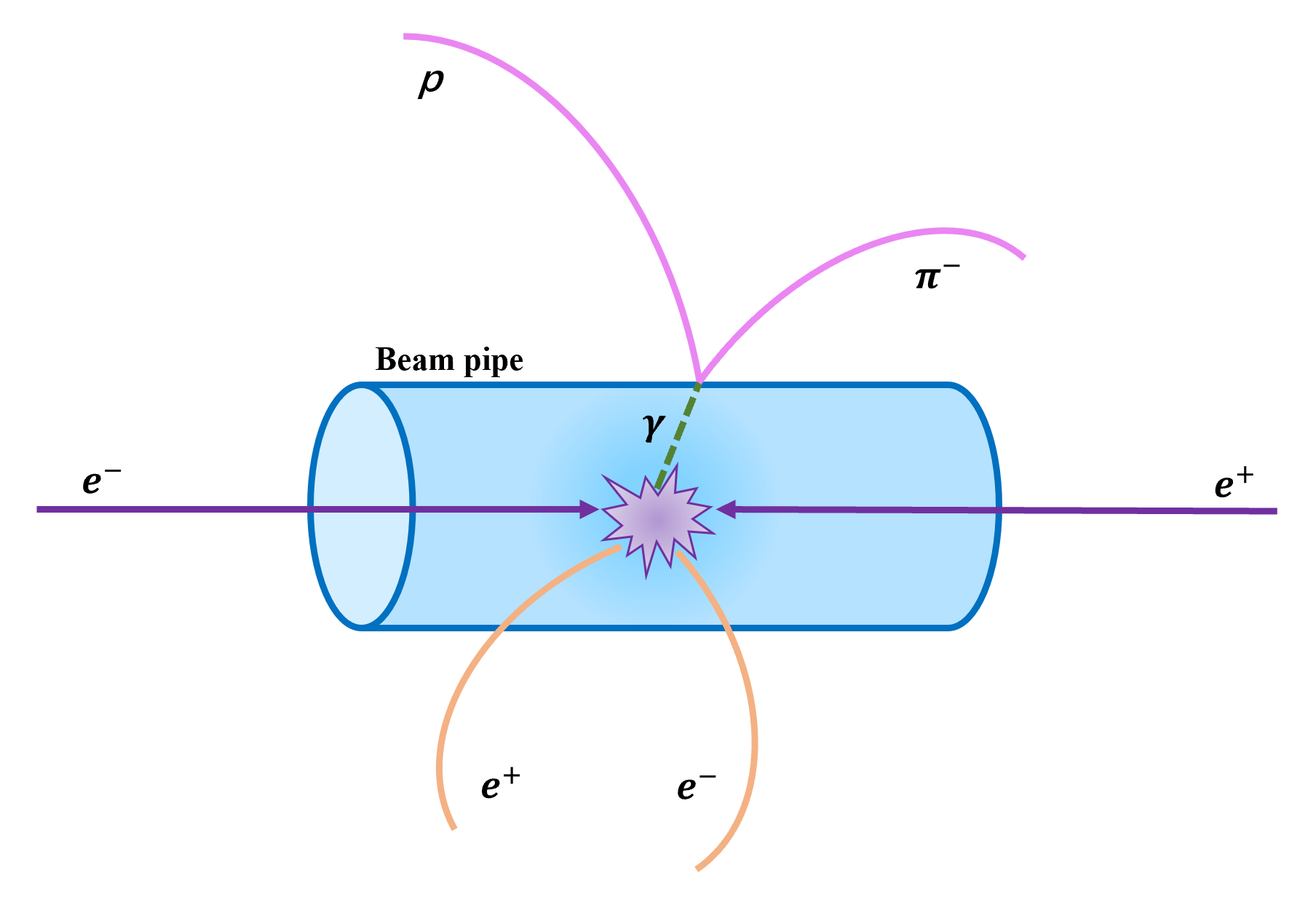
Figure 1: Schematic diagram of the γn→π−p process with the neutron bound in a nucleus. The photon interacts with the neutron, producing a π− and a proton.
The kinematic treatment incorporates both Fermi motion and high-momentum (SRC) components. For ∣pn∣<kF, mean-field motion dominates, while for ∣pn∣>kF SRCs are phenomenologically incorporated using the np-SRC dominance hypothesis. Off-shellness effects and missing energy are parametrized according to empirical constraints from electron-scattering data.
Free and Bound Cross Sections: Model Inputs and Quantitative Results
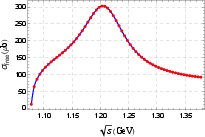
The underlying elementary cross section σfree is taken from the MAID unitary isobar model, guaranteeing accurate unitarity and analyticity constraints across threshold and resonance regimes. The notable resonance structure is anchored by the γn→π−p0 peak.
Figure 2: The total cross section of γn→π−p1 as a function of γn→π−p2, illustrating resonance behavior as predicted by the MAID model.
Neutron momentum distributions in γn→π−p3Be are constructed using the SRC scaling factor γn→π−p4, the Woods-Saxon mean-field parametrization, and VMC-derived high-momentum deuteron tails. For the deuteron, fully ab initio AV18+UX results are used.
The convolution predicts significant nuclear modifications, especially near threshold and at intermediate photon energies:
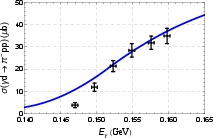
For deuterons, the near-threshold γn→π−p5 cross section is dominated by low-momentum neutrons and exhibits excellent agreement with experimental benchmarks, validating the IA methodology (see empirical comparison in Figure 3).
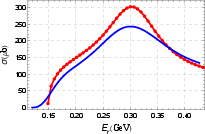
For γn→π−p6Be, high-momentum neutrons (from SRCs) contribute non-negligibly, with nuclear effects altering the cross section by up to γn→π−p7, notably for γn→π−p8 GeV.
Figure 3: The cross section of γn→π−p9 in the near-threshold region, showing theoretical predictions (blue) and PIONS@MAX-lab data (black points).
Figure 4: The cross section for 90 on a 91Be-bound neutron, with the bound (blue) and free (red dashed) contributions illustrating nuclear modification.
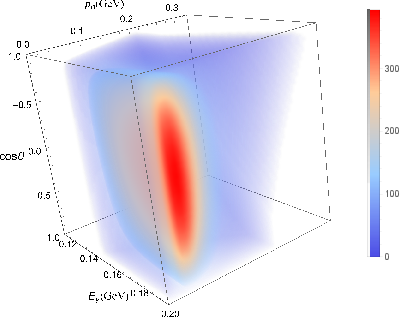
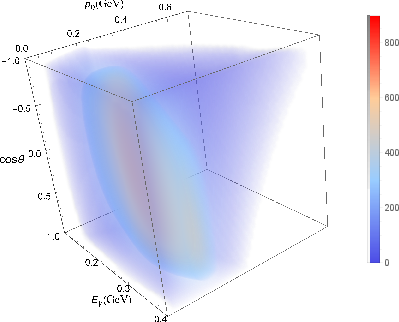
Three-dimensional integrand visualizations reveal that, in beryllium, both Fermi and SRC neutrons contribute across the photon energy range of interest, while in deuteron only Fermi motion plays a significant role at threshold.
Figure 5: The integrand of the IA convolution for 92, mapped onto 93, 94, and 95.
Figure 6: The integrand for 96 on 97Be, highlighting contributions from both Fermi and SRC (high-momentum) neutrons.
Experimental Realization at BESIII: Event Rates and Photon Source
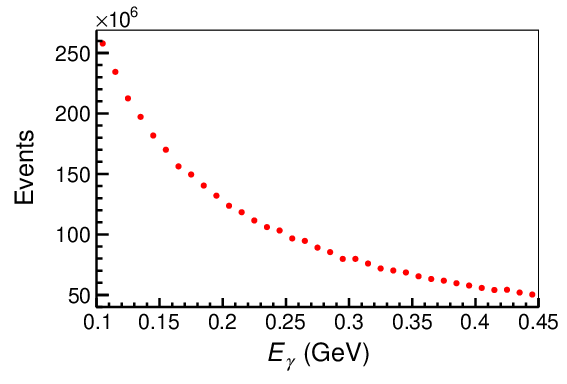
Radiative Bhabha scattering, 98, generates a high-intensity, continuous photon flux with appropriate energies for pion photoproduction. Monte Carlo simulations at 99 (using the Babayaga generator) demonstrate photon yields exceeding e+e−0 per e+e−1 MeV bin, integrated luminosity e+e−2.
Figure 7: Photon energy distribution for radiative Bhabha events at BESIII, showing flux in the range relevant for e+e−3 production.
Accounting for beam pipe geometry, neutron density, and target thickness, the analysis predicts total event rates of e+e−4 for current BESIII datasets, and up to e+e−5 at STCF, ensuring percent-level statistical precision on the extracted nuclear modifications to the cross section. Efficient identification of e+e−6 pairs originating from the beam pipe is feasible due to detector capabilities and unique event topology (four charged tracks, zero net charge, displaced vertex).
Implications and Future Prospects
The proposed implementation enables direct, high-statistics access to neutron momentum distributions in a medium-mass nucleus (e+e−7Be) in an experimentally clean environment, with substantial sensitivity to high-momentum components indicative of SRCs. The comparison of theoretical predictions (with or without nuclear corrections) to measured cross sections as a function of photon energy will enable quantitative extraction of nuclear structure effects, high-momentum tail normalization, and missing energy correlations.
The analysis demonstrates that e+e−8 collider facilities, typically dedicated to high energy and flavor physics, double as effective nuclear physics laboratories. This methodology can be generalized for a range of light and medium nuclei by exploiting different beam pipe materials or auxiliary targets. Theoretical improvements, including full treatment of final state interactions and off-shell effects using ab initio techniques, are required for ultimate precision.
Conclusion
This study establishes a precise and high-statistics program for mapping neutron momentum distributions—and by extension, SRC dynamics—in nuclei via pion photoproduction at electron-positron colliders. The combined theoretical and experimental framework leverages state-of-the-art IA calculations, ab initio nuclear structure input, and robust event rate projections, setting the stage for advances in nuclear structure and nonperturbative QCD studies. The anticipated measurements at BESIII and STCF will provide benchmarks for understanding nucleonic motion under strong interactions and inform next-generation nuclear theory developments.
Reference: "Exploring the neutron momentum distribution in nuclei through e+e−9 at an electron-positron collider" (2607.00783)