- The paper introduces a conditional Bayesian model that quantifies how academic performance strongly influences self-efficacy.
- It employs a partially collapsed Gibbs sampler with spike-and-slab priors to enhance variable selection accuracy and computational efficiency.
- Empirical findings from LSAC data demonstrate that improvements in school belonging lead to higher latent academic achievement and self-efficacy.
Overview
This paper presents a Bayesian methodology for interpretable joint modelling of academic performance (ordinal, parent-rated) and self-efficacy (continuous) among adolescents, underpinned by a latent variable framework. The model encodes the directional dependence posited in recent educational research: academic performance predicts self-efficacy more strongly than the reverse (2607.00722). The authors develop an efficient Bayesian variable selection method tailored to this mixed-response (continuous–ordinal) setting, leveraging a conditional formulation and tailored MCMC (partially collapsed Gibbs) for improved sampling efficiency and variable selection accuracy. The approach is applied to the Longitudinal Study of Australian Children (LSAC), yielding empirical insights and potential policy implications for educational research.
Modelling Framework and Computational Contributions
The core methodological innovation is a conditional Bayesian hierarchical model that represents observed ordinal academic performance as measurements on a latent Gaussian achievement scale, and models self-efficacy as a continuous response, conditionally dependent on this latent achievement. Covariate effects on either outcome are detected via separate spike-and-slab priors supporting outcome-specific Bayesian variable selection.
Formally, let y1i (self-efficacy) be continuous, y2i (academic performance) ordinal, and xi covariates. The model is:
- y2i∗=xi⊤β2+e2i (y2i∗: latent academic achievement),
- y2i determined by thresholding y2i∗,
- y1i−xi⊤β1=δ12(y2i∗−xi⊤β2)+e1i.
This conditional parameterization is not merely algebraically convenient; it yields interpretable coefficients relating deviations from expected academic achievement to deviations from expected self-efficacy, after adjusting for observed covariates.
A significant computational advancement is the design of a partially collapsed Gibbs sampler that exploits latent conjugacy to integrate out regression coefficients during variable-inclusion updates, improving MCMC mixing and effective sample size over generic joint-copula sampling strategies. Simulation studies demonstrate that this tailored sampler yields higher sensitivity and F1 rates in variable selection, particularly under low signal-to-noise regimes, while substantially reducing runtime and autocorrelation relative to standard Gaussian copula regression approaches (see [alexopoulos2021bayesian] for benchmarks).
The authors apply the model to a well-powered (n ≈ 3,000) LSAC Wave 5 sample. Parent-rated academic performance is modelled as a proxy for interpreted mastery experience, considered more relevant to self-efficacy development than test-based achievement.
Posterior Predictive Model Checks
Goodness of fit is assessed via posterior predictive checks for the marginal distributions of academic achievement and self-efficacy, and—critically—for mean self-efficacy within achievement categories:
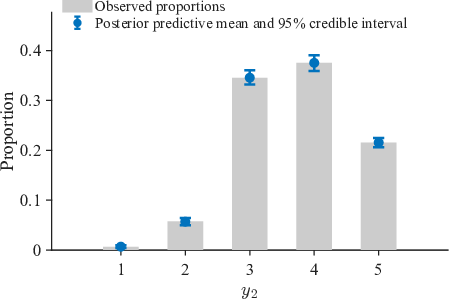
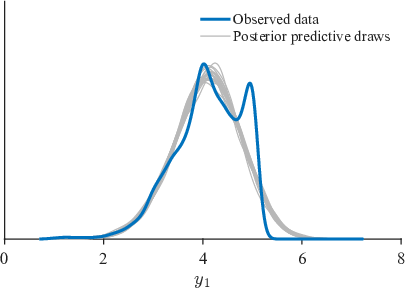

Figure 1: Empirical and posterior predictive distributions for academic achievement. The model closely reproduces observed category proportions.
The model exhibits close calibration for academic achievement. The continuous self-efficacy distribution’s minor bimodality is not fully captured under the Gaussian assumption, suggesting scope for future model extensions.
Variable Selection and Covariate Effects
Posterior inclusion probabilities reveal a pronounced asymmetry in the determinants of latent academic achievement versus self-efficacy. Only a handful of proximal social and psychological factors strongly predict self-efficacy (notably conduct problems, sense of school belonging, presence of a close friend, and extracurricular participation). In contrast, academic performance is broadly influenced by diverse school attendance, parental education, general health, neurodevelopmental diagnoses, and communication variables.
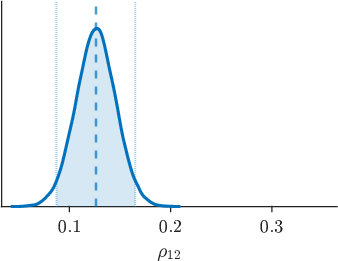
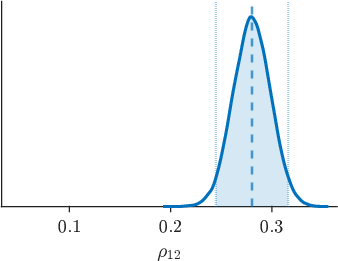
Figure 2: Posterior distribution for the conditional correlation between latent academic achievement and self-efficacy after covariate adjustment.
After adjusting for 20 covariates, the latent academic achievement/self-efficacy association remains positive and significant (posterior mean δ^12=0.070, 95% CrI [0.048, 0.092]), but diminishes by over 50% compared to the unadjusted estimate. The conditional approach thus quantifies the unique incremental association between interpreted achievement and self-efficacy.
Sense of Belonging and Policy-Relevant Pathways
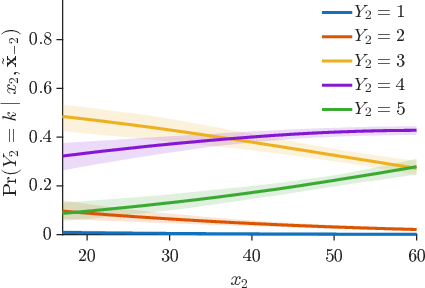
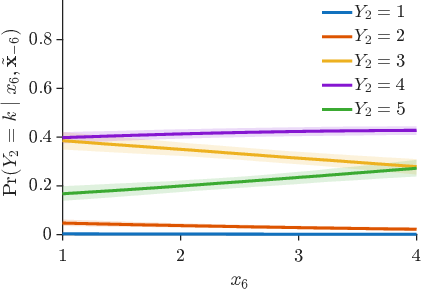
Figure 3: Posterior predictive effects of varying sense of belonging at school on the parental assessment of academic achievement.
Analyses of covariates with high inclusion probability, such as sense of belonging at school, highlight their contributions to academic achievement. Posterior predictive simulations indicate that improvements in belonging strongly shift the probability mass towards higher academic achievement categories, confirming its salience as a modifiable, policy-relevant target.
Theoretical and Practical Implications
These results reinforce contemporary social-cognitive theory: self-efficacy is influenced proximally by interpreted mastery experiences and social connectedness, whereas academic achievement is a cumulative outcome of broader individual, family, and environmental factors. The conditional modelling strategy provides a direct, interpretable scaffold for further causal analyses of these mechanisms.
By demonstrating the superior performance of a tailored MCMC algorithm that leverages the specific continuous-ordinal structure of education outcomes, the paper also provides a blueprint for efficient mixed-response Bayesian inference in other substantive domains.
Future Directions
Potential extensions include multivariate mixed-response models with further outcome types, integration of longitudinal structure (for dynamic self-efficacy/achievement trajectories), and more flexible non-Gaussian models for self-efficacy. The computational approach may generalize to other latent variable settings where conditional structure facilitates analytic parameter marginalization.
Conclusion
The paper advances the modelling of educational psychological constructs by combining interpretable conditional Bayesian modelling with efficient variable selection. The approach enables precise quantification of how interpreted academic mastery relates to self-efficacy above and beyond observed covariates, informs educational policy about proximal drivers of student confidence and achievement, and exemplifies the computational gains achievable by problem-specific MCMC design. The methodological and empirical findings suggest that interventions focused on student belonging and mastery feedback may yield stronger improvements in academic self-efficacy than less targeted approaches.