- The paper introduces a unified active learning framework that leverages strategic query sampling and minimax feedback to separate noisy normal data from subtle anomalies.
- It integrates masked reconstruction into unsupervised pretraining, significantly reducing false positives and negatives with up to 57% AUC improvement on benchmark datasets.
- Empirical evaluations demonstrate that the hybrid approach enhances detection precision across multiple models, notably benefiting Transformer-based systems.
Enhancing Unsupervised Time Series Anomaly Detection via Active Learning
Introduction
Detecting subtle and noisy anomalies in multivariate time series remains an unsolved challenge, particularly in industrial contexts where data annotation is expensive and anomalies are exceedingly rare. The paper "Detecting the Undetectable: Enhancing Unsupervised time series Anomaly Detection via Active Learning" (2607.00720) introduces a unified active learning framework to overcome fundamental limitations of unsupervised reconstruction-based anomaly detectors, specifically their susceptibility to mislabeled noisy normal data and their insensitivity to weak, near-normal anomalies.
Motivation and Problem Definition
Despite widespread adoption of unsupervised deep models, existing approaches systematically misclassify noisy normal fluctuations as anomalies (high false positives) and fail to detect anomalies closely resembling normal patterns (high false negatives). This behavior is empirically demonstrated Figure 1, where reconstruction-based detectors (e.g., LSTM-VAE, Transformer, USAD) show elevated anomaly scores for benign but noisy regions, while subtle true anomalies go undetected.
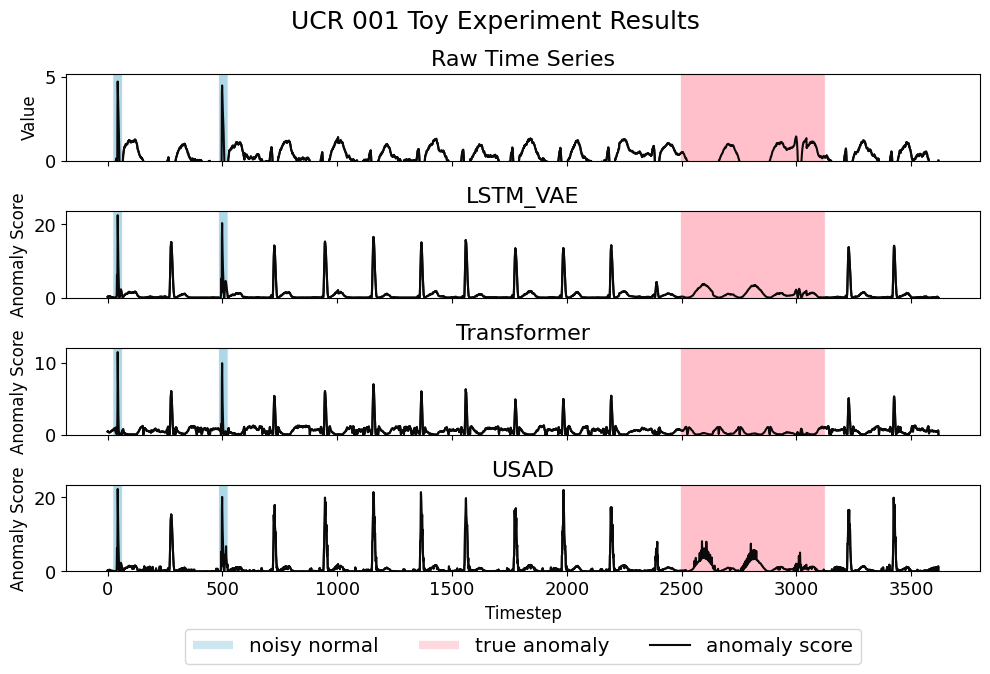
Figure 1: Raw time series of UCR 001 and anomaly score of each model where pink segments are anomalous timesteps.
This observation highlights a core weakness: unsupervised models trained only on normal data develop an incomplete decision boundary, amplifying error in complex, high-dimensional settings with intricate inter-variable dependencies. Purely increasing data volume or using stronger backbones fails to address the generalization bottleneck imposed by the lack of fine-grained supervision.
Framework Overview
The proposed system adopts a three-stage process Figure 2:
- Unsupervised Pretraining: Train a backbone reconstruction-based model (e.g., LSTM-VAE, Transformer, USAD, Anomaly Transformer, VTT variants) to learn normal temporal dynamics via standard reconstruction loss.
- Active Query Sampling: Employ hybrid query strategies to identify and extract high-value windows from unlabeled data for oracle labeling.
- Supervised Feedback: Fine-tune the model using a masked reconstruction task and a minimax loss that enforces divergent optimization for normal (minimize loss) and anomalous (maximize loss) samples, leveraging only oracle-verified labels.
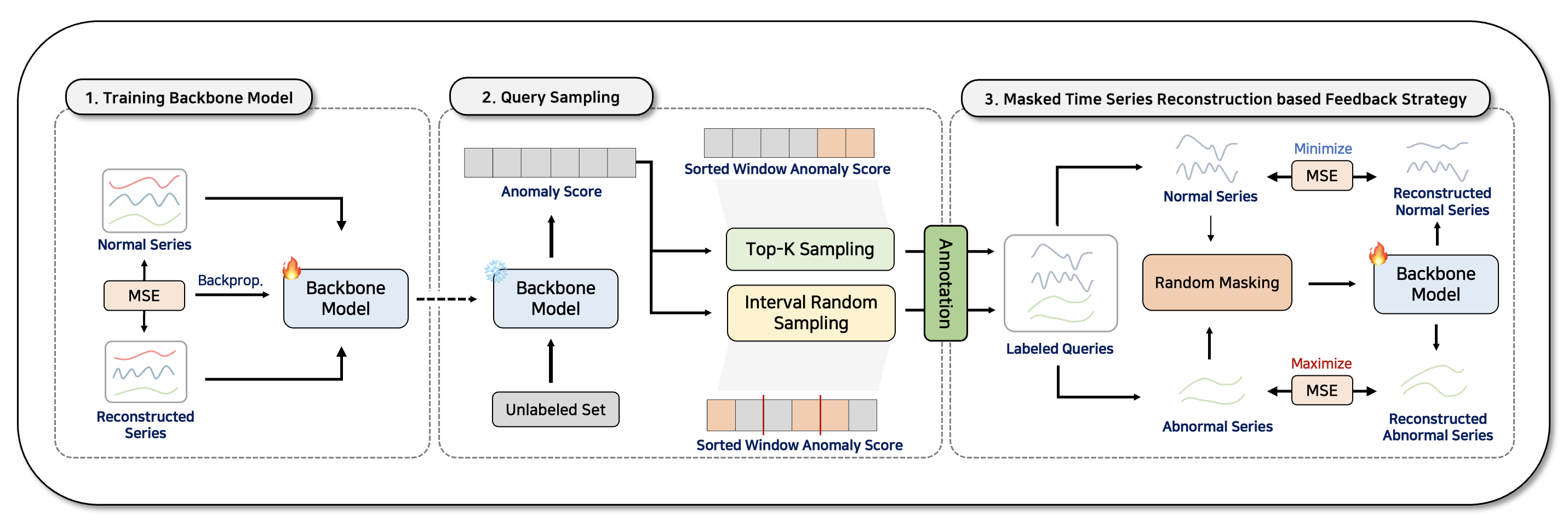
Figure 2: Overall architecture of proposed framework.
The dataset configuration separates normal training data, an unlabeled pool for query sampling, and a label-revealed test set for evaluation, as depicted in Figure 3.
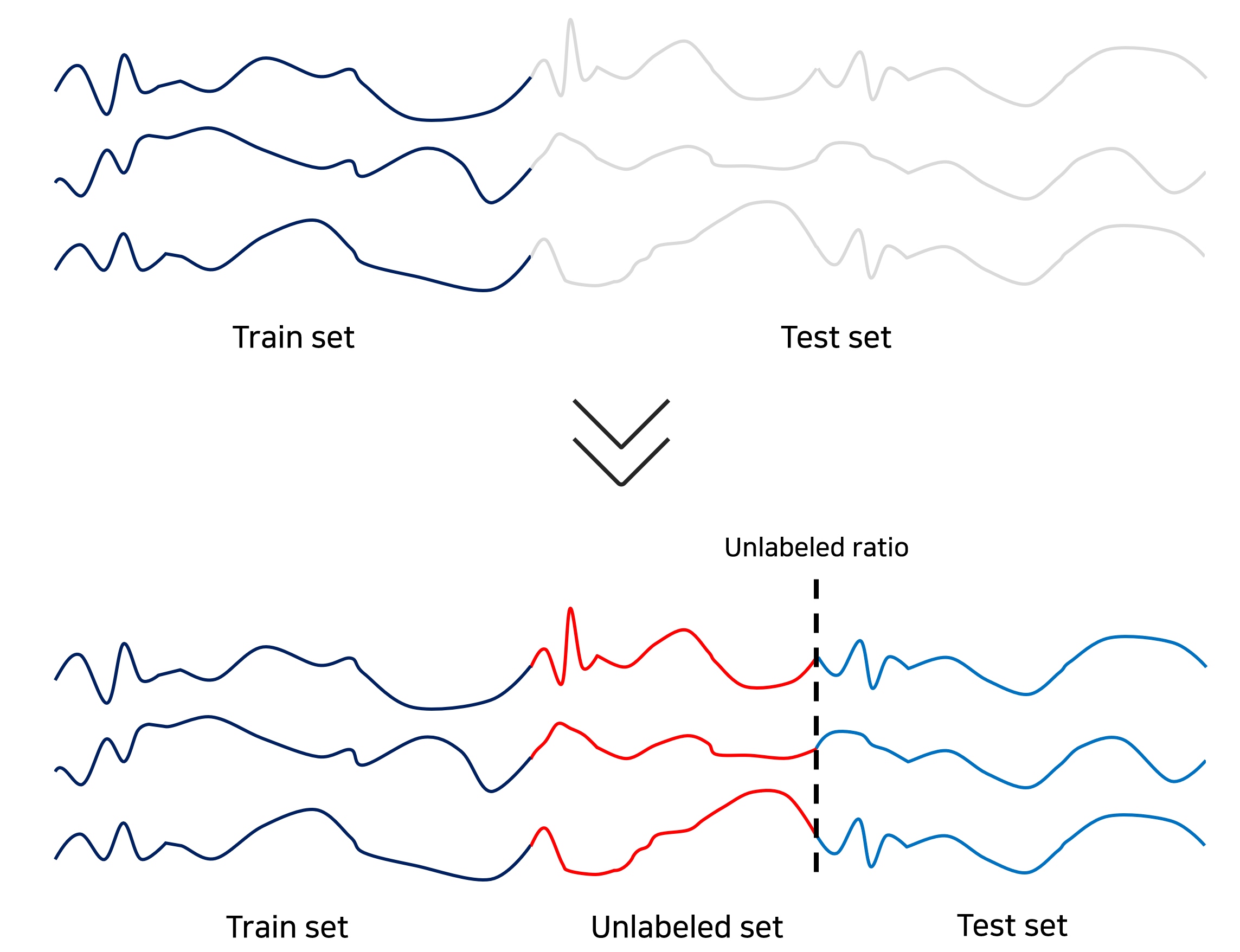
Figure 3: Example of dataset configuration process.
Query Sampling Strategy
Robust performance hinges on strategic query selection Figure 4:
- Top-k Sampling: Select windows with highest anomaly scores, ensuring inclusion of both noisy normal exemplars and true anomalies with high error.
- Interval Random Sampling: Partition anomaly score space into intervals and randomly sample within each, capturing subtle anomalies and underrepresented normal data.
Combining both yields a diverse query set, maximizing informative feedback while minimizing annotation cost.
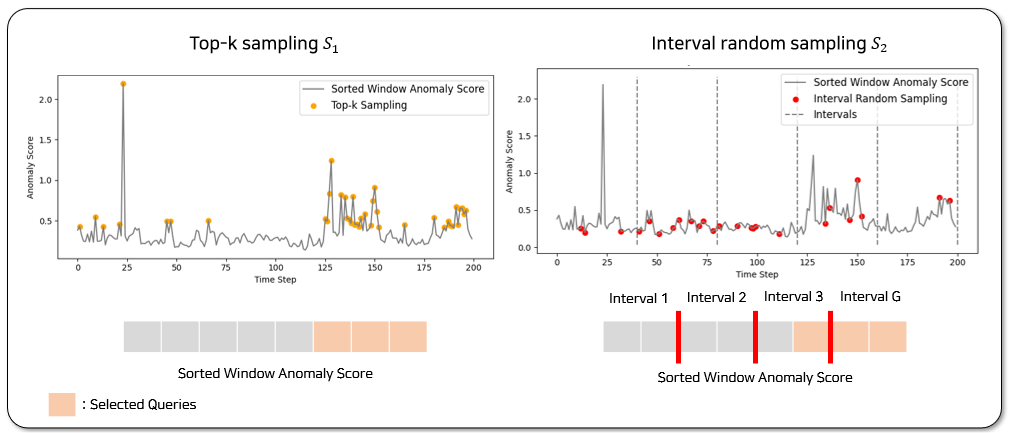
Figure 4: Illustration of two different ways of query sampling strategies.
Masked Time Series Reconstruction Feedback
For each sampled query, the framework employs masked reconstruction: random segments are occluded, and the model is trained to recover these via its learned representations. The feedback objective is a minimax loss: minimize reconstruction error for normal-labeled queries and maximize for anomalous ones. This asymmetric optimization enhances separability in the score space by directly pushing apart the reconstruction characteristics of normal and abnormal classes.
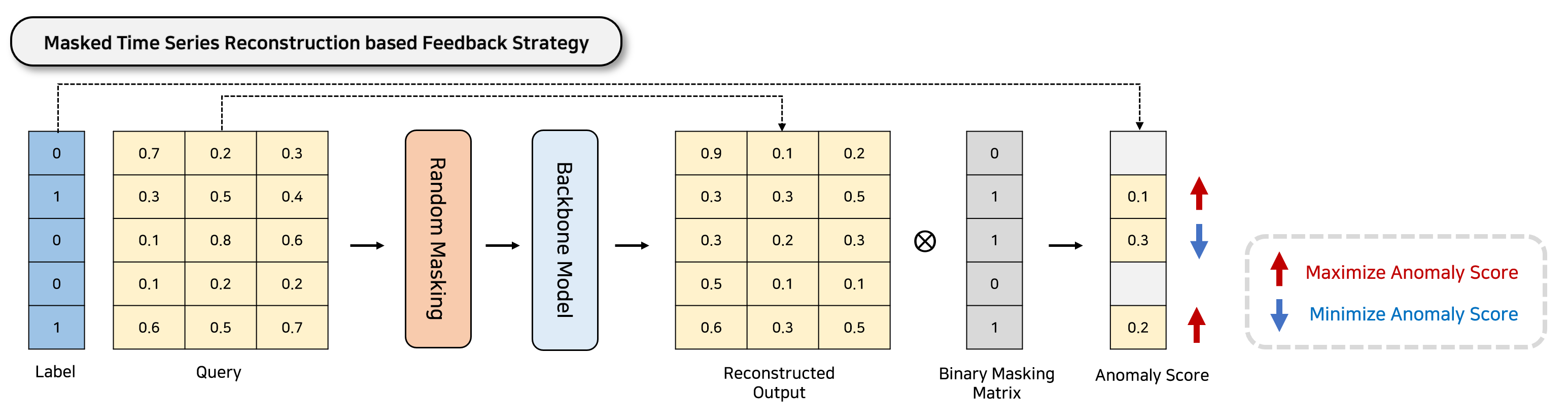
Figure 5: Illustration of Masked time series Reconstruction based Feedback Strategy.
The integration of masking induces the model to capture long-range temporal dependencies and avoid overfitting to trivial pattern memorization, analogous to masked modeling pretext tasks in self-supervised literature.
Empirical Evaluation
Datasets: Extensive validation is conducted on four multivariate benchmarks (SWaT, PSM, Gecco, Swan) with diverse anomaly patterns.
Backbones: Seven widely used unsupervised reconstruction models are considered—including Transformer-based architectures and their variants.
Main Results: The proposed framework yields substantial improvements in AUC (up to 57% absolute increase with Anomaly Transformer, average 12.39% over all settings) across most backbones and datasets (Figure 6 and Figure 7). Notably, Transformer-based models benefit most, implying synergistic gains when the feedback mechanism is paired with attention modules.
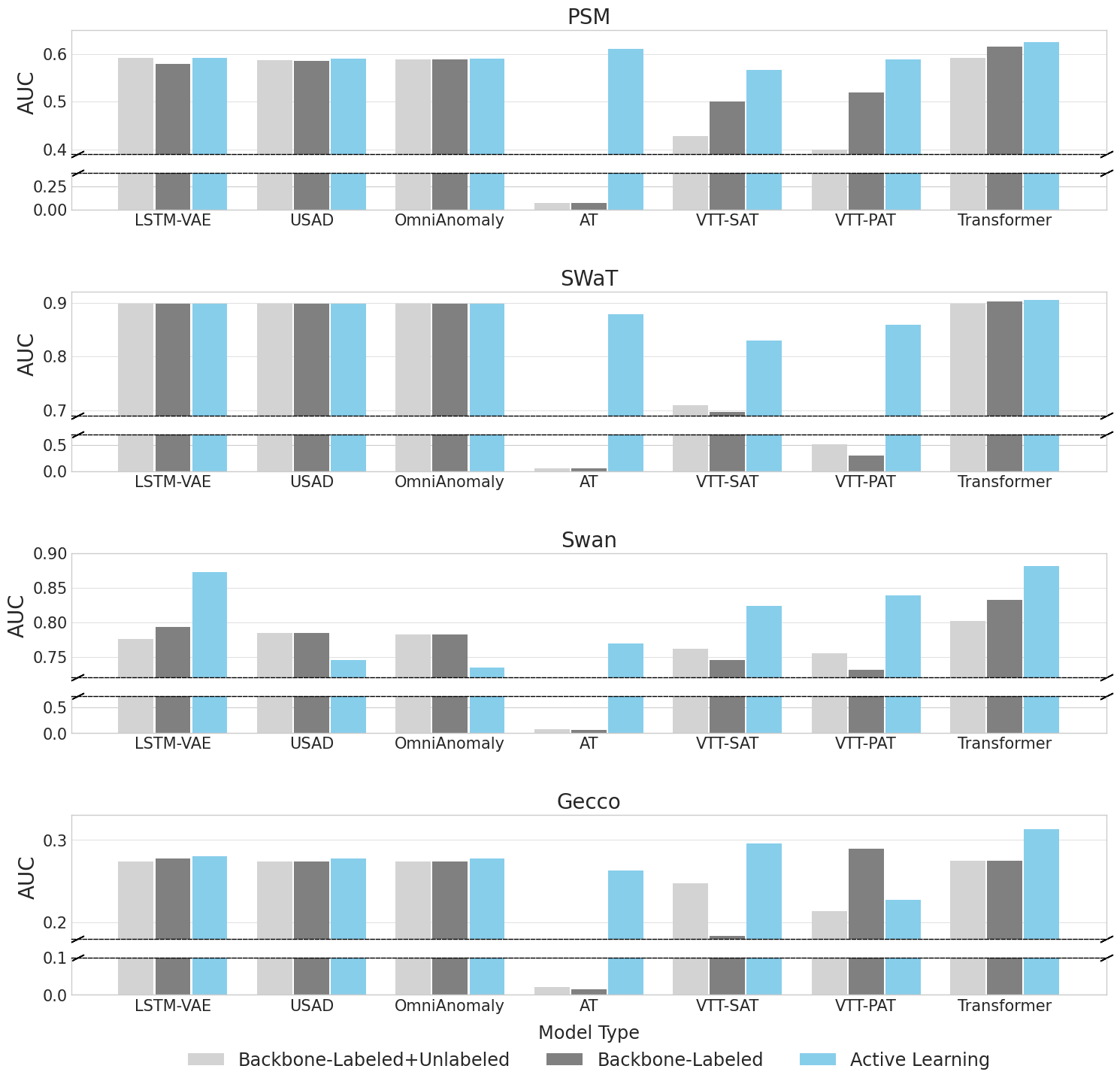
Figure 6: Bar plot showing AUC of experimental result with seven different backbone models on each benchmark. Backbone-Labeled+Unlabeled corresponds to w/unlabeled, Backbone-Labeled to w/ounlabeled, and Active Learning to Ours.
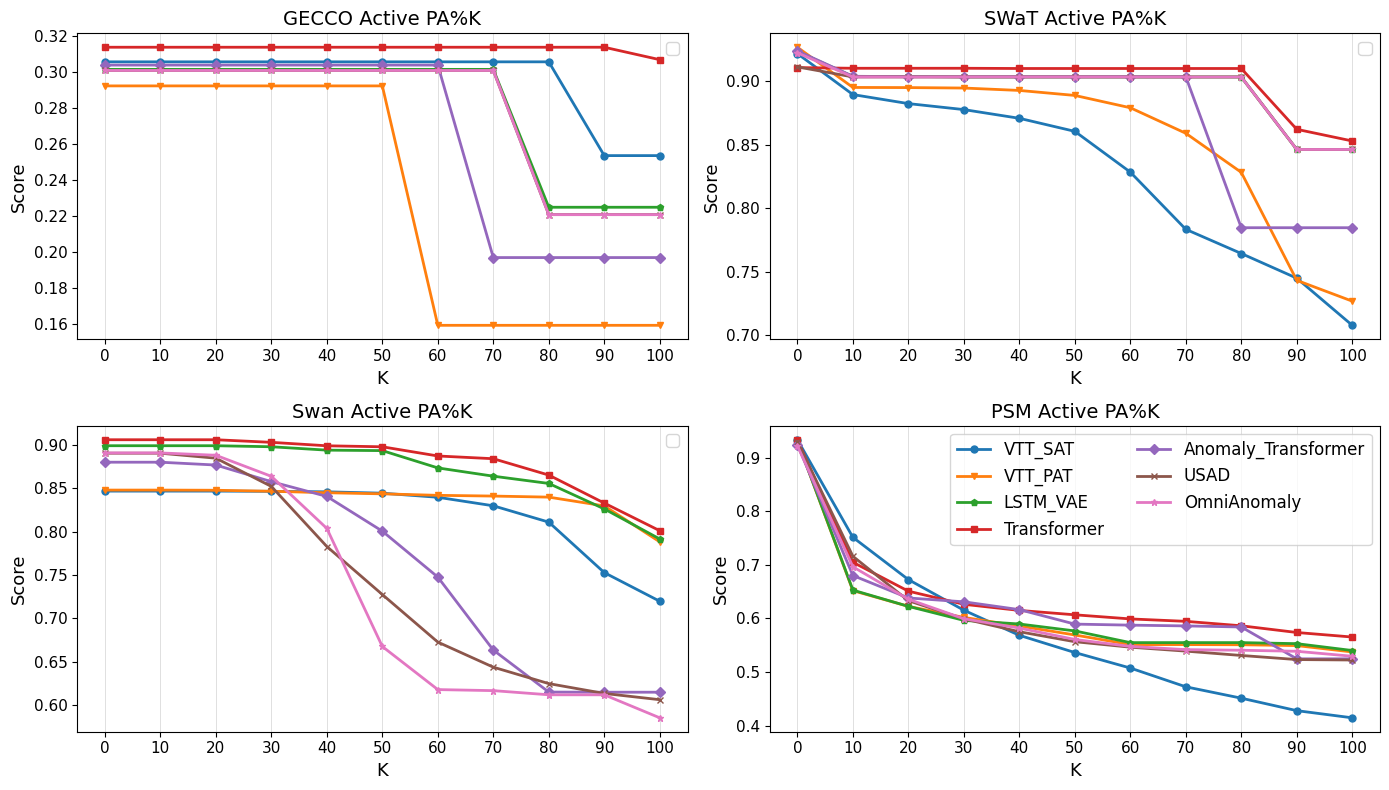
Figure 7: PA%K curve for four datasets and seven backbone models with our proposed framework applied.
An ablation study Figure 8 systematically validates that each component—minimax loss, strategic query sampling, and masking—materially contributes to final detection performance. Disabling any degrades performance, establishing the importance of the synergistic design.
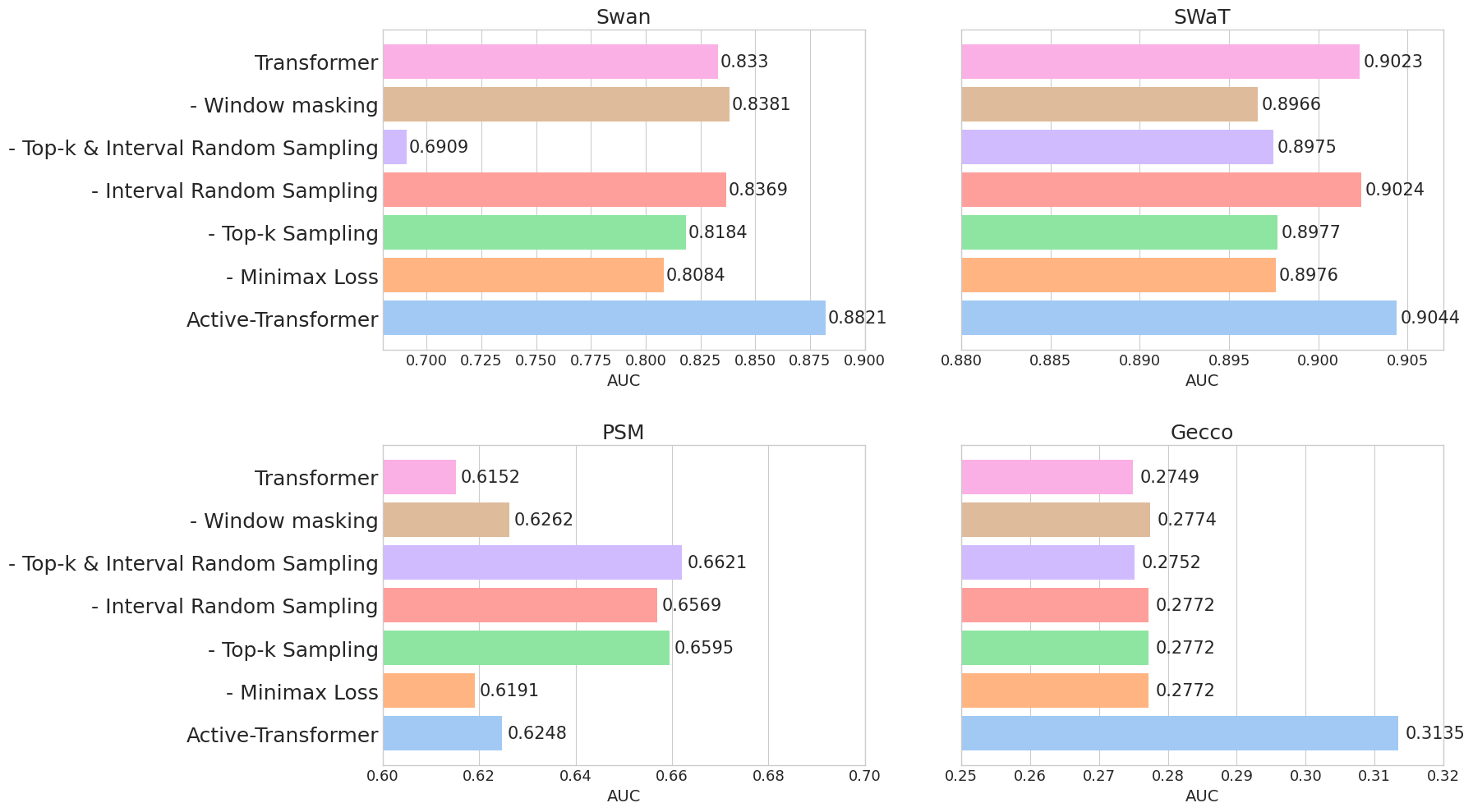
Figure 8: AUC score of Transformer backbone model for four datasets when major components of proposed framework are removed individually.
In scenario analysis Figure 9, the active-learning-augmented model produces sharper anomaly score transitions and improved anomaly localization, even under realistic annotation constraints.
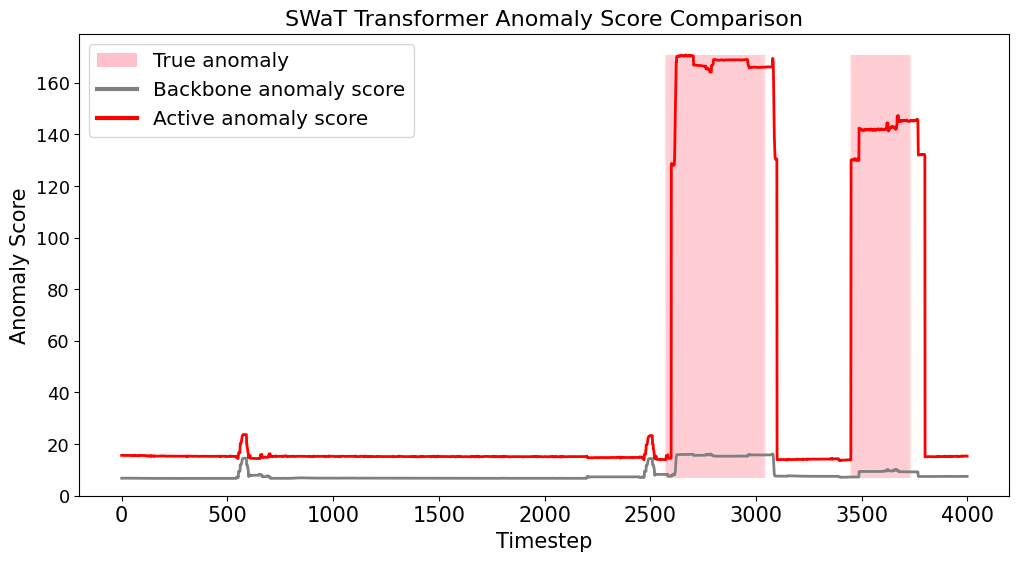
Figure 9: Comparison of anomaly score of Transformer backbone model when active learning is implemented on SWaT test set from timestep 255,000 to 259,000.
Practical and Theoretical Implications
This framework bridges the gap between unsupervised generality and the discriminative power of minimal supervision. By targeting the uncertain margin—the region of overlap between noisy normal and subtle anomaly patterns—the model achieves significant reductions in both false positives and false negatives with limited annotation budget. The minimax feedback principle directly enforces a separation in the reconstructed feature space, which is not attainable with pseudo-label-based metric learning (as in Active-MTSAD) or standard reconstruction losses.
The results demonstrate robustness across model architectures, dataset characteristics, and varying anomaly rates (with limitations on datasets where anomaly prevalence violates the ‘rare anomaly’ assumption). The model-agnostic nature enables straightforward retrofitting to existing unsupervised systems.
Future Directions
Potential improvements include integrating adaptive or self-tuning query schemes, replacing hard minimax objectives with more stable adversarial or contrastive losses, and incorporating multi-scale or hierarchical masking schemes. Further theoretical analysis linking minimax feedback to margin maximization in the feature space could yield explanations for empirical phenomena observed in complex multivariate systems.
Conclusion
The active learning framework outlined in "Detecting the Undetectable: Enhancing Unsupervised time series Anomaly Detection via Active Learning" (2607.00720) delivers robust, architecture-agnostic improvements for reconstruction-based time series anomaly detectors. It achieves this via (1) strategic query selection that focuses supervisory effort on ambiguous and adversarial regions, and (2) a principled feedback strategy that uses masked reconstruction and minimax optimization to enforce separability. The approach achieves high annotation efficiency and strong empirical gains, particularly for Transformer-based models, and lays the foundation for further research into hybrid semi-supervised anomaly detection in challenging high-dimensional temporal data.

