Dipolar flow of identified hadrons at mid-rapidity using transport models
Published 1 Jul 2026 in nucl-th | (2607.00703v1)
Abstract: We report a transport model study of the rapidity even component of dipolar flow, v1<sup>even, for identified charged hadrons at mid-rapidity in Au+Au collisions at sNN=27−200 GeV. The analysis is performed using the AMPT model, with comparisons to HIJING to quantify non-flow contributions. The v1<sup>even of identified hadrons (π, K, and p) shows no significant difference between particles and anti-particles at sNN=200 GeV. However, a clear splitting between proton and anti-proton v1<sup>even develops with decreasing beam energy, while no corresponding difference is observed for mesons (π<sup>± and K<sup>±). A comparison of the AMPT string melting and default configurations shows that the splitting arises only in the string melting scenario, where partonic interactions and quark coalescence play a dominant role. These results indicate that the proton-antiproton difference in v1<sup>even is sensitive to baryon transport and early-stage partonic dynamics. Our study highlights the potential of identified-particle v1<sup>even measurements at RHIC Beam Energy Scan energies as a novel probe of baryon stopping and the evolution of the partonic medium.
The paper demonstrates that rapidity-even directed flow of identified hadrons captures initial-state fluctuations and baryon stopping effects.
It employs HIJING and AMPT transport models to distinguish non-flow contributions from genuine partonic rescattering, revealing energy-dependent proton–antiproton splitting.
The findings imply that enhanced baryon stopping at lower energies and partonic dynamics are critical for probing QGP properties in heavy-ion collisions.
Dipolar Flow of Identified Hadrons at Mid-Rapidity in Transport Models
Introduction
This paper addresses the rapidity-even component of directed flow, v1even, for identified hadrons produced in relativistic heavy-ion collisions, with a focus on Au+Au collisions at sNN=27–200 GeV. v1even arises from dipole-like fluctuations in the initial state geometry, as opposed to the rapidity-odd traditional directed flow originating from the average geometry of the overlapping nuclei. The rapidity-even component offers sensitivity to initial-state fluctuations and the subsequent partonic medium evolution, motivating its role as a probe of baryon transport, partonic dynamics, and baryon stopping, potentially providing access to QGP properties at RHIC Beam Energy Scan energies.
Modeling Frameworks
The study employs two transport models with differing physics content:
HIJING: A perturbative QCD-based Monte Carlo generator incorporating minijet production and nuclear shadowing, followed by hadronization via Lund string fragmentation. HIJING lacks collective flow by construction but can serve as a baseline for non-flow effects due to jet correlations and global momentum conservation.
AMPT: Extends HIJING initial conditions to include partonic and hadronic interactions:
Default mode: Allows only minijet partons to undergo scatterings, followed by string fragmentation.
String Melting (SM) mode: Converts all excited strings to deconfined quarks, supporting intense partonic rescattering and subsequent hadronization by coalescence. This scenario enables the development of collective phenomena, responsive to baryon transport and partonic medium properties.
Flow Measurement Techniques
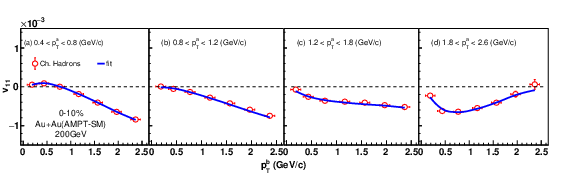
The analysis utilizes two-particle azimuthal correlations with a substantial pseudorapidity gap ∣Δη∣ to suppress short-range non-flow. The v1even is isolated by exploiting its symmetry properties in rapidity and the Fourier decomposition of two-particle correlations, incorporating robust corrections for momentum conservation quantified by a parameter K, proportional to 1/(⟨Nch⟩⟨pT2⟩). The extraction relies on simultaneous fits of the two-particle v11 for multiple pT bins, allowing for consistent comparison across particle species and energies.
Figure 1: v11 versus sNN=270 for several selections of sNN=271 in central Au+Au collisions at sNN=272 GeV; the solid line is the simultaneous fit.
Model Baseline and Non-Flow Considerations
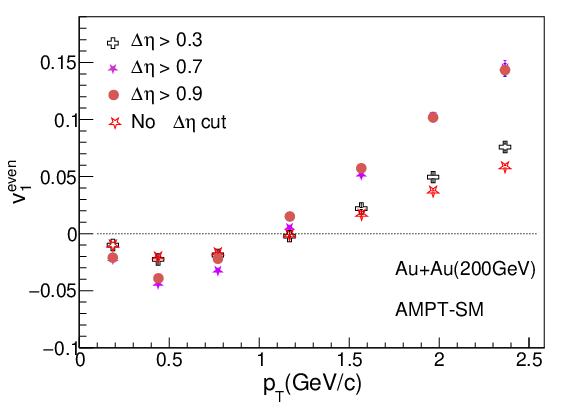
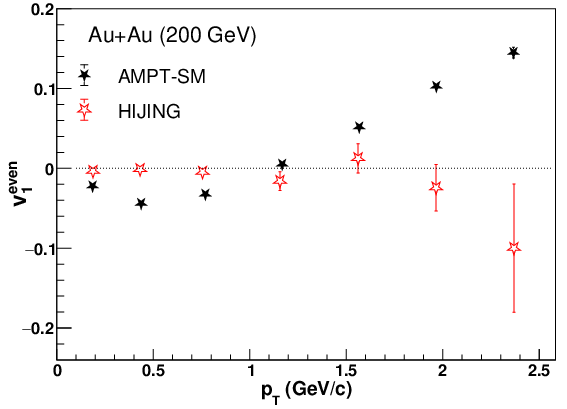
Charged-hadron sNN=273 from AMPT-SM is shown to strongly depend on the imposed pseudorapidity gap, with significant suppression of non-flow residuals at sNN=274. HIJING results are consistent with zero, establishing that observed nonzero values in AMPT are attributable to collective flow.
Figure 2: Left: sNN=275 for charged hadrons as a function of sNN=276 for several pseudorapidity gaps; Right: comparison between AMPT-SM and HIJING, highlighting the lack of collectivity in HIJING.
Particle Species Dependence and Energy Evolution
Systematic AMPT-SM calculations reveal:
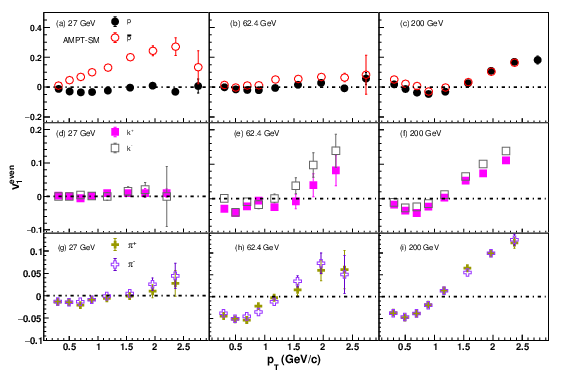
No appreciable difference in sNN=277 between particles and anti-particles for any mesonic species at any considered energy.
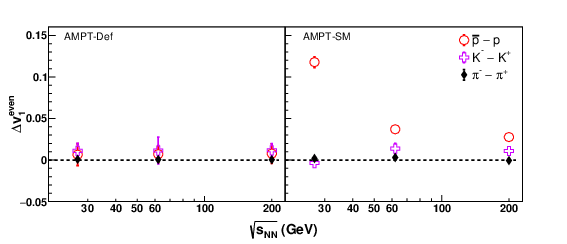
A statistically significant and increasing splitting in sNN=278 between protons and anti-protons as the collision energy decreases, which is absent at top RHIC energy but pronounced at 27 GeV.
Figure 3: sNN=279 for identified v1even0, v1even1, v1even2, and v1even3 at mid-rapidity and multiple center-of-mass energies.
These results emphasize that baryon transport dynamics become more critical at lower energies, specifically affecting baryonic species due to increased baryon stopping at mid-rapidity.
Role of Partonic Interactions: String Melting versus Default
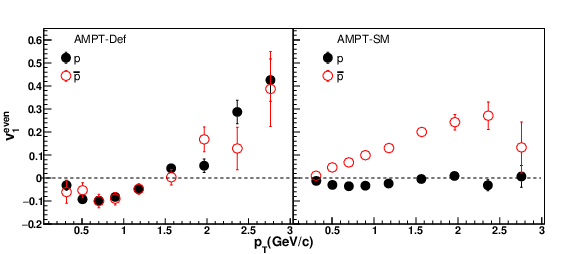
A direct comparison between AMPT-Default and AMPT-SM at 27 GeV demonstrates that the proton–anti-proton v1even4 splitting is present only in the string melting mode, emphasizing the necessity of a deconfined partonic stage for developing this effect. The absence of splitting in AMPT-Default underlines the role of partonic rescattering and quark coalescence in baryon number transport and its manifestation in directed flow.
Figure 4: Comparison of v1even5 for protons and anti-protons in 27 GeV Au+Au collisions from AMPT-SM and AMPT-Default.
Quantitative assessment of the integrated proton–antiproton v1even6 difference as a function of energy further substantiates its monotonic increase at lower energies in AMPT-SM, with no such trend in AMPT-Default.
Figure 5: The v1even7 difference (proton minus antiproton) integrated over v1even8, as a function of collision energy, separately for AMPT-SM and AMPT-Default.
Baryon Stopping and Rapidity Distributions
Net-proton rapidity distributions derived from both model modes exhibit qualitative differences:
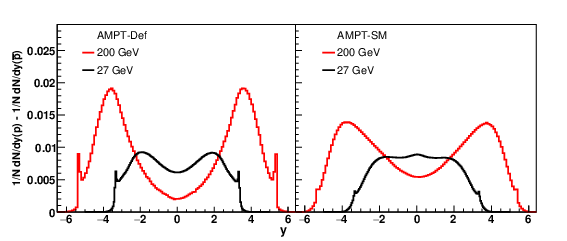
AMPT-SM yields a considerably more peaked distribution at mid-rapidity at lower energy (27 GeV), reflecting increased baryon stopping and the transport of net baryon number to v1even9.
AMPT-Default presents minimal energy dependence, consistent with weak baryon transport.
This supports the conclusion that the presence and magnitude of ∣Δη∣0 splitting correlate with the degree of baryon stopping.
Figure 6: Net-proton rapidity distributions at 27 and 200 GeV for AMPT-SM and AMPT-Default.
Systematic Checks: Momentum Conservation Fit Parameter
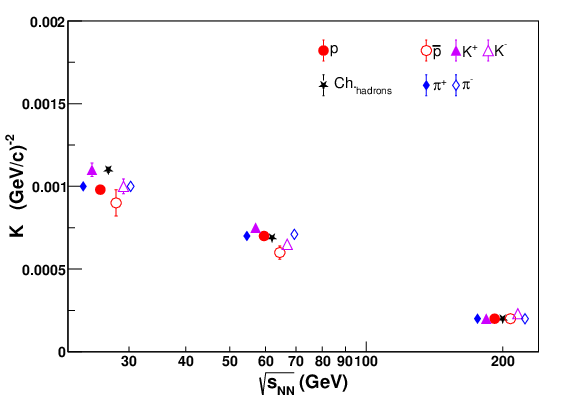
The extracted values of the global momentum conservation correction parameter ∣Δη∣1 are found to be consistent across particle species at a given energy and increase as the beam energy decreases—consistent with declining event multiplicity and mean squared ∣Δη∣2 at lower ∣Δη∣3.
Figure 7: Energy dependence of the non-flow parameter ∣Δη∣4 for different identified hadrons, demonstrating systematic consistency and correct energy scaling.
Implications and Prospective Developments
These findings highlight that the rapidity-even component of directed flow for identified baryons is a sensitive observable for early-time partonic dynamics and baryon transport, particularly within the context of the RHIC Beam Energy Scan program. The observed proton–antiproton splitting in ∣Δη∣5 directly correlates with baryon stopping and is accessible only in models with a substantial partonic phase and quark coalescence, such as AMPT-SM. The insensitivity to meson type or charge further localizes the effect to baryonic number transport mechanisms.
The results imply that future theoretical efforts must refine the modeling of baryon transport and coalescence in the deconfined stage. Experimentally, precise measurements of identified particle ∣Δη∣6 at intermediate and low energies will provide critical constraints on baryon transport models. The sensitivity of ∣Δη∣7 to net-baryon density evolution renders it a promising probe for the QCD phase boundary and the critical point region.
Conclusion
The study establishes that the rapidity-even component of directed flow for identified baryons—particularly the energy-dependent proton–antiproton splitting—serves as a sensitive diagnostic of baryon transport phenomena and early-stage partonic collectivity. The pronounced species and energy dependence observed in AMPT-SM links this effect to the dynamical evolution of net baryon density and partonic rescattering, highlighting ∣Δη∣8 as a key observable for forthcoming investigations into the QGP and baryon-rich matter at RHIC and future heavy-ion programs.