- The paper demonstrates facet-selective ballistic supercurrents in ZrTe5, revealing that conduction is confined to specific crystallographic surfaces predicted for weak topological insulators.
- The study employs superconducting quantum interference, transport measurements, and STM to map narrow (~6 nm) conduction channels, confirming the role of topological surface states.
- The results pave the way for engineering higher-order topological superconductivity and designing Josephson devices with spatially controlled supercurrent pathways.
Facet-Selective Ballistic Supercurrent in Weak Topological Insulators
Introduction
This paper (2607.00683) addresses the induction and spatial mapping of superconductivity on specific facets of a three-dimensional weak topological insulator (WTI), ZrTe5. The authors report direct evidence that supercurrent propagation occurs selectively along certain crystallographic surfaces, governed by the crystal's bulk topological state. Using a combination of superconducting quantum interference experiments, transport, and scanning tunneling microscopy (STM), the work demonstrates ballistic supercurrent transmission localized to distinct surface channels, with the interference phenomena and current-phase relationships (CPRs) supporting their facet-selective and topological origin.
Background and Topological Superconductivity
Three-dimensional topological insulators (TIs) are classified as strong (STI) or weak (WTI) based on their Z2 invariants. In STIs, every surface supports gapless Dirac fermion states; in contrast, WTIs only host such states on facets orthogonal to their weak index vector, leaving other surfaces gapped. Proximitizing TIs with conventional superconductors is a standard approach to engineer topological superconductivity and, potentially, non-Abelian excitations beneficial for fault-tolerant quantum computing.
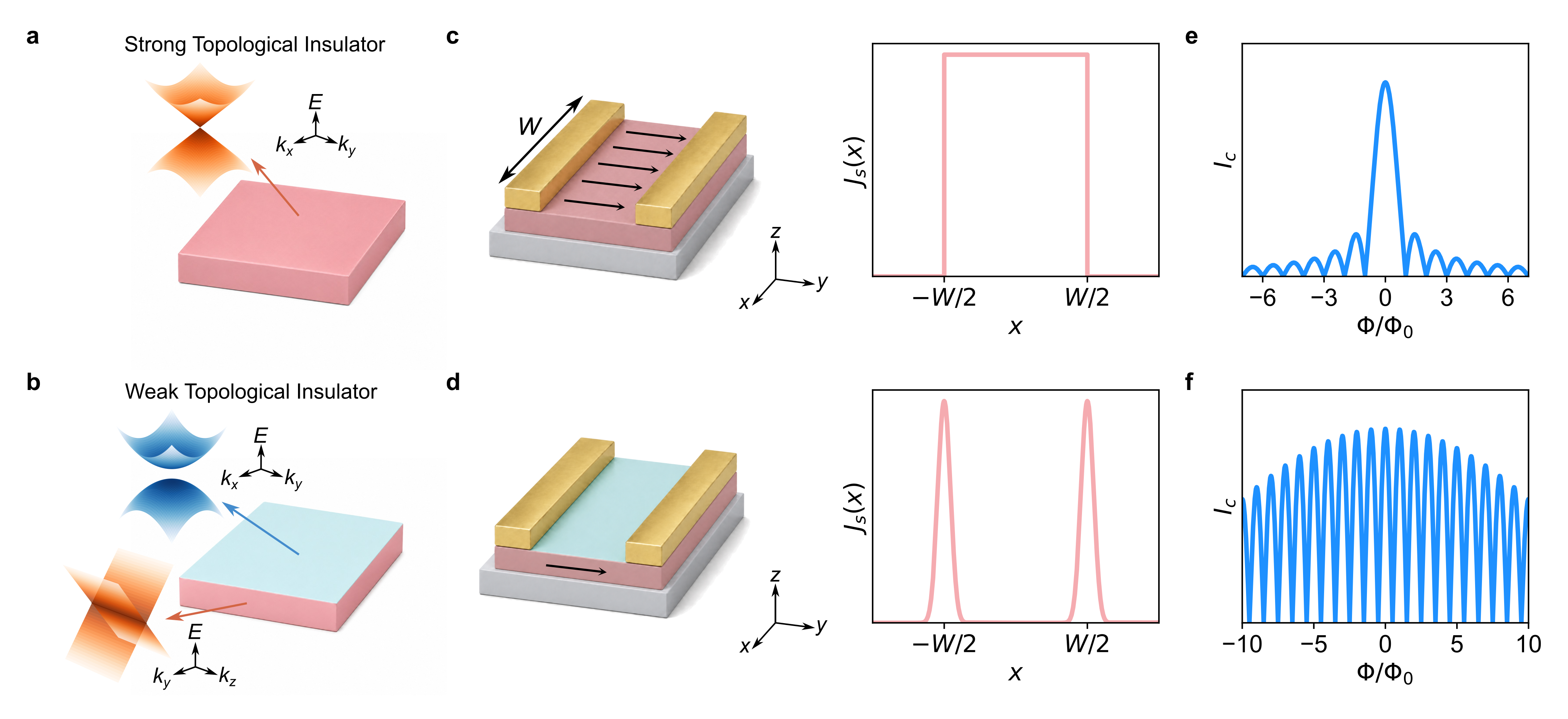
Figure 1: Schematic depiction of surface state distribution and Josephson response in STIs versus WTIs. The Josephson effect in WTIs is restricted to conducting side facets, yielding distinct SQUID-like interference patterns.
The work builds upon the theoretical foundation that, in WTIs, Josephson supercurrents should be spatially confined to these special conducting facets, resulting in interference signatures distinct from the Fraunhofer patterns of homogeneous junctions built on STIs. This spatial selectivity is predicted to enable higher-order topological superconductivity, with possible hinge or corner modes.
Characterization of ZrTe5 as a Weak Topological Insulator
The authors confirm that bulk ZrTe5 realizes the WTI phase. Temperature dependence of the longitudinal resistivity ρxx reveals a Lifshitz transition near 139 K, with Hall data supporting a single electron-like Fermi pocket. Angle-dependent magnetoresistance is consistent with a 3D ellipsoidal Fermi surface. STM topography demonstrates an energy gap of approximately 70 meV on the a–c surface. Critically, mapping the local density of states (LDOS) across step edges shows conducting channels of spatial width ~6 nm along surface steps, coexisting with bulk-gapped behavior.
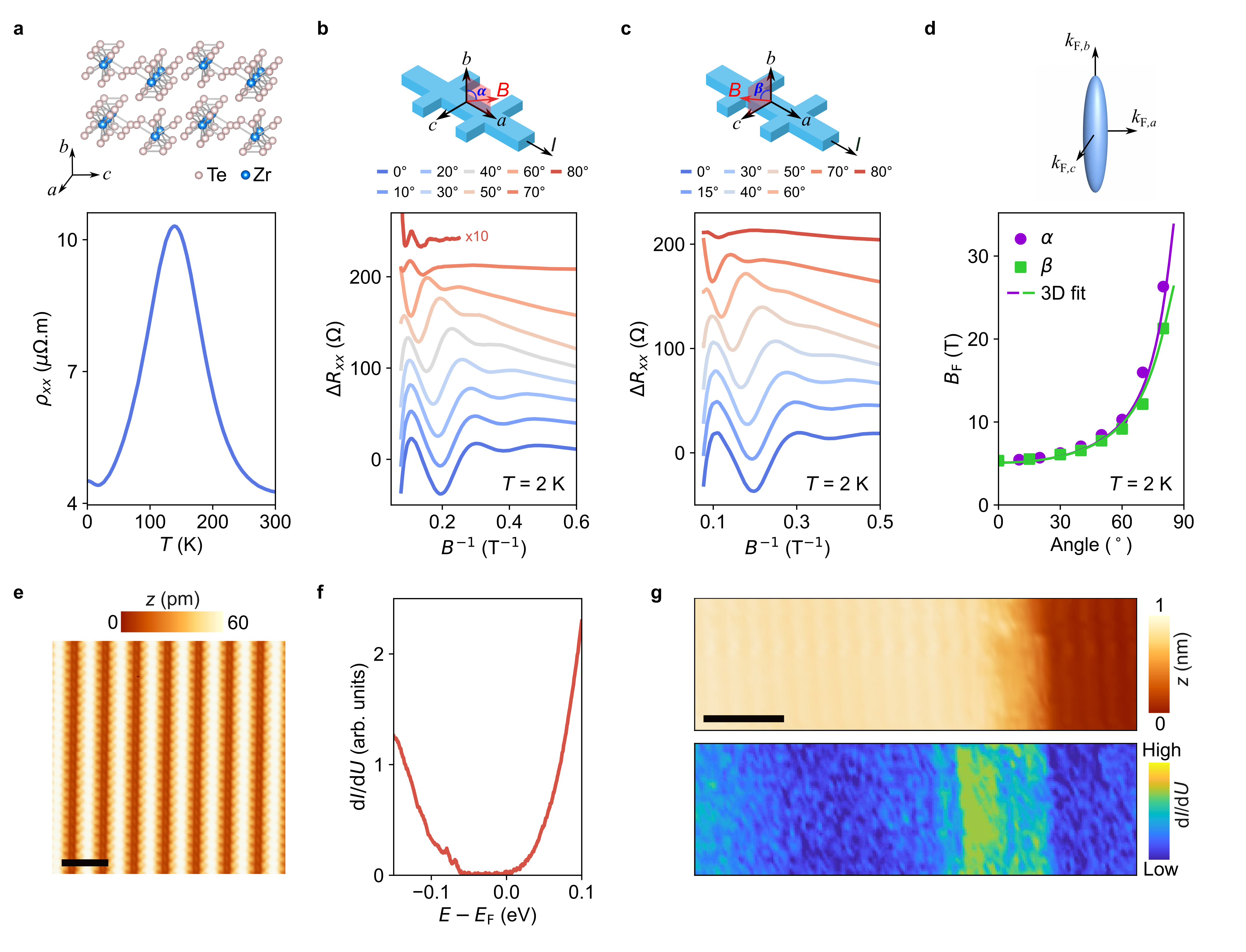
Figure 2: Electronic transport and STM/spectroscopy indicate a gapped bulk with conducting edge states on specific facets of ZrTe5, consistent with WTI classification.
This combination of gapped terraces and edge conduction on the exposed a–c faces is not commensurate with STI behavior but is a strong indicator of the WTI regime.
Proximity-Induced Superconductivity and Ballistic Transport
Josephson junctions were fabricated between ZrTe5 and both Al (long ξ) and NbN (high Bc2) electrodes, with current flow along distinct crystallographic axes. All junctions show a well-defined critical current Ic, with the temperature dependence of Z20 following an exponential form, Z21, as expected for long ballistic SNS junctions. Bulk ZrTeZ22 cannot support ballistic conduction over the device scale due to limited mean free path, but suppression of backscattering in topological surface states provides the necessary coherence and transmission.
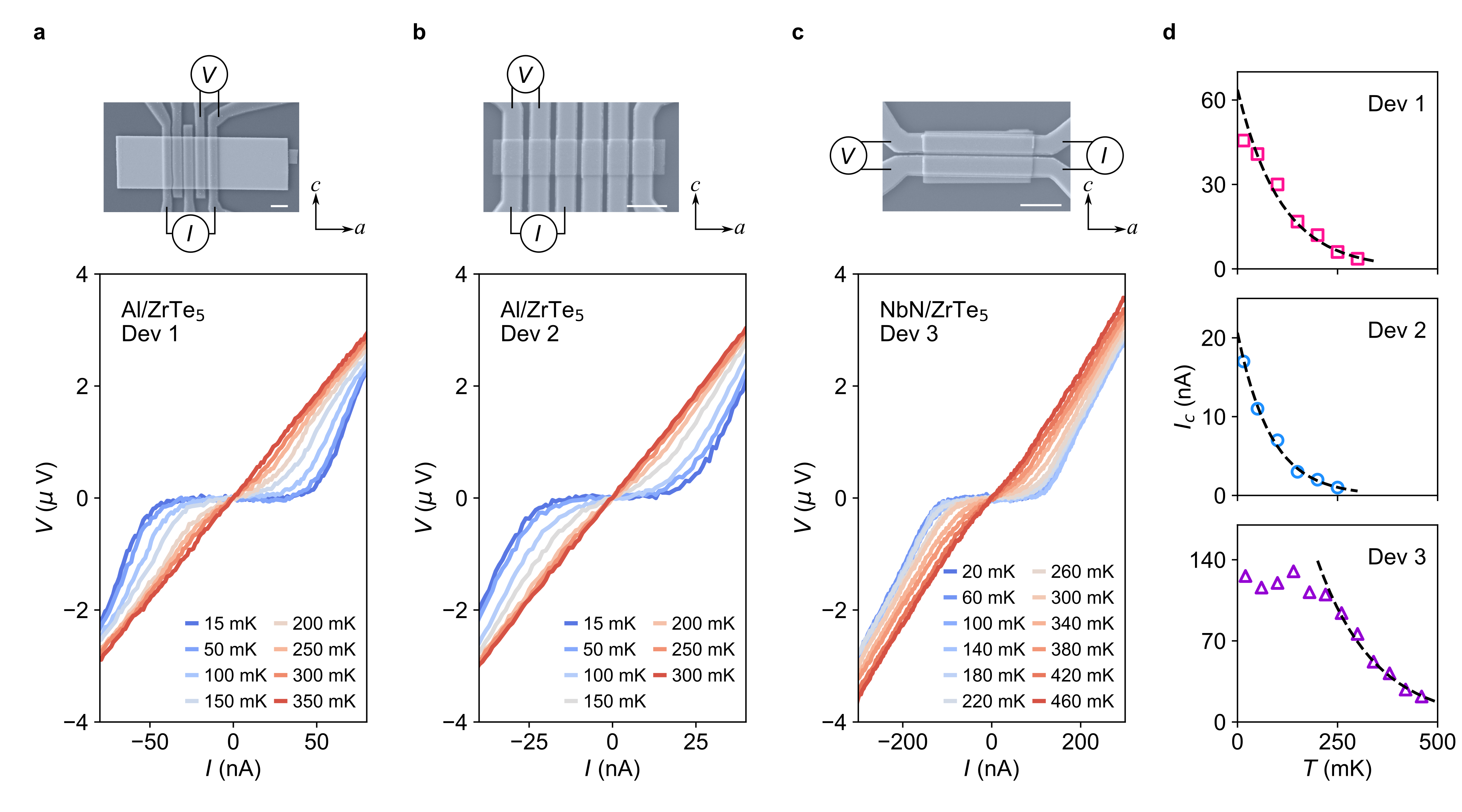
Figure 3: Z23–Z24 characteristics and Z25(Z26) demonstrate proximity-induced superconductivity and support a ballistic, surface-state-mediated transport regime in ZrTeZ27 junctions.
Facet Selectivity via Superconducting Quantum Interferometry
The heart of the study is the extraction of the spatial profile of supercurrents using quantum interference patterns. For currents along the a-axis, interference patterns under perpendicular magnetic field display clear, periodic SQUID-like oscillations in Z28 rather than Fraunhofer diffraction, with minimal amplitude decay at higher fields. Quantitative analysis of supercurrent density derived from these patterns reveals two peaked, edge-localized conduction channels corresponding to the specific WTI facets predicted to be gapless.
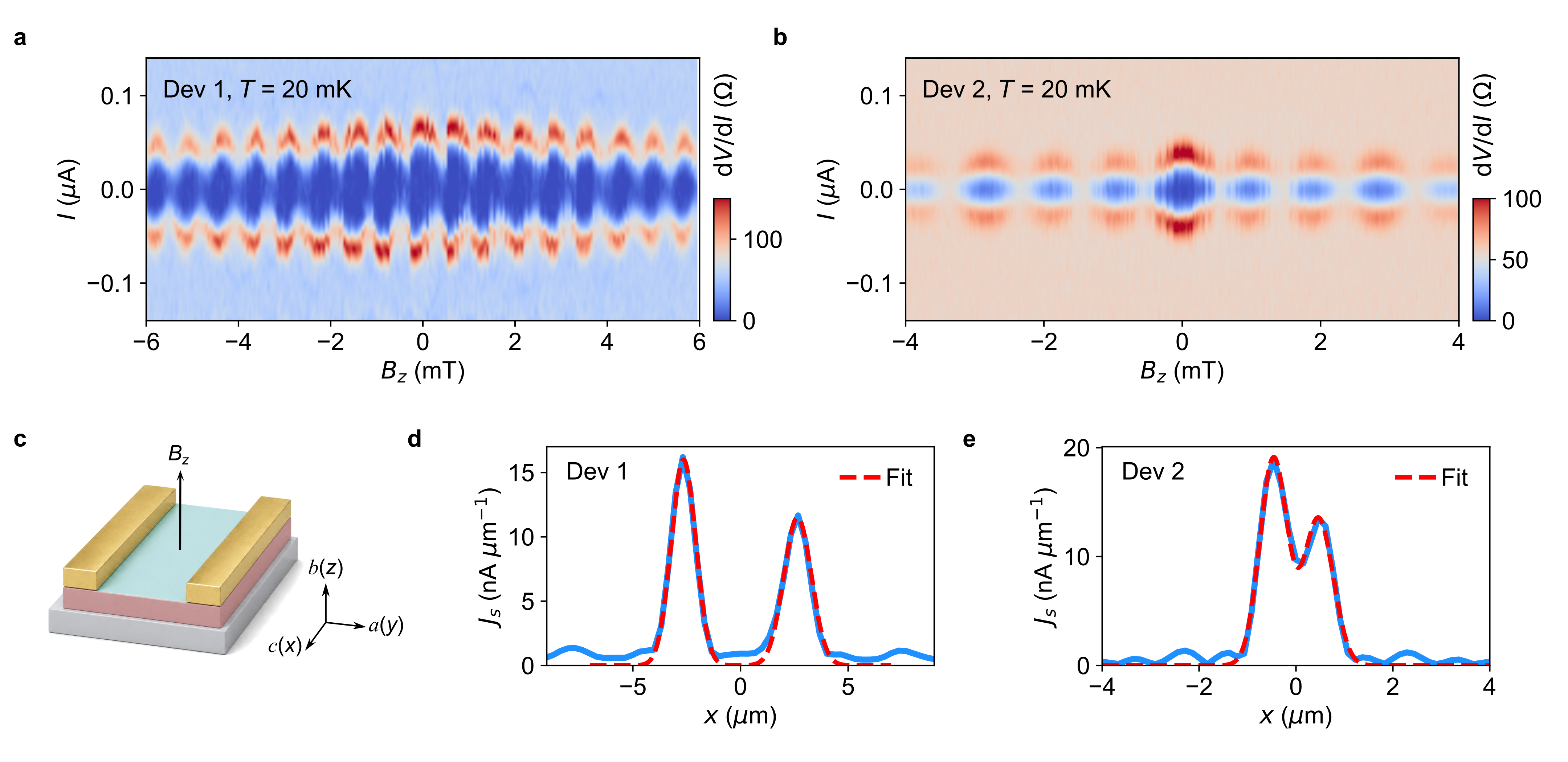
Figure 4: SQUID-like interference patterns and reconstructed supercurrent density in Al/ZrTeZ29 junctions, highlighting the confinement of the supercurrent to two spatially separated facets.
Additional devices with orthogonal current orientation and different superconductors confirm the robustness and orientation dependence of the effect. Notably, field-orientation-dependent interference (via rotating the magnetic field) yields markedly different patterns depending on whether the field threads flux through a facet supporting surface states, further demonstrating facet selectivity.
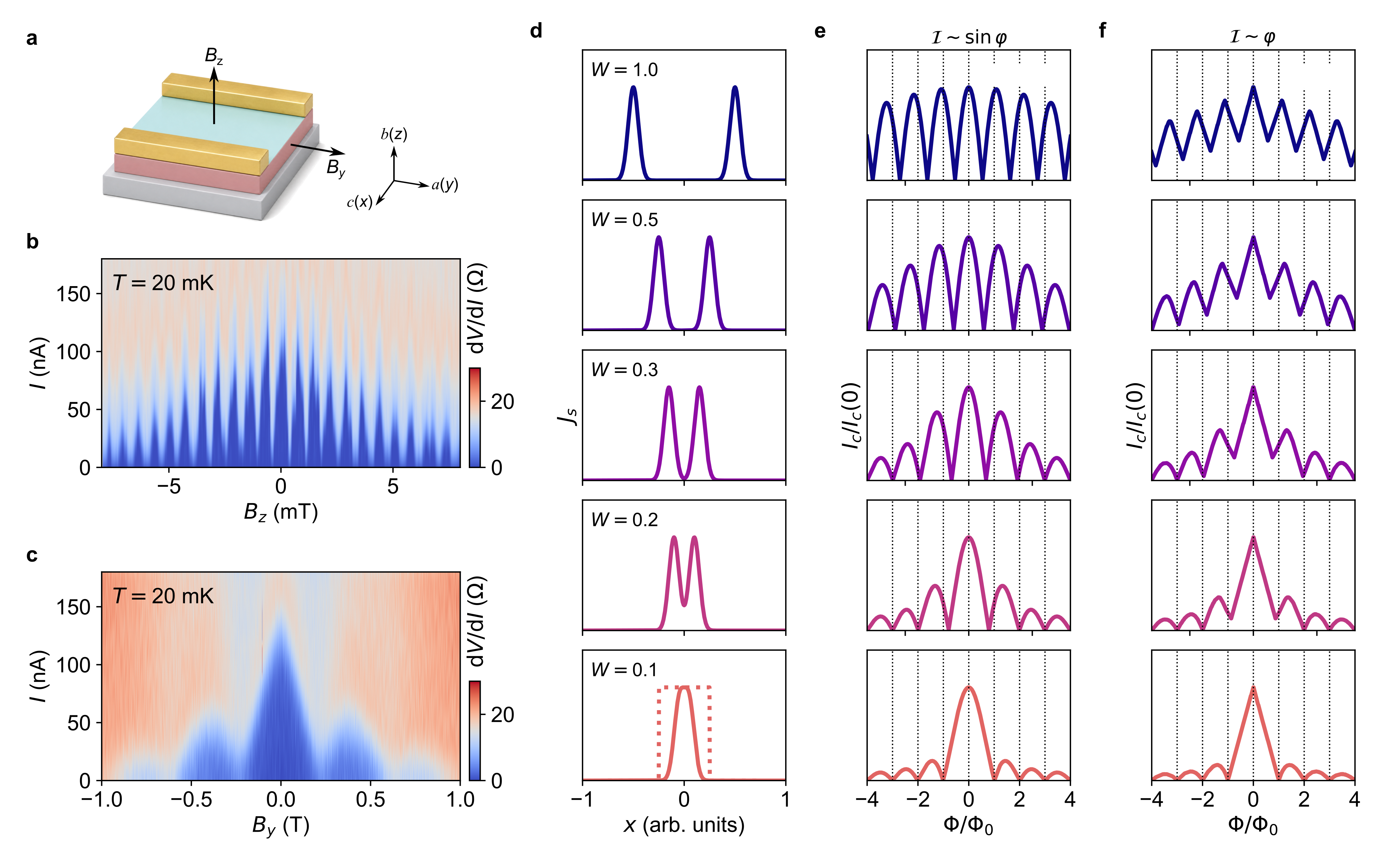
Figure 5: Field-orientation control reveals contrast between interference patterns and supercurrent profiles, underscoring the effect of bulk topology on supercurrent distribution.
Ballistic Current-Phase Relation and Higher-Order Topology
The observed interference patterns feature sharp, triangular lobes which, together with the exponential 50(51) dependence, signal a non-sinusoidal (sawtooth-like) CPR characteristic of ballistic long-junction transport. Simulations confirm that only a narrow, facet-confined current profile with such a CPR can reproduce the shape of the experimental 52–53 oscillations. In-plane field modulations suggest the potential merging or splitting of these channels, raising questions about the presence of higher-order topological hinge or corner modes at certain facet intersections.
Implications and Outlook
The results establish, with multiple consistent experimental signatures, that the bulk topology of WTIs such as ZrTe54 can manifest directly as facet-selective conduction of ballistic supercurrents. This contrasts with trivial edge doping or non-topological channels, which would lack the observed field-orientation dependencies and ballistic transport characteristics. This platform is thus uniquely suited for the controlled realization of higher-order topological superconductivity, including hinge and corner Majorana modes, opening new opportunities for topological quantum device engineering.
Practical implications include the design of facet-engineered Josephson devices and the spatial readout of topology via local supercurrent mapping. Theoretically, these results motivate new models for spatially inhomogeneous superconductivity in topological materials and provide a template for probing higher-order topological states in correlated systems. Future directions may involve gating, phase-sensitive probes of possible Majorana modes, and extensions to other WTI compounds or hybrid heterostructures.
Conclusion
This work accomplishes a clear demonstration of facet-selective ballistic supercurrents in a three-dimensional WTI, ZrTe55, as unambiguously revealed by quantum interference and transport measurements. The findings provide a blueprint for leveraging bulk topology in the spatial engineering of superconducting quantum devices and present a promising pathway toward realizations of higher-order topological superconductivity.