- The paper presents the first ab initio benchmark for elastic deuteron-deuteron scattering in the spin-quintet channel using Nuclear Lattice Effective Field Theory.
- It employs advanced stabilization techniques, including Tikhonov regularization and projection methods, to extract reliable phase shifts and demonstrate a significantly larger scattering length.
- The robust numerical results enhance predictions for Big Bang Nucleosynthesis and pave the way for future multi-channel lattice calculations in nuclear astrophysics.
Elastic Deuteron-Deuteron Scattering in NLEFT: Spin-Quintet 5S2 Channel
Introduction
This study presents an ab initio calculation of elastic deuteron-deuteron (d+d) scattering in the spin-quintet 5S2 channel using Nuclear Lattice Effective Field Theory (NLEFT) with chiral interactions at N3LO. The motivation is to address uncertainties in reaction rates relevant to Big Bang Nucleosynthesis (BBN), particularly those associated with key d+d processes, by providing a robust nuclear-lattice benchmark for d+d scattering phase shifts. The analysis combines wavefunction matching, the adiabatic projection method, and rigorous treatments of numerically ill-conditioned norm matrices.
Methodology
The calculation employs the NLEFT framework, embedding Chiral Effective Field Theory (ChEFT) interactions on a spatial lattice. The high-fidelity chiral Hamiltonian includes kinetic, one-pion exchange, Coulomb, and up to N3LO three-nucleon forces, implemented via a finite-range unitary transformation to facilitate rapid perturbative convergence and reduce the Fermion sign problem.
The adiabatic projection method constructs cluster basis states for the two-deuteron system, focusing on the S=2 sector with a unique spin configuration. To mitigate near-linear dependencies among cluster states at long Euclidean times (large Lt), two stabilization procedures were developed and benchmarked:
- Tikhonov regularization: applying a ridge to the smallest norm-matrix eigenmodes.
- Projection onto well-resolved norm eigenmodes: discarding nearly-null linear combinations while retaining all physical coordinate points in the basis.
Both methods yielded statistically and numerically consistent phase shifts, affirming the robustness of the regularization.
The phase shifts were extracted using an auxiliary potential approach in the asymptotic region, fitting the eigenfunctions to the known Coulomb-modified wave function form. Results for each Lt were extrapolated to the infinite Euclidean time limit. This process was validated both through convergence checks and consistency across the different regularization strategies.
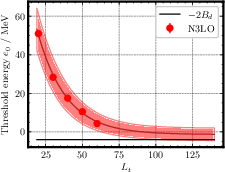
Figure 1: Threshold energy of two non-interacting deuterons on the lattice as a function of Euclidean time d+d0, with an exponential fit and comparison to the expected result from twice the deuteron binding energy.
Remarkably, the threshold energy for two non-interacting deuterons, as a function of d+d1, converges to the expected result, validating the projection methodology and systematic control over lattice artefacts.
Numerical Results
The d+d2 elastic phase shifts computed at Nd+d3LO exhibit striking differences from earlier continuum and variational-bound studies, particularly in the momentum dependence and extracted scattering parameters.
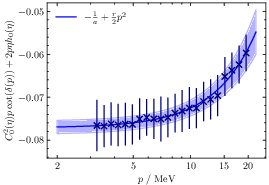
Figure 2: Fitting the modified effective range expansion (ERE) to the lattice results, yielding the Coulomb-subtracted scattering length and effective range in the d+d4 channel.
The fit to the Coulomb-modified effective-range expansion yields:
- Scattering length: d+d5 fm
- Effective range: d+d6 fm
These values are substantially larger (scattering length in particular) than those obtained in other calculations (e.g., d+d7–d+d8 fm), indicating a stronger effective repulsion in the NLEFT result for the d+d9 channel.
A comparison of phase shifts with literature values from RGM, Yakubovskii-equation, and variational/Faddeev-Yakubovsky methods shows that the NLEFT phase shifts become systematically more negative with increasing momentum, reinforcing this claim.
Uncertainty Control and Regularization
The study invests significant computational resources (≈200,000 GPU hours) to ensure thorough statistical sampling and robust uncertainty estimation via a jackknife procedure across multiple independent Monte Carlo runs. The norm-matrix regularizations were tested for stability over a range of control parameters, and systematic uncertainties from finite-volume effects were checked by comparing results across different lattice volumes.
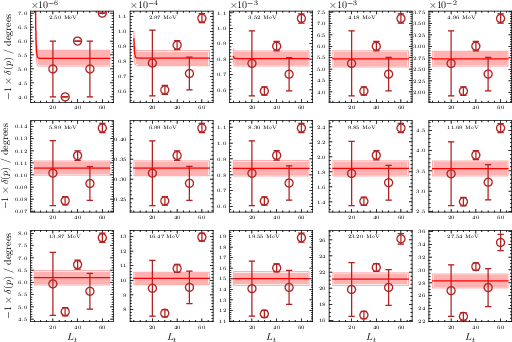
Figure 3: Euclidean time extrapolation for the 5S20 phase shift with the norm mode projection method, illustrating convergence and bootstrap uncertainty.
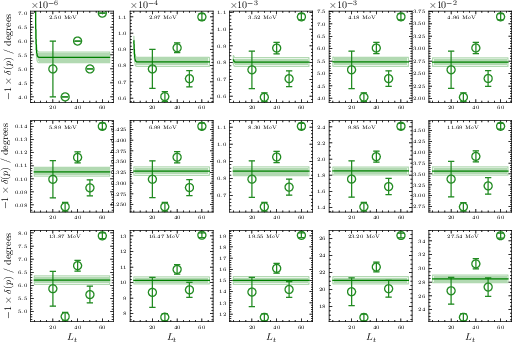
Figure 4: Euclidean time extrapolation for the 5S21 phase shift with Tikhonov regularization, confirming agreement with the projection method.
The close agreement between Tikhonov and projection approaches confirms that the results are insensitive to the specifics of the stabilization procedure when applied within their controlled regimes.
Theoretical and Practical Implications
This work delivers the first NLEFT benchmark for the 5S22, 5S23 phase shifts, forming a foundational step towards coupled-channel lattice calculations of deuteron-induced reactions in BBN. The demonstration of a statistically robust, lattice-based method for four-nucleon elastic scattering highlights NLEFT’s capability to compute reaction rates for processes where three- and four-nucleon breakups and channel couplings are significant.
The observed discrepancies with previous continuum model and variational calculations underscore the sensitivity of low-energy scattering observables to the choice of nuclear interaction, basis truncation, and numerical methodology. This finding emphasizes the necessity of systematic uncertainty quantification and the potential for lattice methods to resolve ambiguities persistent in other approaches.
Practically, more accurate theoretical predictions for 5S24 reaction rates have direct consequences for cosmological modeling, particularly regarding the longstanding "deuteron anomaly" in primordial abundance determinations.
Future Developments
Given computational feasibility, the extension to multichannel scattering—including 5S25, 5S26, and 5S27-wave 5S28 channels—is now within reach. Such calculations will be critical for the ab initio evaluation of all relevant BBN cross sections, enabling confrontation with high-precision observational data and searches for beyond-Standard-Model physics via the early universe element synthesis.
Integration of even higher-order chiral interactions, more refined treatments of electromagnetic effects, and systematic studies of finite-volume artifacts will further enhance the reliability of nuclear lattice predictions.
Conclusion
This study establishes the applicability and precision of NLEFT for elastic 5S29, 30 scattering, providing strong numerical evidence for a larger scattering length and stronger effective repulsion than previously reported. These results set a benchmark for future ab initio studies of light-nuclei reactions and their implications for nuclear astrophysics, while highlighting the maturity of lattice methods in handling four-body scattering phenomena with controlled uncertainties (2607.00681).