- The paper establishes simultaneous global uniqueness for viscosity, interface, and obstacle identification via partial boundary measurements.
- It employs interior transmission problems with singular solutions to amplify discrepancies and distinguish unknown parameters.
- The findings provide a rigorous foundation for developing computational techniques in multiphysics inverse problems such as fluid-porous media interactions.
Simultaneous Inverse Reconstruction in the Stokes-Darcy System from Partial Boundary Data
Introduction and Problem Setting
This paper addresses the inverse boundary value problem (IBVP) for the coupled Stokes-Darcy system, modeling interactions between free fluid flow and a porous medium domain. The analysis considers a bounded Lipschitz domain in R3 partitioned by a smooth interface Γ into a free-flow region Ωf and a porous medium region Ωp. The centerpiece is the Stokes-Darcy system, which features strong coupling at the interface, as well as the embedded presence of an unknown solid object D within Ωf.
The paper’s central result is the simultaneous global uniqueness in reconstructing the constant viscosity μ, the coupling interface Γ, and the internal obstacle D, based solely on partial boundary measurements. The methodology hinges on the construction and analysis of interior transmission problems that amplify solution singularities, allowing for fine discrimination of the unknowns. This approach advances the theoretical landscape, as uniqueness of all these components was previously unaddressed for coupled multiphysics problems of this form.
The domain and problem geometry are illustrated schematically:
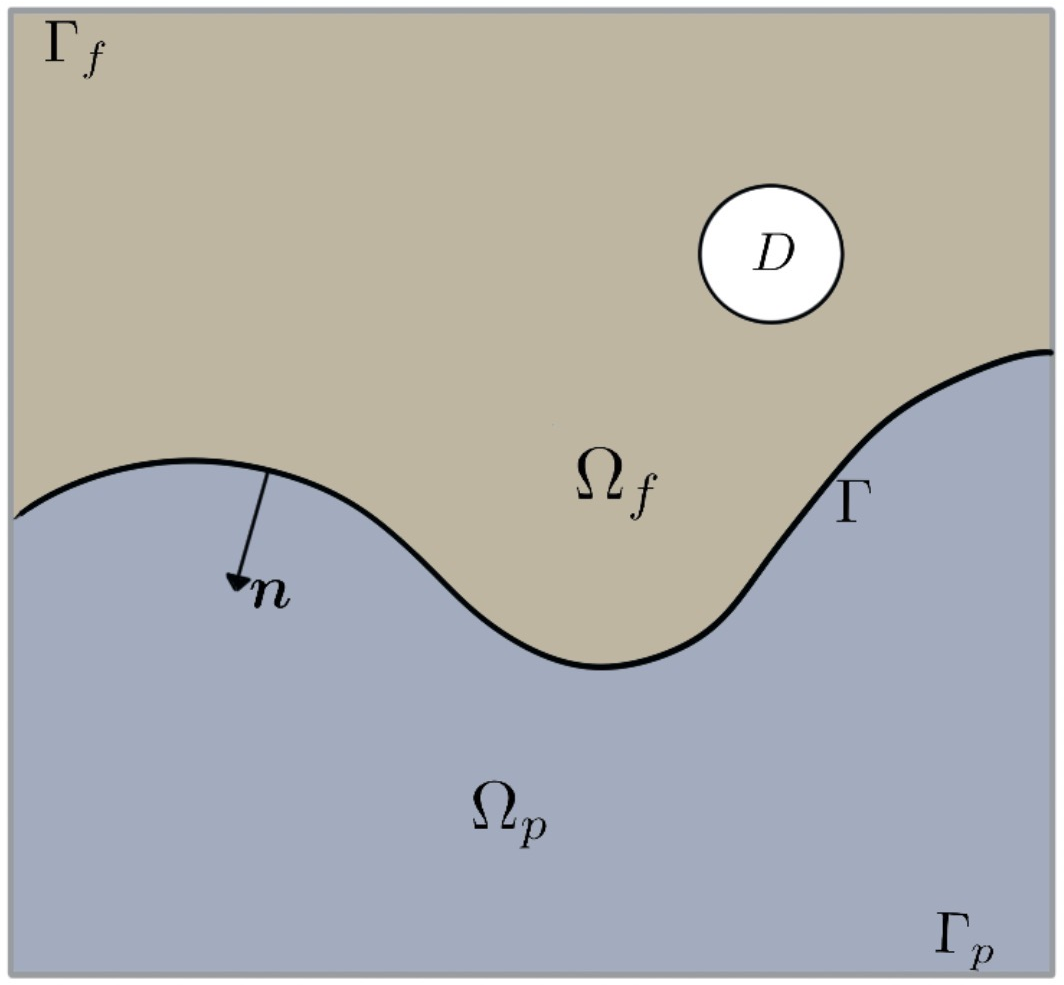
Figure 1: Geometric decomposition of the domain into a free-flow region (Stokes), a porous medium (Darcy), the coupling interface Γ, and the embedded unknown object Γ0.
Stokes-Darcy Coupled Model and Forward Problem
The forward model couples the Stokes and Darcy equations:
Γ2
Γ4
with boundary and interface conditions incorporating:
- Dirichlet data on accessible boundary,
- No-slip on the unknown object boundary,
- Coupling conditions ensuring mass, normal stress, and Beavers–Joseph–Saffman condition for tangential slip at Γ5.
The paper rigorously establishes well-posedness for the variational formulation of this coupled PDE system within appropriate Sobolev spaces, under general geometric configurations, leveraging the coercivity of the sesquilinear forms and the Babuška–Brezzi theory.
Localized Boundary Measurement and the Inverse Problem
The available data consist of local Cauchy pairs
Γ6
where Γ7 is the partial Dirichlet-to-Neumann operator, and Γ8 is an arbitrary nonempty open subset of boundary.
The inverse problem is, from a single set of partial boundary Cauchy data, to uniquely reconstruct:
- the constant viscosity Γ9,
- the (potentially non-flat) interface Ωf0,
- the shape and location of the buried internal object Ωf1.
Interior Transmission Problems and Amplification of Singularities
A main technical device is the introduction of well-posed interior transmission problems for the Brinkman-Darcy system inside small subdomains. By carefully choosing data sequences mimicking fundamental singular solutions, the method amplifies the discrepancies in the solution behavior near the unknown components of the domain. This methodology enables the discrimination of different coefficients, interfaces, and obstacles using only exterior measurements.
The key analytic innovation is to show that, under the assumption of identical Cauchy data from two potential configurations, solution sequences exhibit bounded behavior except in the presence of parameter mismatch, in which case they must blow up due to the singularity structure of the fundamental solutions.
Global Uniqueness: Main Theorem and Proof Outline
The principal result is the following global uniqueness theorem:
If the Cauchy data associated with two configurations coincide on an arbitrary nontrivial boundary subset, then all three unknowns—viscosity Ωf2, interface Ωf3, and internal object Ωf4—are identical.
The proof is built of three main technical steps:
- Uniqueness of Ωf5: By comparing the asymptotics of sequences of solutions with prescribed singularity profiles against fundamental Stokes solutions, and using variational stability results, a discrepancy in Ωf6 leads to a contradiction relative to the blow-up behavior, ensuring uniqueness.
- Uniqueness of Interface Ωf7: Uniqueness in the interface is established using families of Green’s function solutions. By contradiction, any mismatch would violate the necessary singularity found in these specially constructed solutions.
- Uniqueness of Obstacle Ωf8: The argument is extended to the obstacle Ωf9 via local analysis near its boundary, again exploiting singular solution sequences and regularity up to the (supposed) incorrect interface.
Each step fundamentally relies on control of solution regularity, unique continuation properties, and the precise transmission conditions at the interface—highlighting the essential increase in analytic complexity relative to the scalar Calderón problem, due to the multiphysics and geometric coupling.
Theoretical and Practical Implications
The result solidifies a theoretical foundation for coupled inverse boundary problems in multiphysics domains, especially those where fluid–porous interactions are key, such as geophysics, environmental monitoring, and biomedical engineering. The fact that all three unknowns are simultaneously and globally identifiable from partial Cauchy data is significant: it establishes that indirect measurements suffice for full internal reconstruction, under the model assumptions.
On a practical level, these results support future algorithmic and computational approaches to coupled inverse problems, providing a guarantee of uniqueness and hence the possibility of stable numerical inversion under well-posedness and regularization strategies.
Moreover, the methodology—especially the use of transmission problems and boundary Green’s functions—holds promise for extension to more general settings (e.g., variable coefficients, anisotropy, higher-order couplings), as well as for the development of regularization frameworks and error quantification in the context of noisy or incomplete data.
Conclusion
This work establishes, for the first time, global uniqueness in the simultaneous identification of viscosity, domain interface, and embedded object for the coupled Stokes-Darcy system from partial boundary Cauchy data (2607.00677). The analytic strategy relies on constructing interior transmission problems that carefully probe the geometry and coefficients, enabling discrimination via singular behavior analysis. The framework lays a rigorous foundation for future computational methods and theoretical developments in coupled inverse multiphysics problems.