- The paper establishes the main contribution by deriving a precise piecewise-linear (cold Sinkhorn) dynamic that transitions from entropic to unregularized optimal transport with O(1/τ) iteration complexity.
- It rigorously formulates the cold Sinkhorn dynamics as a continuous-time process where dual variables evolve linearly until abrupt phase transitions activate new constraints.
- Empirical findings confirm that primal transport plans remain constant between phase changes, validating the theoretical insights and their applicability to large-scale problems.
Effective Dynamics of the Sinkhorn Algorithm in the Regime of Low Entropy Regularization
Introduction and Motivation
The Sinkhorn algorithm is widely adopted for solving entropy-regularized optimal transport (EOT) problems on finite domains. Despite significant progress in understanding its convergence and performance, much less is understood about its precise behavior as the entropic regularization parameter τ→0, particularly in discrete settings without geometric structure. The paper "Effective dynamics of the Sinkhorn algorithm in the regime of low entropy regularization" (2607.00665) addresses this gap, providing a rigorous and quantitative description of how the Sinkhorn iterates transition from the entropic to the unregularized optimal transport regime.
Through a detailed analysis of both the dual and primal variables in Sinkhorn, the work characterizes the emergent piecewise-linear dynamics observed empirically as the entropy parameter becomes small. The results establish a sharp and previously unattainable convergence guarantee for Sinkhorn in this regime, reducing the required complexity for dual suboptimality from O(τ−2) iterations—predicted by earlier polynomial analyses—to O(τ−1).
Empirical Phenomenology and Algorithmic Behavior
Empirical observations, presented through numerical experiments, reveal several distinct features when Sinkhorn is run at small τ. The evolution of the dual EOT suboptimality often shows piecewise-linear trends, while the primal marginals demonstrate piecewise-constant behaviors, with abrupt transitions ("phase changes") corresponding to alterations in active constraints within the transportation polytope.
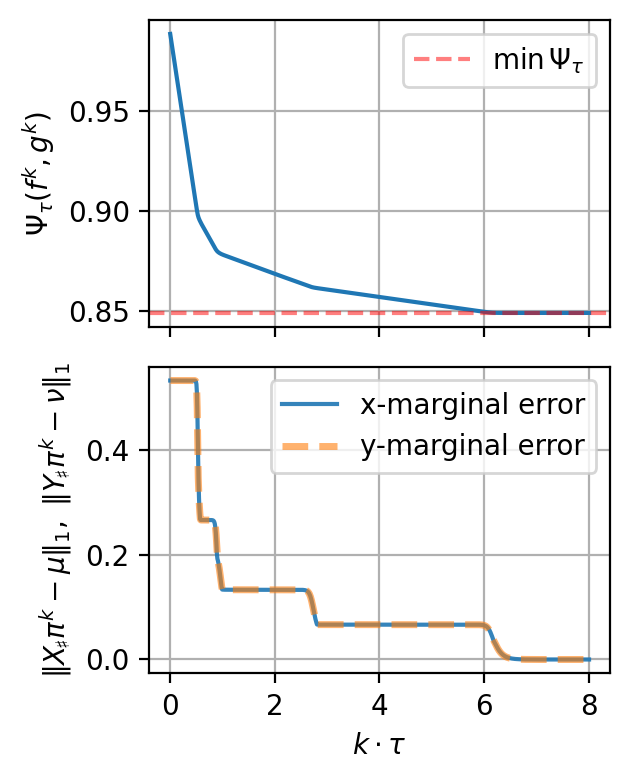
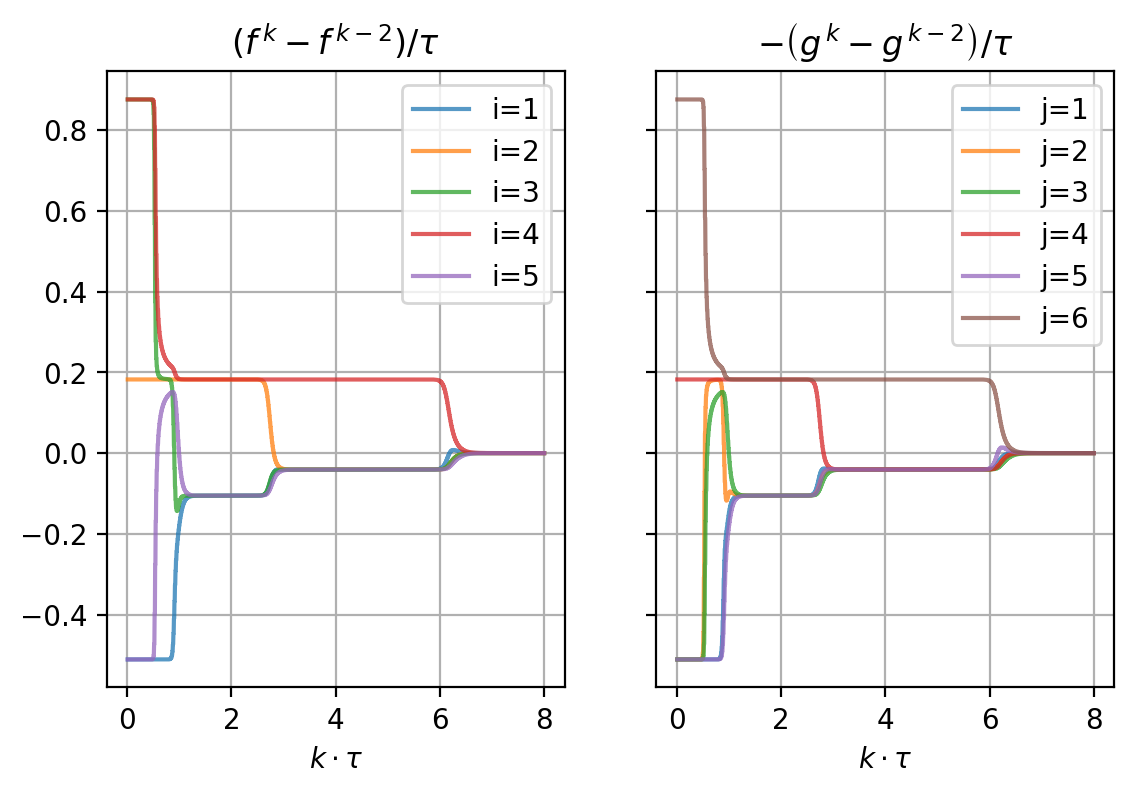
Figure 1: Suboptimality in the dual objective Ψτ and marginal errors, showcasing distinct linear segments corresponding to Sinkhorn's piecewise-linear phases as τ→0.
Moreover, the increments in dual variables collapse onto a discrete set of values, largely independent of the cost matrix but dictated by the marginal structure and combinatorics of the active set. Additional experiments with higher-dimensional problems (e.g., m=n=50 or m=n=400, see Figure 2) confirm the persistence of these phenomena at scale and reinforce their generality.
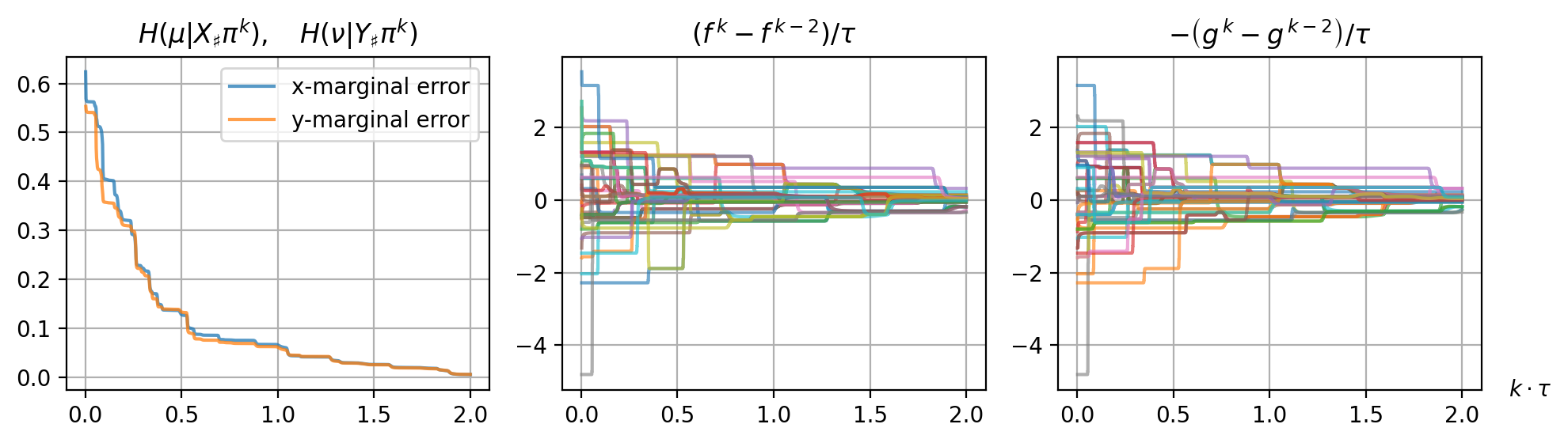
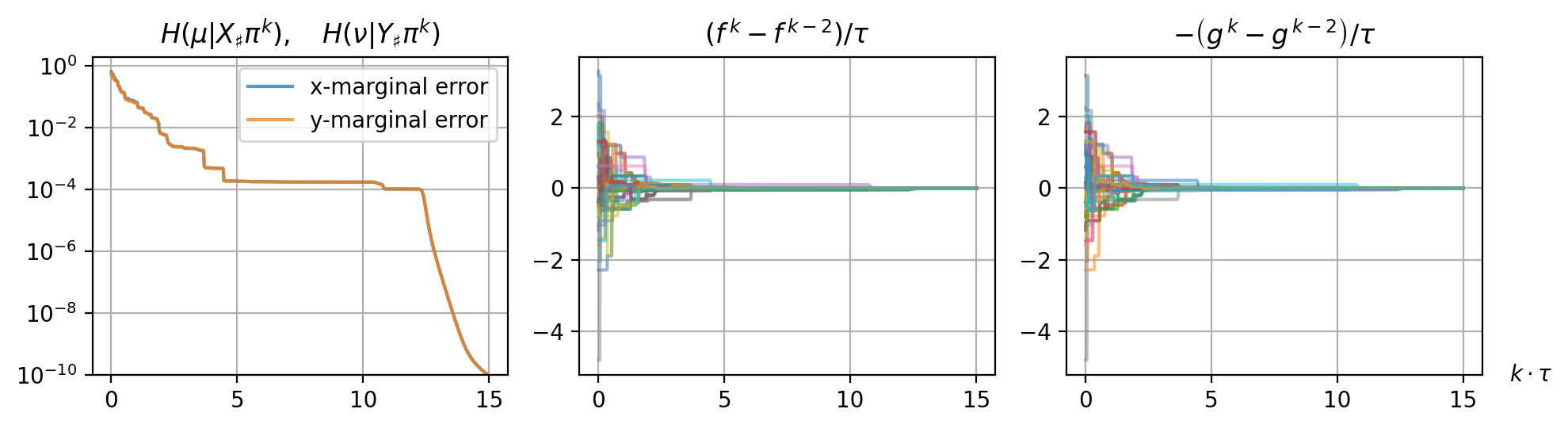
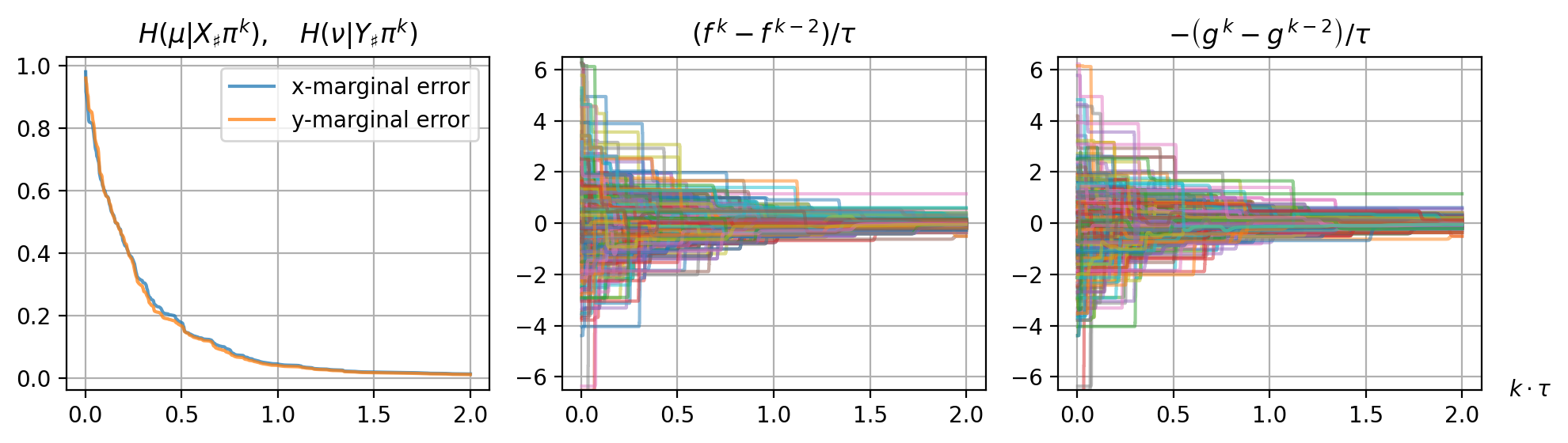
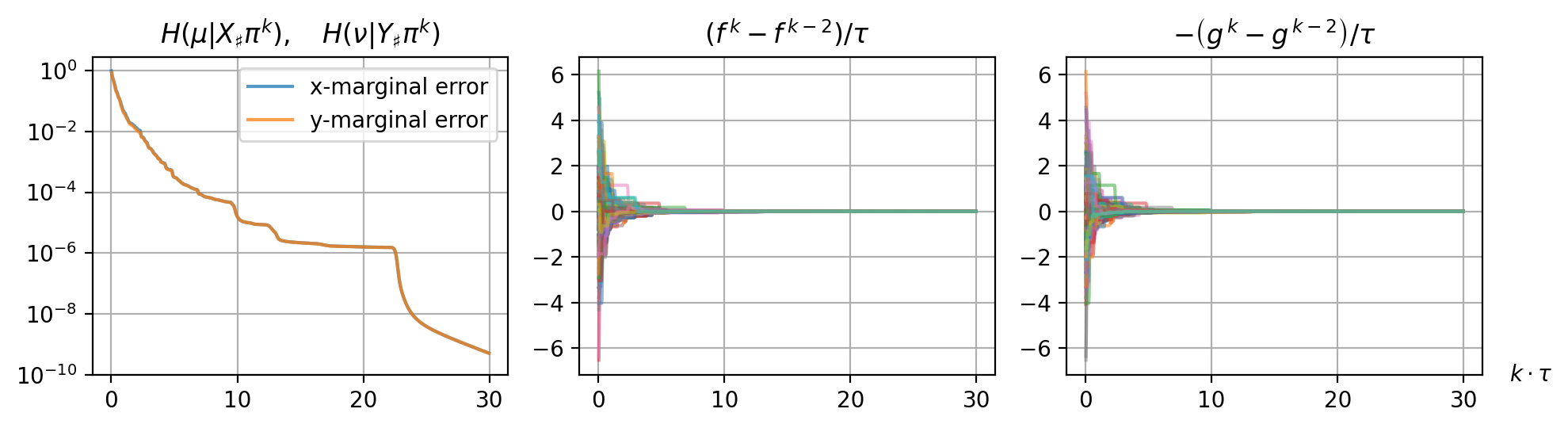
Figure 2: Large-scale Sinkhorn instance (m=n=50, τ=0.001), illustrating prolonged plateaus and sharp transitions dominating the late-phase dynamics.
To explain these observations, the study rigorously defines the "cold Sinkhorn dynamics"—the limit of the Sinkhorn algorithm as O(τ−2)0, properly rescaling time as O(τ−2)1. This limiting process proceeds as a continuous-time, piecewise-linear trajectory in the space of dual variables, with transition points corresponding to the activation of new polytope constraints.
Crucially, each linear segment (or "phase") of the cold dynamics corresponds to a uniquely defined edge pattern (support set) in the transport graph, with velocities derived from the unique solution to an associated matrix scaling problem (asymptotic scaling of the support pattern). The process terminates in finite time at an optimal solution of the unregularized dual OT, after which the iterates are stationary.
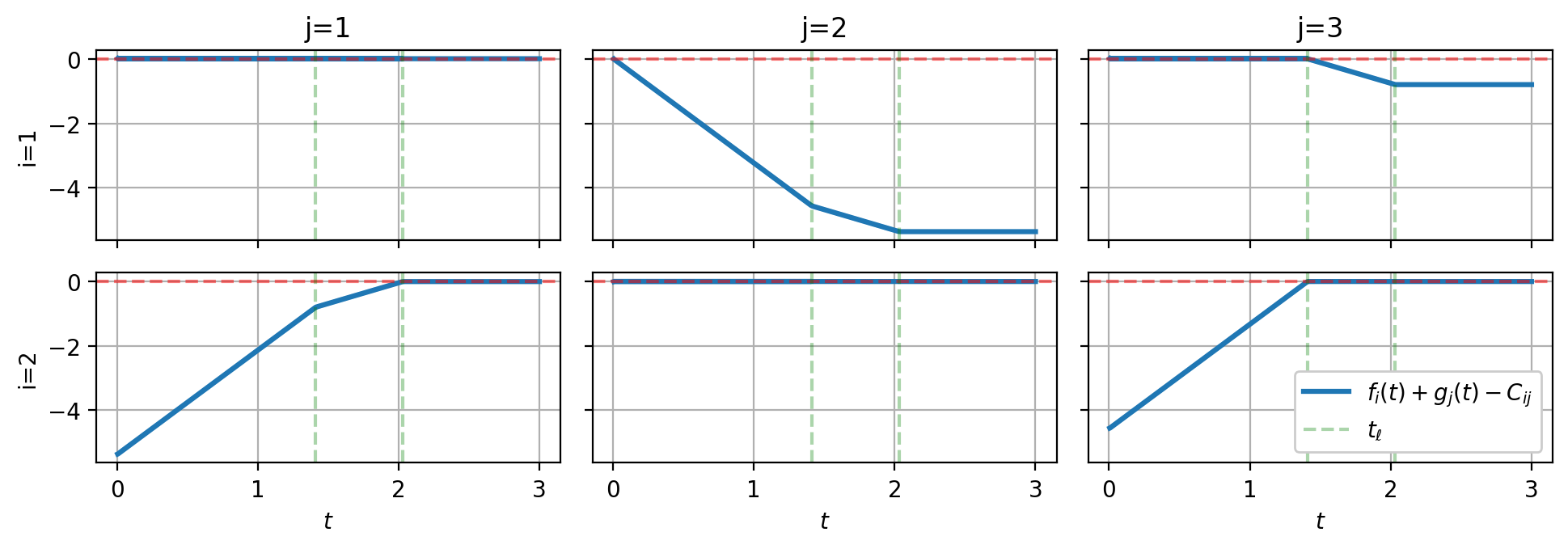
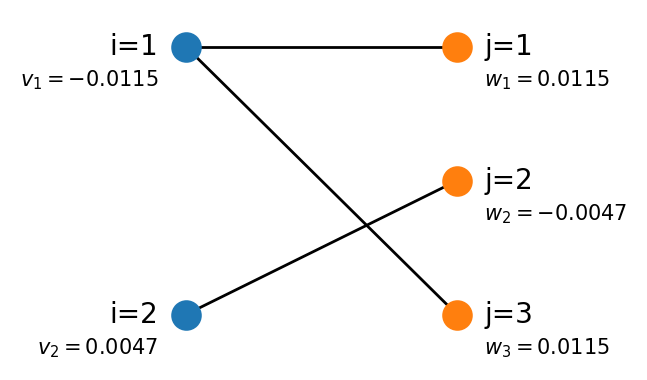
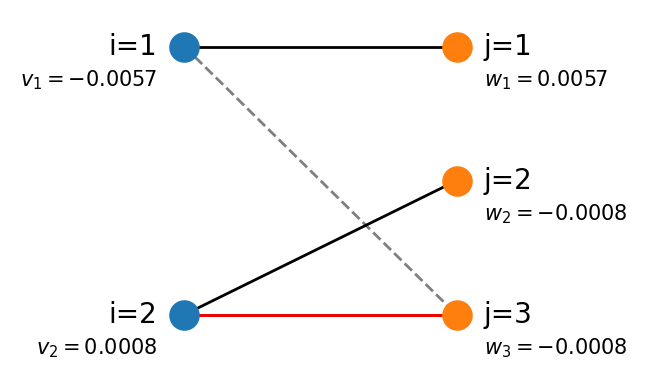
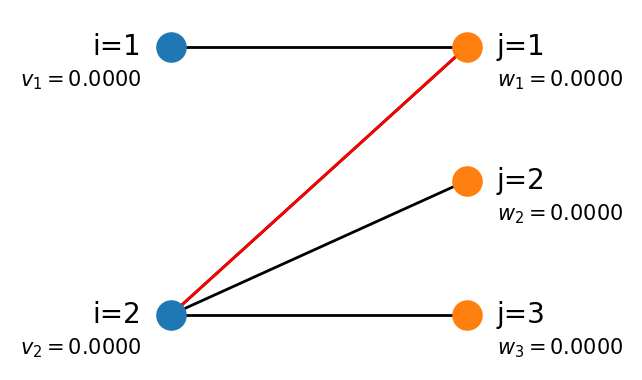
Figure 3: Evolution of O(τ−2)2 over time in the cold Sinkhorn limit. The trajectory is piecewise-linear with abrupt transitions when an inactive constraint is activated.
Analytically, within each phase the dual variables move at a fixed rate until a new constraint O(τ−2)3 is met, at which point the support set is enlarged and the process repeats. The dynamics is reminiscent of a simplex path along faces of the dual feasible polytope.
Main Theoretical Contributions
- Limiting Curve Characterization: It is proved that, under time-rescaling, Sinkhorn iterates converge to the cold Sinkhorn trajectory—solving a simplex-type dual OT algorithm. All observed empirical properties, such as piecewise-linear behavior and phase transitions, are thereby rigorously justified.
- Uniform Finite-Time Convergence: The cold dynamics is shown to reach dual optimality in a finite number of phases, with explicit uniform bounds on total convergence time and the number of transitions (O(τ−2)4 for an O(τ−2)5 problem).
- Sharp Iteration Complexity: The cold Sinkhorn analysis leads to a new result for the finite-O(τ−2)6 Sinkhorn: for any fixed accuracy O(τ−2)7 in duality gap, the number of required iterations is O(τ−2)8 rather than the O(τ−2)9 predicted by previous analyses. This result is both nontrivial and practically significant for large-scale problems and for computational reductions that require low-regularization OT solutions.
- Saddle-to-Saddle Dynamics for the Primal Variable: The primal iterates (transport plans) exhibit a "saddle-to-saddle" behavior; during each phase, the limiting primal plan remains constant except at discrete phase transitions where it jumps, mirroring recent mirror descent saddle-trajectory analyses. The limiting sequence of primal matrices is explicitly characterized in terms of auxiliary EOT problems restricted to evolving support sets.
Numerical and Qualitative Insights
Further analytical tools are developed to handle cases where the OT cost matrix contains infinite entries, extending the scope to partially defined transportation problems with sparse supports. Auxiliary lemmas provide uniform bounds on increments and convergence rates regardless of support patterns.
Large-scale experiments highlight:
- The persistence of piecewise-linear behavior and abrupt transitions even for O(τ−1)0 in the hundreds
- The decrease in prominence and duration of these phases as the problem dimension grows, relevant for practical implementation thresholds
Implications and Broader Impact
Optimization Complexity: The sharpened theoretical understanding of the low-O(τ−1)1 Sinkhorn regime closes the gap between practice (where small regularization is often required) and existing theory. With the accurate prediction of necessary iterations, implementations and parameter selections can be better optimized for runtime and stability.
Reduction to Unregularized OT: Many contemporary reductions for unregularized OT rely on solving EOT for small O(τ−1)2 and using rounding procedures to obtain feasible transport plans. This work underpins these reductions with rigorous guarantees and offers a principled explanation for the empirically observed speedup in the small-O(τ−1)3 regime.
Algorithmic Design: The identification of cold Sinkhorn as a simplex-like algorithm for dual OT problems suggests intriguing directions for designing new OT solvers that may explicitly exploit phasewise dynamics, potentially accelerating convergence when the structure permits.
Relationship to Matrix Scaling and Linear Programming: The results draw a direct bridge between entropy-regularized matrix scaling (i.e., the Sinkhorn problem) and classical linear programming in the O(τ−1)4 limit. This unification has implications for the analysis and design of combinatorial optimization algorithms in applications such as matching, economics, and transport modeling.
Extensions and Open Questions: The techniques and findings initiate several future research directions:
- Quantitative determination of when the cold Sinkhorn regime sets in for a given dimension and regularization parameter
- Fine analysis of transition phase neighborhoods and their width as O(τ−1)5 varies
- Extension to generalized OT settings (multi-marginal, unbalanced, continuous), where sparse or structured supports dominate
- Theoretical extension of observed convergence behavior to accelerated variants or stochasticized Sinkhorn variants
Conclusion
The paper provides a precise and comprehensive description of the Sinkhorn algorithm's effective dynamics as the entropy regularization parameter becomes vanishingly small. By introducing and analyzing the cold Sinkhorn dynamics, it establishes a rigorous simplex-type limiting process, characterized by finite-time, piecewise-linear motion across the boundary of the dual OT feasible set. This viewpoint leads to an improved theoretical guarantee on iteration complexity for low-entropy regularization, with practical consequences for unregularized OT computation and the large-scale application of Sinkhorn-type algorithms. The work opens new avenues for both theoretical and algorithmic advances in discrete optimal transport, matrix scaling, and related areas of mathematical optimization.