- The paper presents a unified light-curve analysis of SNe Ibn, Icn, and FBOTs using Gaussian processes and the TransFit-CSM model.
- It finds significant overlap in CSM and ejecta properties, indicating shared dense pre-explosion environments despite differences in luminosity and color.
- FBOTs show higher ejecta velocities and rapid evolution, suggesting additional non-thermal powering, such as magnetar spin-down, is at work.
Mapping Dense Circumstellar Environments of SNe Ibn, SNe Icn, and Fast Blue Optical Transients
Introduction
This work presents a unified comparative analysis of the optical properties and circumstellar environments of SNe Ibn, SNe Icn, and Fast Blue Optical Transients (FBOTs), utilizing a homogeneous modeling framework to quantify their physical parameter space. While SNe Ibn (characterized by interaction with He-rich, H-poor circumstellar material) and SNe Icn (featureless in H and He, C/O-dominated CSM interaction) are well-established stripped-envelope transients, FBOTs represent a rapidly evolving, luminous class with uncertain origins and a wide range of proposed powering mechanisms, including CSM interaction, central engines, and magnetar spin-down. The authors compile and analyze multiband light curves for a sample of 25 objects spanning these classes, reconstructing empirical observables via Gaussian processes and performing uniform fits using the physically motivated TransFit-CSM light-curve framework. The focus is on whether these transient classes form distinct or overlapping populations in both empirical and fitted parameter spaces, and the implications for their progenitor channels and powering sources.
Sample Selection and Empirical Light-curve Analysis
A robust sample was constructed using criteria ensuring strict classification, multiband photometric coverage, pre-peak constraints, and calibration for extinction and distance. Gaussian-process (GP) reconstructions enabled measurement of empirical observables, such as peak monochromatic luminosities, rise timescales (τrise), fixed-interval post-peak declines (Δm10), and peak colors at r-band maximum ((g−r)r,max). These were derived preferentially in the observed g band to minimize filter-based systematics while maintaining a statistically significant sample size.
The reconstructed g-band light curve for SN~2019myn, with clear graphical illustration of observables, demonstrates this methodology.
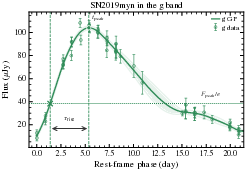
Figure 1: Gaussian-process reconstruction of the g-band light curve of SN~2019myn, with marked epochs for tpeak, Fpeak/e, and the rise interval.
The comparison of peak luminosity versus rise time, and decline proxy versus rise time, shows partial but significant overlap between SNe Ibn/Icn and FBOTs. FBOTs generally inhabit the more luminous and rapidly evolving regime, yet several objects from all three classes populate contiguous regions in these planes.
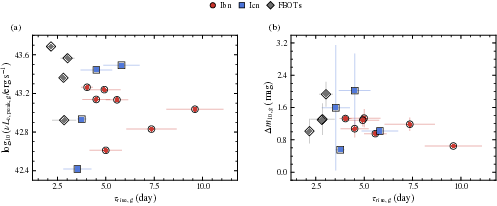
Figure 2: Distribution of peak luminosity and post-peak decline proxies versus rise timescale from g-band GP measurements for the 15-object same-band subsample.
A key result is that the empirical light-curve diversity of these fast blue transients is continuous, not strictly separated, especially in proxies for temperature and color: their extinction-corrected peak Δm100 color distribution is broadly overlapping, with FBOTs extending to slightly bluer values, indicating higher optical temperatures on average.
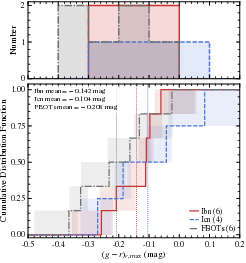
Figure 3: Cumulative distributions of extinction-corrected Δm101, with all three classes spanning similar blue ranges.
Light-curve Modeling Framework: TransFit-CSM
The analysis employs the TransFit-CSM model, a time-dependent radiative diffusion and shock-interaction framework, which enables uniform physical parameterization across SNe Ibn, SNe Icn, and FBOTs. The model couples the dynamics of ejecta--CSM interaction (with power-law CSM shells; typically wind-like Δm102), time-varying shock heating (via an efficiency parameter Δm103), and an effective inner heating source (treated as Δm104Ni-like, but subsuming all possible interior power contributions). This formalism allows for variable CSM mass (Δm105), CSM radius (Δm106), ejecta mass (Δm107), explosion energy (Δm108), opacity (Δm109), and inner power, with propagating shocks and dynamic photospheric conditions governing the bolometric and multiband light curves.
The dependence of light-curve morphology on these physical parameters is visualized, demonstrating that increases in r0 at fixed mass (i.e., more extended, lower-density shells) broaden, delay, and lower the optical peaks without invoking different progenitor classes.
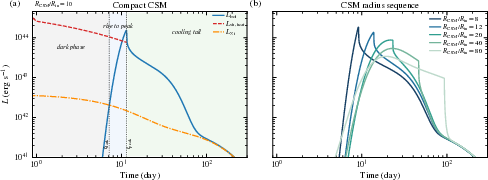
Figure 4: Bolometric light-curve behavior for varying CSM extent, holding all other parameters fixed within the unified shock+r1Ni model.
Multiband Fits and Physical Parameter Distributions
Multiband modeling for representative events in each class (Ibn: SN~2014av, Icn: SN~2019hgp, FBOT: SN~2018gep) shows that a single coherent prescription for CSM-interaction can reproduce a broad range of observed behaviors, including peak timing, luminosity, color evolution, and post-peak declines.
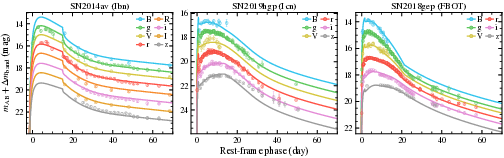
Figure 5: Representative TransFit-CSM fits to Ibn, Icn, and FBOT events, demonstrating consistency of the unified framework across classes.
Across the full sample, posterior medians of fit parameters reveal significant overlap in both r2--r3 and r4--r5 spaces, indicating that SNe Ibn, SNe Icn, and FBOTs do not segregate by CSM or ejecta mass or by characteristic radial scales in the context of optical light-curve modeling.
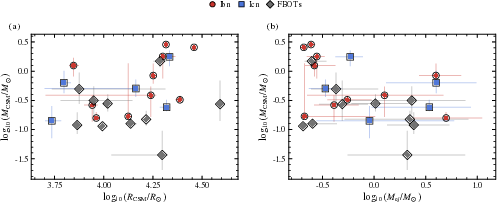
Figure 6: Posterior median fitted parameters in the r6--r7 and r8--r9 planes; substantial cross-class overlap is evident.
Inclusion of characteristic ejecta velocity ((g−r)r,max0) reveals that FBOTs tend to higher velocities, reinforcing their empirical extremity (high luminosity, fast evolution) is more a consequence of higher specific kinetic energy than differentiation in CSM mass or extent.
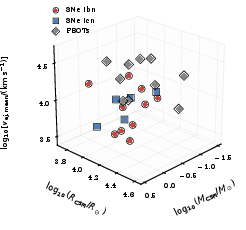
Figure 7: Fitted (g−r)r,max1--(g−r)r,max2--(g−r)r,max3 space for the sample, highlighting a trend of FBOTs to higher ejecta velocities.
Implications for Progenitors and Power Sources
The overlapping parameter distributions imply that all three transient classes may share similar immediate circumstellar environments: compact, dense, and H-poor shells expelled shortly (years to decades) before explosion. For SNe Ibn, this is consistent with He-envelope progenitors and episodic eruptive mass loss; for SNe Icn, the even greater CSM chemical stripping points to origins in C/O-rich layers, probable binary interaction, or highly stripped Wolf-Rayet descendants.
FBOTs, while empirically more extreme, do not require sharply greater CSM masses or radii. Their fast evolution is generally explained through smaller diffusion times (due to more compact CSM or higher velocities) and/or higher shock and inner heating efficiency. The effective (g−r)r,max4Ni mass inferred for FBOTs in this framework is often too large for a radioactive origin, suggesting the necessity for non-thermal or central engine contributions (e.g., magnetar spin-down, engine-driven jets, or fallback accretion), in line with independent multi-wavelength findings for prototypes like AT2018cow (2607.00453).
The results strongly constrain the possibility that the fastest and hottest FBOTs form a fully distinct population in terms of their CSM or ejecta mass. Instead, their optical phenomenology is quantitatively reproducible within the secularly broader SN Ibn/Icn parameter space, with additional components invoked as needed for X-ray/radio and late-time power.
Theoretical and Practical Implications
This unified modeling approach enables systematic comparison of explosion environments across fast blue transients. The findings indicate that rapid, luminous optical transients may arise naturally in systems with recent (pre-explosion) dense mass loss, regardless of fine details in composition or mass, provided the CSM is sufficiently compact and massive to mediate optical-wavelength shock breakout and conversion of ejecta kinetic energy into radiated power.
These results clarify that emergent differences among FBOTs, Ibn, and Icn are primarily quantitative (diffusion time, velocity, inner power) and chemical (degree of envelope stripping), rather than indicative of fundamentally distinct physical mechanisms in the majority of optical phenomenology. This has implications for transient rate predictions from population synthesis, constraints on binary evolution, and understanding the process of pre-supernova mass loss.
Practically, fitting optical light curves with models that couple interaction physics and radiative transfer provides a stronger diagnostic for underlying progenitor structure than reliance on empirical timescale and color cuts alone. The need for accurate multi-band coverage and robust spectroscopic monitoring remains essential, particularly to distinguish cases with substantial inner, non-thermal power sources.
Conclusion
This work demonstrates that SNe Ibn, SNe Icn, and FBOTs occupy a continuum in both empirical optical properties and physically interpreted CSM/ejecta parameter space when analyzed with a uniform, physically motivated light-curve model. While FBOTs typically represent the high-velocity, short-diffusion-time, and high-luminosity end of this distribution, their CSM and ejecta mass/radius overlaps with less extreme transients are substantial. This argues for a common phenomenological framework based on dense CSM interaction for the bulk of the optical emission in these transients, though additional non-thermal power sources remain necessary for the most extreme FBOTs. Future extensions should employ joint modeling of optical, X-ray, and radio data, and focus on robust identification of pre-explosion mass-loss signatures to further refine progenitor and environmental constraints (2607.00453).