- The paper demonstrates that hallucinations stem primarily from inference misalignment, where high-frequency shortcut associations override correct reasoning.
- It introduces a latent key–task framework that formalizes inference paths and quantifies a lower bound on inference loss, separating factual ignorance from deployment errors.
- Using the TrapQA benchmark, empirical results highlight significant error rates in constrained settings, emphasizing the need for improved inference alignment in LLMs.
Understanding Hallucination in LLMs: Inference Misalignment and Priors
Overview
"Understanding Why LLMs Hallucinate: Testing Reasoning Against Priors" (2607.00447) presents a formal and empirical investigation into the mechanisms underlying hallucination in LLMs. The core thesis is that hallucination commonly arises from inference misalignment: a model may have access to the requisite factual knowledge but nevertheless produces erroneous responses due to the dominance of statistically salient shortcut associations acquired during pretraining. This work advances a latent key--task framework to rigorously characterize such failures, distinguishes between factual ignorance and improper deployment of known facts, provides theoretical and empirical support for frequency-induced shortcut dominance, and introduces TrapQA—a diagnostic benchmark suite specifically constructed to reveal these failure modes.
Hallucination as Inference Misalignment
The authors reframe hallucination not merely as a retrieval or knowledge deficit but as a form of misaligned inference within a probabilistic sequence model. For a given prompt z, a trained LLM induces a conditional distribution P(⋅∣z), ideally matching a "correct" ground-truth distribution P⋆(⋅∣z). However, due to statistical regularities from pretraining, shortcuts—high-frequency associations—may dominate the inference trajectory chosen by the model. The mismatch is quantified via inference loss, ℓ(z):=∥P(⋅∣z)−P⋆(⋅∣z)∥TV, enabling a principled analysis of hallucination distinct from surface-level textual fidelity.
The key insight is that prompts activate latent inference paths composed of salient keys (cues) and associated tasks (semantic subgoals). When shortcut key--task pairs have higher prior probability (from pretraining frequency) than the prompt-supported, constraint-sensitive paths, the model’s output becomes misaligned with the prompt intent. Theoretical results demonstrate that pretraining frequency imbalances can induce a non-vanishing lower bound on inference loss, i.e., hallucination is theoretically expected in the presence of statistical shortcut dominance.
The central analytic framework is the latent key--task model, formalizing the model's implicit two-stage reasoning:
- Key selection: The model identifies salient pattern(s) (keys) in the prompt.
- Task retrieval: The model then retrieves and composes the corresponding subtask(s).
Potential failure modes are:
- Key-selection bias: The model attends to frequent but prompt-irrelevant keys, guided by pretraining statistics rather than prompt constraints.
- Task-retrieval bias: Even with the correct key, the model retrieves an incorrect association, again due to frequency imbalance.
A series of formal assumptions and theorems establish that, under realistic modeling conditions, shortcut pairs can easily dominate the correct path in the posterior, and that this leads to a measurable lower bound on total variation inference loss. This formalism robustly explains why hallucination persists even when the relevant knowledge is accessible to the model in isolation.
TrapQA Benchmark: Controlled Diagnostic Evaluation
To empirically validate the theory, the authors introduce TrapQA, a closed-book QA benchmark with two complementary components:
- ScientistQA: Focuses on entity disambiguation among highly confusable scientists. Each item consists of a paragraph compatible with both candidates, appended with a decisive constraint that rules out exactly one. Additionally, two single-fact probes accompany each item to diagnose whether the model knows the decisive facts in isolation. The design enables separation of knowledge deployment failures from outright ignorance.
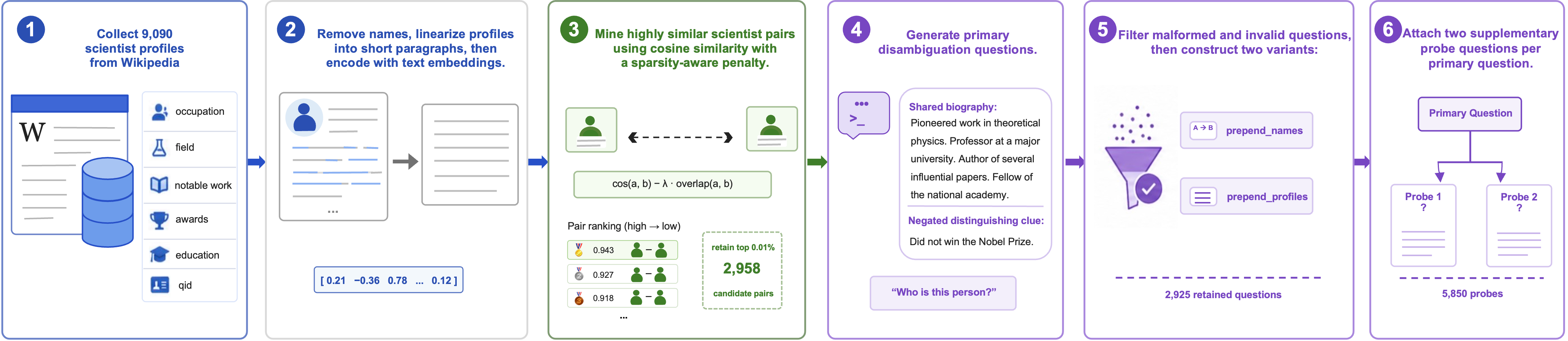
Figure 1: Overview of the Scientist QA construction pipeline. Starting from Wikipedia-linked scientist profiles, highly confusable pairs and pairwise disambiguation questions are created, each with two supplementary probes.
- Real-Life Constrained QA: Tests the ability to adhere to practical, procedural, or physical constraints when a salient shortcut suggests an incorrect but plausible answer. Scenarios are instantiated from high-association SWOW word cues and organized into structured templates covering daily-life tasks.
Both components are designed to rule out outside knowledge sources, enforcing closed-book evaluation and ensuring that errors arise from internal model processing.
Empirical Findings
ScientistQA: Disambiguation and Knowledge Deployment
Across 2,925 names-only disambiguation questions and four major LLM families (GPT, Claude, Gemini, DeepSeek), hallucination rates vary widely (2.5% to 37.2%) depending on model and settings. Crucially, errors sharply decline in the "profiles-in-context" retrieval-relaxed regime, showing that if explicit structured information is provided, models rarely err. However, in the names-only condition, many errors persist even when both candidate-specific factual probes are answered correctly, establishing that the failure is not due to the absence of relevant knowledge but rather due to improper knowledge deployment in comparative contexts.
Key results:
- Significant fractions of hallucinations occur when the model correctly answers both supplementary factual probes, indicating a deployment failure rate (up to ~80% of errors in Gemini settings).
- Providing more "thinking" (e.g., high-reasoning settings) reduces hallucinations for some models, but not universally, indicating that inference effort is not a panacea for shortcut bias.
- Fame-driven priors do not explain the shortcut bias: hallucination rates are in fact lower when the incorrect candidate is more famous.
Real-Life Constrained QA: Everyday Constraint Following
Across 500 real-world, two-choice constrained scenarios, models display hallucination-like errors at significant rates (Claude: 16.2%, GPT: 8.8%, DeepSeek: 36.4%, Gemini: 3.6%). Models often prefer high-association but constraint-violating actions, for example recommending "walking" to a nearby car wash when the task unambiguously requires driving the car there. This recapitulates the same frequency-induced inference misalignment seen in the biographical domain and demonstrates transferability of the shortcut failure mode to everyday procedural reasoning.
Implications and Further Directions
Theoretical and Practical Implications
- Hallucination arises not only from knowledge gaps but prominently from misalignment in the selection and composition of inference paths. Models possess the relevant facts but often fail to apply them when faced with strong but misleading priors.
- Reducing hallucination requires addressing shortcut bias at inference, not merely increasing factual coverage. Mitigation efforts must target improved identification and weighting of task-relevant cues versus competing statistical associations.
- Calibration, fame suppression, or confidence estimation are insufficient mitigations, since models can be confidently wrong along the shortcut path and fame does not predict error direction.
Prospects for Model Improvement
- Enhanced prompt disambiguation techniques and architectures that better enforce constraint-sensitive inference may offer routes to reduced hallucination.
- Designing fine-tuning or RLHF objectives that penalize shortcut path dominance and reward correct deployment of known constraints could drive improvements—though this requires care, as overfitting to benchmarks can undermine generalization.
- Research on dynamic inference path selection and compositionality is supported by these findings, as static association-driven reasoning proves brittle under constraint.
Conclusion
This work articulates and supports a mechanistic theory for why LLMs hallucinate, grounded in a latent inference structure disrupted by statistical shortcut dominance from pretraining. The introduction of the TrapQA benchmark enables precise separation of knowledge absence from inferential deployment errors. Empirical results substantiate that many hallucinations in state-of-the-art LLMs are inference-pathological: models have the necessary knowledge but, due to dominant priors, fail to deploy it appropriately. The findings direct future research toward inference-aware, constraint-enforcing modeling and diagnostic evaluation, moving beyond simply expanding the factual memory of LLMs.

