- The paper proposes a contractivity-based framework for regularized MPC, establishing LMI conditions that guarantee exponential stability under various regularizers.
- It leverages implicit Lur'e analysis and incremental multiplier techniques to address convex smooth, convex closed proper, and Lipschitz-gradient regularizers.
- Numerical experiments validate the approach for soft, hard, sparse, and state-penalty MPC scenarios, demonstrating robust performance and strict constraint adherence.
Regularized Model Predictive Control via Contractivity and Implicit Lur'e Analysis
Introduction and Motivation
The paper "Regularized Model Predictive Control via Contractivity and Implicit Lur'e Analysis" (2607.00383) presents a comprehensive theoretical and computational framework for the stability analysis of Model Predictive Control (MPC) when augmented with regularization. Incorporating regularizers—such as penalties for constraint violations, hard constraints, or sparsity-promoting terms—into the cost function of MPC is essential for achieving desired control objectives in practical systems. However, this complicates traditional Lyapunov-based analysis due to the implicit definition of the feedback law via an optimization problem.
This work establishes a new, contractive perspective for regularized MPC based on incremental multiplier theory and implicit Lur'e analysis, yielding Linear Matrix Inequality (LMI) conditions certifying exponential stability and robustness for broad classes of regularizers (convex smooth, closed proper, and Lipschitz-gradient). The approach is validated numerically on stiff, constrained, and sparse control problems, demonstrating the ability to tune closed-loop objectives while retaining formal stability guarantees.
Theoretical Setting: Implicit Lur'e Systems and Contraction
The central contribution is to interpret regularized MPC as an implicit Lur'e system, wherein the feedback law emerges as the solution to a generalized equation representing the optimality conditions of a convex (or nonconvex) finite-horizon problem with a regularizing cost. The analysis leverages contraction theory, which establishes system stability by certifying that the distance between any pair of closed-loop trajectories decays exponentially with time in a prescribed norm.
Formally, contractivity is certified by identifying incremental multiplier matrices (IMMs) for the nonlinear regularization operator—as in monotonicity, Lipschitz, or strong convexity arguments—then using multipliers to formulate LMI conditions ensuring contraction for the overall system. The existence of appropriate multipliers is demonstrated for three structurally distinct classes of regularizers, and sufficient conditions for well-posedness and uniqueness of the closed-loop map are provided.
Certified Contractivity for Three Classes of Regularizers
Convex Smooth Regularizers
For regularizers constructed as a sum of convex and smooth per-stage penalties, the gradient mapping admits an incremental multiplier derived from the L-smoothness property. This leads to explicit LMI conditions for contraction, enabling tuning of the regularization scale for desired transient and steady-state performance. The framework applies to standard soft constraint relaxations for input and state bounds.
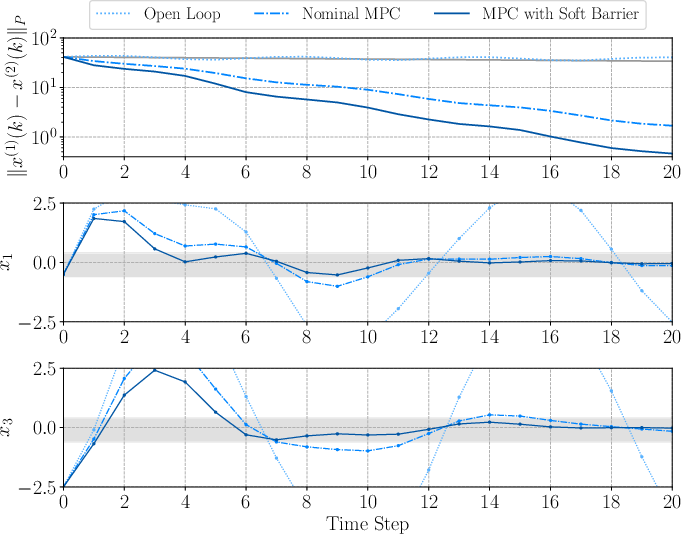
Figure 1: Soft input-penalty example. Top: distance between two closed-loop trajectories, measured in the certified norm ∥⋅∥P, with the gray line indicating the prescribed decay rate η. Middle and bottom: input trajectories u1 and u2. The input-penalized MPC preserves the certified contraction behavior while keeping the inputs closer to the desired interval [−1,0.5] than the nominal MPC.
Convex Closed Proper (CCP) Regularizers
For CCP regularizers (including hard constraints and ℓ1 penalties), the subdifferential is maximally monotone, and the corresponding IMM exploits monotonicity structure. The associated LMI can account for hard constraints or induce sparsity, with strong contractivity certified even in the presence of nonsmooth, possibly set-valued nonlinearities. This generality encompasses both classical hard-constrained MPC and sparse actuator selection problems.
Figure 2: Tracking example with hard input constraints. Top: distance between two error trajectories, measured in the certified norm ∥⋅∥P, with the gray line indicating the prescribed decay rate η. Middle and bottom: input trajectories u1 and ∥⋅∥P0. The nominal MPC tracks accurately but can violate the input bounds, whereas the hard-constrained MPC enforces ∥⋅∥P1 and converges to the constrained periodic response.
Figure 3: Sparse consensus-control example with ∥⋅∥P2. Top: distance between two reduced-state trajectories, measured in the certified norm ∥⋅∥P3, with the gray line indicating the prescribed decay rate ∥⋅∥P4. Middle and bottom: representative edge inputs ∥⋅∥P5 and ∥⋅∥P6. The sparse MPC retains contraction while driving selected inputs exactly to zero, illustrating the sparsity-promoting effect of the ∥⋅∥P7 regularizer.
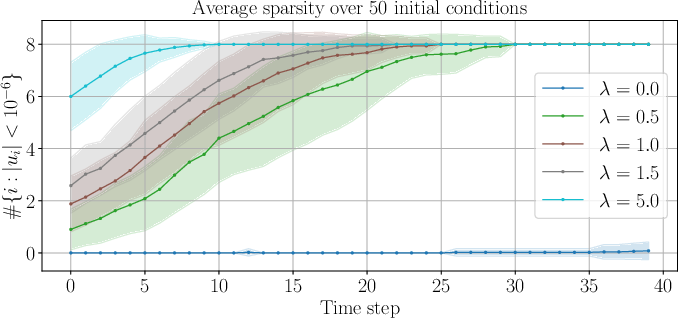
Figure 4: Sparsity statistics for the consensus example over 50 randomly generated initial conditions. The curves show the number of zero-valued edge inputs over time for different ∥⋅∥P8. Larger ∥⋅∥P9 values produce sparser control actions, whereas the nominal MPC rarely sets inputs exactly to zero.
Differentiable Lipschitz-Gradient Regularizers
For regularizers with Lipschitz-continuous gradients (allowing for nonconvexity), the analysis constructs IMMs based on Lipschitz constants. The approach offers an SDP-based procedure to jointly search for metric norms and maximal allowable regularization strengths while certifying contraction and fixed-point uniqueness. This setting subsumes soft penalties on possibly nonconvex state or output constraints.
Figure 5: Soft state-penalty example. Top: distance between two trajectories, measured in the certified norm η0, with the gray line indicating the prescribed decay rate η1. Middle and bottom: position trajectories η2 and η3 of the two masses. The state-penalized MPC preserves contraction and encourages the positions to remain in the desired interval η4, while the open-loop system does not exhibit the certified decay.
Numerical Evidence and Certified Robustness
The paper demonstrates the framework on several representative systems:
- Soft input-penalized MPCs: The addition of structured convex penalties yields a certified contraction rate η5, with strong reduction in cumulative input constraint violations compared to unregularized MPC.
- Tracking MPC with hard constraints: The approach certifies global contraction while constraining the closed-loop inputs with hard bounds. Unlike the nominal MPC, no constraint violations occur, and exponential convergence to periodic orbits is recovered.
- Sparse control of consensus networks: η6-regularized feedback exhibits strong contraction, with increasing regularization coefficient η7 yielding more control actions identically equal to zero across all randomized initializations.
- State soft-penalized MPCs: The contractivity of MPC with smooth, possibly nonconvex penalties on state constraints is certified, and the closed-loop state rapidly enters and remains inside a prescribed safe interval.
Implications and Future Directions
The formalism advanced in the paper enables the joint design of closed-loop control law and its performance-oriented regularization, while maintaining rigorous exponential stability, robustness to disturbance, and well-posedness guarantees. These results are directly relevant for high-stakes applications (e.g., robotics, power systems, economic MPC) demanding constraint adherence, sparsity, or tailored state and input objectives.
The broader theoretical implications reside in advancing implicit Lur'e theory for feedback systems defined through optimization-based, possibly nonsmooth, and set-valued nonlinearities, with LMIs serving as tractable certificates computable via convex programming. This opens new avenues for:
- Contractive analysis of economic and distributed MPC regimes
- Extending the approach to nonlinear system settings and infinite-dimensional state spaces
- Certified synthesis of control laws for implicit models in learning and estimation (e.g., neural ODEs, equilibrium networks)
- Local contractivity analyses for constrained and hybrid systems
Further, the developed invariance and robustness properties could inspire algorithmically robust, data-driven MPC design pipelines, translating theoretical certificates into automated controller tuning in practical, safety-critical AI systems.
Conclusion
This paper develops a foundational contractivity-based framework for stability analysis of regularized MPC through implicit Lur'e systems, enabling precise, scalable certification of exponential stability and robustness under general convex and nonconvex regularization. The formulation is validated on challenging closed-loop control scenarios and delivers practical tools for the certification of advanced optimization-driven controllers (2607.00383).

