- The paper introduces a unified framework integrating Data-Guidance and Enhanced Model-Guidance to mitigate timbre leakage and reduce sampling steps.
- It employs a dual-stage heterogeneous perturbation strategy that robustly disentangles content from speaker identity in speech synthesis.
- Enhanced Model-Guidance distills CFG behavior into flow matching models, achieving over 3× faster inference with minimal performance loss.
Enhancing Flow Matching with A Unified Guidance Framework for Efficient and Robust Speech Synthesis
Introduction
Flow Matching (FM) architectures have achieved high fidelity in data-to-data generation tasks by parameterizing continuous transformations between simple priors and complex target distributions. In speech generation, FM-based models have shown competitive performance across text-to-speech (TTS), audio language modeling, and voice conversion (VC). Despite their success, practical deployment is hindered by two primary obstacles: significant inference latency due to ODE-based sampling with high numbers of function evaluations (NFE), and robust zero-shot generation being compromised by timbre leakage, where speaker identity is entangled with content in semantic tokens. Classical mitigation approaches degrade either linguistic intelligibility or introduce prohibitive computational cost during inference, particularly via Classifier-Free Guidance (CFG). This paper introduces a unified guidance framework that systematically addresses both bottlenecks through two synergistic mechanisms: Data-guidance (DG) for robust disentanglement and Enhanced Model-guidance (MG) for trajectory and guidance-aware acceleration.
Data-Guidance: Dual-Stage Heterogeneous Perturbation
The Data-guidance (DG) strategy directly attacks timbre leakage inherent in conditional FM by disrupting the “information shortcut” where semantic tokens contain residual speaker or timbral cues. The DG pipeline constructs acoustically mismatched, linguistically identical training pairs through sequential model-driven and signal-driven perturbations. Specifically, source semantic tokens are synthesized into audio using a pretrained VC/TTS system to introduce identity shifts. To further eliminate latent acoustic residues, explicit pitch shifting and energy scaling are applied at the signal level, following established augmentation protocols. Semantic tokens extracted from these doubly-deformed waveforms serve as corrupted linguistic conditions for supervision.

Figure 1: The Data-guidance (DG) pipeline forms severely mismatched training pairs by cascading model-driven cross-synthesis with signal-driven acoustic deformation to force robust content-timbre disentanglement.
This dual-stage augmentation forces the Flow Matching model to prioritize the acoustic prompt (e.g., mel, speaker embeddings) for timbre, as the semantic tokens become unreliable for non-linguistic information. The effect is robust mitigation of timbre leakage under zero-shot settings, even against strong cross-speaker stimuli. Empirical results confirm DG alone yields near-ideal speaker preservation and outperforms single-stage perturbation strategies.
Enhanced Model-Guidance: Unified Acceleration and Guidance Distillation
Inference latency traditionally arises from two sources in flow-based models: (1) the inherent curvature of the ODE paths, necessitating many iterative solver steps, and (2) the overhead of CFG, which doubles forward passes per step to enforce conditional fidelity. Prior attempts addressed these orthogonally—Rectified Flows for trajectory straightening and Model-guidance for replacing CFG—but left a gap in their integration.
The Enhanced Model-guidance (MG) mechanism in this framework jointly distills CFG behavior directly into the FM model parameters and simultaneously enforces path linearization. During training, the network is first updated to track a guidance-aware velocity field—this replaces typical CFM targets with the vector field induced by CFG, using the stop-gradient operation to avoid interfering with internal representations. Next, with the updated weights, the model simulates forward passes by integrating along the straightened ODE trajectory, and is further optimized to predict the correct end positions with minimal steps. The entire process is embedded in a unified, batch-level online loop, enabling efficient guidance integration and trajectory rectification with a single forward pass in deployment.
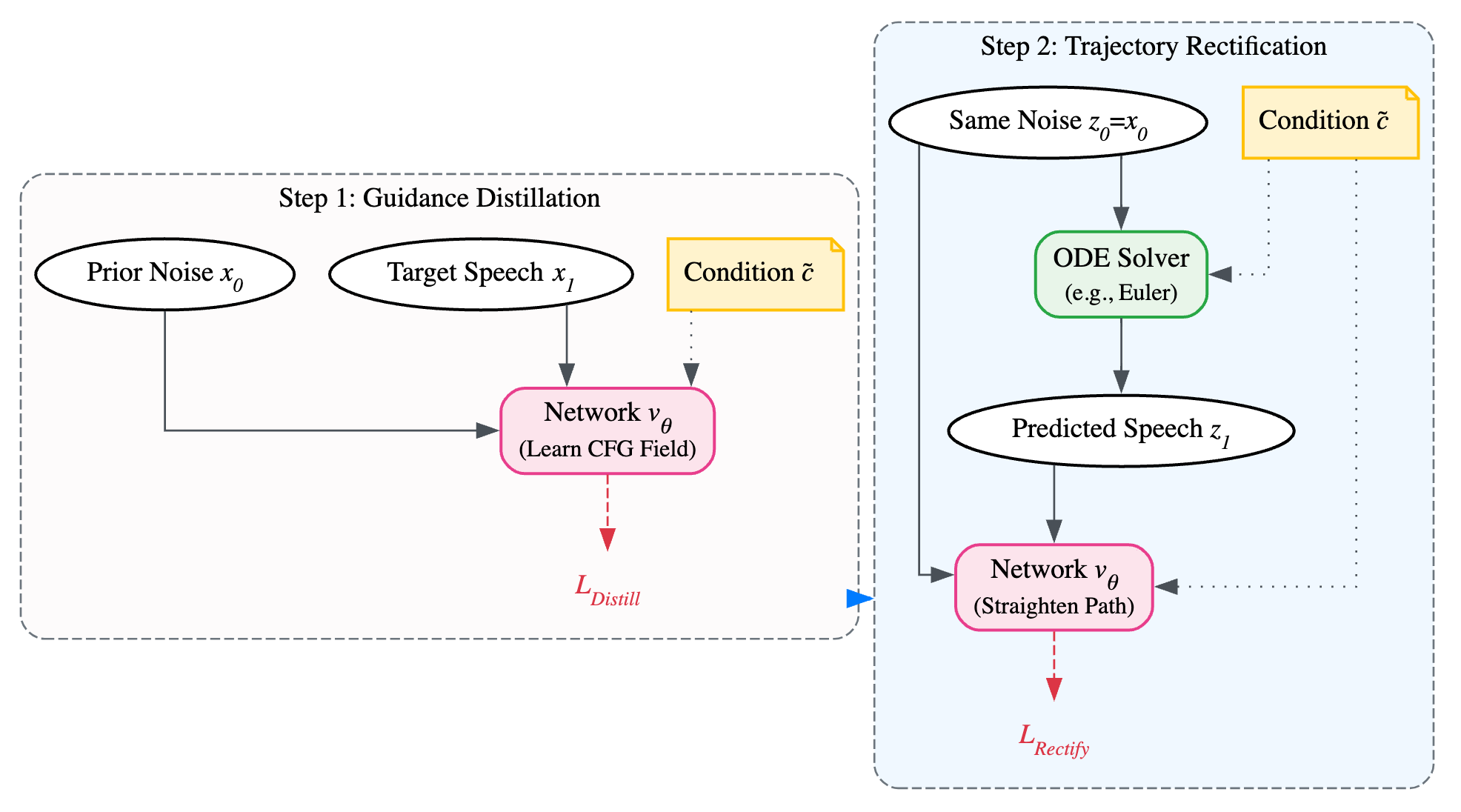
Figure 2: Enhanced Model-guidance (MG) distills the CFG-aware velocity field into the network and enforces straight-path ODE integration within a batchwise unified optimization.
This integration eliminates the need for per-step CFG passes and achieves high-fidelity, condition-consistent speech with as few as three solver steps. The approach maintains detailed prompt adherence without sacrificing computational efficiency, outperforming vanilla FM and base Model-guidance approaches.
Experimental Analysis
Voice Conversion
Evaluation on LibriTTS and Seed-TTS test sets focused on both parallel (same-speaker) and non-parallel (cross-speaker) conversion. Metrics included real-time factor (RTF), speaker similarity (SIM), and WER. Results indicate that DG yields the highest SIM—even exceeding ground-truth in non-parallel regimes—demonstrating that aggressive data augmentation is crucial in breaking timbre shortcuts. Vanilla MG and Enhanced MG reduce RTF significantly, but only the unified DG+MG framework achieves a balanced tradeoff: a 3.25× speedup (RTF = 0.024) with SIM surpassing strong FM baselines without CFG, especially in zero-shot regimes. The approach consistently outperforms pure acceleration or guidance variants in real-world multi-speaker and cross-domain conversion.
Text-to-Speech
Integration of the proposed FM backend with a state-of-the-art LLM (CosyVoice2) and HiFTNet vocoder shows that the unified guidance framework achieves superior SIM while only negligibly increasing WER compared to various TTS and FM architectures. This indicates minimal compromise in intelligibility while delivering notable improvements in speaker consistency, even in extreme low-step regimes.
Practical and Theoretical Implications
The proposed unified guidance approach decisively advances the operational viability of FM-based speech generation systems for real-time and zero-shot applications. The method demonstrates that joint optimization of data-level disentanglement and trajectory/guidance-aware modeling is necessary to traverse the tradeoff surface between speed, robustness, and prompt fidelity. By internalizing guidance logic and maximizing acoustic-conditional dependence, the framework paves the way for low-latency, scalable FM systems deployable in interactive applications (e.g., conversational AI, voice banking, and in-the-wild VC). The ability to decouple linguistic and timbral features robustly reaffirms the argument favoring structured data augmentation over reliance on architectural bottlenecks (VQ, adversarial filtering). This unified strategy could generalize to other modalities where conditional generation suffers from mode collapse or entanglement artifacts.
Future research directions may investigate expanded DG pipelines (e.g., learned augmentations or adversarial perturbations), finer-grained MG schedules, or multi-modal prompt disentanglement. The robust internalization of guidance behavior opens paths for efficient plug-and-play modularity in larger audio-visual LLM systems, and for few-step generation protocols beyond speech.
Conclusion
The unified guidance framework introduced in this paper systematically addresses timbre leakage and inference latency in conditional Flow Matching speech synthesis. Data-guidance via heterogeneous perturbation forces the model toward prompt-anchored timbre, while Enhanced Model-guidance achieves CFG-free, straight-path sampling in minimal steps. Empirically, the framework accelerates inference by over 3× and establishes new state-of-the-art benchmarks in zero-shot speaker similarity for both VC and TTS. This joint approach offers a practical pathway to efficient, robust, and scalable generative speech systems.