- The paper introduces a polynomial-time de-randomization algorithm that converts sampling-based policies into deterministic sequences without any revenue loss.
- It proves that locally-optimal deterministic policies achieve a 1/2-approximation guarantee via DR-submodular analysis and a greedy coordinate ascent approach.
- Empirical results demonstrate significant revenue improvements, especially in CVaR metrics, validating the practical benefits of de-randomized dynamic assortment strategies.
Killing the Case for Randomization in Dynamic Assortment Optimization
Problem Setting and Motivation
Dynamic assortment optimization is a central problem in revenue management, concerning the design of policies that sequentially offer product assortments to a stream of customers with heterogeneous preferences, in the presence of stochastic arrivals and finite inventories. Typical formulations rely on high-dimensional dynamic programs which are computationally intractable in realistic settings, especially when the number of products, customer types, or the planning horizon is large. To overcome this, a longstanding paradigm involves the deployment of sampling-based inventory-agnostic policies. These policies generate random assortments to offer to incoming customers, drawing assortments independently for each customer type and time period from a fixed distribution.
Inventory-agnostic policies, by construction, may propose assortments including products with depleted stocks; in this case, customers fail to purchase. However, the practical inefficiency is mitigated since, by the substitutability property of discrete choice models, removing out-of-stock products does not decrease performance. In contrast, the randomization aspect of policies is more contentious, as it introduces artificial variability, potentially undermining trust, stability, and out-of-sample performance.
Main Contributions
This paper delivers a comprehensive theoretical and algorithmic treatment justifying that randomization is, in fact, unnecessary for high-quality dynamic assortment optimization. The authors present:
- A polynomial-time de-randomization algorithm converting any sampling-based inventory-agnostic policy into a deterministic sequence of assortments, without any loss of expected revenue. Notably, de-randomization is achieved both within the support of the original randomized policy (i.e., draws only from existing random assortment support) and, crucially, beyond the support via exploiting static assortment optimization solvers.
- Performance guarantees for locally-optimal deterministic policies: The work proves that any deterministic policy that is locally optimal with respect to single-assortment swaps attains at least a 1/2−ϵ approximation ratio (for arbitrarily small ϵ>0) to the best possible inventory-agnostic policy, a guarantee derived via DR-submodularity and relying on recent advances in submodular optimization.
- A formal reduction of inventory-agnostic to inventory-aware execution: It is shown rigorously that implementing a deterministic or randomized inventory-agnostic policy with online removal of out-of-stock items guarantees no performance loss, formalizing folklore results and ensuring practical applicability.
- Empirical quantification of the de-randomization benefits: Extensive experiments demonstrate substantial revenue and risk profile improvements, especially pronounced in the lower quantiles of the revenue distribution (CVaR).
De-Randomization: Algorithms and Theoretical Analysis
Given a sampling-based policy μ, the key is to replace random assortment draws independently for each (j,t) pair (customer type j at time t) with a deterministic assortment, chosen to maximize the total expected revenue (possibly conditioned on the fixed choices for other pairs). The process is iterative: for each (j,t), exhaustively try each assortment in the support of μ, compute the resulting expected revenue of the modified policy, and greedily fix the locally best option. Due to Carathéodory's theorem, the support size is tractable: any mixture over a convex set in n-product space can be represented with at most n+1 elements.
The algorithm can be extended, conditionally on an efficient static assortment optimization oracle (common for choice models like MNL), to search over all feasible assortments at each ϵ>00, producing globally de-randomized policies outperforming those that restrict to the original support.
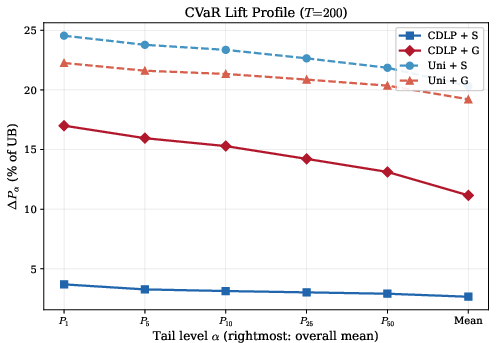
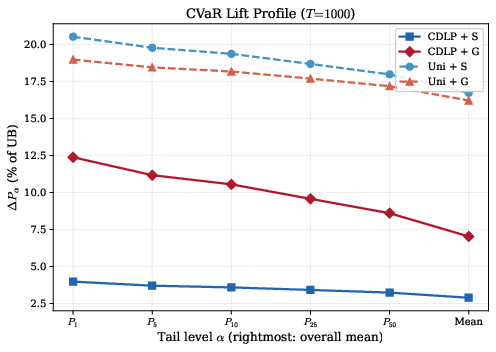
Figure 1: Values of ϵ>01, quantifying CVaR improvements under de-randomization as a function of percentile cutoff ϵ>02.
Computing total expected revenue for a candidate policy leverages dynamic programming, given customer arrival distributions, choice probabilities, and capacities, and can be efficiently evaluated using appropriate recursions.
Locally-Optimal Deterministic Policies: 1/2-Approximation Results
A major technical advance is the proof that any locally-optimal deterministic policy (i.e., one that cannot be improved by changing a single assortment for any ϵ>03) achieves a constant-factor approximation to the best possible sampling-based policy's expected revenue.
This is established by:
- Constructing the policy value as a monotone, continuous DR-submodular function over the assignment of purchase probabilities,
- Showing, via submodular optimization theory, that stationary points yield at least a half-approximation (modulo an ϵ>04 additive error),
- Providing a coordinate ascent algorithm—provably polynomial-time—to reach such stationary points.
The result is broadly general, applying to most random utility maximization choice models.
Lossless Inventory-Aware Implementation
The inventory-agnostic assumption, while analytically convenient, is resolved at the implementation level: simply "mask" assortments at runtime by removing out-of-stock items. The paper rigorously shows that if the underlying choice model is substitutable, this transformation can only improve (never decrease) expected revenue versus the original policy.
Numerical Investigations
The empirical section systematically evaluates de-randomization on a suite of synthetic instances with realistic size (ϵ>05 products, ϵ>06 customer types, ϵ>07 up to 1000), customer choices defined via MNL, and time-heterogeneous arrival rates and consideration sets. Two policy baselines are studied: a choice-based deterministic LP (CDLP) and a "uniform-myopic" construction.
Key findings:
- De-randomized policies achieve up to 20% improvement in CVaR (worst-case quantile) and reduce coefficient of variation of revenues by up to 90%.
- The effect is strong for weak random policies (higher entropy), and remains nontrivial for policies with narrow randomization support.
- Running times of the de-randomization procedures are practical for the tested problem sizes.
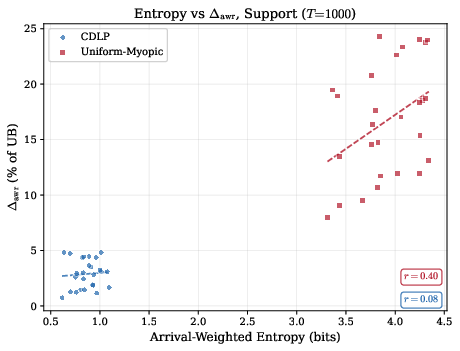
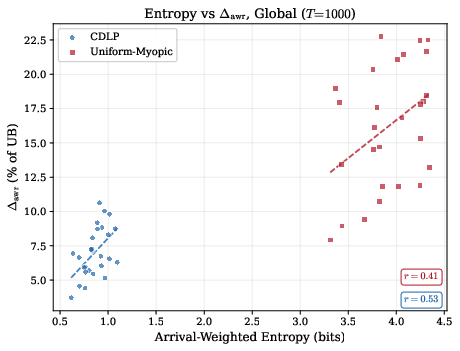
Figure 2: Scatter plot of arrival-weighted entropy versus improvement in expected revenue (ϵ>08) post de-randomization, evidencing higher gains for greater policy entropy.
Theoretical and Practical Implications
The dismantling of the necessity of randomization in dynamic assortment optimization under the considered models has immediate practical and conceptual consequences:
- Deterministic policies suffice for optimality (or guaranteed approximation) and can be efficiently constructed, reducing variance and improving tail performance.
- For revenue management systems, these results justify a shift away from randomized strategies, enhancing interpretability and managerial trust.
- The half-approximation for locally-optimal policies suggests powerful greedy/local-search heuristics suffice even in high-dimensional dynamic allocation problems, leveraging submodularity structure.
- Connections to DR-submodular function maximization point to new algorithmic paradigms for dynamic resource allocation, inviting broader adoption of continuous submodular optimization tools.
Conclusion
This work establishes that randomization is not required in dynamic assortment optimization under substitutable choice models. De-randomization, both within and beyond original policy support, is tractable, improves expected and tail revenues, and is supported by strong approximation guarantees via DR-submodularity. These contributions advance both the theory and practice of revenue management, providing actionable algorithms and clarifying the structural landscape of optimal dynamic policies.