- The paper introduces and validates a region-based parametric modelling framework to accurately extract the 21cm signal amid dominating Galactic foregrounds.
- It systematically compares models—including power law, curved, and synchrotron+free-free—using Bayesian evidence and RMSE to quantify recovery performance.
- The study proposes mixed-region splitting strategies that enhance free-free emission recovery and mitigate parameter degeneracies in complex spectral conditions.
Synchrotron and Free-Free Mapping with Simulated REACH Observations: Technical Analysis
Introduction and Motivation
The global detection of the redshifted 21cm line from neutral hydrogen provides a direct probe of the thermal and ionization history of early cosmic epochs, including the Cosmic Dawn and Epoch of Reionization (EoR). Experiments such as REACH (Radio Experiment for the Analysis of Cosmic Hydrogen) depend on precise subtraction of foreground radio emission, which exceeds the expected 21cm signal by more than four orders of magnitude across the 50–170 MHz frequency band. Accurate parametric modelling of this foreground radiation—composed primarily of synchrotron and subdominant free-free (thermal bremsstrahlung) Galactic emission—is essential for robust cosmological inference.
The paper "Synchrotron and free-free mapping with simulated REACH observations between 50–170 MHz" (2607.00299) presents a systematic simulation study that benchmarks REACH’s forward modelling framework across a hierarchy of foreground models and evaluates the accuracy with which both the cosmological signal and the sky foreground components can be reconstructed under realistic instrumental conditions. The study introduces physically motivated decomposition and rigorous region-based parametric inference, quantifies foreground parameter degeneracies, and explores advanced region-splitting strategies tailored to component-specific emission morphology.
Parametric Foreground Modelling Framework
REACH’s approach divides the sky into Nreg regions (default Nreg=10), each parameterized independently, with region boundaries defined by percentile splits of the sky’s spectral index map. This ensures grouping pixels according to similar spectral properties rather than simple Galactic latitude.
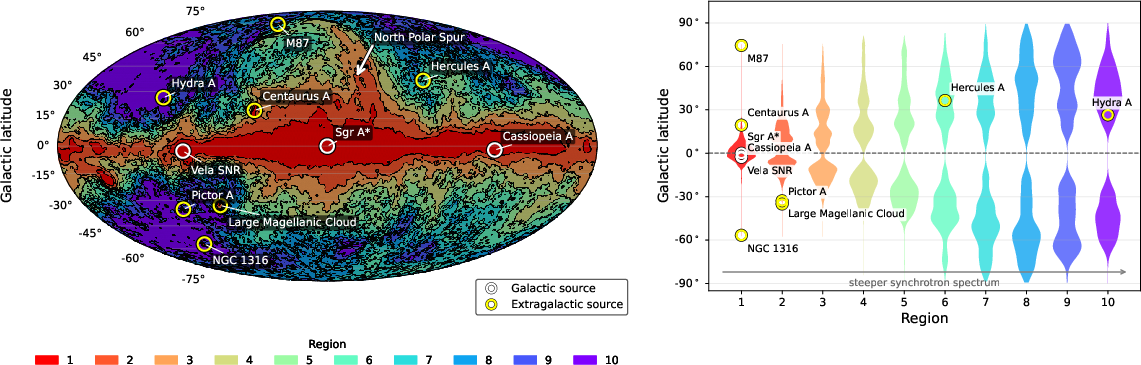
Figure 1: Sky partitioning into 10 spectral-index-based regions, with right panel showing distribution in Galactic latitude.
Four model classes of increasing complexity are employed:
- Power Law: One parameter (spectral index β) per region; motivated by pure synchrotron emission.
- Variable Amplitude Power Law: Adds an amplitude A per region to capture calibration uncertainty.
- Curved Power Law: Introduces a curvature parameter c to account for spectral bending.
- Synchrotron + Free-Free (sync + ff): Explicitly decomposes into synchrotron (amplitude Async, index βsync) and fixed-index (βff=2.1) free-free (Aff) components.
The analytic forms ensure anchor to an externally calibrated 230 MHz Global Sky Model (GSM) map and incorporate realistic spatial complexity and model flexibility.
Simulation Pipeline and Data Generation
Synthetic observations are based on nine distinct sky models, combining GSM-derived foregrounds (with varying degrees of spectral complexity and parameterization) and a PySM3 realization based on CMB community standards, permitting discriminatory stress-testing. Both pixel-wise and region-wise datasets are used, the latter enabling controlled assessment of parameter recovery as each region’s true value is known.
The forward-modelling pipeline convolves input maps with the REACH beam, performs time/LST integration, adds Gaussian radiometric noise, and injects a Gaussian 21cm absorption profile.
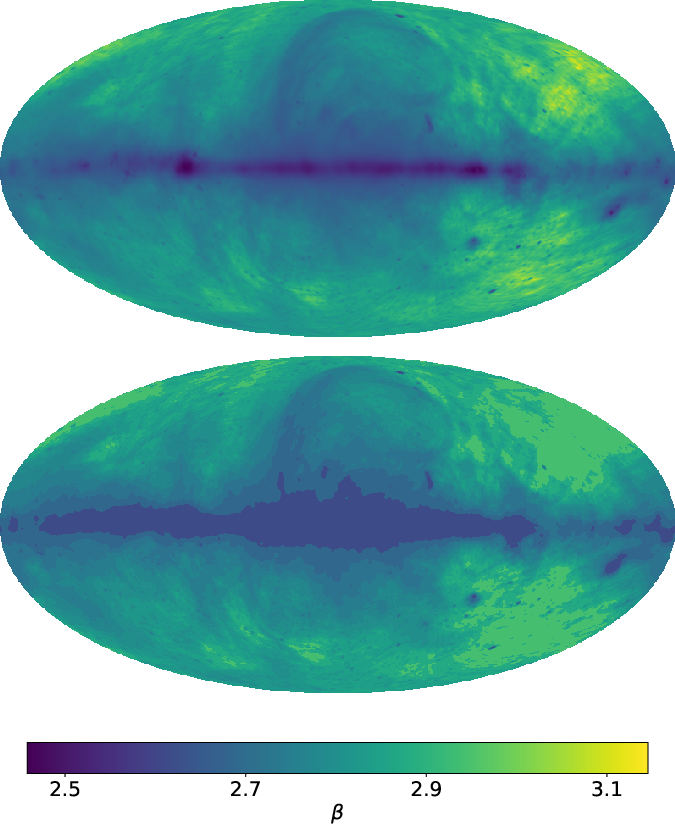
Figure 2: Pixel-wise vs region-wise spectral index maps demonstrating the loss of small-scale features in the region-averaged parametrization.
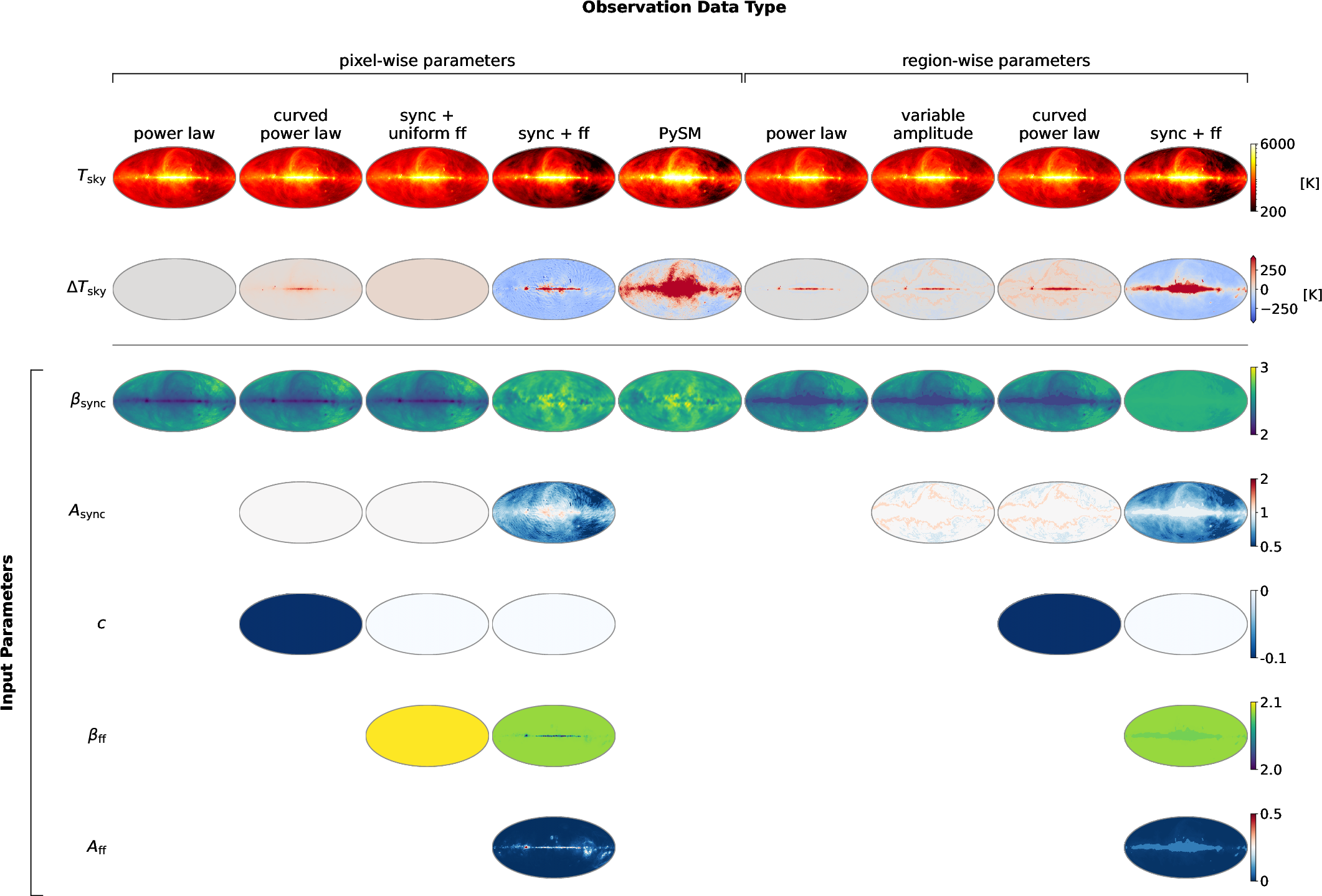
Figure 3: Input parameter maps at 125 MHz for all simulated datasets, showing temperature and principal parameters.
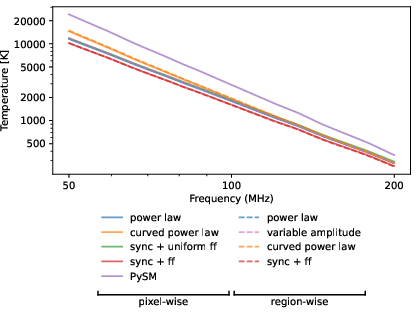
Figure 4: Observed frequency spectra for all nine simulated datasets (12-hr integration), including injected noise and 21cm signal.
Bayesian Inference and Model Selection
A nested sampling approach is used to jointly fit foreground and 21cm signal parameters to the observed antenna spectra. Bayesian model evidence provides an objective criterion for comparing model complexity and data fit quality, with RMSE on the recovered 21cm signal used as an additional fidelity metric.
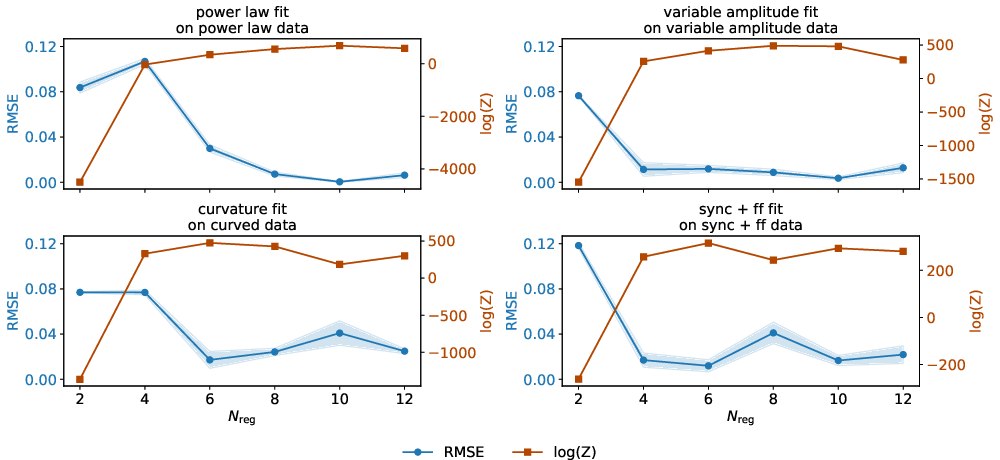
Figure 5: Evolution of Bayesian evidence and RMSE with increasing number of regions, showing optimality and diminishing returns beyond Nreg=10.
Increasing Nreg=100 allows the model to accommodate finer angular structure but rapidly inflates dimensionality and computational demands, with signal recovery showing saturation of improvement at Nreg=101 for most models.
Comprehensive fits on pixel-wise simulated data demonstrate rapid degradation of the simple power law’s ability to recover the 21cm signal as soon as true sky spectra deviate from this case, resulting in high residuals and bias (shown by poor RMSE and pathological posterior intervals).
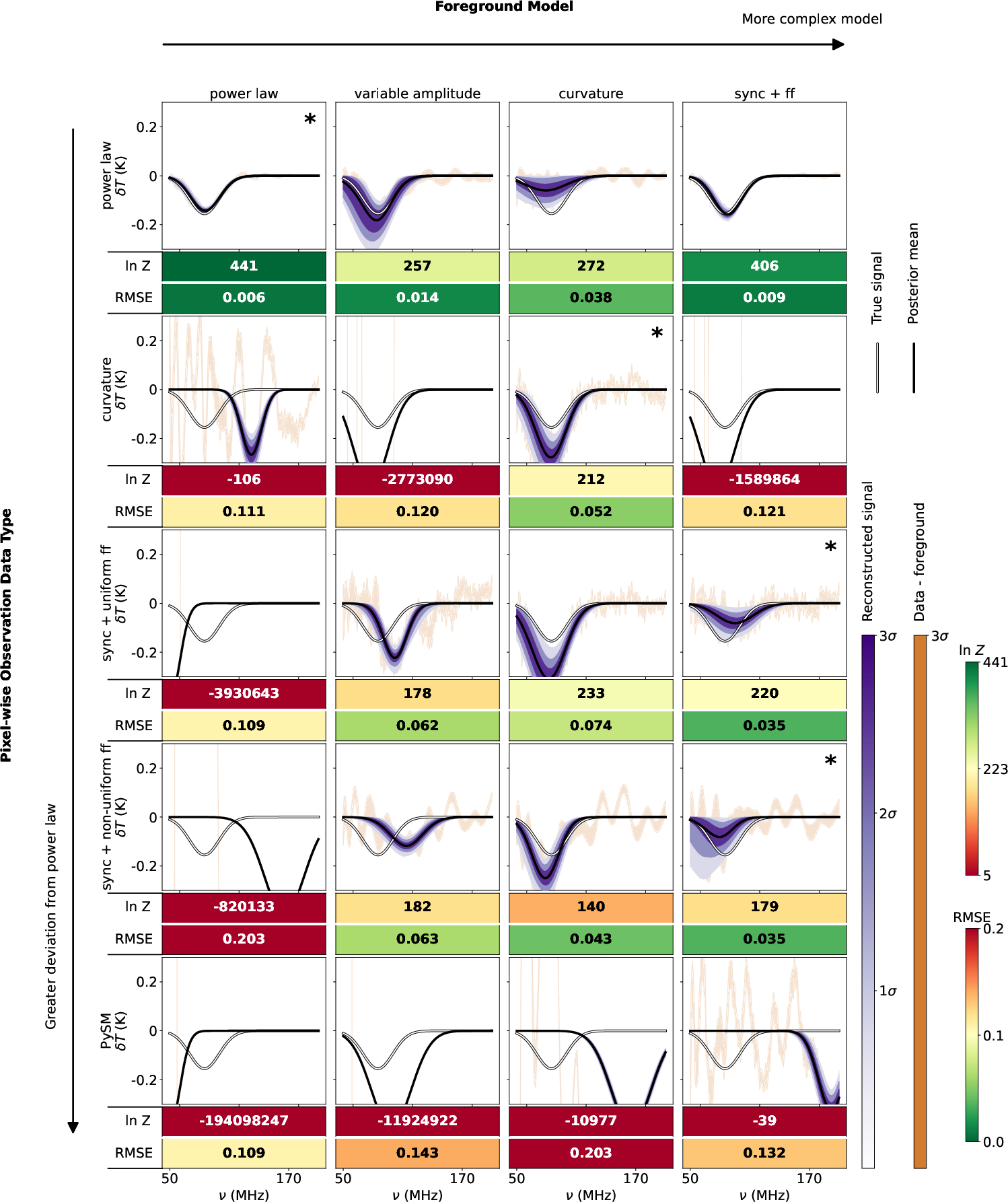
Figure 6: Model-dependent 21cm signal recovery on pixel-wise data, showing credible intervals and RMSE/evidence (columns: models; rows: data types).
Complex data require adoption of higher-order models: variable amplitude, curved, and sync + ff models can successfully extract the input signal when the model matches the true sky, albeit with increased uncertainty due to parameter degeneracy. The sync + ff model cannot compensate for spectral curvature, resulting in erroneous fits on curved power law data; similarly, all tested models critically fail to recover the 21cm signal from the PySM3 sky, highlighting current models' inability to absorb high-frequency spectral structure with limited regionalization.
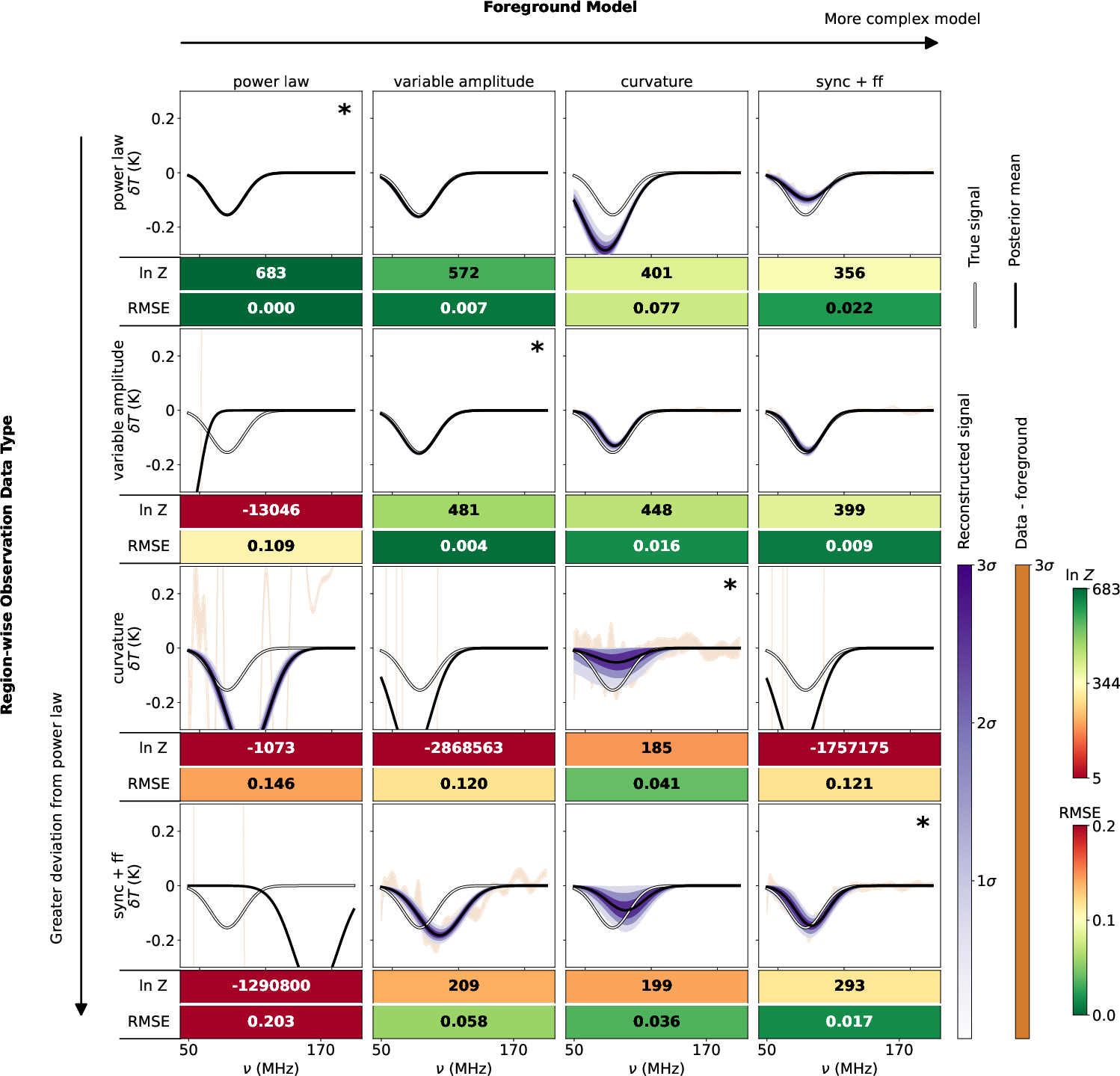
Figure 7: Model-dependent 21cm signal recovery on region-wise data; signal is best recovered when model and data parameterizations are matched.
Signal recovery in the region-wise regime is uniformly better across all models, due to the simplification of spatial variations; diagonal model-data matches ({\it e.g.}, curvature model on curved data) consistently deliver the highest evidence and lowest RMSE.
Foreground Parameter Estimation and Degeneracy
Parameter recovery (with direct comparison to ground truth) for region-wise data shows near-perfect correspondence for the power law model, but quickly degrades as parameterization complexity increases. Notably, in both the curvature and sync + ff models, strong degeneracies prevent accurate joint recovery of all physical parameters—particularly between spectral index and curvature, and between synchrotron and free-free amplitudes.
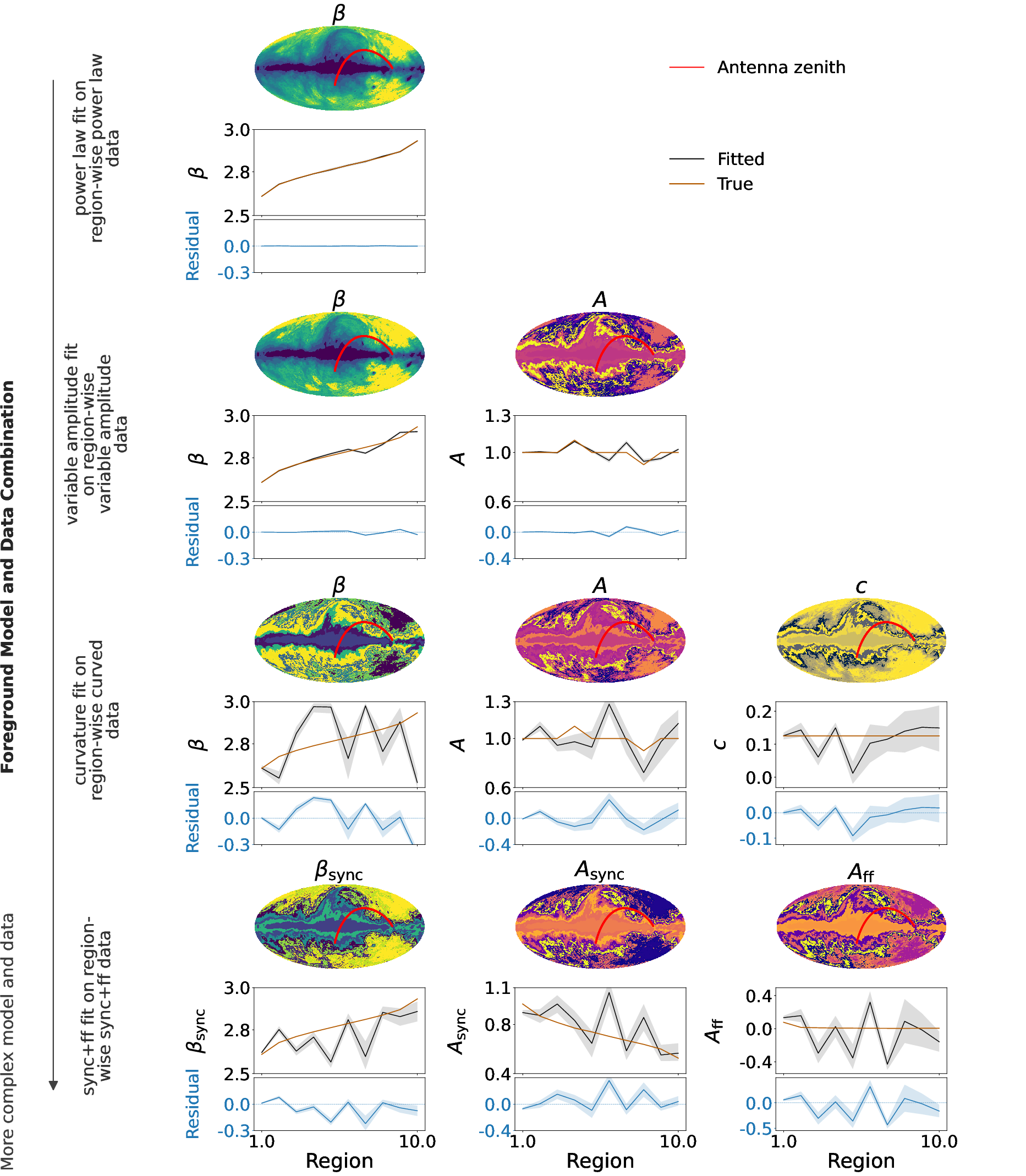
Figure 8: Fitted parameter maps, fitted vs true parameters, and residuals for the four matched model/data pairs; accuracy is highest for low-complexity models.
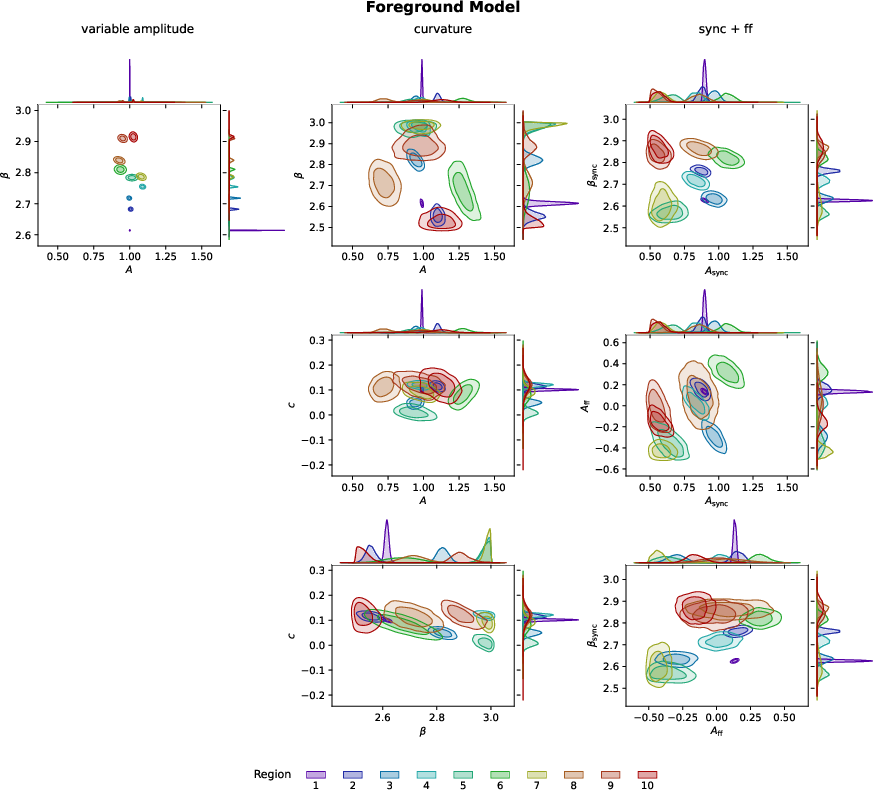
Figure 9: Posterior parameter degeneracies for multi-parameter models, with color coding showing results for all regions.
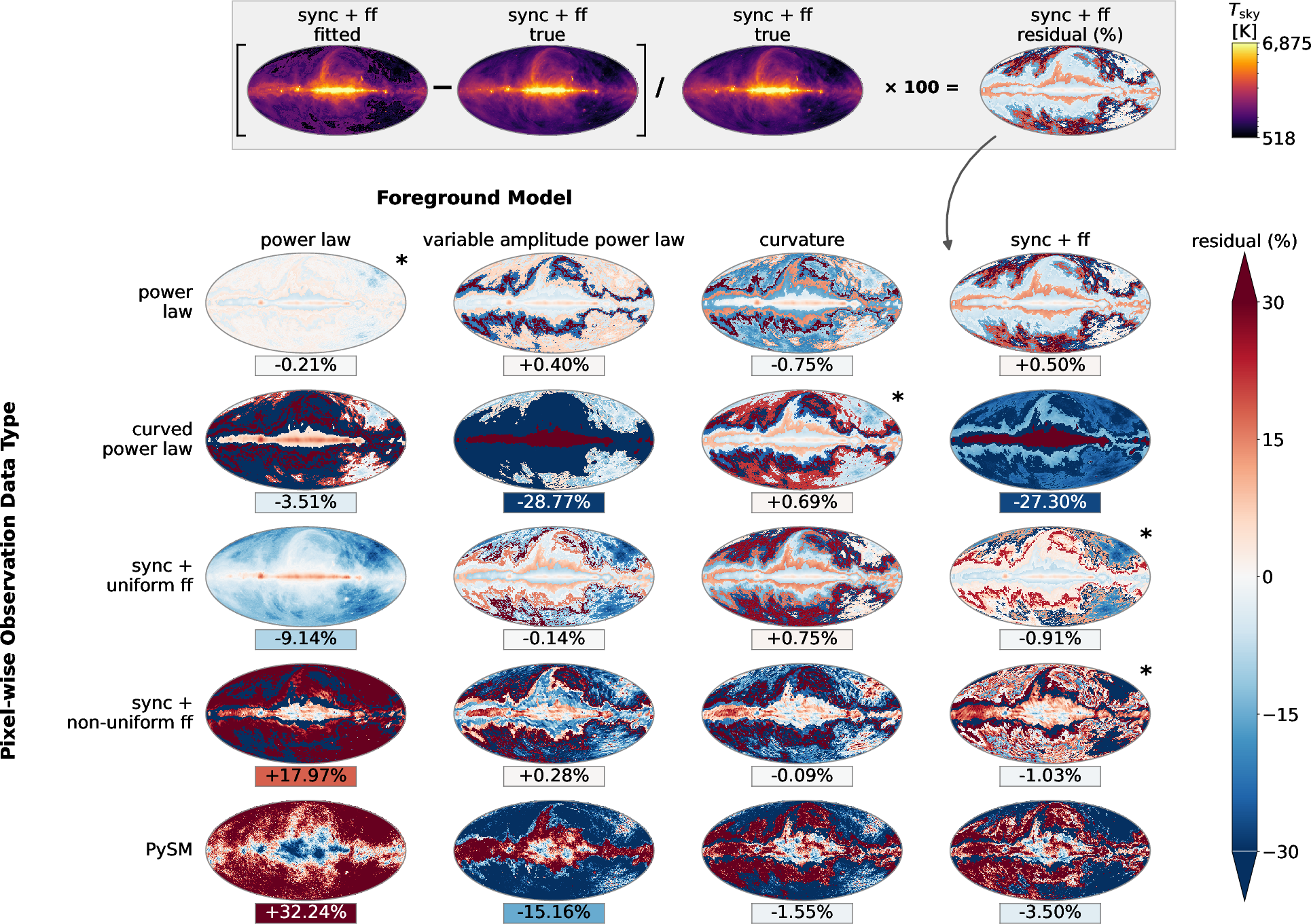
Figure 10: Sky reconstruction residuals at 100 MHz for fit-to-pixel-wise data, demonstrating combined model/data effects on recovery quality.
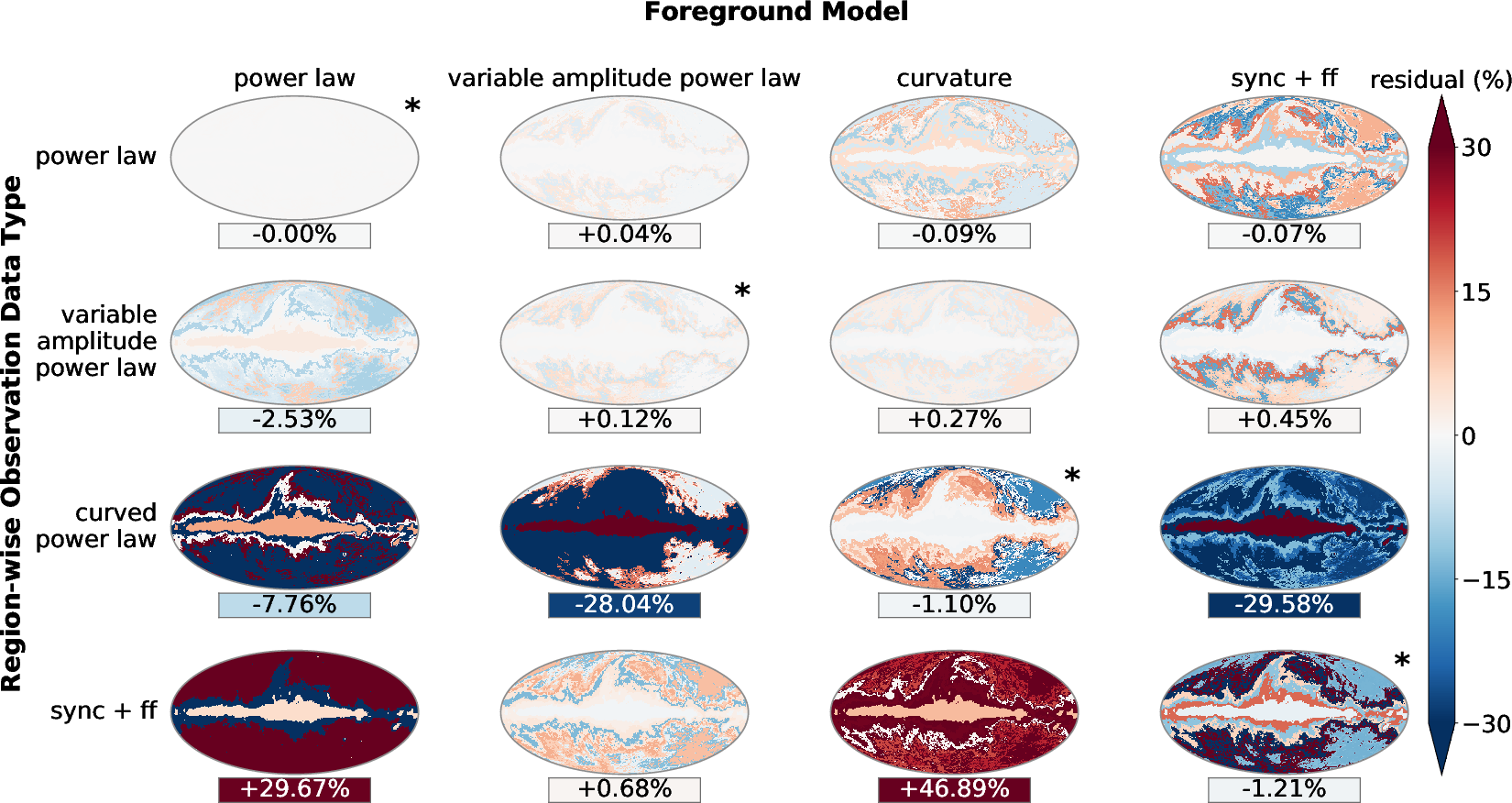
Figure 11: Sky reconstruction residuals at 100 MHz for fit-to-region-wise data, with matched combinations yielding smallest errors.
Component-Separated Mapping and Region-Splitting
The sync + ff model’s physically grounded parameterization enables component-separation of the diffuse sky into synchrotron- and free-free-dominated submaps. However, standard region splitting—optimized for total spectral index—introduces geometric mismatches (as the distribution of free-free emission is sharply concentrated near the Galactic plane), resulting in spurious attribution of structure to the free-free map (e.g., leakage of the North Polar Spur).
Evidence-weighted averaging across Nreg=102 values suppresses some region-boundary artifacts, but cannot fully solve the geometric mismatch.
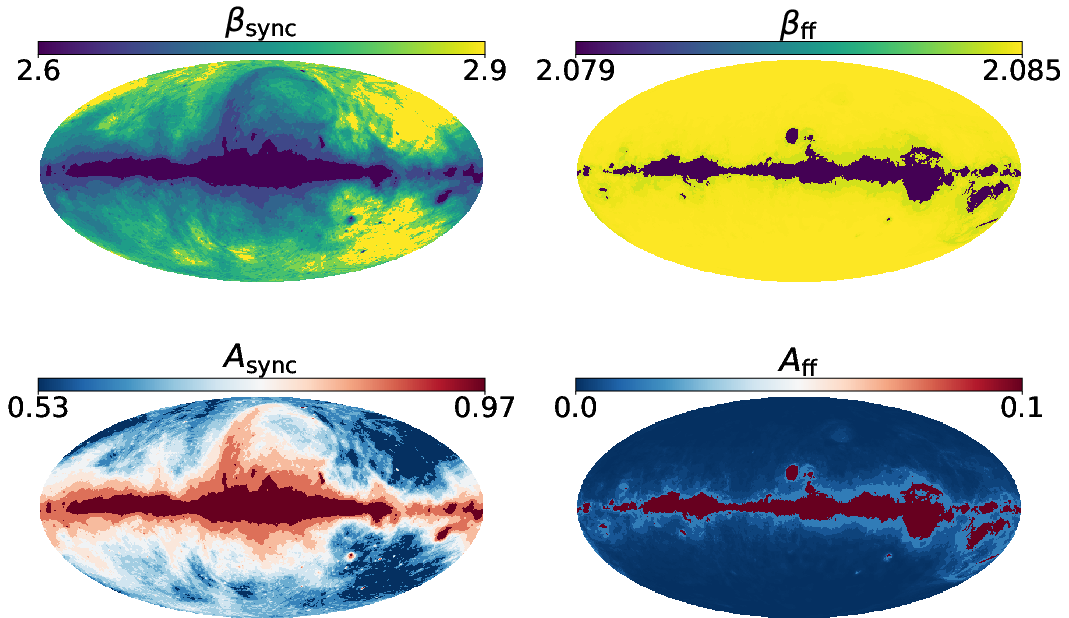
Figure 12: Input synchrotron and free-free parameter maps for the mixed-split dataset, with independent region splits for each component.
A mixed-splitting strategy—in which synchrotron and free-free are fit using independent region sets optimized for their underlying spatial distributions—substantially improves foreground RMSE and per-region parameter accuracy, as well as the recovered 21cm signal.
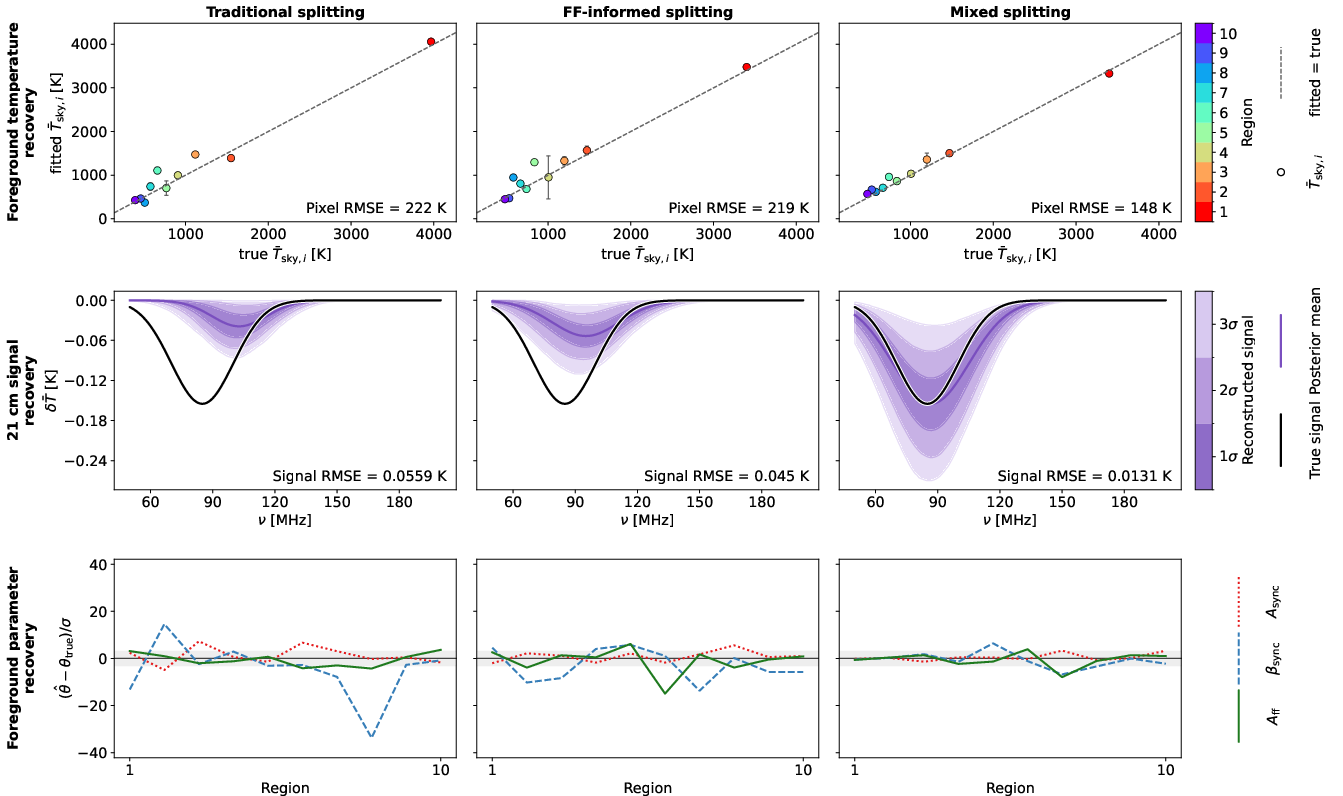
Figure 13: Recovery metrics for traditional, FF-informed, and mixed region splitting strategies, with mixed splitting yielding lowest RMSE and best parameter correspondence.
Implications and Theoretical Significance
The results demonstrate that model complexity must be precisely matched to the spectral richness of the actual foregrounds. While minimal models enable highly robust signal extraction in spectrally simple regimes, real data are likely to require higher-order parameterizations (sync + ff or curvature), at the unavoidable cost of introducing strong foreground parameter degeneracies. This challenge is compounded in the presence of unmodeled spectral richness (as in PySM3), which fundamentally limits current region-limited frameworks’ capacity for unbiased foreground subtraction, unless more aggressive regionalization or external priors are used.
For Galactic science, the successful recovery of spatially varying synchrotron parameters across the sky at 50–170 MHz frequencies provides a valuable cross-calibrated map product not accessible to higher-frequency surveys. However, recovery of free-free emission is fundamentally limited by both its low signal-to-noise and the geometric limitations of region-based models. Mixed-splitting approaches provide a practical path to mitigate these issues.
The degeneracy structure quantified here matches analytic expectations: parameter posteriors are highly elongated (evidenced by high correlation coefficients between key parameter pairs), and broader in regions with low sky brightness. Bayesian evidence supports the use of moderate Nreg=103 (around 10) as a compromise between spatial flexibility and parameter identifiability.
Outlook and Future Developments
The future development of global 21cm cosmology foreground frameworks will require integration of complementary datasets, informative physical priors, and—potentially—adaptive or hierarchical region definition that captures higher-order variation with a manageable parameter set. Advancements in computational strategies (e.g., GPU-accelerated nested sampling) [tutt2026optimising] will facilitate higher Nreg=104 exploration and more sophisticated, physically interpretable parameterizations.
Improvements in the fidelity and calibration of anchor sky maps (e.g., Bayesian GSM approaches [carter2025bayesian], new absolute measurement campaigns [McKay2026]) will directly feed into improved absolute calibration and parameter confidence.
Finally, this work demonstrates the dual utility of global 21cm experiments: even in the absence of a detected cosmological 21cm signal, precision mapping of foreground components at these frequencies is valuable both for cosmology and for Galactic astrophysics.
Conclusion
"Synchrotron and free-free mapping with simulated REACH observations between 50–170 MHz" (2607.00299) provides a technically rigorous and comprehensive benchmark of region-based, physically motivated foreground modelling in the context of global 21cm experiments. The primary conclusions are:
- Power law models are only sufficient when the true sky is spectrally elementary; evidence and RMSE strongly support matching model to data complexity.
- Degeneracies fundamentally limit the identifiability of foreground parameters as model complexity increases, most acutely for curvature and component-separated models.
- Mixed and component-specific region partitioning strategies extend the fidelity and interpretability of foreground maps, especially for free-free recovery near the Galactic plane.
- PySM3-level complexity in real sky data would necessitate adaptive strategies with massive increases in regionalization and/or strongly informative external constraints.
These findings provide both a roadmap and a set of cautions for ongoing and future analysis of REACH and comparable datasets, with significance for both cosmological parameter estimation and the construction of the lowest-frequency, absolutely calibrated Galactic emission maps to date.