- The paper introduces a finite-thickness tube model that replaces singular worldlines with a smooth stress-energy tensor, resolving issues in GR coupling.
- It employs a geometric construction and singular foliation technique to derive a brane-like action that recovers effective worldline behavior in the UV limit.
- The study analyzes energy conditions and perturbative stability, offering insights into regular black holes, self-force dynamics, and cosmological applications.
Gravitating Tubes as Codimension-Zero Matter Models in General Relativity
Motivation and Background
The classical conception of elementary matter as idealized point particles, represented by one-dimensional worldlines, is fundamentally incompatible with the nonlinear structure of Einstein gravity. The essence of the problem lies in the distributional character of the point-particle stress-energy tensor, which is singularly supported on a worldline. The seminal work by Geroch and Traschen formalized this obstruction: in generic situations, Einstein’s equations coupled to sources of codimension ≥ 2 (e.g., point particles and strings in four dimensions) fail to admit sufficiently regular (weak) metric solutions, making the coupling of smoothly concentrated matter and gravity inconsistent (2607.00036). The junction condition approach of Israel provides a well-posed framework for codimension-one sources—thin shells or branes—but fails to permit further localization beyond this.
Proposals to regularize these pathologies include the extended-body formalism of Dixon, where matter is described by a smooth stress-energy tensor inside a finite worldtube, with the multipole expansion capturing internal structure and self-force. However, such approaches typically retain sharp localization in the UV limit and often consider the background as fixed rather than dynamically coupled.
This paper develops a rigorous alternative paradigm: codimension-zero gravitating tubes as the primary model for material sources in general relativity. By geometrically thickening the worldline into a finite tube endowed with an internal foliation, the authors construct a class of matter models with a regular (non-distributional) stress-energy tensor, thereby resolving the Geroch–Traschen obstruction at both the geometric and dynamical levels.
Geometric Construction of Tubes and Foliations
The construction begins from first principles in differential geometry. Given a timelike auxiliary trajectory γ(τ), a tubular neighbourhood is defined via the exponential map along all orthogonal spacelike directions; the normal space at each point on γ is positive-definite, ensuring a well-posed tubular geometry.
The finite tube is equipped internally with a codimension-one foliation {ΣΦ}, parametrized by the level sets of a smooth scalar field Φ(x) playing the role of a radial transverse coordinate (Figure 1).
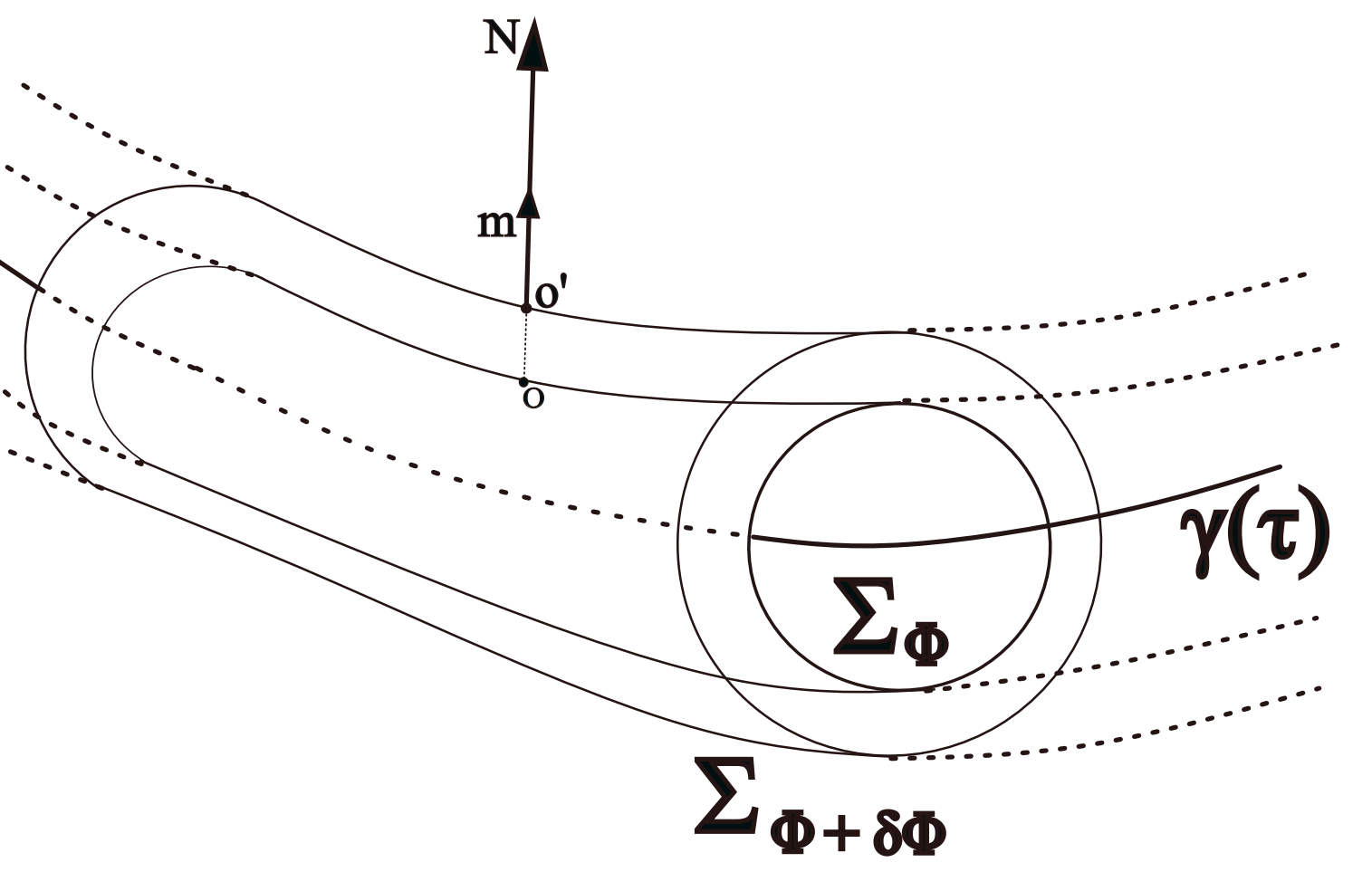
Figure 1: Tubular foliation constructed by level sets of the scalar field Φ in the neighbourhood of a timelike curve γ(τ). The central core, corresponding to the auxiliary curve, is a Morse–Bott critical set where the foliation becomes singular.
However, in contrast to conventional foliations, the structure degenerates at the tube’s core: the foliation scalar Φ vanishes and ∇Φ=0 along the central curve, marking a Morse–Bott type singularity. This requires a singular foliation framework, with γ identified as a non-degenerate critical submanifold of Φ (see Figure 2).
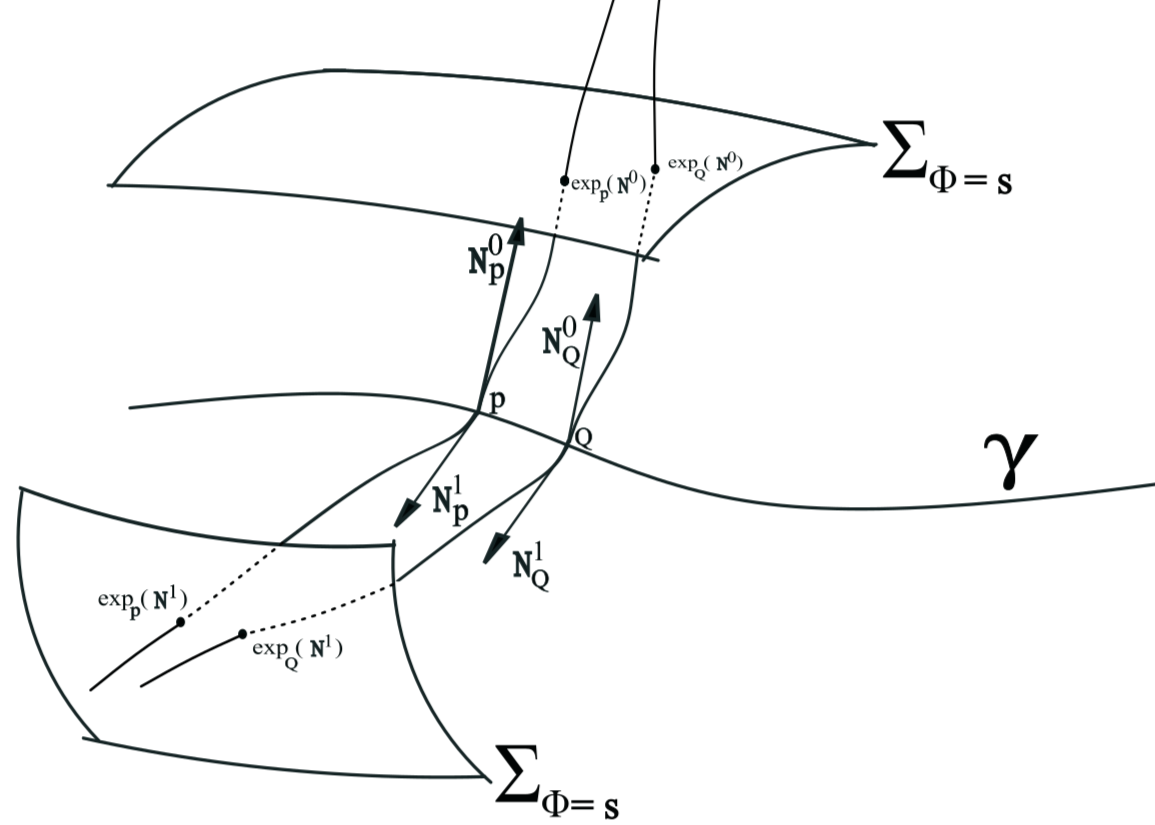
Figure 2: Normal flow from γ0 along the transverse spacelike basis, intersecting the leaves γ1.
This singular foliation approach ensures that the central core is consistently incorporated into the geometry, while maintaining regularity and coordinate invariance elsewhere in the tube.
Brane-Like Action and Soft Emergence of the Worldline Limit
Each leaf γ2 of the foliation is assigned a brane-type area action functional. The full tube action is constructed by integrating these over the transverse direction. A Polyakov-like auxiliary variable formalism is adopted to circumvent degeneracies where γ3, resulting in a regularized Lagrangian:
γ4
where γ5 (tension) and γ6 (potential) are profile functions controlling the material and geometric properties of the tube.
The key result is that, in the ultraviolet limit (transverse radius γ7), after integrating out the transverse and angular directions, the tube action reduces to a worldline action with a well-defined effective mass:
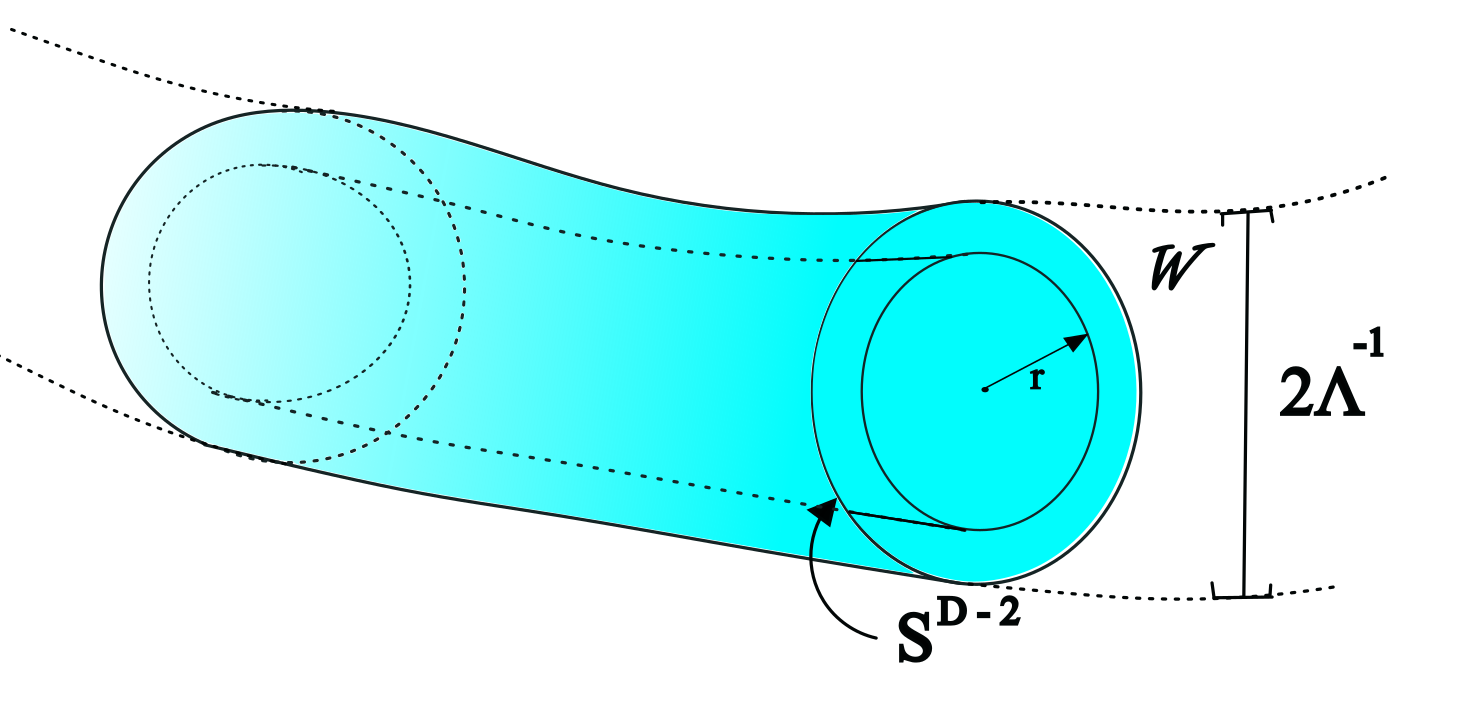
Figure 3: The tube’s geometry and foliation structure in coordinates adapted to the core and the transverse angular variables.
γ8
where γ9 is computed from the integrated tension/potential profiles, and {ΣΦ}0 encapsulates additional geometric self-force-like terms sourced by non-constant induced metric components on the leaves. This demonstrates the emergent character of worldline mass; it arises from internal tube geometry rather than as a bare parameter.
Regular Stress-Energy and Energy Condition Analysis
The tube construction yields a smooth, well-behaved stress-energy tensor for all points in the tube, including at the core where the foliation is singular. This stands in marked contrast to the singular, distributional worldline source in standard particle models.
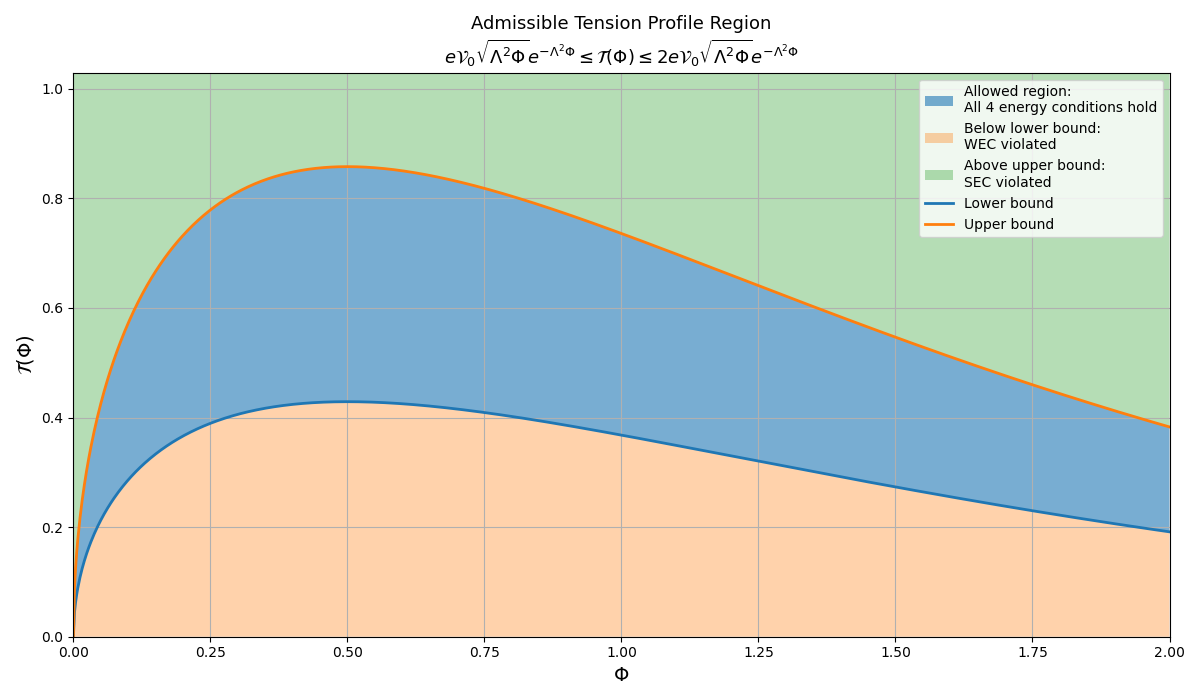
Energy condition analysis reveals distinctive features:
The geometric violation of the SEC in these tube models suggests mechanisms for non-singular interiors and potentially regular black hole structure, as well as connections to cosmological core phenomenology.
Dynamical and Perturbative Stability
The field equations for the foliation-generating scalar field yield that each leaf is a constant-mean-curvature hypersurface, with the mean curvature determined by the local balance of tension and the derivative of the potential.
Analysis of linearized perturbations proceeds along two fronts:
Theoretical and Practical Implications
Regularization of Singular Sources
This geometric paradigm for matter resolves longstanding pathologies in GR by forbidding delta-function sources in favor of smooth, regular tubes, consistent with the Geroch–Traschen obstruction. The analysis shows that worldlines, and the associated notion of point-particle mass, are effective rather than fundamental—products of UV limits within a fully regularized theory.
Application to Black Hole Interiors and Self-Force
The in-built SEC violation and regularization at the core motivate applications to regular black hole interior models, particularly in light of the attractor de Sitter/AdS core behavior, echoing regular black hole proposals (e.g., Bardeen, Hayward). Moreover, the emergent self-force term {ΣΦ}2 represents a geometric counterpart to the perturbatively computed self-force encountered in the extended body formalism and radiation reaction problems. This approach thus provides a non-perturbative, geometric origin for core self-forces.
Extensions and Future Directions
- Cosmological Fluid Models: Ensembles or distributions of tubes may serve as the basis for novel cosmological fluids, effective dark energy, or structure formation scenarios.
- Quantum Generalization: The geometric regularity and fundamental role of the tube suggest tractable quantization schemes, potentially avoiding obstacles present in point-particle quantization in curved spacetime.
- Field-Theoretic Generalizations: The Morse–Bott foliation structure and associated critical sets may be useful in the construction of scalar–tensor modifications of gravity, emergent brane-world scenarios, or effective field theories allowing for inherent codimension-zero regularization.
Conclusion
This work establishes a technically complete framework for gravitating matter sources in general relativity based on finite-thickness, codimension-zero tubes with controlled singular foliation at the core. The classical worldline paradigm—and with it, ill-defined distributional stress-energy—is demoted to an effective, non-fundamental status. The geometric, regular tube model provides a robust foundation for investigating self-force, regular black holes, and cosmological models where regularization and the avoidance of singularities are essential. The core mathematical and physical ideas—Morse–Bott singular foliations, brane-like tube actions, and emergent mass/self-force—may have wide-reaching theoretical implications for gravitational physics and are primed for future developments in both classical and quantum contexts.