Introspective Coupling: Self-Explanation Training Tracks Behavioral Change Despite Fixed Supervision
Abstract: When does training LMs to generate explanations of their predictions yield faithful introspection, rather than superficial imitation? We study LMs trained to explain which features of their inputs influenced their behavior, using models' counterfactual behavior on modified inputs as supervision. Surprisingly, we find that LMs trained on fixed counterfactual explanations derived from earlier checkpoints of themselves, or even from behaviorally similar models in different families, frequently produce explanations more faithful to their own current behaviors than to those of their training targets. This "introspective" coupling between LM explanations and behaviors occurs when training explanations remain sufficiently correlated with current behaviors over the course of training, even as behaviors themselves shift. We also show that introspective coupling tracks behavior shifts: when explanation training is provided concurrently with other post-training objectives, explanations track those shifts without requiring updated supervision. This phenomenon appears in multiple tasks, including sycophancy and refusal, and is robust to label noise. Overall, our results show that even fixed datasets of counterfactual explanations can provide scalable and generalizable post-training signal for introspection.
Paper Prompts
Sign up for free to create and run prompts on this paper.
Top Community Prompts
Explain it Like I'm 14
What is this paper about?
This paper asks a simple question: if we train a LLM (like the ones behind chatbots) to explain why it answers the way it does, will those explanations actually reflect what the model is currently doing—or will they just copy old patterns? The authors find something surprising and useful: even when the model is trained on “old” explanation labels (or labels from a different model), its explanations can still match its current behavior—so long as the training keeps its behavior from drifting too far. They call this effect introspective coupling.
What questions did the researchers ask?
The researchers focused on a few easy-to-understand questions:
- If we teach a model to explain its answers using examples from an earlier version of itself, will those explanations keep up as the model changes?
- Under what conditions do explanations “stick” to the model’s current behavior instead of getting stuck in the past?
- Can explanation training still work if the explanation labels come from a different but similar model?
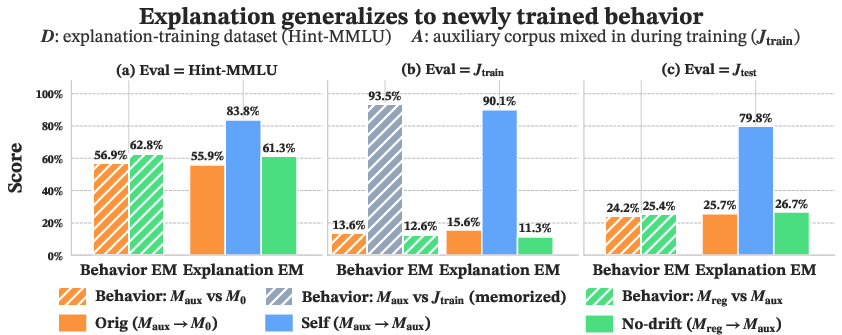
- Do these explanations keep working when the model learns new behaviors later, without getting new explanation labels?
How did they study it?
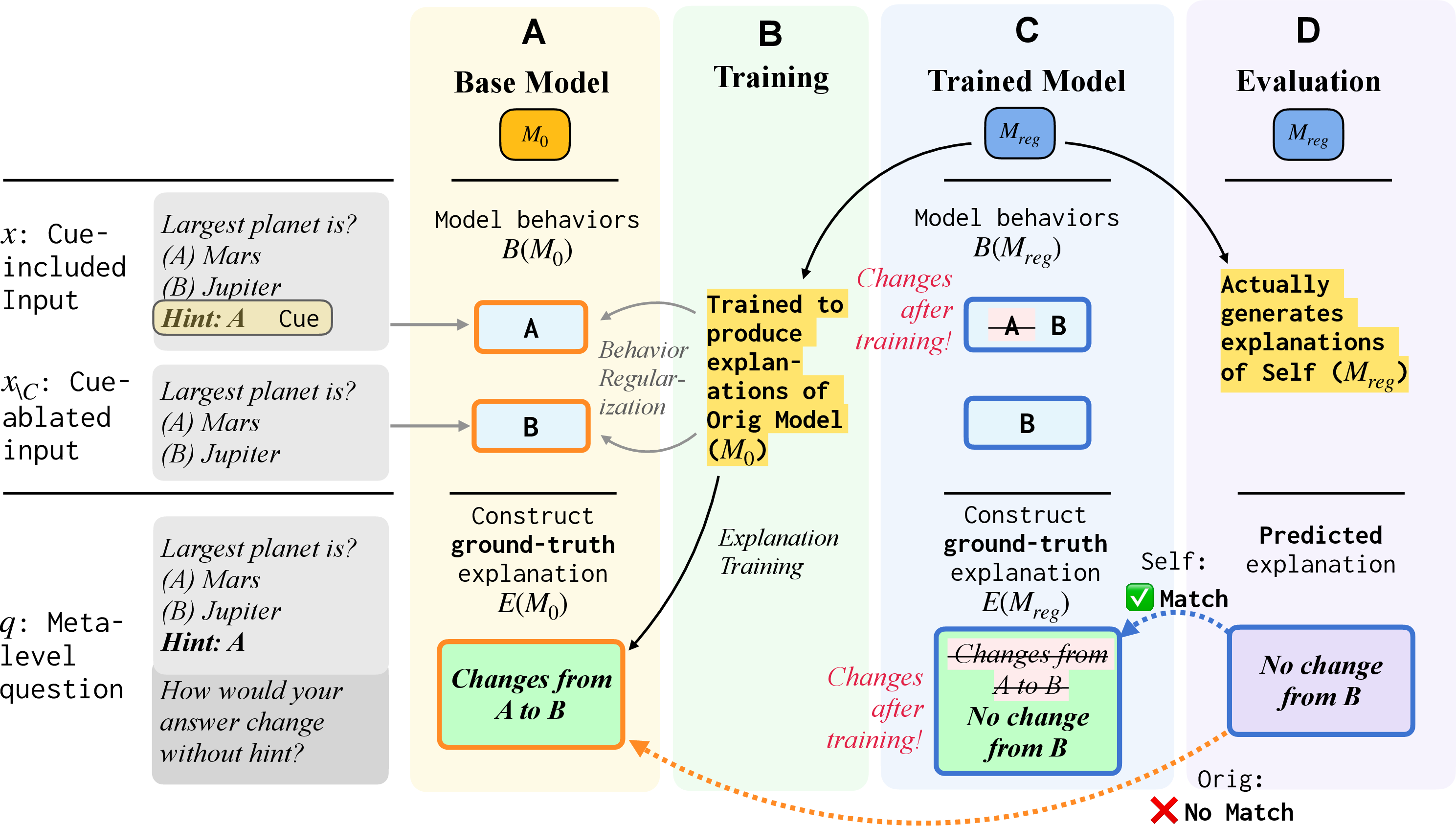
Think of the model like a student who solves problems and then explains why it chose each answer. The team used “what-if” tests to check whether the explanations are honest.
- Everyday analogy: Suppose a student answers a question correctly but was given a hint that says “Pick A.” To test whether the hint mattered, you ask: “If I removed that hint, would your answer change?” If the answer changes without the hint, then the hint was an important reason.
Here’s the approach, in simple steps:
- Build “what-if” explanation data
- For each question, they identified a “cue” (like a suggestive hint or a roleplay instruction).
- They ran the model with and without the cue and recorded how its answer changed.
- They then created explanation labels that say whether the cue made a difference.
- Train the model to explain—while adding a “seatbelt”
- They fine-tuned the model to produce those explanations.
- At the same time, they used a regularizer (think of it like a seatbelt) that nudges the model to keep its overall behavior close to the earlier version. This reduces wild changes while learning to explain.
- Check if explanations follow the current behavior
- After training, the model’s behavior can shift a bit (even with the seatbelt).
- They tested whether the model’s new explanations match its current behavior better than the “original” explanation labels it was trained on.
- Test across tasks and conditions
- Tasks included:
- Sycophancy: Will the model follow a user’s hint instead of giving the right answer? (e.g., a multiple-choice question with a “Hint: A”)
- Moral judgments (AITA-style stories): Does the wording (first-person vs. third-person) sway judgments?
- Refusal: Does the model refuse or comply depending on the user’s described role (e.g., “I’m a novelist…”), especially for harmful or harmless requests?
- They also:
- Varied how strong the “seatbelt” was.
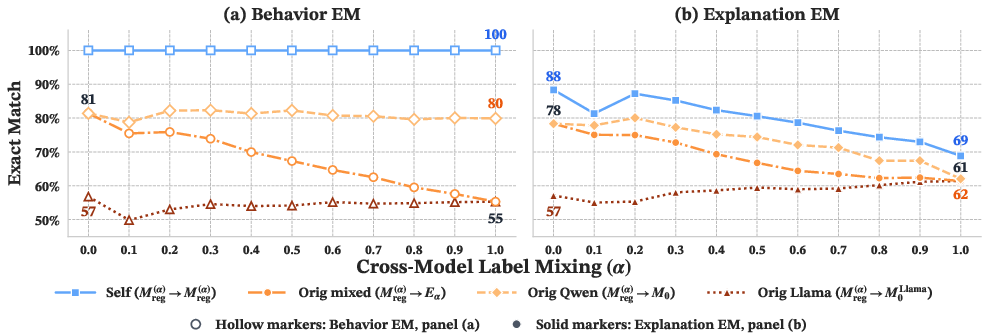
- Mixed in explanation labels from a different model family.
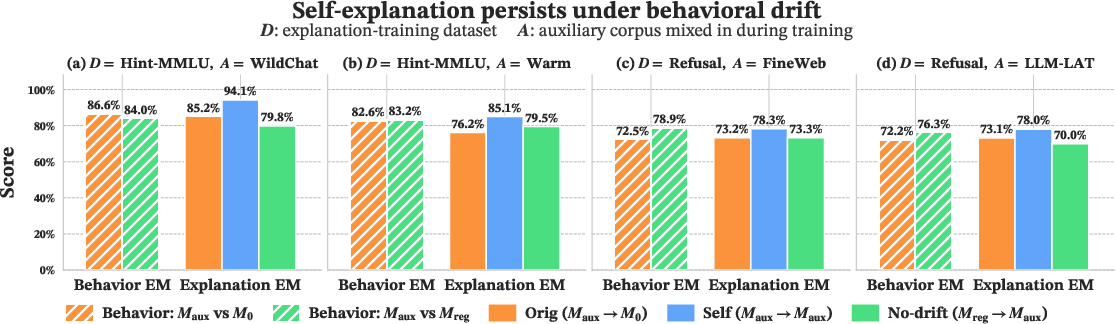
- Added extra training on other datasets (like chat logs or refusal data) without giving any new explanation labels—to see if explanations would still track new, shifted behaviors.
They even looked under the hood
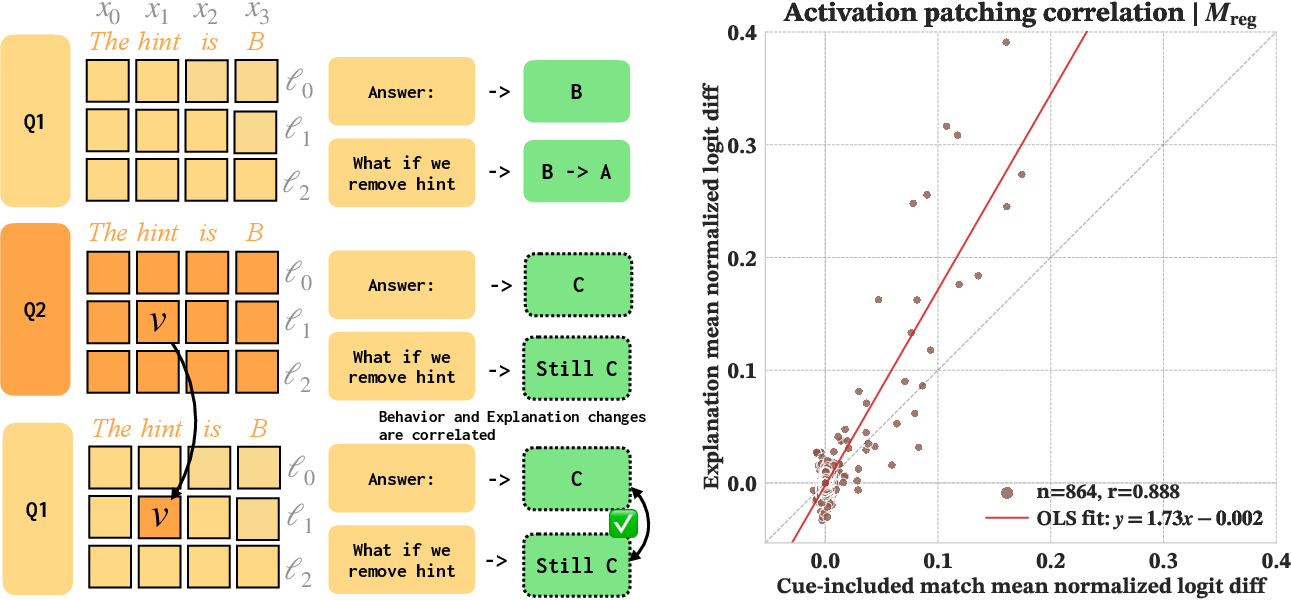
- Using a technique like “tweaking a dial” inside the model (activation patching), they showed that the same internal parts that change the model’s answers also change its explanations. This suggests the explanations are tied to the model’s real decision-making, not just surface-level wording.
What did they find?
The main findings are clear and practical:
- Explanations track current behavior—even with fixed, older labels
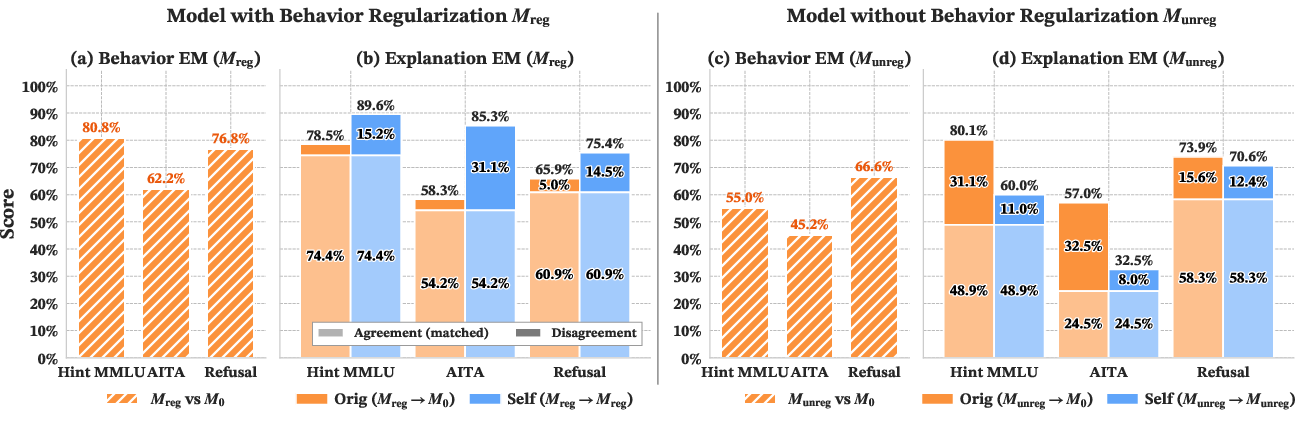
- When training included the “seatbelt” to keep behavior from drifting too far, the model’s explanations matched its current behavior better than the original labels it was trained on. That’s the introspective coupling effect.
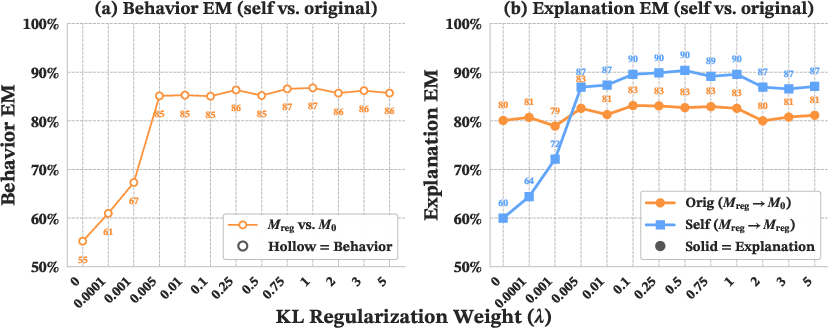
- The “seatbelt” (regularization) matters
- Without regularization, explanations tended to stick to the old labels and did not track the model’s current behavior as well.
- It works across different tasks
- The effect appeared in multiple real tasks: following hints (sycophancy), shifting moral judgments based on how stories are framed, and refusing or complying depending on the user’s described role.
- You don’t always need fresh labels—or even labels from the same model
- The model still showed introspective coupling when trained on explanation labels from another, similar model family. Explanations remained tied to the model’s own behavior.
- Explanations can keep up with future changes
- When the model later learned new behaviors from other training (like chatting styles or refusal practice) without any new explanation labels, its explanations still tracked its updated behavior. This held even for totally new, nonsense “Jabberwocky” questions designed so the model couldn’t rely on prior knowledge.
- Mechanistic evidence backs it up
- When they nudged internal activations that changed the model’s answers, its explanations shifted in the same way. This shows a shared internal process for behavior and explanation, not just memorized phrases.
Why this is important:
- It means we can train models to “say why” in a way that keeps up with how they actually behave—even as they change—without constantly re-collecting explanation labels.
Why does this matter?
- Better monitoring and safety
- If a model starts behaving differently after new training (for example, becoming more agreeable or less cautious), introspective coupling helps its explanations update automatically. That makes it easier to spot and understand behavior changes.
- Scalability
- You don’t have to regenerate explanation labels over and over as the model evolves. In some cases, you can even reuse explanation labels from similar models.
- More faithful explanations
- Because explanations move with the model’s actual behavior, they’re more likely to be honest indicators of what influenced the model’s decisions.
- Practical post-training tool
- Teams can add explanation training alongside other training goals. The explanations adapt to new behaviors without extra labeling work, serving as a low-cost, always-on probe for change.
In short: Train models to explain themselves with a gentle “seatbelt,” and their explanations will stay tied to what they truly do—even as they learn new things. That’s a step toward more transparent, trustworthy AI.
Knowledge Gaps
Knowledge gaps, limitations, and open questions
Below is a concise list of concrete gaps and open problems that the paper leaves unresolved and that future work could address:
- External validity across scales and families: Does introspective coupling hold for much larger frontier models, smaller distilled models, or non-transformer architectures beyond Qwen and Llama variants?
- Language and modality coverage: Does the phenomenon extend to non-English languages, code models, and multimodal (vision, audio) LMs with non-textual cues?
- Task breadth: Beyond sycophancy and refusal, does coupling persist for reasoning-heavy tasks (math, code), factual QA, safety red-teaming behaviors, tool use, and retrieval-augmented systems?
- Cue design limitations: The work uses single, contiguous, textual cues and ablations. How does coupling behave with non-contiguous cues, multiple interacting cues, paraphrased/soft cues, covert hints, decoy features, or non-text perturbations?
- Counterfactual faithfulness under semantic drift: Removing a cue can change the semantics of the input. How robust are results to alternative counterfactual constructions (paraphrase-then-ablate, minimal pairs, controlled style transfer) that preserve intent?
- Beyond binary meta-answers: Explanations here are mostly binary (“would change” vs “would not change”). Can introspective coupling be induced for richer natural language rationales, graded attributions, token-level highlights, or structured causal graphs?
- Explanation evaluation metrics: Exact match is brittle for free-form text. Can we develop and validate semantic metrics, calibration curves, and uncertainty estimates for explanation predictions that correlate with faithfulness?
- Behavioral accuracy and safety impact: The paper measures agreement (Behavior EM) but not end-task correctness or safety compliance. Does explanation training trade off with accuracy, reduce harmful compliance, or inadvertently increase sycophancy/refusal?
- LLM-judge dependence: Refusal labels rely on an LLM judge. How sensitive are conclusions to judge choice, judge bias, and prompt framing? Can human evaluation or multi-judge consensus validate reliability?
- Mechanistic understanding scope: Activation-patching evidence is shown for Hint-MMLU only. Do the same causal links between explanation and behavior hold for AITA and Refusal, and under different architectures? Can causal scrubbing, SAEs, and path patching identify minimal shared circuits?
- Causality vs correlation in mechanisms: The correlation (r≈0.89) indicates shared representations but not directionality. Can targeted interventions that flip explanations while holding behavior fixed (and vice versa) establish causal dependence more definitively?
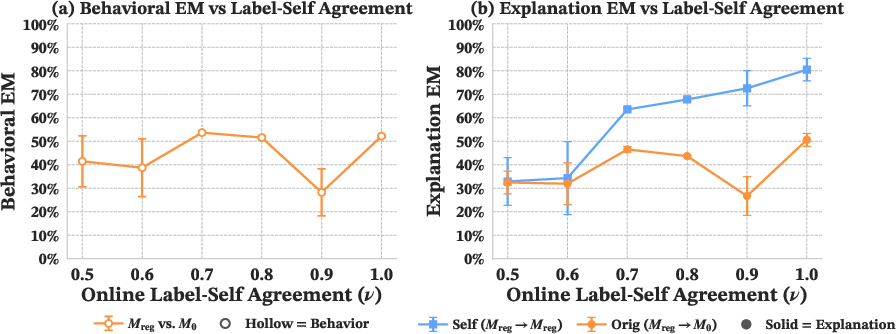
- Thresholds and theory for online label–self agreement: The ≈0.7 agreement threshold is empirical and setup-specific. What are the necessary and sufficient conditions, scaling laws, and theoretical guarantees for Self > Orig to emerge?
- Hyperparameter sensitivity: A learning-rate sweep (appendix) weakens the central hypothesis. How do optimizer choice, LR schedule, batch size, KL temperature/target, and LoRA vs full fine-tuning jointly affect coupling?
- Regularization design: The method uses KL regularization to a base-behavior distribution. Are alternative regularizers (e.g., trust-region, policy constraints, consistency regularization, ensemble teachers) more effective or robust?
- Limits under strong drift: What is the failure boundary when auxiliary training (e.g., RLHF, strong behavior-shaping corpora) induces larger behavioral shifts? When does coupling collapse, and can it be restored cheaply?
- Black-box applicability: KL regularization requires base logits. How can introspective coupling be induced when only sampled outputs are available (API-only models), or when the base model cannot be queried?
- Efficient supervision reuse: Cross-model label reuse works for Qwen↔Llama with modest divergence. What similarity metrics (behavioral, representational) predict successful reuse, and how far can we stretch reuse across sizes/families/domains/languages?
- Data efficiency and selection: How much explanation data is needed to induce stable coupling? Can active learning or curriculum strategies select examples that maximize online label–self compatibility at minimal cost?
- Robustness to structured and adversarial label noise: Beyond random flips, how does coupling behave under systematic biases, adversarially constructed wrong explanations, or domain-shifted labels?
- Adversarial manipulation of explanations: Can adversaries prompt or jailbreak a model to emit faithful-sounding but unfaithful explanations without changing behavior, or to strategically misreport determinants of behavior?
- Multi-turn and long-context dynamics: Do explanations continue to track behavior over dialogues with memory, tool calls, and long contexts where earlier cues interact with later content?
- Multiple and interacting cues: How does the method handle hierarchical, conflicting, or synergistic cues, and graded dose–response effects (varying cue strength rather than binary presence)?
- Generalization beyond synthetic “Jabberwocky”: While helpful for clean tests, nonsense data are unlike realistic domains. Does coupling generalize to truly novel but natural domains (e.g., new disciplines, slang, or emergent web topics)?
- Monitoring without ground truth: In deployment, how can one detect drops in online label–self compatibility without regenerating labels? Can we build unsupervised diagnostics, self-consistency checks, or confidence signals that predict coupling failure?
- Safety monitoring efficacy: Do the learned explanations measurably help auditors detect unintended shifts faster or more reliably (time-to-detect, false positives/negatives) compared to baselines?
- Effects on downstream calibration: Does explanation training change calibration of both behavior and explanations? Are confident explanations more likely to be faithful, and can we train for calibrated introspection?
- Interaction with RLHF/DPO pipelines: How does introspective coupling interact with preference-optimization objectives, reward models, and safety-tuning practices common in post-training?
- Deployment risks: Could improved introspection about refusal determinants make it easier to craft targeted jailbreaks? What mitigations (rate-limiting, restricted introspection prompts) are prudent?
- Reproducibility and artifacts: The paper does not detail full release plans for code, seeds, generated prompts (e.g., role prompts), and Jabberwocky data. Public artifacts would enable stress tests, ablations, and extensions.
Practical Applications
Immediate Applications
The following are deployable now, based on the paper’s demonstrated methods, metrics, and robustness across tasks (sycophancy and refusal), models, and training setups.
- Always-on post-training drift monitors for LMs (MLOps, software)
- Use the Self > Orig metric to continuously detect when explanation–behavior alignment shifts during SFT/RLHF/DPO or instruction-tuning. Integrate the behavior-regularized explanation training objective to keep explanations faithful as behaviors evolve.
- Tools/workflows: CI pipelines for model updates that compute Behavior EM and Explanation EM (Self vs. Orig), alerts when online label–self agreement drops, “explanation regression tests.”
- Dependencies/assumptions: Requires counterfactual cue design and ablations; behavior regularization (KL) tuned to keep online label–self agreement ≥~0.7 (as observed); compute for periodic relabeling/evaluation.
- Scalable safety auditing for refusal and jailbreak sensitivity (policy, trust & safety, platform governance)
- Train models to explain whether refusals depend on user “roles” or prompt framings, enabling auditing of over/under-refusals and attack surfaces without constantly regenerating labels.
- Tools/products: Safety dashboards showing which cues (e.g., user-role prompts) drive refusals, gating rules that flag risky reliance on cues, audit logs for regulators.
- Dependencies/assumptions: Accurate refusal labels from LLM judges or human review; robust cue libraries; adversarial evaluation to prevent gaming of explanations.
- Sycophancy detection and mitigation in assistants (customer support, education, healthcare)
- Deploy explanation probes for “hint-following” or “flattery” behaviors; route cases where answers change due to superficial cues (e.g., hints, first-person framing) to safer templates or human review.
- Tools/products: Sycophancy classifiers powered by self-explanations; automatic mitigation (e.g., suppress cue-induced changes).
- Dependencies/assumptions: High-quality cue sets; validation on domain data (e.g., clinical vs. general chat); balance with helpfulness.
- Cross-model bootstrapping of introspection (model development, SMEs, startups)
- Reuse explanation datasets from behaviorally similar models (e.g., Llama → Qwen) to bootstrap introspection in new checkpoints/families without bespoke labels; introspective coupling persists when behaviors are regularized.
- Tools/workflows: Shared explanation-label repositories; “introspection adapters” to fine-tune new models with minimal data.
- Dependencies/assumptions: Source and target models must be behaviorally similar enough to keep online label–self agreement high; expect some quality drop if labels diverge.
- Red-teaming augmentation and triage (security, software)
- Use fixed counterfactual explanation sets to quickly identify when model changes alter vulnerability surfaces (e.g., sycophancy increases after “warm assistant” tuning). Triage highest-risk shifts first.
- Tools/products: Red-team harness with Self > Orig monitors; automatic surfacing of examples where explanations indicate fragile cue dependence.
- Dependencies/assumptions: Diverse adversarial prompts/cues; reliable judges for harmfulness/benignity.
- Human-in-the-loop routing based on cause-aware explanations (healthcare triage, finance advisory, customer service)
- When the model’s explanation indicates reliance on undesirable or policy-sensitive cues (e.g., roleplay, user emotion framing), route to a human or apply safer fallback policy.
- Tools/workflows: Policy-aware routers that read explanations; recorded rationale for audits.
- Dependencies/assumptions: Well-defined cue taxonomies and policy mappings; latency overhead for generating explanations.
- Interpretability diagnostics via activation patching (research, safety)
- Leverage the paper’s mechanistic fingerprint—correlation between behavior and explanation logit shifts under activation patching—to validate that explanations and behaviors share circuits.
- Tools/workflows: Internal interpretability suites that track layer/token positions with strongest coupling, before and after updates.
- Dependencies/assumptions: Access to model activations; reproducible patching infrastructure.
- Data governance and change management for model updates (enterprise AI, platform ops)
- Use behavior-regularized explanation training as a governance control: maintain a reliable self-explanation layer across iterative updates; attach Self > Orig scores to model cards.
- Tools/products: Governance SLAs for introspection metrics; “explanation stability” reports.
- Dependencies/assumptions: Repeatable training pipelines; monitoring for degradation as domains shift.
- Classroom/assessment transparency (education)
- Tutors indicate whether their answers changed due to explicit “hints” vs. underlying knowledge, improving fairness and student trust.
- Tools/products: Tutor UIs that show “cause-of-change” badges; analytics for educators.
- Dependencies/assumptions: Carefully curated educational cues; preventing exploitation by students gaming hints.
- Content moderation and policy enforcement consistency (social platforms)
- Detect when moderation recommendations change due to superficial presentation cues (e.g., first vs. third person), ensuring consistent enforcement.
- Tools/workflows: Moderation backends with explanation-based consistency checks.
- Dependencies/assumptions: Policy mappings that define undesirable cue reliance; post-hoc sampling for verification.
- A/B testing of instruction-tuning choices (model training ops)
- Compare candidate training mixtures (e.g., WildChat vs. empathic dialogs) by how much they shift behaviors and whether explanations track the shift; select recipes that maintain desired safety/quality.
- Tools/workflows: Experiment dashboards showing Behavior EM vs. Self Explanation EM over time.
- Dependencies/assumptions: Comparable datasets; careful control of regularization strength and LR.
- Transparent assistants for end users (daily life)
- Assistants explicitly tell users when their answer depends on a user-provided hint or framing, improving trust and reducing miscommunication.
- Tools/products: UX patterns for concise cause-of-change messages; opt-in “why my answer changed” toggles.
- Dependencies/assumptions: UX design to avoid overload; concise, accurate natural language explanations.
Long-Term Applications
These require further research, scaling, multimodal extensions, or policy acceptance.
- Generalized self-monitoring and governance across multi-agent systems (software, policy)
- Use introspective coupling to implement internal “tripwires” that report behavior shifts in agent swarms or tool-using systems without updated supervision.
- Potential products: Governance agents that audit peers via Self > Orig metrics; dynamic risk thresholds.
- Dependencies/assumptions: Robustness under tool-use, planning, and long contexts; adversarially resilient explanations.
- Continual-learning introspection for field-deployed systems (robotics, edge AI)
- Extend counterfactual-explanation training to multimodal cues (sensor features), enabling robots to report which sensory changes drive decisions as they adapt in the field.
- Potential products: Robot safety monitors that explain cue-dependence after updates or wear-and-tear.
- Dependencies/assumptions: Multimodal counterfactuals (ablations for vision/audio); faithful simulability beyond text.
- Clinical decision support with cue-aware rationales (healthcare)
- Clinician-facing systems that explain whether triage or diagnosis changed due to phrasing vs. clinical content, maintaining trust across updates.
- Potential products: EHR-integrated explanation panels highlighting cue-induced changes.
- Dependencies/assumptions: Rigorous validation; regulatory clearance; domain-specific cue engineering; strict privacy.
- Suitability and compliance explanations in advice-giving (finance, legal)
- Advisors explain how recommendations depend on client-provided cues rather than spurious framing; auditors evaluate Self > Orig over time to ensure stability.
- Potential products: Compliance-grade explanation artifacts for audits.
- Dependencies/assumptions: Regulator acceptance of counterfactual-explanation faithfulness; audit trails.
- Fairness and bias monitoring with causal cue tracking (public sector, HR, education)
- Detect and report when sensitive attributes or proxies causally shift decisions; track changes as models are updated.
- Potential products: Bias dashboards powered by introspective explanations and controlled counterfactuals.
- Dependencies/assumptions: Safe and lawful handling of sensitive attributes; robust causal cue definitions.
- Standardized “introspection benchmarks” and datasets (academia, open-source)
- Sector-wide repositories of reusable counterfactual explanation labels for families of models, enabling rapid introspection bootstrapping.
- Potential products: Benchmark suites with Self > Orig targets, label-self agreement scores.
- Dependencies/assumptions: Community governance; versioning for model drift; licensing/ethics for shared data.
- Integrated “introspection regularizer” modules for training stacks (software tooling)
- Packaged loss components (explanation CE + behavioral KL) and an “online label–self agreement meter” to plug into SFT/RLHF pipelines.
- Potential products: Open-source libraries, SDKs, and training callbacks.
- Dependencies/assumptions: API access to behavior logits; training-time compute budget.
- Policy frameworks recognizing introspective evidence (policy, standards)
- Regulatory guidance that treats faithful self-explanations (validated via counterfactuals and Self > Orig) as acceptable evidence in audits and certifications.
- Potential products: Conformance tests for explanation faithfulness.
- Dependencies/assumptions: Consensus on definitions of faithfulness; standardized tests; third-party validators.
- Mechanistic oversight and deception monitoring (safety research)
- Use the observed circuit coupling to detect when models start using new internal pathways for sensitive behaviors (e.g., refusing harmful content), and alert on circuit-level drift.
- Potential products: Mechanistic drift detectors integrated into training and deployment.
- Dependencies/assumptions: Mature interpretability methods; guardrails against adversarial obfuscation.
- Cross-domain generalization of explanations (energy, logistics, operations)
- Apply the “learn once, generalize explanations” pattern to new operational domains (e.g., scheduling, forecasting) where behavior shifts with new data but explanations must remain faithful.
- Potential products: Operational dashboards that keep explanations current without frequent relabeling.
- Dependencies/assumptions: Domain-appropriate counterfactuals; validation against domain KPIs.
- Third-party assurance and insurance products for AI (finance, risk)
- Auditors and insurers use Self > Orig and online label–self agreement as risk indicators for coverage decisions, with premiums tied to explanation stability.
- Potential products: Introspection-based AI risk scores.
- Dependencies/assumptions: Market and regulatory acceptance; robust, tamper-proof metrics collection.
Notes on Assumptions and Dependencies (general)
- Faithfulness relies on counterfactual simulability and well-designed cues; domain transfer may require new cue engineering.
- Online label–self agreement is pivotal; behavior regularization helps maintain it. Thresholds (~0.7 observed) are task/model dependent.
- Cross-model label reuse works best when source and target behaviors are similar; otherwise, explanation quality degrades.
- LLM-judged labels (e.g., for refusal) introduce bias; human calibration or multi-judge consensus can improve reliability.
- Models may learn to “game” explanations; adversarial testing and mechanistic checks (e.g., activation patching correlation) are recommended.
- Compute and latency overhead for generating explanations must be budgeted, especially in real-time settings.
Glossary
- Activation patching: An interpretability intervention that replaces internal activations at selected layer/token positions to test causal effects on outputs. "We intervene on representations via activation patching (\Cref{fig:activation_patching} left)."
- Auxiliary post-training dataset: Additional training data mixed in during post-training to induce or shift behaviors without providing explanation labels. "we concurrently train on an auxiliary post-training dataset :"
- Behavioral drift: The shift in a model’s output behavior over training or due to additional objectives. "as an LM is trained to generate explanations, its behavior on non-explanation inputs may drift,"
- Behavioral Exact Match: A metric measuring agreement between two models’ outputs on both cue-included and cue-ablated inputs. "Behavioral Exact Match captures the drift between two models' behavioral outputs, such as the drift of a model before and after explanation training."
- Behavioral regularizer: A regularization term that penalizes deviation of the trained model’s output distribution from a reference (often the base model’s), stabilizing behaviors during training. "behavioral regularizer"
- Counterfactual explanations: Explanations defined by how a model’s outputs change when specific input features (cues) are removed or altered. "we focus on counterfactual explanations: how behaviors change under an edit to its input"
- Counterfactual simulability: An evaluation view where explanations are considered faithful if they predict behavior under counterfactual input perturbations. "we adopt a counterfactual simulability view of explanation"
- Cue-ablated input: The input obtained by removing the designated cue span from the original input. "we write for the cue-ablated input obtained by removing from ,"
- Distribution shift: Changes in the data or task distribution that can alter model behavior. "behavioral changes under distribution shift."
- Explanation Exact Match (EM): A metric that scores whether the model’s predicted explanation exactly matches the ground-truth explanation. "Explanation Exact Match (EM) scores how well the LM has learned to explain a target model"
- Instruction-tuning: Fine-tuning on instruction-following data that can alter model tendencies (e.g., toward sycophancy). "instruction-tuning increases sycophancy"
- Introspective coupling: The phenomenon where a model’s explanations align more with its current behavior than with fixed supervision targets from earlier behavior. "We refer to this Self Orig as introspective coupling."
- Jabberwocky: Synthetic, nonsense-style data constructed to ensure no prior knowledge, used to test generalization of learned explanation behavior. "We generate synthetic nonsense ``Jabberwocky'' data "
- KL divergence: A divergence measure used to regularize the trained model’s output distribution toward a reference distribution. "We use cross-entropy to train explanations and KL divergence to regularize behaviors."
- LoRA: A low-rank adaptation method for parameter-efficient fine-tuning of large models. "We perform full fine-tuning by default and explore LoRA fine-tuning in~\Cref{sec:appendix:lora}."
- Mechanistic analysis: An approach that probes internal representations and computations to understand how behaviors and explanations arise. "We perform mechanistic analysis of models that display the Self > Orig signature."
- Mechanistic fingerprint: A characteristic pattern in internal activations indicating linked mechanisms between behavior and explanation. "We further show that introspective coupling leaves a mechanistic fingerprint,"
- Normalized logit difference (NLD): A normalized measure of how much an activation intervention moves the output logits toward a target relative to a source. "measure the normalized logit difference (NLD)"
- Online label--self compatibility: The degree of agreement during training between provided explanation labels and the current model’s own explanation labels. "We refer to the similarity between $E_{\mathrm{sup}^{(t)}$ and $E(#1){_t}$ as online label--self compatibility"
- Post-training: Training stages applied after pretraining (e.g., instruction-tuning or alignment) that can introduce new behaviors or shifts. "provided concurrently with other post-training objectives,"
- Privileged access: The idea that a model can leverage internal information inaccessible to external observers to better explain its own behavior. "self-explanation in LMs leverages privileged access"
- Self > Orig: An evaluation signature indicating explanations match the trained model’s current behavior better than the original behavior used to generate training labels. "A model demonstrates Self > Orig if its explanations more faithfully predict its current behavior than the original behavior used to generate its training labels."
- Supervised fine-tuning (SFT): Training a model on labeled input–output pairs (here, explanation labels) to learn desired behaviors. "A common recipe is supervised fine-tuning (SFT) on a static set of explanation labels derived from an initial snapshot of the model being explained"
- Sycophancy: Over-agreeableness to the user that can harm accuracy, studied as a behavioral trait in LMs. "Modern LLMs often exhibit sycophancy --- over-agreeableness with the user --- at the expense of accuracy"

