SpheRoPE: Zero-Shot Optimization-Free 360 Panorama Generation with Spherical RoPE
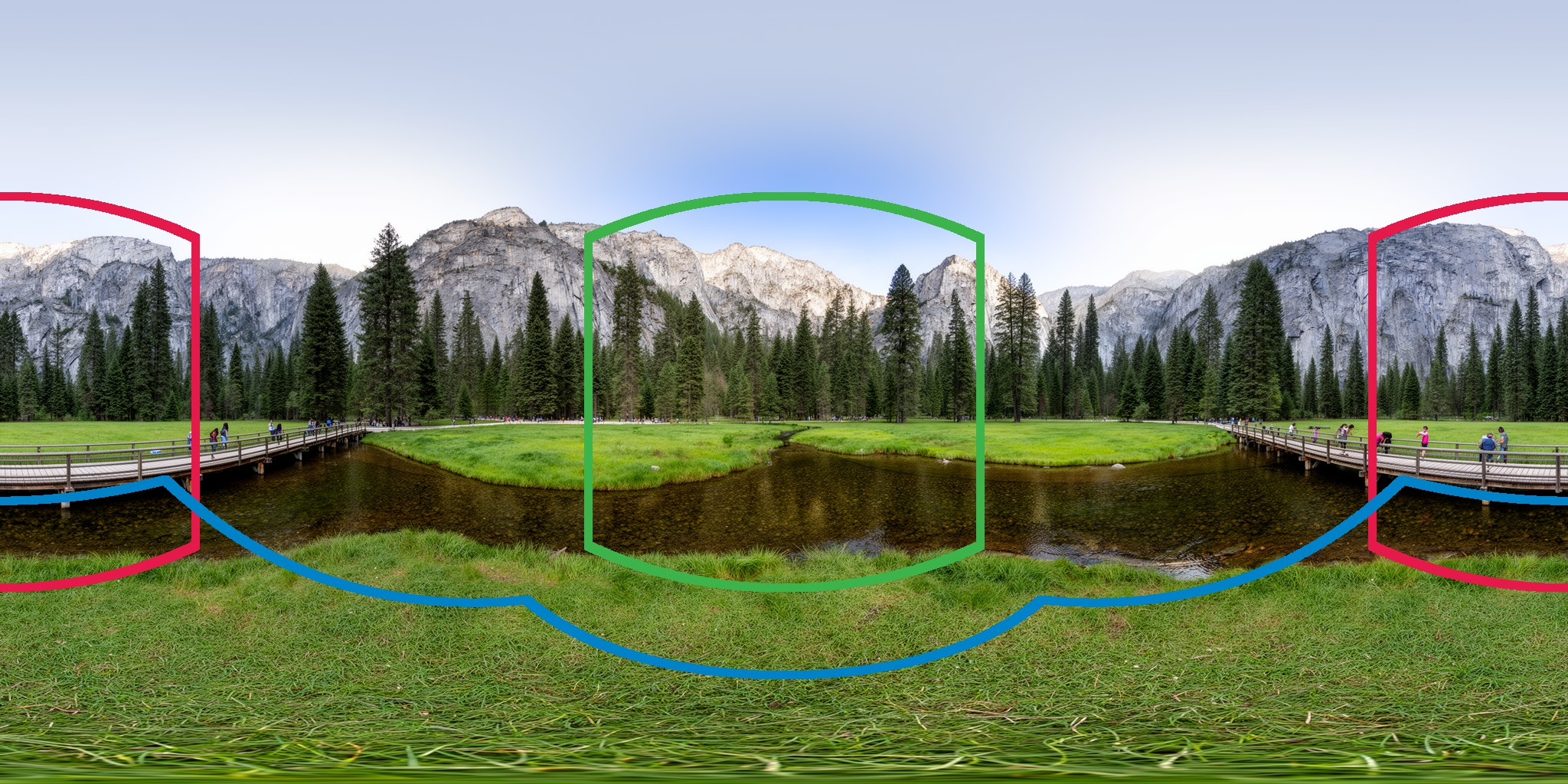
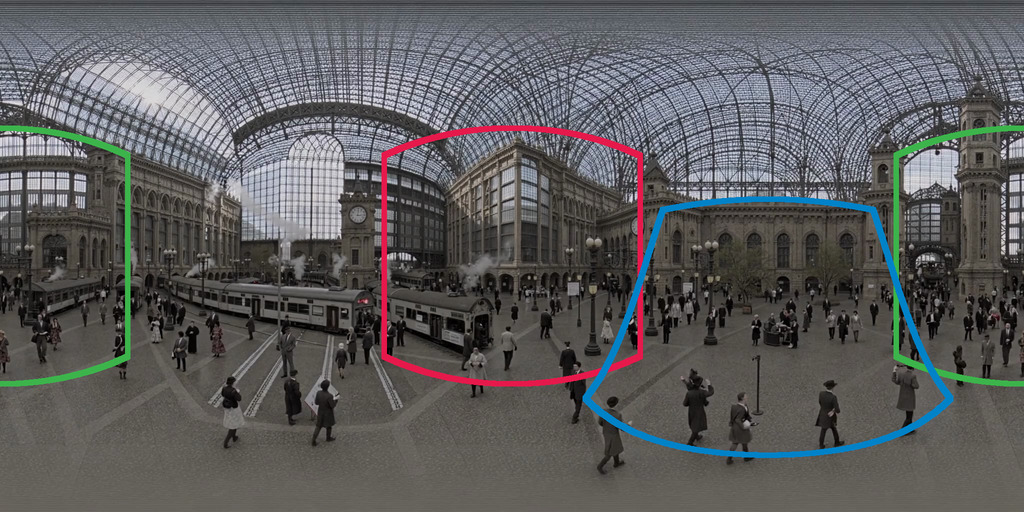
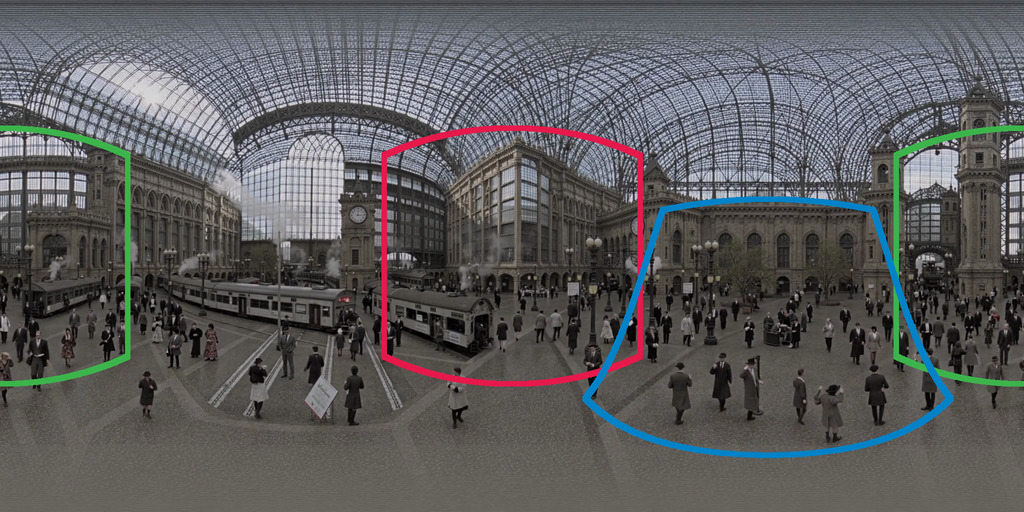
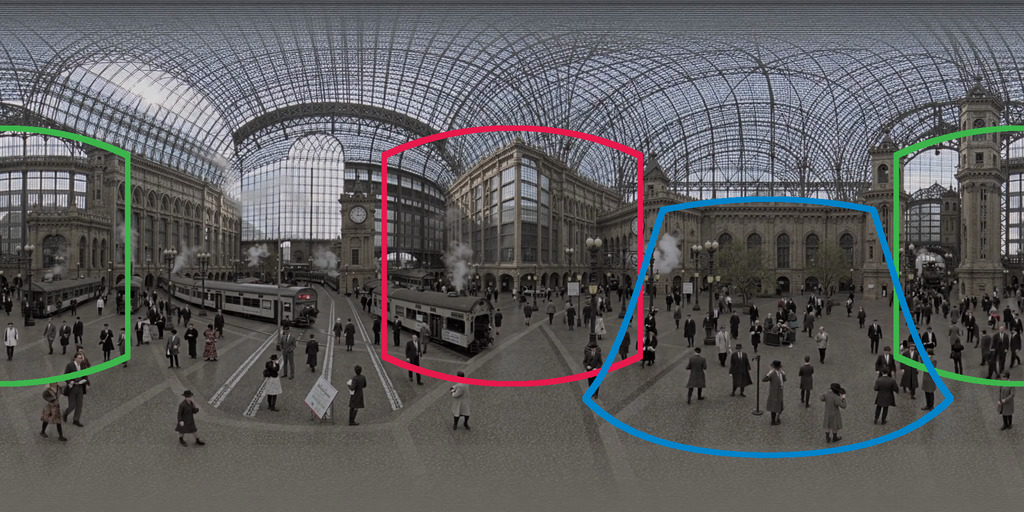
Abstract: We present a zero-shot, training-free and optimization-free framework for generating 360 panoramic images and videos by directly injecting spherical priors into pre-trained diffusion transformers. Existing methods either rely on costly fine-tuning on scarce panoramic data that limits generalization, or leverage multi-step optimization that incurs prohibitive inference latency. We observe that contemporary generative models natively exhibit some panoramic priors from large-scale training. However, these emergent capabilities are insufficient, as the models fundamentally fail to satisfy the rigorous topological constraints imposed by equirectangular projection (ERP). We introduce a zero-shot and optimization-free approach that resolves these constraints at inference time. Spherical RoPE replaces standard rotary position embeddings: low-frequency channels are re-parameterized as 3D Cartesian coordinates to natively encode the spherical manifold, while high-frequency channels are harmonically quantized to enforce exact periodicity. Coupled with complementary Semantic Distortion classifier-free guidance (CFG) that explicitly steers geometry, we avoid retraining and inherit the full creative breadth of state-of-the-art models. Our approach generalizes across diverse backbones and 360 generation modalities. We demonstrate this across text-to-panorama using Flux.1, Flux.2, and LTX-Video backbones, achieving competitive performance against baselines, all while remaining training-free. Project page: https://orhir.github.io/SpheRoPE











Paper Prompts
Sign up for free to create and run prompts on this paper using GPT-5.
Top Community Prompts
Explain it Like I'm 14
Easy-to-Understand Summary of “SpheRoPE: Zero‑Shot Optimization‑Free 360° Panorama Generation with Spherical RoPE”
What is this paper about?
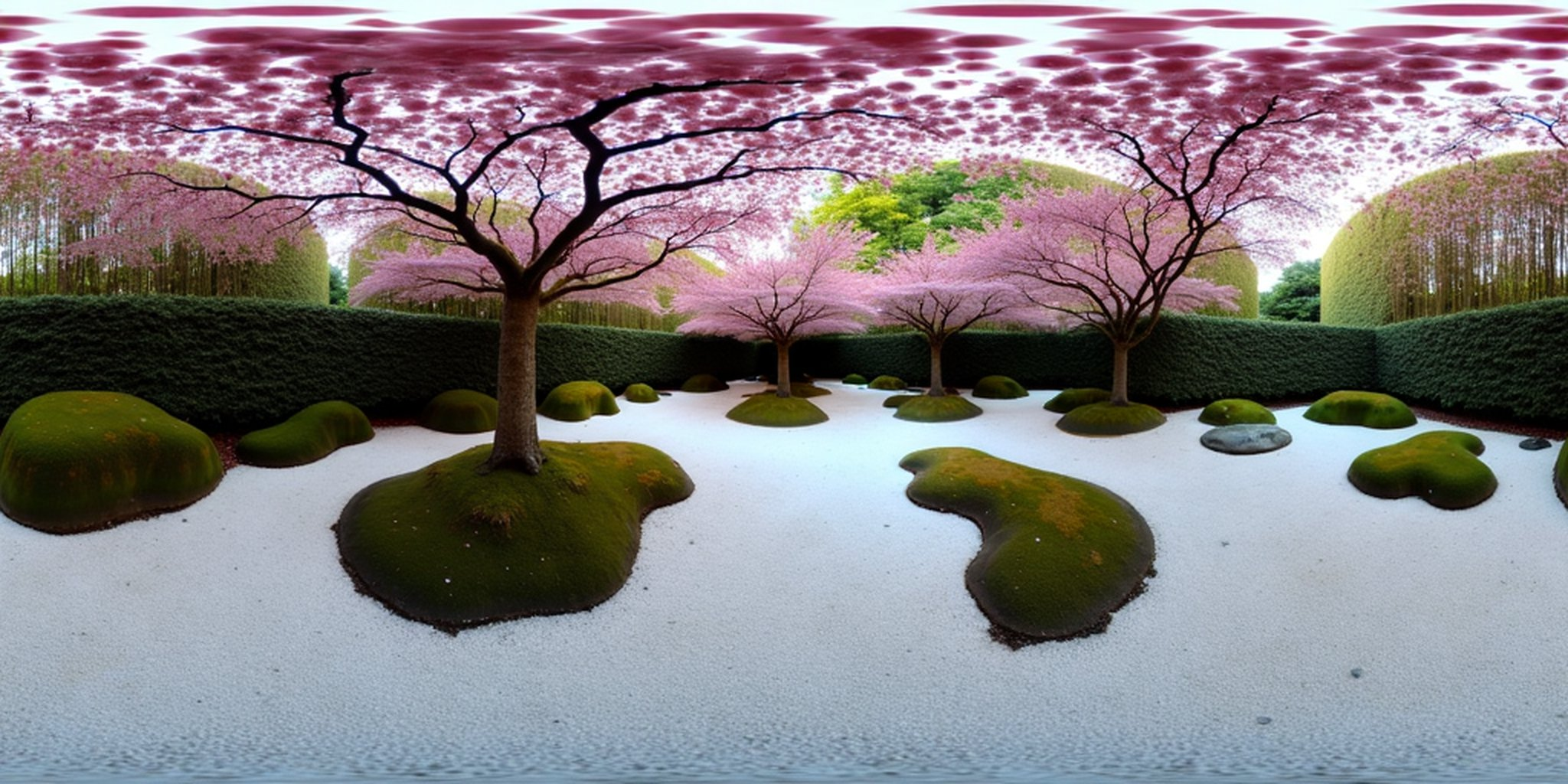
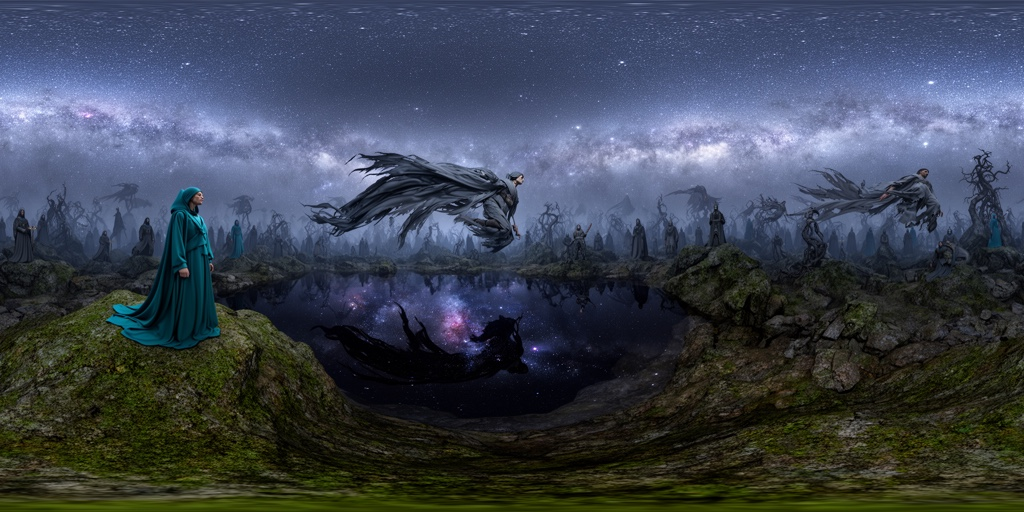
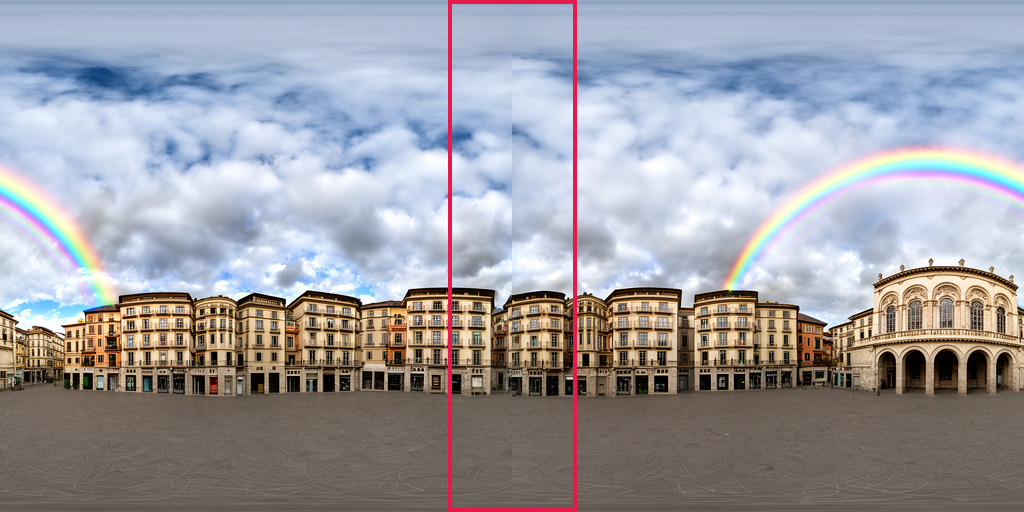
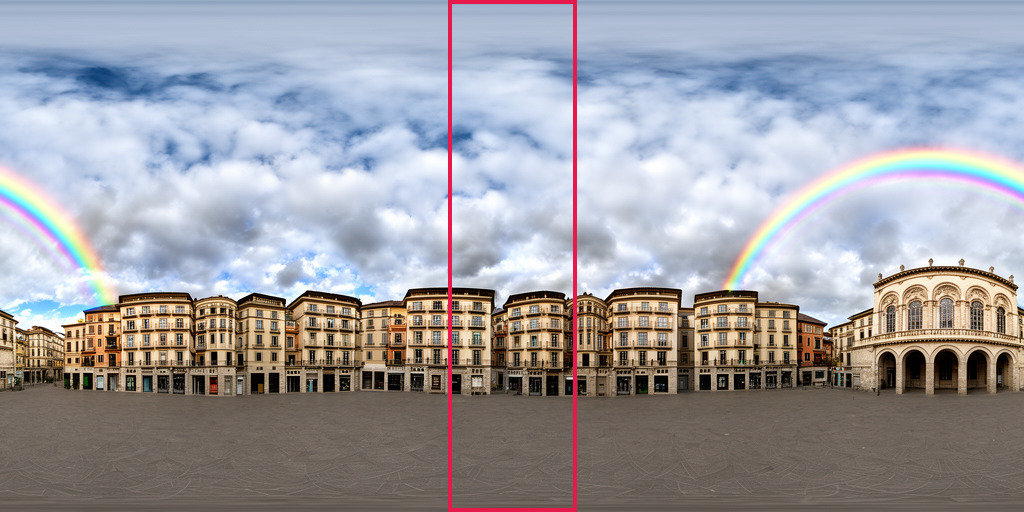
This paper shows a new way to make 360° pictures and videos (the kind you can look around in, like in VR) using today’s powerful AI image/video generators, without retraining them and without slow extra steps. The method makes the AI “think” in spherical space, so the final panorama has no visible seams and looks correct at the top and bottom.
What questions are the researchers trying to answer?
- Can we make high‑quality 360° panoramas using existing AI models without retraining them on special 360° datasets?
- Can we fix the usual problems in panoramas, like a seam where the left and right edges meet and weird stretching at the poles (top and bottom)?
- Can this work not just for images but also for videos (and even video with audio), while staying fast?
How did they do it? (Explained simply)
Most big image/video AIs today are “diffusion transformers.” Think of them as artists that start with random noise and slowly paint an image guided by a text prompt. They also use a “position system” so they know where each pixel or patch is in the image—kind of like giving each spot GPS coordinates.
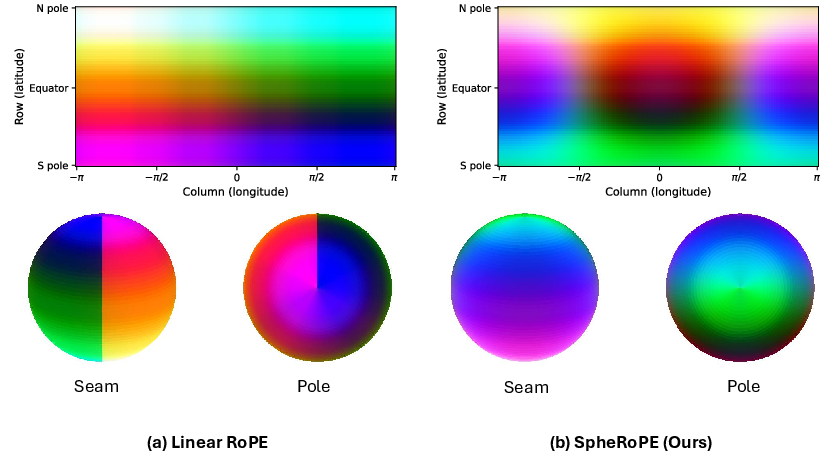
The problem: a 360° panorama is not a flat photo. It’s like a world map:
- The left and right edges must match perfectly (wrap-around).
- At the very top and bottom (the poles), all directions meet in a single point.
Regular AI models don’t naturally follow these rules, so panoramas get a seam or look broken at the poles.
The paper proposes two key ideas to fix this, while keeping everything training‑free:
1) Spherical RoPE: teaching the model the shape of a sphere
RoPE (Rotary Position Embeddings) is the model’s built‑in way to mark “where things are” in an image. The authors replace the standard version with a spherical version only at inference time (when the model is generating, not during training). Here’s the idea in everyday terms:
- Imagine music: low notes carry the big, slow rhythm (the overall layout) and high notes add fine details (crisp textures).
- The model has “channels” that behave like these low and high notes.
- For low‑frequency channels (the “big picture”):
- They encode positions using 3D coordinates on a sphere (like using latitude and longitude on a globe, then turning that into x/y on a sphere).
- This naturally makes the image wrap around left-to-right and makes everything meet cleanly at the poles.
- For high‑frequency channels (the “details”):
- They keep a normal, flat encoding but snap it so it repeats exactly every full turn. Think of lining up wallpaper so the pattern matches at the seam.
- This keeps textures sharp and continuous at the left/right boundary without messing up the overall structure.
Together, this makes the model “see” the 360° layout correctly while preserving sharp details.
2) Semantic Distortion CFG: gently steering the model toward 360° geometry
CFG (Classifier‑Free Guidance) is a common trick to get images that better match your prompt. The authors add a third guide—a short, geometric hint that says “remember, this is a 360° panorama”:
- The model mixes:
- The normal prompt (what you asked for),
- An empty prompt (for stability),
- And a “geometry reminder” prompt (to keep the 360° shape right).
- This is like whispering to the artist: “Keep drawing the castle the user wants—but also remember it’s a wrap‑around world map.”
Importantly, none of this requires retraining the AI. They just change how positions are encoded and how guidance is combined while generating.
What did they find?
The authors tested their method on popular, high‑quality base models:
- For images: Flux.1 and Flux.2
- For video (with audio): LTX‑Video 2.3
They compared against other methods that either:
- retrain models on 360° data (which is rare and expensive), or
- run slow, multi‑step optimization during generation.
Key takeaways:
- Their panoramas are seamless (no left/right seams) and look correct at the poles.
- Image quality stays high: local details (textures) remain sharp.
- For video, motion is stable over time (less flicker), and scenes stay consistent.
- People preferred their results in a user study.
- It’s fast and flexible: because they don’t retrain, it works across different models and also supports features those models already have (like image‑to‑image, or text‑to‑video with audio).
Why this matters:
- You get panoramic images and videos that look right everywhere you look, without heavy costs.
- It’s practical for VR, games, and robotics simulations where a full 360° view is important.
Why is this important? What’s the impact?
- No retraining needed: It saves time, data, and compute. You can plug this into new models as they appear.
- Better VR and immersive media: Seamless, correct 360° imagery makes virtual environments feel more real.
- Works for both images and videos: The same idea scales to moving scenes, which is hard to do well.
- Broad compatibility: Because the method only tweaks how positions are encoded and how guidance is applied, it can ride along with future advances in AI models.
In short, this research shows a smart, efficient way to make AI truly “panorama‑aware,” producing better 360° images and videos without the usual pain of retraining or slow generation.
Knowledge Gaps
Knowledge gaps, limitations, and open questions
Below is a concise, actionable list of what remains missing, uncertain, or unexplored in the paper.
- Incomplete polar convergence in high-frequency channels: the paper acknowledges that harmonically quantized high-frequency RoPE “technically violates” polar convergence (C2) but relies on low-frequency dominance; the magnitude, visual impact, and conditions where this approximation breaks (e.g., high-frequency content near poles) are not quantified.
- Sensitivity to the frequency split threshold and tolerance: the heuristic for selecting
i_split(near-integer harmonic tolerance ε) is not systematically analyzed for robustness across backbones, resolutions, or prompts; guidelines for choosing ε and its effect on quality vs. seam closure are missing. - Unspecified radius scaling for spherical Cartesian encoding: the scale-dependent radius R is not defined or tuned; how R should vary with token grid size, latent scaling, and model width is unclear and could affect stability and fidelity.
- Resolution and aspect-ratio robustness: the approach assumes ERP with W = 2H and uses
W_tokensfor harmonic alignment; behavior under other ERP aspect ratios (e.g., 3:1), variable tokenization strides, or extreme resolutions (e.g., 8K×4K for VR) is not evaluated. - No correction for latitude-dependent area distortion: attention still operates on a uniform planar grid; the method does not weight tokens by spherical area (cos θ) or adapt neighborhoods, potentially causing density/texture biases near poles.
- Planar attention neighborhoods on a spherical signal: beyond positional phase changes, attention neighborhoods remain planar; explicit spherical neighborhood kernels or geodesic-aware attention are not explored, especially near poles where adjacency differs.
- Temporal consistency of spherical constraints in video: temporal RoPE is unchanged; there is no guarantee that seam continuity and polar behavior remain stable across long sequences, especially under camera motion or scene rotations.
- Long-horizon and looped video behavior: the method’s stability over minute-long sequences, loop consistency, and drift at the seam or poles over time are not evaluated.
- Global rotation control and equivariance: the method does not provide a mechanism to control or enforce invariance/equivariance to arbitrary spherical rotations (yaw/pitch/roll); steerable or rotation-aware positional encoding is an open direction.
- Applicability to models without RoPE: the approach assumes DiT-style RoPE; generalization to architectures using absolute 2D sin/cos embeddings, learned PEs, or U-Net-based latent diffusion without RoPE is not addressed.
- Interactions with RoPE scaling schemes: compatibility with frequency-rescaling methods (e.g., NTK, YaRN, FiT/FiT-v2) is not analyzed; combined effects on harmonic quantization and i_split selection are unknown.
- Dependence on implicit panoramic priors: success depends on base models having emergent ERP priors; performance on backbones with weak or absent panoramic exposure (or domain-shifted training corpora) is not characterized.
- Geometry prompt design in SD-CFG: the paper does not specify the content or templates of the geometric prompt p_geo, its language dependence, or how to auto-generate/translate it; misalignment risks and best practices remain to be defined.
- Guidance schedules over timesteps: w_sem and γ are fixed scalars; the benefits of noise-aware or timestep-adaptive schedules, or automatic tuning per prompt, are unexplored.
- Multi-language and style robustness for SD-CFG: the effect of p_geo on non-English prompts, hybrid styles (e.g., anime, pixel art), or technical domain prompts is not systematically evaluated.
- ERP-only formulation: generalization to other spherical parameterizations (cubemap, octahedral, HEALPix) and their specific topological constraints is not investigated.
- Stereo and depth for VR: the method produces monoscopic panoramas; generating consistent stereo 360, layered depth, or 4D neural fields for motion parallax in VR remains open.
- Spatial audio: while video-audio generation is demonstrated, spatial audio (e.g., ambisonics/binaural matching panoramic visuals) and alignment of audio events to spherical directions are not addressed or evaluated.
- Quantitative metrics for spherical validity: aside from FAED and a boundary DS, there is no metric explicitly measuring polar convergence, geodesic continuity, or spherical periodicity; a standardized panoramic metric suite is needed.
- Image-to-panorama evaluation: although examples are shown, there is no quantitative assessment of identity/content preservation, FOV alignment, or overlap consistency with the input perspective.
- Real-time and resource constraints: despite being optimization-free, measured speeds (e.g., ~1.1 s/frame) fall short of real-time VR; memory/latency profiles at 4K–8K ERP, multi-GPU scaling, and mobile/edge feasibility are not reported.
- Robustness across seeds and prompts: variance analysis (seed sensitivity), failure cases (e.g., high-frequency textures near poles), and outlier prompts causing seam artifacts or distortions are not documented.
- Seams after decoding/upscaling: enforcement occurs at token attention; potential reintroduction of seams by the VAE decoder or upsamplers, and mitigation strategies, are not analyzed.
- Theoretical analysis of attention behavior: beyond intuitive arguments, there is no formal study of how spherical RoPE reshapes attention patterns/logits or guarantees of topological invariants under transformer operations.
- Combination with light fine-tuning: whether a small amount of fine-tuning (e.g., LoRA) on panoramic data further improves quality without losing zero-shot benefits—and how it interacts with SpheRoPE—is untested.
- Compatibility with editing and control: panorama inpainting, camera-orbit control, horizon leveling, or geometry-constrained editing pipelines (e.g., depth/normal control) are not explored.
- Benchmarking coverage and fairness: SphereDiff was excluded from ODI-SR due to latency; side-by-side, equal-budget comparisons (e.g., matched inference time/compute) and cross-metric trade-offs remain to be established.
- Failure characterization near poles: qualitative and quantitative analysis of moiré/aliasing, texture stretching, and fine detail retention at extreme latitudes is limited; targeted stress tests are absent.
- Reproducibility details: exact settings for ε, R, w_sem, γ, and prompt templates for p_geo are not fully specified in the main text; rigorous hyperparameter ranges and defaults that transfer across backbones would aid adoption.
Practical Applications
Immediate Applications
The following applications can be deployed now by practitioners using pre-trained diffusion transformers and adopting the paper’s inference-time modifications (Spherical RoPE and Semantic Distortion CFG), without any model retraining.
- Seamless 360 skyboxes and environment maps for interactive media
- Sectors: games, film/TV/VFX, advertising, design visualization, software
- Use case: Generate seam-free equirectangular panoramas from text or reference images, then convert to cubemaps/skyboxes for game engines or renderers; use as image-based lighting (IBL) for look-dev.
- Tools/workflow: Prompt in FLUX.2 + SpheRoPE → ERP → cubemap conversion → import to Unity/Unreal/Blender (SkyLight/HDRI world); optional color/HDR tonemapping.
- Assumptions/dependencies: Access to a compatible DiT (e.g., FLUX.1/2) and GPU with sufficient VRAM; HDR output may require post-processing or separate HDR upconversion; licensing of backbone weights.
- Rapid VR background generation for 360 experiences
- Sectors: entertainment, education, museums, tourism, healthcare (calming/therapeutic VR scenes)
- Use case: Produce immersive 360 backdrops for VR lessons, virtual exhibits, relaxation spaces, and guided meditations.
- Tools/workflow: Text prompt + SpheRoPE → ERP panorama → load into VR player or authoring tool (e.g., Unity XR/Unreal VR templates).
- Assumptions/dependencies: LDR panoramas are visually compelling but not physically accurate; ensure content safety and age-appropriate filtering.
- 360 video plates and ambience loops for post-production
- Sectors: film/TV/VFX, broadcast, events
- Use case: Generate 360 establishing shots, ambience loops (day/night/weather variants), or backplates for LED volumes and stage cycloramas.
- Tools/workflow: LTX-Video 2.3 + SpheRoPE → ERP video (e.g., 10–20 s) → reproject or use directly in Nuke/AE/Resolve; loop in editorial.
- Assumptions/dependencies: Current throughput (~1.1 s/frame in paper) suits offline workflows, not live real-time; audio sync available through the backbone but not spatialized by default.
- Synthetic 360 data for robotics perception and domain randomization
- Sectors: robotics, autonomy, simulation
- Use case: Generate diverse omnidirectional scenes for training/evaluating 360-camera pipelines (e.g., indoor navigation, warehouse robotics).
- Tools/workflow: Batch-generate ERP panoramas/videos under varied styles/lighting/layouts; feed to perception models or sim viewers; optionally reproject to multiple pinhole views for model pretraining.
- Assumptions/dependencies: Visual plausibility is high but physical/metric accuracy is not guaranteed; consider downstream validation and domain gap studies.
- Accelerated prototyping for real estate and hospitality visual concepts
- Sectors: real estate, travel, hospitality, architecture/interiors
- Use case: Draft mood boards and concept tours (lobbies, suites, restaurants) when actual photography is unavailable.
- Tools/workflow: Text or image-conditioned prompts → ERP panoramas → web 360 viewer (e.g., three.js/krpano) or AR/VR viewers for internal reviews.
- Assumptions/dependencies: Must clearly label as synthetic; avoid misleading marketing claims; ensure brand/legal approvals.
- Web and mobile 360 experiences for marketing and education
- Sectors: marketing, e-commerce, education
- Use case: Interactive 360 landing pages, product lifestyle scenes, or field-trip modules.
- Tools/workflow: Prompt → ERP → lightweight web viewer; batch-variant generation (seasons, styles) with Semantic Distortion CFG for consistency.
- Assumptions/dependencies: Performance optimized by image resolution and viewer implementation; disclose AI-generated content where required.
- Video conferencing/virtual event backgrounds for XR
- Sectors: enterprise software, events
- Use case: Curate branded 360 backgrounds for virtual meetings or XR events.
- Tools/workflow: Prompt → ERP panorama → preloaded background options in conferencing tools or XR meeting spaces.
- Assumptions/dependencies: Pre-generation is practical; true real-time synthesis during a live session remains challenging.
- Developer integration: drop-in panorama mode for diffusion inference servers
- Sectors: software, MLOps, platform teams
- Use case: Offer “360 mode” in existing T2I/T2V APIs by swapping horizontal RoPE at inference and enabling geometric anchor prompts for SD-CFG.
- Tools/workflow: Implement Spherical RoPE channel partitioning + harmonic quantization in attention modules; expose gamma and semantic weights; keep vertical/temporal RoPE unchanged.
- Assumptions/dependencies: Requires access to inference code or custom attention kernels; version compatibility with target DiT backbones.
- Image-to-panorama synthesis for identity/style preservation
- Sectors: media, IP/brand teams, education
- Use case: Expand a character/brand style or reference photo into a 360 scene (e.g., classrooms, exhibits) while retaining identity cues.
- Tools/workflow: Use the base model’s native image conditioning + SpheRoPE; adjust SD-CFG to balance geometry with style fidelity.
- Assumptions/dependencies: Reference input quality governs preservation; adhere to IP and likeness rights.
- Lower-cost alternatives to fine-tuned 360 models
- Sectors: startups, SMEs, public sector
- Use case: Deliver panoramic content without collecting 360 datasets or running LoRA/fine-tuning jobs.
- Tools/workflow: Swap positional encoding at inference; reuse existing serving infrastructure and content safety layers.
- Assumptions/dependencies: Output quality tracks backbone quality; some prompts may still benefit from light prompt engineering.
Long-Term Applications
These opportunities are feasible but require further research, optimization, or integration beyond the current system’s capabilities (e.g., real-time constraints, 3D consistency, spatial audio).
- Real-time 360 generation on XR devices
- Sectors: consumer XR, enterprise XR, live events
- Use case: Generate responsive 360 backgrounds and ambience on-headset; dynamic scene styles that adapt to user context.
- Dependencies: Model distillation/ONNX/TensorRT ports, quantization, memory-optimized attention; mobile-friendly backbones and caching.
- 6DoF, parallax-consistent world generation (beyond fixed panoramas)
- Sectors: games, simulation, telepresence
- Use case: Move from static ERP to navigable 3D scenes by combining panorama generation with multi-view consistency, NeRF/Gaussian splats, or mesh lifting.
- Dependencies: Multi-view consistent generation, depth priors, geometry-aware training or post-lifting pipelines; stronger temporal-spatial coherence.
- Autonomous driving and urban planning 360 simulation
- Sectors: mobility, public infrastructure
- Use case: Generate procedurally diverse 360 urban environments for planning, signage layout studies, and perception stress-testing.
- Dependencies: Traffic agents, physics, and sensor realism (LiDAR/radar); policy guidance for synthetic data use in safety-critical validation.
- Spatial audio and ambisonics coupling
- Sectors: audio engineering, VR/AR media
- Use case: Map generated audio to ambisonics (B-format) aligned with 360 visuals for head-tracked spatial sound.
- Dependencies: Audio-visual synchronization with spatial encoding; training-free or lightweight adapters to convert stereo outputs to ambisonics.
- Therapeutic and clinical XR environments
- Sectors: healthcare, mental health
- Use case: Personalized calming or exposure therapy scenes with clinician controls (lighting, scene complexity, themes).
- Dependencies: Clinical validation, safety protocols, content moderation, device certifications; possibly on-device generation for privacy.
- Training synthetic digital twins for robots and operators
- Sectors: manufacturing, energy, logistics, public safety
- Use case: Generate 360 situational training modules for control rooms, inspections, or emergency response drills.
- Dependencies: Procedural asset control, scenario scripting, evaluation metrics for transfer; compliance with training standards.
- Personalized virtual travel and cultural heritage reconstructions
- Sectors: tourism, education, heritage
- Use case: AI-curated tours that adapt to a syllabus or a user’s interests; stylized or historically informed reconstructions.
- Dependencies: Guardrails to avoid factual errors; provenance metadata; collaboration with curators and educators.
- Privacy-preserving substitutes for street-level imagery
- Sectors: mapping, policy, civic tech
- Use case: Synthetic 360 depictions of areas where collection is restricted; used for planning, accessibility wayfinding, or public communication.
- Dependencies: Clear labeling as synthetic; calibration to avoid misleading geometry; policy frameworks for acceptable use.
- Watermarking and provenance for panoramic media
- Sectors: policy, platforms, content moderation
- Use case: Embed robust watermarks/signals into ERP outputs; integrate with C2PA or platform provenance standards.
- Dependencies: Standardization across engines; resilience to reprojection/cubemap transforms and compression.
- On-device creative assistants for 360 content
- Sectors: consumer apps, creator economy
- Use case: Smartphone or tablet apps that generate 360 wallpapers, story backgrounds, and short 360 loops on demand.
- Dependencies: Efficient local models, or hybrid edge-cloud rendering; UX for prompt control, SD-CFG sliders, and safe content filters.
Notes on feasibility and dependencies
- Backbone access and licensing: Practical use requires access to compatible diffusion transformers (e.g., FLUX.1/FLUX.2/LTX-Video) and compliance with their licenses.
- Compute requirements: While training-free, high-resolution ERP and video generation still require capable GPUs; video is currently offline-speed for most use cases.
- Geometric/physical fidelity: Outputs are visually coherent for ERP but not metrically accurate or physically simulated; avoid safety-critical interpretations.
- Content safety and IP: Synthetic 360 scenes should adhere to IP, likeness rights, and platform policies; consider disclosure and watermarking.
- Integration effort: Implementing Spherical RoPE requires modifying attention positional encodings along the horizontal axis and adding Semantic Distortion CFG controls to inference; no model weights are changed.
Glossary
- Anchored geometric prompt: An auxiliary text prompt that encodes geometry cues and is concatenated to the user prompt to steer panoramic structure without adding new semantics. Example: "using an anchored geometric prompt, steering the denoising process toward valid ERP projections"
- Background consistency: A video evaluation criterion measuring whether the background remains stable across frames. Example: "and semantic persistence (subject and background consistency)."
- Cartesian coordinates on the unit sphere: A 3D position representation (x,y,z with radius 1) used to encode spherical topology for positions on a panorama. Example: "low-frequency channels are re-parameterized as 3D Cartesian coordinates to natively encode the spherical manifold"
- CLIP Mean: A text–image alignment metric based on CLIP embeddings, averaged across frames or views. Example: "text-alignment (CLIP Mean~\cite{radford2021learning})"
- Classifier-free guidance (CFG): A diffusion guidance technique that combines conditional and unconditional predictions to strengthen adherence to prompts without an external classifier. Example: "Semantic Distortion classifier-free guidance (CFG) that explicitly steers geometry"
- Cyclic Linear Encoding: A high-frequency positional encoding that snaps frequencies to integer harmonics to enforce exact wrap-around periodicity at panorama boundaries. Example: "we enforce strict cyclic periodicity by using Cyclic Linear Encoding."
- Denoising step: An iteration within the diffusion sampling process where noise is incrementally removed to form the image or video. Example: "At each denoising step, we compute three noise predictions"
- Diffusion transformer (DiT): A diffusion model architecture that uses transformer blocks (self-attention) instead of U-Nets for generative modeling. Example: "Diffusion transformers (DiTs)~\cite{peebles2023dit}"
- Discontinuity Score (DS): A metric for measuring seam artifacts at the wrap boundary of equirectangular panoramas. Example: "and quantify wrap-boundary artifacts via DS~\cite{christensen2024geometry}."
- Equirectangular projection (ERP): A mapping that unwraps spherical imagery onto a 2D rectangle, used for 360° panoramas with strict wrap and pole constraints. Example: "equirectangular projection (ERP)"
- FAED: A distortion-aware image quality metric tailored for omnidirectional content. Example: "We assess panoramic fidelity using distortion-aware features (FAED)~\cite{oh2022bips}"
- Fréchet Inception Distance (FID): A generative quality metric comparing feature distributions between generated and real images. Example: "we compute universal metrics (FID~\cite{heusel2017gans}, KID~\cite{binkowski2018demystifying}, IS~\cite{salimans2016improved}, CS~\cite{radford2021learning})"
- Fundamental frequency: The base angular frequency corresponding to exactly one cycle around the panorama width, used to enforce periodicity. Example: "where $\omega_{\text{fund} = 2\pi / W_{\text{tokens}$ is the fundamental frequency for horizontal wrap-around."
- Harmonic quantization: Adjusting frequencies to the nearest integer multiple of a fundamental frequency to ensure periodic boundary conditions. Example: "high-frequency channels are harmonically quantized to enforce exact periodicity."
- Horizontal periodicity: The requirement that left and right edges of an ERP image match exactly because longitudes −π and π coincide. Example: "Horizontal periodicity: "
- Inception Score (IS): A generative quality metric using a pretrained classifier’s predictions to score image realism and diversity. Example: "we compute universal metrics (FID, KID, IS, CS)"
- Kernel Inception Distance (KID): A generative quality metric based on MMD in Inception feature space, robust for smaller sample sizes. Example: "we compute universal metrics (FID, KID, IS, CS)"
- Latent diffusion: A diffusion approach that operates in a learned latent space instead of pixel space for efficiency and fidelity. Example: "latent diffusion~\cite{rombach2022ldm} for panorama generation"
- Low-Rank Adaptation (LoRA): A parameter-efficient fine-tuning technique that inserts low-rank updates into pretrained weights. Example: "parameter-efficient adaptation via LoRA~\cite{hu2022lora"
- Motion smoothness: A video metric evaluating how smoothly motion evolves frame-to-frame without jitter. Example: "temporal flickering, motion smoothness~\cite{li2023amt}"
- MultiDiffusion: A stitching technique that aggregates overlapping diffusion-based patches to generate larger or structured outputs. Example: "patch-based MultiDiffusion~\cite{bartal2023multidiffusion}"
- Out-of-distribution (OOD): Data or prompts that lie outside the distribution seen during model training, challenging generalization. Example: "degraded generalization in out-of-distribution (OOD) scenarios~\cite{wang2025survey}"
- Polar convergence: The constraint that all columns meet at the poles in ERP, so polar rows must be constant across columns. Example: "Polar convergence: "
- Rotary position embeddings (RoPE): A positional encoding that injects relative position information via rotations in query/key spaces. Example: "rely on rotary position embeddings (RoPE)~\cite{su2024roformer}"
- S2: The mathematical notation for the 2-dimensional unit sphere manifold. Example: "the topological invariants of the sphere ()"
- Semantic Distortion CFG: A three-way extension of CFG that adds a geometry-anchored prompt to guide ERP-specific distortions and structure. Example: "we leverage Semantic Distortion CFG that extends standard CFG to a three-way scheme using an anchored geometric prompt"
- Spectral decomposition: Partitioning representation channels by frequency to treat low- and high-frequency behaviors differently. Example: "via spectral decomposition"
- Spherical manifold: The curved surface (topological space) of a sphere, with properties different from a flat Euclidean plane. Example: "to natively encode the spherical manifold"
- Spherical RoPE (SpheRoPE): A modified RoPE that encodes spherical topology: low frequencies use spherical Cartesian coordinates, high frequencies are harmonic-quantized. Example: "We introduce Spherical RoPE, a frequency-aware reformulation of the standard transformer RoPE"
- Temporal flickering: A video artifact where appearance varies abruptly across frames; also a metric measuring temporal stability. Example: "temporal flickering, motion smoothness~\cite{li2023amt}"
- VBench: A benchmarking suite that evaluates multiple dimensions of text-to-video quality, alignment, and temporal consistency. Example: "we assess performance on two prompt sets using VBench~\cite{vbench2024}"
Collections
Sign up for free to add this paper to one or more collections.

