- The paper introduces an operational method that assigns a unique contact temperature to quantum states using a universal heat flow protocol.
- It derives explicit analytic formulae for the expected energy flow, demonstrating monotonicity and convergence across both equilibrium and inverted regimes.
- The work connects quantum channel dynamics and stochastic processes to experimental thermometry, paving the way for practical applications in nonequilibrium quantum systems.
This essay analyzes "The contact temperature of arbitrary quantum states" (2606.31969), which introduces a universal, operational method to assign a temperature—the contact temperature—to any quantum state via a well-defined heat flow protocol. The work synthesizes quantum thermodynamics, stochastic processes, and open quantum systems, offering explicit results on heat exchange, temperature definitions, and channel dynamics for generic finite-dimensional quantum systems interacting with an idealized quantum thermometer.
Operational Definition and Model Construction
The central operational scheme is to bring a quantum system, potentially far from equilibrium, into contact with a "universal thermometer"—modeled as an infinite-level quantum system (reservoir) in a Gibbs state at inverse temperature β. The thermometer is engineered to exchange energy broadly, such that the joint system evolves under a unitary operation U that conserves total energy and produces equiprobable transitions between degenerate joint energy levels. This construction unambiguously defines a function QA(β), the expected energy (heat) flow into the system as a function of β:
QA(β)=TrA+B[U(ρ⊗τβ)U∗HA]−TrA[ρHA]
where ρ is the system's state and τβ the thermometer's Gibbs state.
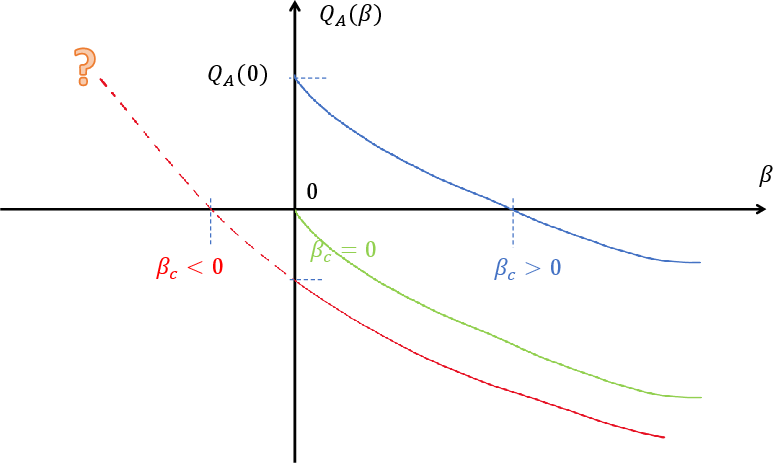
Figure 1: The energy flow QA(β) as a strictly decreasing, convex function of β>0, with scenarios for positive, zero, and negative QA(0) resulting in positive, null, or negative roots, respectively.
The contact temperature of a quantum state U0 is defined as the unique value U1 such that U2, i.e., the point at which no net energy is transferred when the system is coupled to the thermometer at that temperature.
The paper presents a closed-form, explicit analytic formula for U3 for a finite U4-level, non-degenerate system:
U5
where U6 are level populations and U7 energy eigenvalues.
Monotonicity properties of U8—strictly decreasing in U9 except for pure ground or top excited states—guarantee the existence and uniqueness of the contact temperature for all states except possibly extremal ones, where it diverges to QA(β)0. Notably, QA(β)1 becomes independent of the thermometer's level spacing in the QA(β)2 limit, ensuring the universality of the procedure.
The contact temperature is thus positive, zero, or negative depending on the sign of QA(β)3, with negative contact temperatures arising, e.g., for inverted populations or certain active (non-passive) states.
Contact Temperature Beyond the Physical Domain
A central challenge arises from the fact that the Gibbs state for the infinite thermometer is ill-defined for QA(β)4. The authors regularize this by introducing a finite-level thermometer QA(β)5, deriving the physical heat flow QA(β)6 for all QA(β)7, and then taking QA(β)8. This yields a continuous, analytic extension QA(β)9 with a unique root for all non-extreme states:
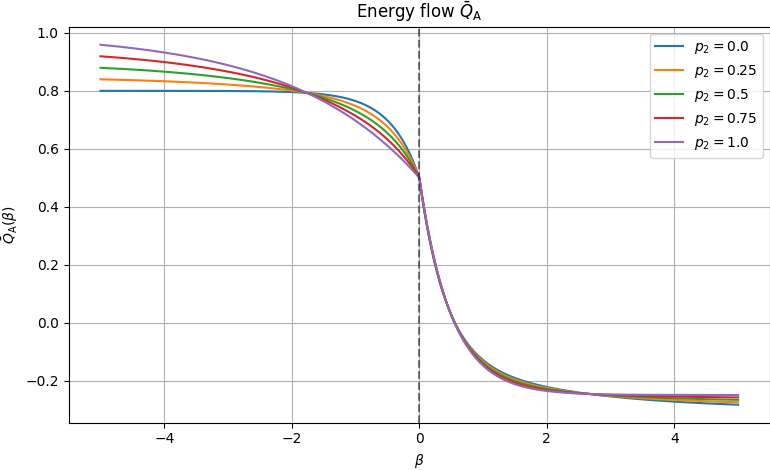
Figure 2: The extended heat flow β0, demonstrating well-behaved, monotonic transitions across β1 (physical to unphysical regions) for various state parameters.
This framework unifies the treatment of positive and negative temperature states, a necessity for the operational assessment of highly non-equilibrium and inverted systems.
Quantum Channels, Stochasticity, and Approach to Equilibrium
Interpreting the interaction as a quantum channel, the paper establishes that each contact realizes a completely positive, trace-preserving map β2, which preserves the system's Gibbs state at temperature β3:
β4
The restriction to populations corresponds to a strictly positive, β5-dependent stochastic matrix with the unique stationary distribution matching the Gibbs state. The detailed spectral analysis demonstrates rapid convergence to thermal equilibrium under repeated contact, reinforcing the operational validity of the contact temperature as a meaningful dynamical attractor.
Numerical and Structural Insights
The theory is exemplified in detail for qubit and qutrit systems, including closed-form relations between contact temperature, populations, and energy gaps. Notably, for qubits, the contact temperature coincides with the effective temperature inferred from energy matching (relative entropy minimization), but this equivalence breaks in higher dimensions. The authors construct families of states that, despite equivalently matching mean energy or entropy, differ significantly in their contact temperature, highlighting the operational subtleties of nonequilibrium thermodynamics at the quantum level.
Theoretical and Practical Implications
The proposed method delivers a robust, experimentally realizable assignment of temperature to arbitrary quantum states, including non-passive and far-from-equilibrium scenarios not amenable to traditional thermodynamic or information-theoretic definitions. By building on physical heat flow and universal dynamical protocols, it aligns with operationalist principles while also capturing virtual/negative temperature regimes relevant in population-inverted media and quantum thermal machines.
On a theoretical level, the connection with CPTP channels, stochastic matrices, and convergence under repeated contacts illustrates deep links to open quantum systems and Markov process theory. The analytic formulae provide a toolkit for probing fundamental limits of irreversibility, entropy production, and non-equilibrium resource theories.
Outlook and Future Directions
This work paves the way for systematic experimental characterization and control of temperature-like quantities in quantum devices, especially where non-equilibrium operations and active quantum states play a role. Its universality and explicitness make it relevant for quantum information processing, quantum thermometry, and the foundational understanding of the quantum second law in strongly non-classical regimes.
Potential avenues for future research include:
- Extending the operational protocol to systems with degeneracy, continuous spectra, or time-dependent Hamiltonians.
- Investigating the role of coherences in the contact temperature definition and their thermodynamic consequences.
- Employing the formalism in quantum thermodynamic cycles, such as in heat engines with engineered reservoirs.
- Linking the contact temperature dynamics to recently proposed resource-theoretic notions of passivity, ergotropy, and nonequilibrium free energies.
- Developing numerical and experimental protocols for measuring contact temperatures in open quantum systems.
Conclusion
The article presents a mathematically rigorous, physically grounded, and broadly applicable framework for assigning a unique contact temperature to any finite-dimensional quantum state via tangible heat flow considerations. The explicit, universal thermometer model, together with stochastic dynamical analysis and analytic formulae, enables precise treatment of temperature in the quantum regime well beyond equilibrium, setting a robust foundation for both theory and applications in quantum thermodynamics.

