- The paper demonstrates that VSC resonantly enhances the vibrationally-resolved C6 coefficient, modulating London dispersion forces.
- It employs perturbative analysis and mixed quantum–classical dynamics to reveal polariton-induced barrier lowering in reaction kinetics.
- The study shows that collective cavity effects narrow the distribution of C6 values, highlighting the critical role of precise resonance in chemical reactivity.
Resonant and Collective Modification of London Dispersion Interactions under Vibrational Strong Coupling
Introduction and Motivation
The paper "Resonant and collective modification of London dispersion interactions under vibrational strong coupling" (2606.31932) rigorously examines how vibrational strong coupling (VSC) in optical microcavities alters London dispersion interactions between molecules, with implications for cavity-modified chemical reactivity. This work addresses two central criteria for any theoretical mechanism seeking to explain experimental VSC-induced reaction rate modifications: the requirement of resonant frequency dependence and enhancement from collective effects over many molecules. Previous theoretical routes, which focused on direct vibrational mode-cavity coupling, were limited—exhibiting resonance only in few-molecule scenarios or failing under disorder and collective limits. Here, the authors adopt a new perspective rooted in vibrationally-resolved perturbative treatment of dispersion, exploring both quantum state dependence and collective scaling.
Vibrationally-Resolved Dispersion: Framework and Phenomena
The starting point is the perturbative expression for London dispersion energy, traditionally derived from electronic excited states. To introduce vibrational dependence, the authors resolve the vibrational substructure within electronic states, producing a C6 coefficient which now depends explicitly on the vibrational quantum numbers of both interacting molecules.
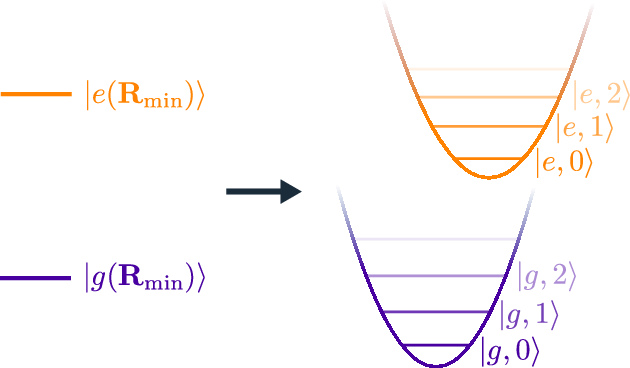
Figure 1: Vibrationally-resolved London dispersion forces; calculation incorporates vibrational states into the standard perturbation expansion for dispersion.
This vibrational resolution permits calculation of state-dependent C6 coefficients. Numerical evaluation for prototypical systems demonstrates that exciting a vibrational mode increases C6 from 1.65 a.u. (ground state) to 2.35 a.u. (single excitation), validating that even modest vibrational excitations can modulate dispersion strength, underpinning reaction barrier modifications.
Placing N molecules inside a Fabry–Pérot cavity modifies their eigenstates via VSC, leading to formation of polaritons and dark states, especially when the cavity mode is tuned near molecular vibrational frequencies.
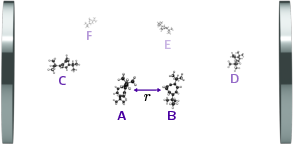
Figure 2: Schematic of cavity-mediated interactions; only molecules A and B experience direct dispersion, while other molecules couple to the cavity mode.
When the cavity is resonant, states bifurcate into polaritons (with enhanced bright-state character) and dark states (antisymmetric, with suppressed cavity interaction). Analytical and numerical analysis for N=2 yields sharply resonant enhancement of C6 in polaritonic states compared to out-of-cavity values, while dark states demonstrate suppression.
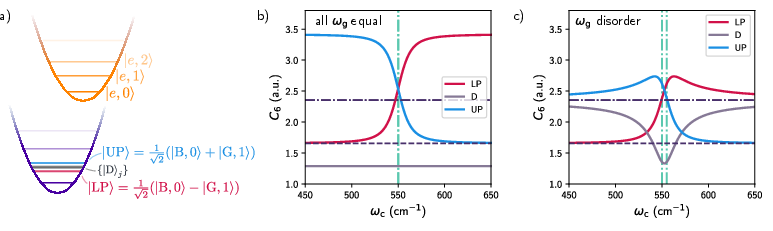
Figure 3: Resonant tuning of cavity yields polaritons with enhanced C6 coefficients; disorder and detuning restore out-of-cavity values.
With frequency disorder included, enhancement persists only on resonance, and C6 returns to baseline off-resonance, underscoring the necessity of precise cavity tuning. This modulation of C6 is a direct quantum-optical fingerprint of the cavity’s ability to control intermolecular forces.
Reaction Rate Modulation: Mixed Quantum–Classical Dynamics
To connect cavity-induced modification of dispersion to chemical kinetics, the authors construct a model with two molecules, each possessing a reactive mode (double-well potential) and a perpendicular mode strongly coupled to the cavity. The reaction rate is analyzed as a function of solvent friction and cavity detuning.
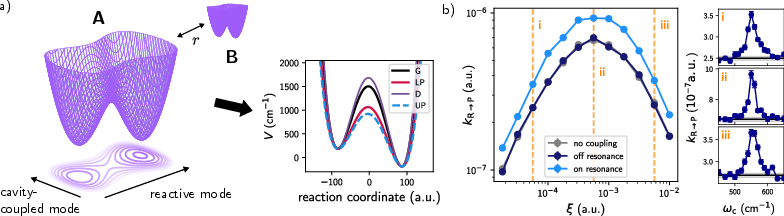
Figure 4: Reaction model—dispersion-dependent barrier lowering via polaritonic state occupation leads to resonant rate enhancement across friction regimes.
Simulation using a mixed quantum–classical approach (surface-hopping combined with a Pauli master equation) reveals robust resonant reaction rate enhancement at all friction regimes, with peaks absent in off-resonant or out-of-cavity conditions. The rate enhancement is attributed both to polaritonic state's barrier lowering and their shorter lifetimes (higher transition probabilities), a nontrivial kinetic effect unique to cavity resonance.
Collective Effects and Scaling with Ensemble Size
The study advances to higher ensemble sizes, analyzing C6 and its variance across excitation manifolds as molecule number increases. For large C60, polariton states increasingly resemble ground states due to excitation dilution—a well-known consequence of the Tavis–Cummings model. However, the cavity-induced narrowing of the statistical distribution of C61 coefficients persists, as verified by simulations for up to C62.
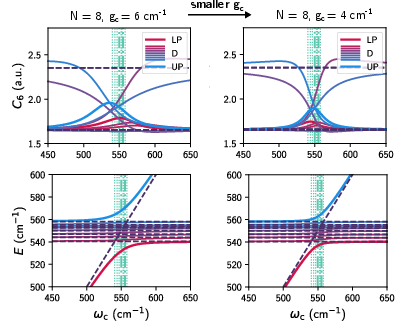
Figure 5: C63 coefficient and eigenstate energies for 8 molecules; polarity of resonance effects narrows with reduced coupling strength.
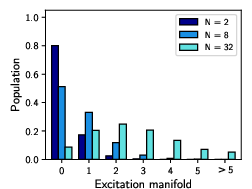
Figure 6: Excitation manifold population shifts for increasing C64 illustrate the importance of higher excitation states in thermal equilibrium.
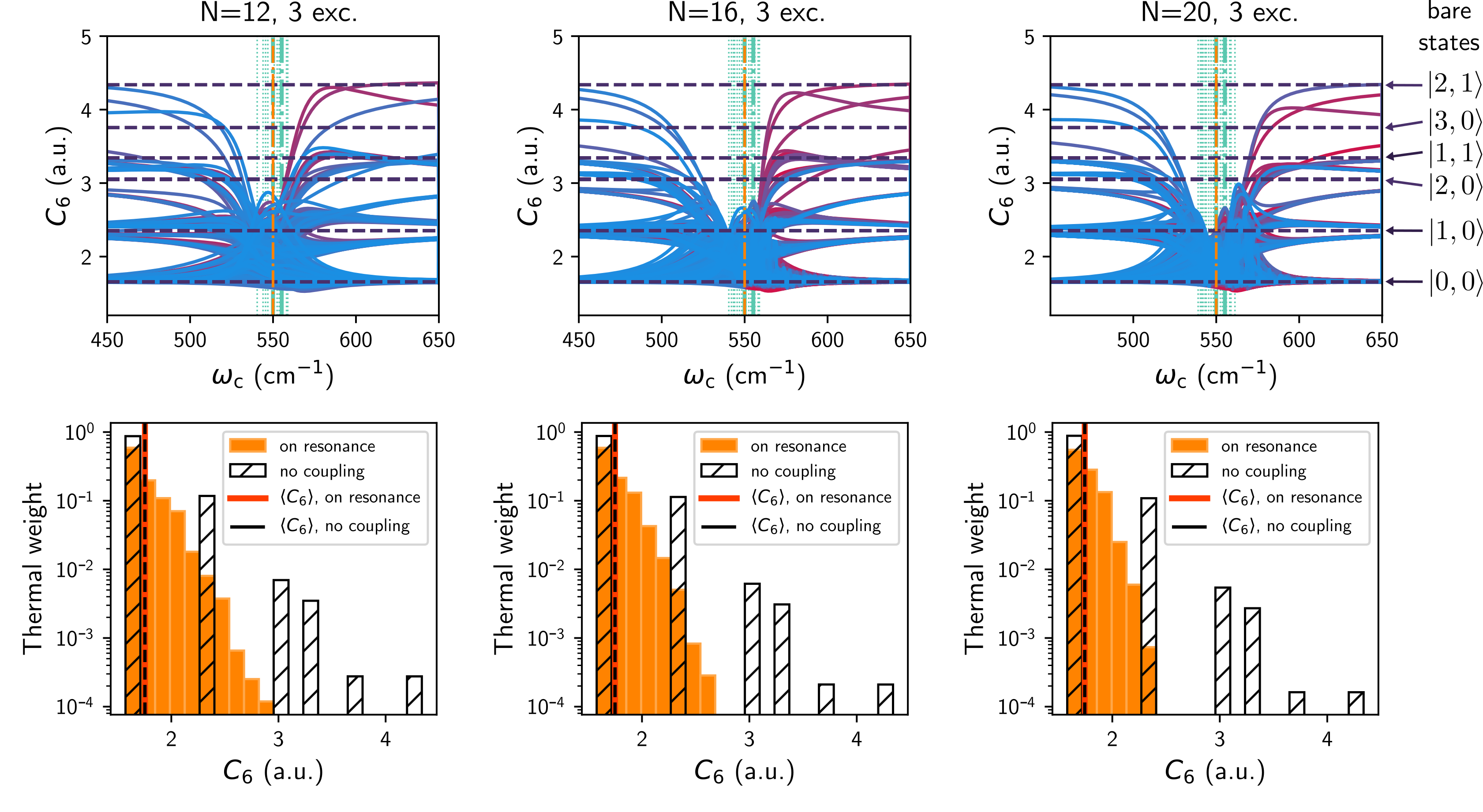
Figure 7: Cavity-frequency dependence of C65 for 12, 16, 20 molecules; persistent "dip" on resonance proves collective effect.
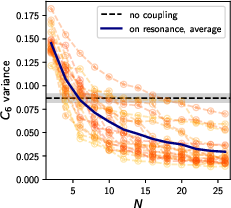
Figure 8: The thermal variance of C66 coefficients converges below out-of-cavity values as C67 grows, demonstrating a collective narrowing.
This narrowing implies that, while the average dispersion interaction is unchanged, the high-value tail (states with exceptionally strong dispersion) disappears under VSC: on resonance, such states cannot be accessed. This has direct implications for cavity-modified reactivity if reactions rely on rare, strongly stabilized transition state configurations.
Methodology: Diagonalization, Disorder, and Dynamics
The authors’ computational protocol rigorously incorporates quantum diagonalization of the cavity-molecule Hamiltonian, disorder in vibrational frequency and coupling strength, and stochastic quantum–classical dynamics. Detailed convergence and disorder averaging substantiate the robustness of collective narrowing phenomena.
Discussion and Theoretical Implications
The main theoretical achievement is demonstrating, via perturbative and numerical analysis, that VSC modifies vibrationally-resolved dispersion forces in a resonant and collective manner. The collective narrowing effect persists with orientational and frequency disorder, suggesting relevance for real, large-scale ensemble experiments. The connection between polaritonic eigenstate structure and intermolecular interaction strength now grounds hypotheses that altered dispersion underpins cavity-modified chemistry.
The dynamical simulations extend understanding of how kinetic effects, including polariton lifetimes, participate in rate enhancement. Notably, the authors highlight that mixed quantum–classical approaches break down in the large-C68 excitation-manifold regime, motivating development of fully quantum or non-secular dynamical theories.
Practical and Future Directions
Practically, this framework supports the interpretation of VSC experiments where chemical rates depend on dispersion stabilization (e.g., isomerizations, cluster formation). The formalism can be generalized for ab initio calculations of transition dipole moment surfaces, for nonperturbative treatments, and for inclusion of anharmonicity or exchange interactions.
Open problems include:
- Quantifying electronic transition dipole dependence on nuclear coordinates for relevant molecular systems.
- Extending quantum dynamics simulations to the many-molecule regime beyond secular approximations.
- Assessing effects of structural heterogeneity and time-dependent disorder on VSC-modified interactions.
- Exploring higher-order (such as three-body) dispersion alterations under VSC.
Conclusion
This work establishes that vibrational strong coupling in optical microcavities enables resonant, quantum-state-dependent modulation of London dispersion interactions, which is collective in nature and leads to statistical narrowing of accessible interaction strengths. These effects persist in regimes with many molecules and realistic disorder, laying theoretical foundation for interpreting and designing chemical processes under VSC. The results motivate further theoretical and computational development, especially in quantum dynamics for large ensembles and nonperturbative dispersion calculations, to clarify the nature and scope of cavity-controlled chemical reactivity.