- The paper introduces a martingale-based statistical approach to certify quantum states without the i.i.d. assumption, ensuring rigorous confidence intervals even under drift.
- The paper employs randomized spot-checking and Horvitz-Thompson sampling to derive unbiased, bounded estimators that achieve sample complexity matching standard i.i.d. protocols.
- The paper validates its framework with numerical simulations and experimental demonstrations on IBM quantum processors, confirming its practical applicability under realistic conditions.
Certification of Quantum States Beyond Independence: A Martingale Framework
Motivation and Context
Conventional quantum state certification and verification protocols depend crucially on the assumption that experimental sources emit independent and identically distributed (i.i.d.) quantum states. However, real-world conditions—including temporal drift, feedback, memory effects, and correlated noise—often violate this assumption. As a result, standard statistical analyses may underestimate uncertainty, overstate device performance, or even yield erroneous confidence guarantees, undermining applications in quantum cryptography, simulation, and benchmarking. The work "Certifying quantum states without independence assumptions" (2606.31913) presents a rigorous framework for quantum state verification and certification that remains valid even when the independence assumption is dropped.
Non-i.i.d. Source Model and Statistical Estimation
The authors formalize non-i.i.d. quantum sources as adversarial or adaptive processes, where each quantum state ρt prepared at round t may depend arbitrarily on the entire prior experimental history, modeled via a classical filtration {Ft}. This generality encompasses memory effects, drift, and feedback, and allows for the possibility that the state sequence is derived from locally measuring a globally entangled state conditioned on previous outcomes.
Given a Hermitian observable $O = \alpha_I \mathds{1} + W$ (with TrW=0), the statistical task is to estimate
ωt=Tr(Wρt) under adversarially constructed {ρt} using randomized, bounded, unbiased single-shot estimators Xt. The corresponding measurement procedure must be private (the setting is chosen independently of Ft−1) and unbiased in expectation. The only structural assumption is predictability: each ρt is fixed prior to measurement setting selection.
Martingale Analysis and Confidence Intervals
The core technical contribution is a martingale-based statistical analysis of certification and verification without independence assumptions. The difference t0 forms a martingale difference sequence relative to the filtration. Azuma-Hoeffding-type inequalities then provide high-probability bounds for the cumulative sum of these differences.
The verification task, where every generated state is destructively measured, admits rigorous concentration bounds on the deviation between the empirical mean t1 and the true average property t2:
t3
where t4 bounds the estimator. Importantly, this matches standard i.i.d. sample-complexity.
The spot-checking certification protocol is substantially more subtle. A randomly chosen subset of systems is measured, and statistics from this subset (the test set) are used to certify a property of the unmeasured subset (the use set). The authors introduce an estimator derived from Horvitz-Thompson sampling and martingale difference construction for this partition, yielding confidence intervals on the average property of the unmeasured quantum states.
Randomized Pauli Estimation
The framework specializes naturally to randomized Pauli measurement protocols, pervasive in quantum information tasks such as energy estimation and entanglement witnessing. A Hermitian observable’s traceless part is decomposed in the t5-qubit Pauli basis, and an importance-sampling scheme is employed for measurement selection.
The authors rigorously derive the sample complexity and confidence bounds for both verification and certification in this context, showing no loss in scaling compared to the i.i.d. scenario when using bounded unbiased estimators for the property of interest.
Numerical Demonstration: Drift Models and Entanglement Witnesses
To concretize their theory, the authors consider quantum sources subject to coherent drift: at each round, the target state is coherently rotated by a slowly evolving, randomly sampled error generator, introducing strong temporal correlations between rounds and violating i.i.d. assumptions.
For energy estimation under such drift on 3-qubit ground states of the transverse-field Ising and XXZ spin models, the certified test-set estimate matches the true property of the unmeasured use-set within rigorous confidence intervals, even as the test probability t6 varies. Notably, decreasing t7 increases certification error, in quantitative agreement with the theoretical bound.
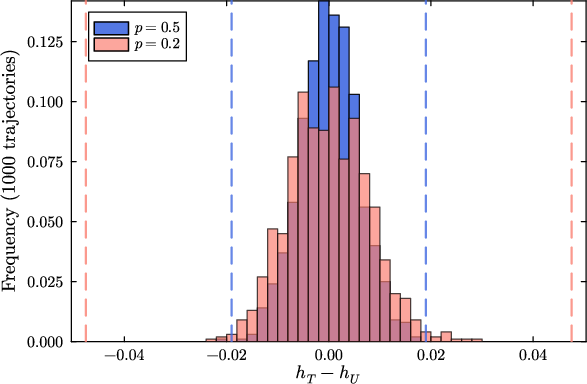
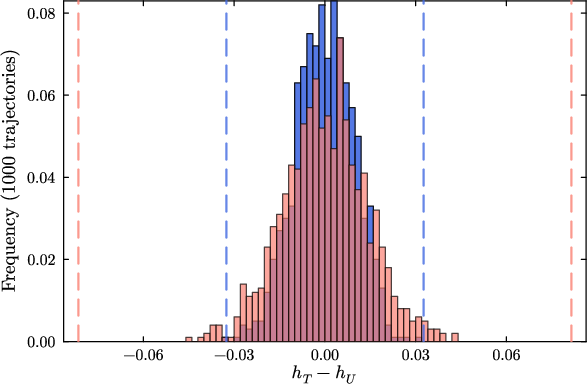
Figure 1: Certification error histograms for energy estimation under drift in two Hamiltonian models, with observed errors tightly bounded by the theoretical certification interval.
Entanglement certification is addressed using a partially entangled state and a specific witness observable. The protocol is compared against a static block-certification protocol (where only an initial block of states is measured and used for estimation), demonstrably showing that static block certification can lead to systematic bias under drift, whereas the dynamic spot-checking protocol remains unbiased and robust.
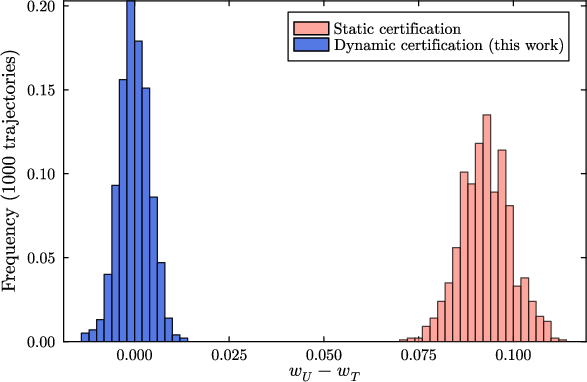
Figure 2: Comparison of the dynamic spot-checking protocol with block certification for entanglement witnessing under ongoing drift; only the former yields unbiased and reliable error bounds.
Experimental Realization on a Superconducting Quantum Processor
The framework is experimentally validated on the IBM t8 quantum processor by certifying the fidelity of Bell-state preparations across 64 disjoint qubit pairs. Each state is stochastically assigned to a test or use round; certification bounds are computed from test-round data alone. The measured certification error is consistently within the predicted bounds, despite correlated hardware drifts and crosstalk inherent to large-scale quantum devices.
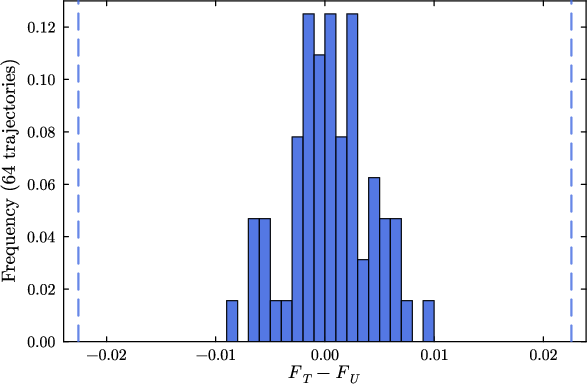
Figure 3: Experimental Bell-state certification error on an IBM quantum processor: certified test-set estimates robustly predict the average property of the use-set within strict confidence limits.
Implications and Future Directions
This work establishes that non-i.i.d. (history-dependent) quantum sources can be certified with statistical rigor comparable to i.i.d. sources, provided that the measurement protocol is randomized and the estimator is unbiased and bounded. Contrary to longstanding conventions, independence is not a prerequisite for strong quantum certification guarantees. The framework’s flexibility enables sample-efficient certification in the presence of drift and temporal correlations that are ubiquitous in modern experimental platforms.
Potential extensions include the use of tighter (e.g., Freedman’s) inequalities for improved bounds at small test probabilities, adaptation to process certification and randomized benchmarking under drift, and integration with cryptographic protocols where memory effects are adversarial.
Conclusion
"Certifying quantum states without independence assumptions" introduces a comprehensive and statistically robust approach to quantum certification in the presence of memory, feedback, and drift, leveraging martingale concentration for unbiased, bounded estimators. Theoretical results are corroborated in numerical and experimental settings, underscoring the practicality and generality of the approach for certifying quantum protocols, sensors, and distributed quantum systems beyond independence assumptions. This work lays a new statistical foundation for the verification and certification of quantum technologies operating in realistic, non-idealized regimes.

