- The paper presents a tight characterization of d-Clique Packing by proving both an n^(O(k^(d‑1))) algorithm and matching ETH-based lower bounds for graphs parameterized by clique-width.
- It employs a fingerprint-based dynamic programming method over clique-width decompositions to efficiently compute partial clique solutions.
- The study rigorously demonstrates W[1]-hardness for d-Clique Packing and Partition, highlighting a clear complexity barrier for dense graph algorithmics.
Tight Complexity Bounds for Clique Packing Parameterized by Clique-Width
Introduction and Motivation
The paper "Tight bounds for clique-packing parameterized by clique-width" (2606.31873) presents a rigorous analysis of the d-Clique Packing (d-\ClqPackp) and d-Clique Partition (d-\ClqPartp) problems with respect to the structural graph parameter clique-width. The central object of study is, for fixed integer d≥3, the computational complexity of finding t pairwise vertex-disjoint d-cliques in a graph G, where G is additionally provided with a clique-width decomposition (specifically, a k-expression). The clique-width parameter is of particular interest as it generalizes treewidth and efficiently characterizes dense graphs.
The primary technical result of the paper is the establishment of both algorithmic upper bounds and matching lower bounds under ETH for d0-\ClqPackp and d1-\ClqPartp parameterized by clique-width d2. Specifically, the authors show that these problems admit algorithms running in d3 time given a d4-expression of d5, and that no d6 time algorithm exists for fixed d7 unless the Exponential-Time Hypothesis fails, even for d8-clique partitioning on graphs with a given linear d9-expression.
Clique-Width, NLC-Width, and Problem Definition
Clique-width (d0) is defined as the minimum number d1 such that the graph d2 can be described by a sequence of four operations (vertex introduction, relabeling, joining, and union) with at most d3 labels. The NLC-width is a related parameter that supports a slightly different formalism but remains proportional (within a factor of two) to clique-width, facilitating dynamic programming approaches over expression trees.
The d4-Clique Packing problem is formalized as: given graph d5 and integer d6, is there a family of d7 pairwise vertex-disjoint d8-cliques in d9? For d0, this is maximum matching; for d1, it is NP-complete. The d2-Clique Partition is the case where d3, i.e., can d4 be partitioned into d5 d6-cliques?
Upper Bound: XP Algorithm for Clique Packing
The main positive result is the design of an d7-time algorithm for d8-\ClqPackp given a d9-expression of d≥30.
The approach uses dynamic programming over the syntax tree of an NLC-expression (converted from the given d≥31-expression), maintaining a table of "fingerprints" (partial solutions) at each node. Each fingerprint encodes, for every multiset of labels of size at most d≥32, the number of partial cliques in the current subgraph with that label signature. Once d≥33 vertices have been accumulated in a clique, the precise label composition can be forgotten, and these completed cliques are counted collectively.
The crucial observation enabling complexity reduction is that the number of relevant label multisets for cliques of size up to d≥34 is d≥35. Dynamic programming tables are thus of size d≥36, and all transitions (introductions, joins, relabels, unions) can be computed efficiently with respect to this table size.
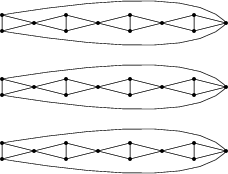
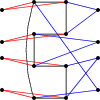
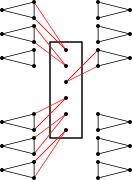
Figure 1: Visualization of gadget constructions used in the reduction—(a) alternation of 2-cliques and single vertices in a color gadget for d≥37, (b) illustration of a selection gadget with two simple edge gadgets, and (c) a simple edge gadget replacing inner cuts in two id gadgets.
Lower Bound: Tight Complexity via ETH
Complementing the algorithmic result, the authors give reductions (from Multi-Colored Clique and its binomial variant) establishing that, under ETH, no d≥38-time algorithm exists for d≥39-ClqPartp on graphs of clique-width t0 even when a linear t1-expression is provided.
The reduction is highly structured, employing novel gadget constructions to encode the selection of a t2-clique as the intersection of several choices propagated through grid-like gadgets. The key lower bound transfer relies on showing that in their construction, the clique-width of the resulting graph grows only as t3 and that the number of relevant partitions in the reduction scales as t4, tightly matching the upper bound.
Figure 1 is directly relevant as it depicts the core gadgets used in this lower bound construction, specifically for t5 (triangle packing/partition).
Notably, the ETH-based hardness persists even for the "partition" version, i.e., when the whole vertex set must be covered.
Hardness and W[1]-Intractability
Beyond tight XP-time bounds, the constructed reductions witness W[1]-hardness of t6-ClqPackp for each t7 parameterized by clique-width. This categorically distinguishes the problem from the numerous FPT cases for monadic second-order (MSO) definable problems on bounded clique-width graphs (by Courcelle's Theorem), since t8-ClqPackp is not MSO-expressible for variable t9.
Structural and Technical Contributions
The paper provides a complete parameterized complexity classification for d0-\ClqPackp and d1-\ClqPartp with respect to clique-width:
- XP-algorithm in d2 time for every fixed d3, matching lower bound under ETH.
- d4-\ClqPackp and d5-\ClqPartp are W[1]-hard for parameter d6.
The technical novelty lies in (i) the fingerprint-based dynamic programming scheme that reduces the exponential dependence on d7 in the exponent to d8, and (ii) the meticulous gadget-based reductions that preserve clique-width.
Implications and Future Directions
The results directly generalize the understanding of clique-width parameterizations beyond well-studied problems (e.g., Max-Cut, Hamiltonian Cycle). They demonstrate that even within a natural problem family, the complexity landscape parameterized by clique-width can admit tight XP (but non-FPT) upper and lower bounds with polynomial dependence in the exponent, in contrast to FPT or subexponential algorithms possible for bounded treewidth.
Practically, this means that improving upon d9 time for clique packing is unlikely unless ETH fails. Theoretically, the techniques reinforce the sharp distinction between clique-width and treewidth in dense graph algorithmics.
There remain considerable open questions in the classification of other packing and partitioning problems (and their induced variants) on bounded clique-width graphs. The paper prompts investigation into which other problems exhibit XP-type tight bounds parameterized by clique-width and which fall into FPT or harder complexity classes.
Conclusion
This work establishes a comprehensive and tight parameterized complexity dichotomy for the G0-Clique Packing and Partition problems with respect to clique-width. By providing matching upper and lower bounds, it precisely delineates the computational barrier for these problems and identifies the exact exponents attainable under ETH. The algorithmic frameworks and lower bound techniques developed herein will be instrumental in further research on structural parameterizations of dense graph problems.
Reference: "Tight bounds for clique-packing parameterized by clique-width" (2606.31873)