- The paper introduces TopoGPT, which applies an autoregressive sequence model with geometry priors to enhance lane graph completeness and endpoint alignment.
- It utilizes a two-stage training, beginning with large-scale map pre-training using cubic Bézier tokenization and followed by sensor data fine-tuning via BEV tokens.
- Empirical evaluation on OpenLane-V2 shows significant improvements over existing methods, reinforcing its potential for robust autonomous driving.
Generative Lane Topology Reasoning via Autoregressive Model with Geometry Prior
Motivation and Problem Analysis
Lane topology reasoning is central to autonomous driving, enabling vehicles to transform sensor data into structured lane graphs and accurately infer centerline connectivity. Prevailing designs predominantly adhere to detection/association paradigms, generating lane instances independently and subsequently constructing topology via dense pairwise reasoning. This decoupling introduces geometric inconsistencies, notably misaligned centerline endpoints, and incomplete lane graphs under occlusion or limited recall, undermining navigational reliability. The paper advances the hypothesis that lane graphs possess strong geometric priors—structural regularities intrinsic to roadway topologies—which, if effectively exploited, can ameliorate the aforementioned deficiencies. To that end, the authors propose TopoGPT, a framework that leverages generative sequence modeling to encode geometry priors in lane topology reasoning.
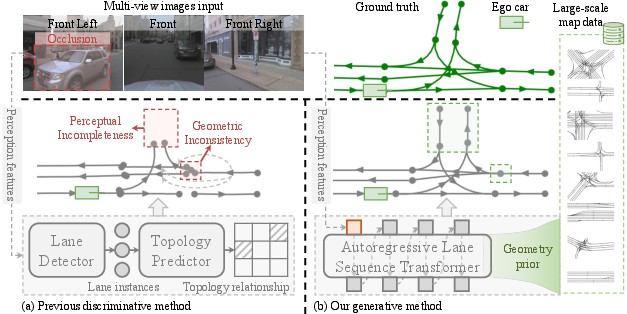
Figure 1: Conventional discriminative methods exhibit misaligned endpoints and omissions under occlusion; TopoGPT generates complete, contiguous lane graphs using geometry prior conditioned on image-derived perception tokens.
TopoGPT: Framework and Model Architecture
TopoGPT's architecture is built upon an autoregressive Lane Sequence Transformer (ALST) and is structured as a two-stage training paradigm. Initially, geometric map-prior pre-training is performed using a map-only dataset comprising 3.3 million scenes from diverse HD map sources (e.g., Waymo, nuPlan). Each lane graph is serialized into lane token sequences via a custom tokenizer that fits cubic Bézier curves to centerlines, quantizing the control points for discrete representation. Lane graphs are additionally rasterized to produce pseudo-images, which are encoded as scene tokens via a convolutional encoder. The ALST is then conditioned on these scene tokens to perform next-token prediction, learning the joint distribution and topology structure of lane graphs.
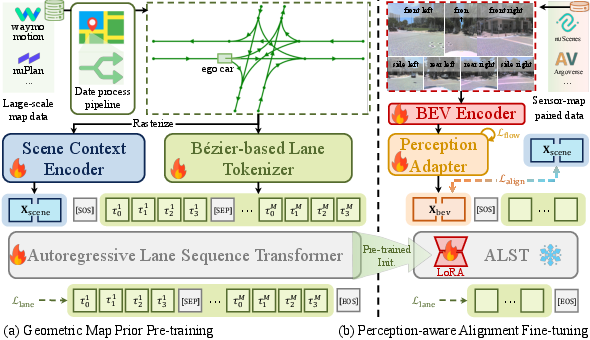
Figure 2: TopoGPT workflow: Lane sequence transformer is first pre-trained on large-scale map data with scene-conditioned lane token sequence generation; fine-tuning aligns BEV perception tokens with pre-trained scene tokens for sensor-conditioned topology prediction.
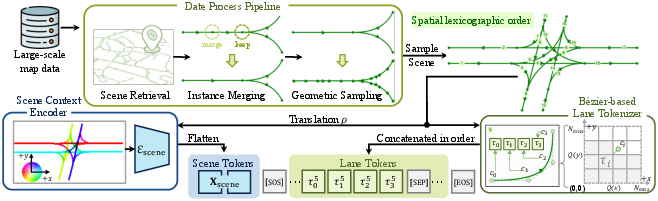
Figure 3: Lane graph tokenization pipeline: Map data is rasterized for scene encoding and centerlines are discretized with Bézier control point quantization, then spatially ordered for token sequence assembly.
In the second stage, perception-aware alignment fine-tuning is executed on sensor-map paired data. Multi-view images are processed by a Bird's-Eye-View (BEV) encoder (ResNet-50 backbone), which lifts fused 2D features to 3D BEV space. These features are mapped to the pre-trained scene condition token space by a perception adapter using noise-free flow matching, a deterministic trajectory-based distribution alignment method, ensuring seamless conditioning in downstream ALST decoding.
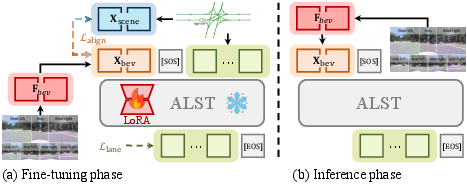
Figure 4: Fine-tuning process: BEV tokens are optimized jointly for alignment and lane prediction; inference directly uses BEV tokens as generative conditions for lane graphs.
Methodological Innovations
Lane Graph Serialization: The lane tokenizer provides a compact, deterministic serialization of centerlines using cubic Bézier parameterization, ensuring endpoint consistency and robust spatial ordering. The quantization strategy enables direct token sequence reconstruction, facilitating offline learning from large-scale map data decoupled from sensor constraints.
Geometry Prior Learning: Pre-training with global scene context and completion data augmentations—random geometric transformations and scene token degradation—enables the model to internalize structural regularities and infer missing lanes, addressing perceptual incompleteness under occlusion.
Perception Adapter Using Flow Matching: Unlike diffusion models reliant on Gaussian noise, flow matching permits structured feature alignment across modalities, allowing efficient adaptation from BEV tokens to the pre-trained scene token distribution. Loss objectives combine feature-level alignment and end-to-end cross-entropy on lane token prediction, minimizing modality shift and leveraging pre-trained priors.
Empirical Evaluation
Experiments are conducted on the OpenLane-V2 benchmark, with comparisons to TopoNet, TopoMLP, TopoLogic, and TopoPoint. TopoGPT demonstrates substantial improvements—average +6.4 on lane-level and +11.6 on point-level metrics (e.g., M-P, M-R, M-T, G-IoU, SDA, G-F1, T-F1, JT-F1, APLS). These gains validate the efficacy of geometry prior transfer and autoregressive generative modeling.
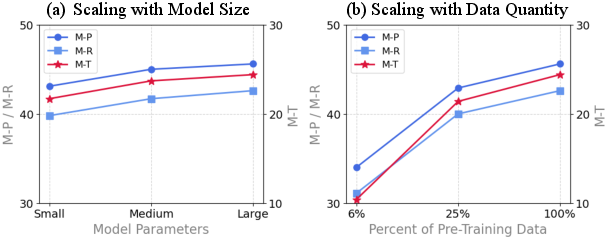
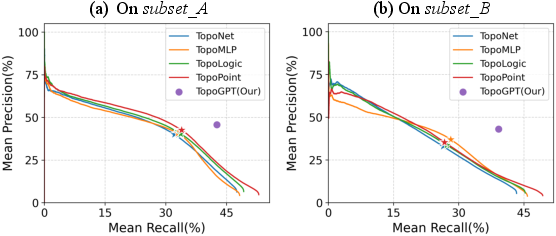
Figure 5: Performance scaling: Larger models and increased pre-training data consistently yield improved fine-tuned results across all lane topology reasoning metrics.
Qualitative comparisons reveal TopoGPT's capability to generate structurally complete lane graphs, superior geometric consistency at endpoints, and accurate inference of occluded connectivity, outperforming TopoPoint in challenging scenarios.
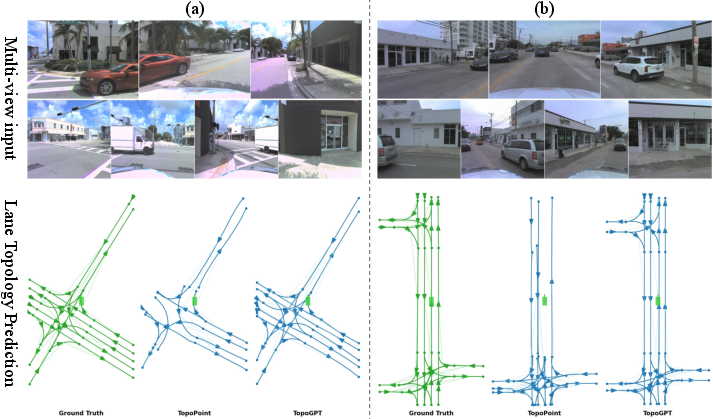
Figure 6: Lane graphs generated by TopoPoint (baseline) and TopoGPT reveal improved structural coherence, endpoint alignment, and topology completeness using geometry prior conditioning.
Ablation studies systematically validate model design choices: pre-training augmentations (global and condition degradation) synergistically enhance metric performance; LoRA-based fine-tuning achieves parameter-efficient adaptation; flow-matching steps in the perception adapter augment alignment quality; removal of loss terms significantly degrades accuracy, underscoring the importance of end-to-end optimization.
Implications and Future Directions
TopoGPT establishes generative sequence models with geometry priors as a viable solution for lane topology reasoning, capable of producing spatially consistent and structurally realistic lane graphs from visual data. Practical implications include improved navigational robustness in autonomous vehicles, enhanced lane graph completion under occlusions, and reduced reliance on large paired sensor-map datasets.
Theoretically, this methodology demonstrates the potential for transferring structural priors from large-scale unpaired map data to sensor-conditioned generative models via autoregressive learning and flow-based alignment. The scalability results suggest that expanding pre-training corpora and model size may further augment downstream performance, analogous to scale trends in language and vision models.
Future research may target reducing autoregressive decoding latency for real-time applications, mitigating error propagation in sequential token generation, and improving generalization to non-standard road layouts. Extensions could involve hierarchical tokenization for finer topology resolution, integration with trajectory or SD map priors, and leveraging multi-modal sensor fusion.
Conclusion
TopoGPT advances generative lane topology reasoning by explicitly modeling geometry priors through autoregressive sequence prediction. The framework utilizes map-only large-scale pre-training to encode structural regularities and adapts perception-conditioned inference via robust flow-matching adapters. Empirical evaluation confirms its superiority over discriminative approaches in both lane-level and point-level metrics, producing lane graphs with improved geometric consistency and completeness. The methodology sets the stage for further explorations in generative map reasoning and structural prior transfer in autonomous driving systems.