- The paper compares LBT's laser-based metrology with Rubin's wavefront sensing to track telescope alignment and collimation.
- The paper highlights that LBT’s TMS provides superior stability against gravity and thermal perturbations, reducing re-collimation frequency.
- The paper demonstrates that integrating metrology and wavefront sensing offers promising strategies for the design of future Extremely Large Telescopes.
Comparative Analysis of Laser-Based Metrology and Wavefront Sensing in Active Optics: Large Binocular Telescope versus Vera C. Rubin Observatory
Introduction
This paper provides a rigorous comparative evaluation of the telescope alignment and collimation tracking architectures deployed at the Large Binocular Telescope (LBT) and the Vera C. Rubin Observatory, focusing on the intersection and trade-offs between laser-based metrology and image-based wavefront sensing approaches in 8-meter class facilities. The distinct operational paradigms and technical implementations for both the initial alignment phase and real-time active collimation during science observations are systematically analyzed, with direct implications for the optomechanical design and control of upcoming Extremely Large Telescopes (ELTs).
Architecture and Implementation of Alignment and Collimation Control
LBT: Laser-Based Metrology with Image-Domain Wavefront Sensing
LBT's AOS exemplifies a hybrid approach where an initial optical alignment is established via focal plane image analysis (FPIA) using the science detectors themselves, thereby circumventing the need for dedicated wavefront sensors. In ongoing operation, a laser-based Telescope Metrology System (TMS) delivers real-time, micron-level monitoring and correction of the relative position between the primary mirror and the focal plane instrumentation (LBC), which is currently extended toward the adaptive secondary system. This enables persistent maintenance of collimation—effectively decoupling gravity-induced and thermally driven rigid-body drifts from dynamic (seeing-induced) aberrations.
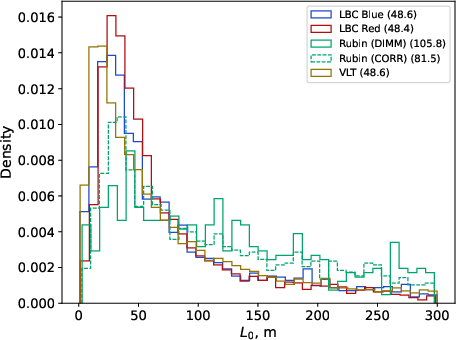
Figure 1: Distribution of turbulent outer scale (L0) derived from empirical FWHM and DIMM seeing data for LBT, Rubin, and VLT reference datasets, illustrating site-specific turbulence statistics and systematic effects in FWHM estimates.
Rubin: Laser-Tracker Initial Alignment and Curvature Wavefront Sensing
The Vera C. Rubin Observatory adopts an opposing baseline paradigm: initial coarse alignment is established via high-precision mechanical measurement using a laser tracker (LT), whereas real-time alignment and mirror figure adjustments during observations rely on a closed-loop curvature wavefront sensing (CWFS) system using dedicated defocused detectors at the LSSTCam focal plane corners. The wavefront sensing pipeline processes in- and out-of-focus stellar images, extracting Zernike polynomial aberrations up to 28th order and providing corrections for both rigid-body alignments and high-order mirror deformations.
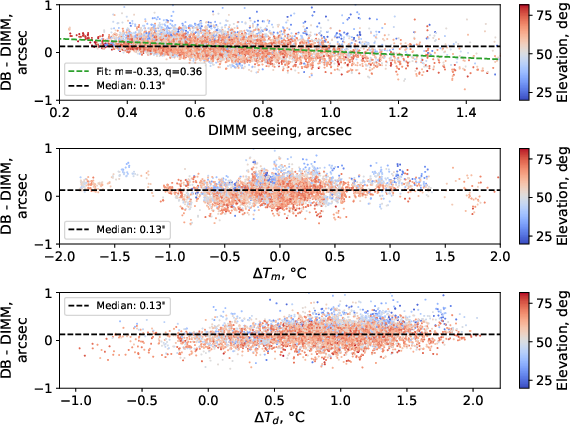
Figure 2: Differential analysis of Rubin Observatory's DONUT BLUR (DB, a PSF-derived seeing metric) vs DIMM seeing, revealing residual systematics and sensitivity to dome/mirror thermal conditions.
Seeing Calibration and Systematic Analysis
Quantitative performance comparison hinges on robust separation of atmospheric seeing from telescope- and dome-induced aberrations. The study utilizes a FWHMAOS metric, derived by subtracting the appropriately calibrated seeing contribution (DIMM-based, correcting for air-mass, wavelength, and finite outer scale per von Karman turbulence) from the measured science FWHM raised to the 5/3 power—a standard in image quality decomposition. The extracted L0 distributions (Figure 1) underscore site-specific differences, as well as potential systematics in Rubin's FWHM calibration (median outer scale ∼105 m compared to 49 m for LBT/VLT), likely attributed to residual PSF broadening from incomplete dome venting and AOS LUTs not fully optimized in the final commissioning phase.
Effectiveness Against Gravity and Thermal Perturbations
Evaluation of FWHMAOS as a function of atmospheric seeing, telescope elevation, mirror-dome temperature gradients, and time since last active alignment reveals:
- Both AOS implementations are robust against external seeing fluctuations, with median FWHMAOS showing negligible dependence on seeing (Figure 3).
- LBT's TMS-aided scheme exhibits superior stability at low elevations, suggesting more effective compensation for gravity flexure, while Rubin's performance degrades earlier with decreasing elevation.
- Both systems show increased FWHMAOS for ∣ΔTm∣>1 K (mirror-air) and ∣ΔTd∣>0.5 K (dome-outside), validating the residual impact of local seeing and underlining the necessity for advanced thermal management (Figure 4).
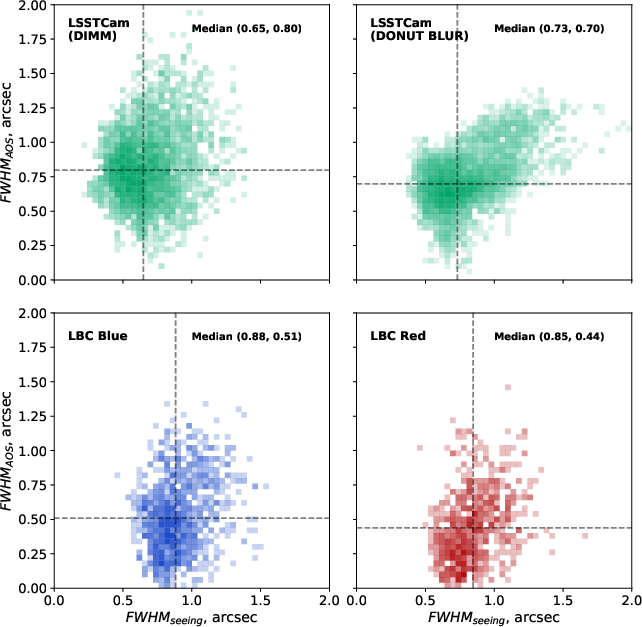
Figure 3: FWHMAOS0 versus telescope elevation for Rubin and LBT, highlighting differing system response to gravity-induced flexures; exponential fits demonstrate LBT’s enhanced low-elevation performance.
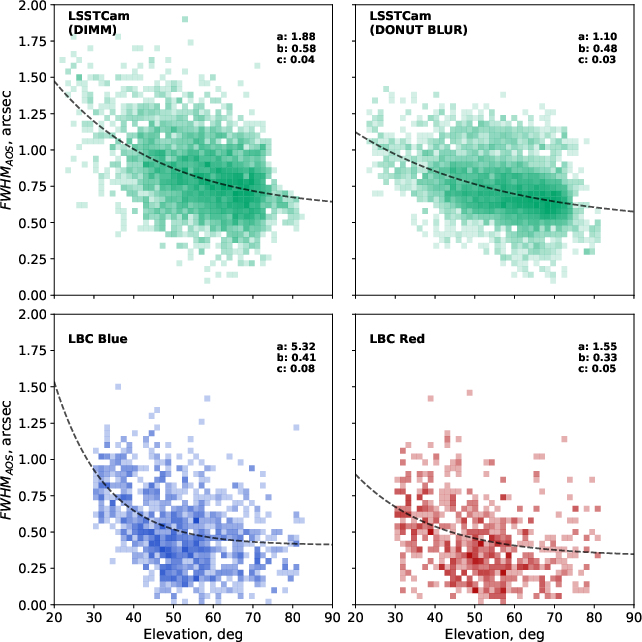
Figure 4: FWHMAOS1 as a function of primary mirror-to-air temperature gradient, revealing the thermal sensitivity of both systems beyond 1 K differential.
- Temporal analysis determines that both systems sustain alignment over substantial (>1.5 hr) intervals post-collimation, with the TMS reducing re-collimation frequency at LBT relative to pre-metrology operation.
Implications for Extremely Large Telescope Design
The LBT and Rubin architectures serve as demonstrators for essential technologies in the upcoming ELT era. Key insights include:
- Absolute metrology systems (TMS, LT) provide a robust initial state and enable extended intervals between full optical recollimation, crucial for large, flexure-prone ELT structures and their massive focal instruments.
- Wavefront sensing (especially in wide FoV, thermally dynamic survey telescopes) is indispensable for real-time correction of higher-order aberrations, unobservable via sparse mechanical fiducials alone.
- Hybrid control, balancing metrology-based rigid-body feedback and image-based wavefront analysis, offers the most operational flexibility, particularly as optomechanical complexity and thermal heterogeneity increase in future ELTs.
- The observed systematics in PSF width at Rubin highlight the ongoing need to refine LUTs and final thermal/ventilation balancing, underlining the maturation that ELT AOS pipelines will require post-commissioning.
Future Development and Research Directions
With Rubin Observatory’s LT system approaching routine operation and LBT extending its TMS toward the adaptive Gregorian focus, both facilities are positioned to empirically test the ultimate complementarity of laser-based and wavefront-sensor-driven architectures. Critical future research includes:
- Assessment of pure-LT versus empirical-restoration initial alignment at Rubin, specifically quantifying impact on AOS performance and science image quality.
- Joint exploitation of TMS and focal-plane wavefront sensors at LBT for high-order mode discrimination and non-rigid body error attribution.
- Application and eventual enhancement of these frameworks for ELTs, particularly with respect to modular open/closed-loop LUT adaptation and thermal loading compensation strategies.
Conclusion
This comparative study establishes that both laser-metrology and wavefront sensing strategies, when judiciously integrated and calibrated, provide highly stable and robust collimation tracking in 8-meter class telescopes under real operational constraints. LBT’s TMS delivers outstanding stability in alignment, especially at low elevations and over long durations, while Rubin’s image-domain CWFS enables continuous closed-loop corrections during rapid survey operations. The future of ELT-scale AOS will be strongly informed by this synergistic approach, emphasizing operational flexibility, system redundancy, and fine-grained optomechanical diagnostics. Ongoing refinements in thermal management, LUTs, and sensor fusion are expected to yield further performance gains as both architectures converge toward the next generation of astronomical instrumentation.