- The paper introduces the Barycentric Dominance Field as a continuous scalar field that encodes vertex topology for direct native 3D mesh generation.
- It leverages a BDF-guided flood-fill algorithm to decode voxel intersections, achieving superior artifact-free reconstruction and outperforming autoregressive models on metrics like Chamfer and Hausdorff distances.
- The approach integrates decoupled VAEs and sparse diffusion transformers to jointly generate mesh topology and PBR textures with minimal computational overhead.
Barycentric Dominance Field for Scalable Native 3D Mesh Generation
Motivation and Background
Direct generation of native 3D meshes—explicit topology and vertex positions—has seen considerable advancement with autoregressive (AR) sequence models. However, the AR paradigm introduces intrinsic bottlenecks: face/token count limits due to fixed sequence lengths, discretization granularity tied to limited vocabulary, and sequence error propagation resulting in geometric artifacts. These issues impair the scalability, resolution, and robustness of AR-generated meshes, especially for high-poly, artist-created models. Continuous diffusion models, while highly effective for implicit 3D generation, have lacked a representation that can bridge back to native, topology-explicit mesh synthesis without dramatic architectural overhauls.
This paper introduces the Barycentric Dominance Field (BDF), a continuous, intrinsic surface signal derived from the maximal barycentric coordinate at each surface point. BDF is shown to possess continuity and bounded variation, offering a mathematically principled field that encodes vertex topological information in a form compatible with neural field learning and continuous generative frameworks.
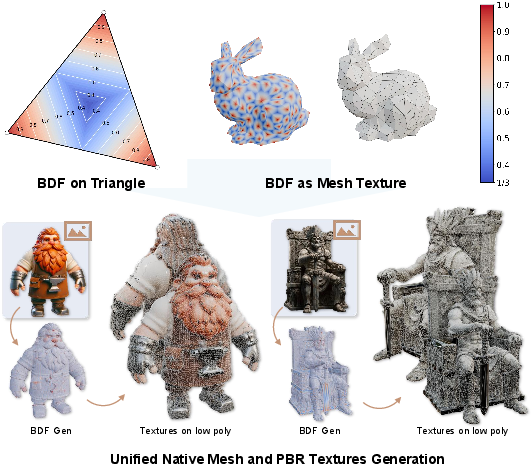
Figure 1: (Top) Visualization of the Barycentric Dominance Field's scalar values and contour lines on a triangular mesh; (Bottom) Joint native mesh and PBR texture generation enabled by the unified BDF framework.
Given a triangle T with vertices {V1,V2,V3}, the barycentric coordinates (w1,w2,w3) of any point p∈T satisfy w1+w2+w3=1, with wi≥0. The BDF at p is defined as B(p)=max(w1,w2,w3). BDF assigns a value in [1/3,1] across the mesh surface, peaking at vertices (B(p)=1) and reaching a minimum at face centers ({V1,V2,V3}0).
Key mathematical properties include:
- {V1,V2,V3}1 continuity: BDF remains continuous across triangle boundaries, avoiding artificial discontinuities.
- Lipschitz continuity: The local variation of BDF is bounded due to the affine nature of barycentric coordinates and the non-expansive max operation, supporting robust neural network regression.
These properties make BDF apt as a neural supervision target, facilitating integration with mature diffusion model architectures.
Mesh Encoding, Decoding, and the Generation Pipeline
Integration of BDF into a scalable generative pipeline is achieved by extending the Dual Contouring (DC) mesh-to-sparse-voxel codec with BDF supervision. During encoding, BDF values are densely sampled and stored on intersected voxel edges in a high-resolution grid. Mesh vertices are highlighted by associating peak values ({V1,V2,V3}2) to edges corresponding to original vertex locations. At the decoding and reconstruction stage, a novel BDF-guided flood-fill algorithm recovers mesh topology by propagating along BDF contours from local maxima, yielding Voronoi and wireframe structures from which faces are trivially reconstructed.
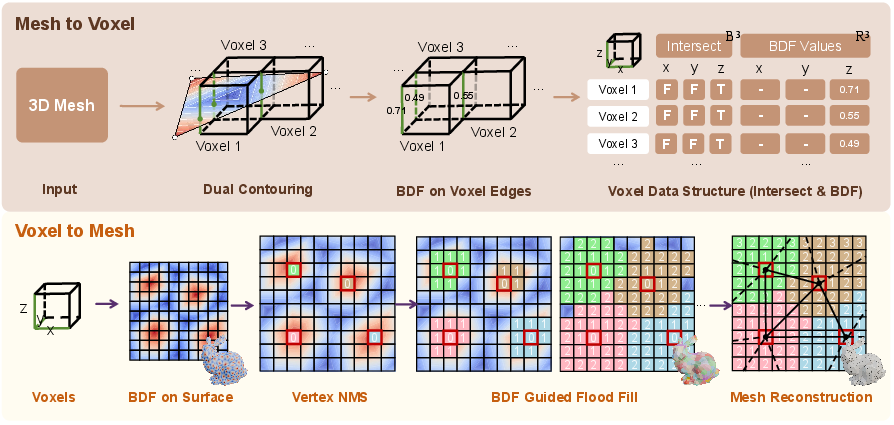
Figure 2: (Top) BDF encoding in sparse voxels leveraging DC edge intersections; (Bottom) Flood-fill decoding finds mesh vertices and propagates contours to recover mesh wireframes.
A Variational Autoencoder (VAE) and sparse Diffusion Transformer (DiT) are employed in a fully decoupled, modular latent pipeline. The VAEs for shape, material/texture, and BDF channels share identical U-Net-derived architectures with minimal adaptation, ensuring extensibility and parameter isolation. BDF channels, encoding only three edge BDF values per voxel, impose negligible compute/memory overhead.
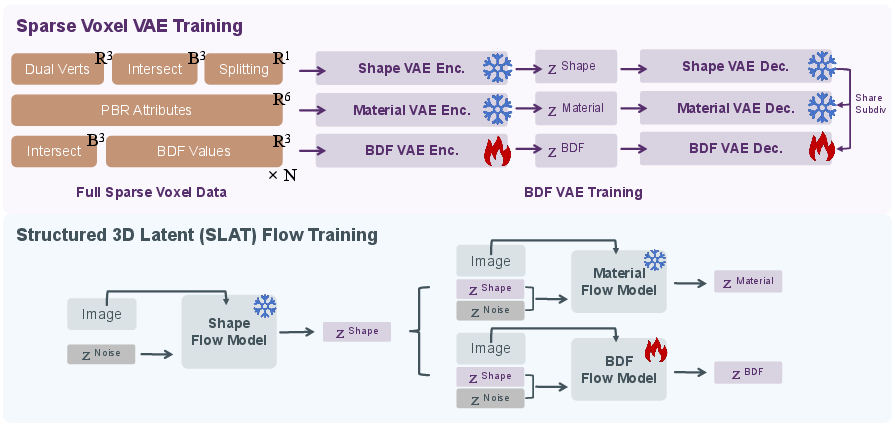
Figure 3: VAE and Flow model architectures, demonstrating channel separation and reuse of the same core U-Net design, only changing the number of input/output channels.
Evaluation on the Toys4k dataset demonstrates strong geometric fidelity and scalability advantages over AR baselines (MeshSilksong, DeepMesh, MeshRipple). On complex, high-poly models, BDF-based diffusion consistently outperforms AR methods in Chamfer Distance (CD), Hausdorff Distance (HD), and Normal Consistency (|NC|). As mesh complexity increases, AR methods experience catastrophic error propagation—fragmented faces and missing surfaces driven by sequence-length related noise—while BDF-based diffusion maintains topology and geometric integrity without resolution-limiting constraints.
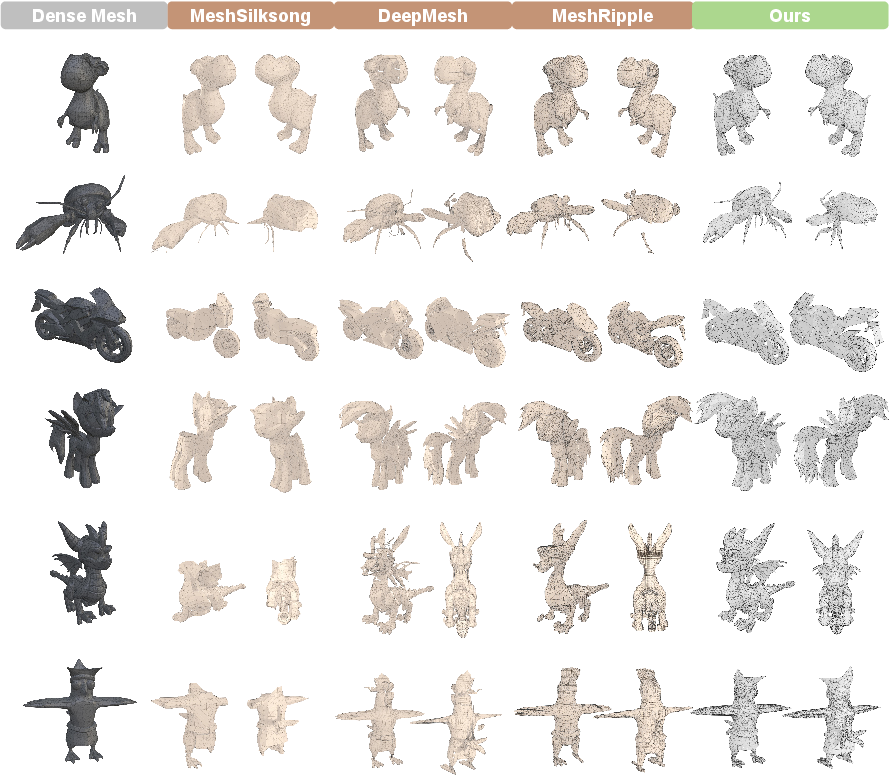
Figure 4: Qualitative comparison—AR models fail on complex meshes; the BDF approach yields stable, artifact-free topologies.
Comparison with decimated high-poly mesh pipelines (e.g., Trellis.2) highlights the production readiness of BDF-generated meshes: direct output at moderate, controlled face counts preserves both topology and surface quality, whereas aggressive decimation of dense meshes induces chaos in adjacency and geometry.
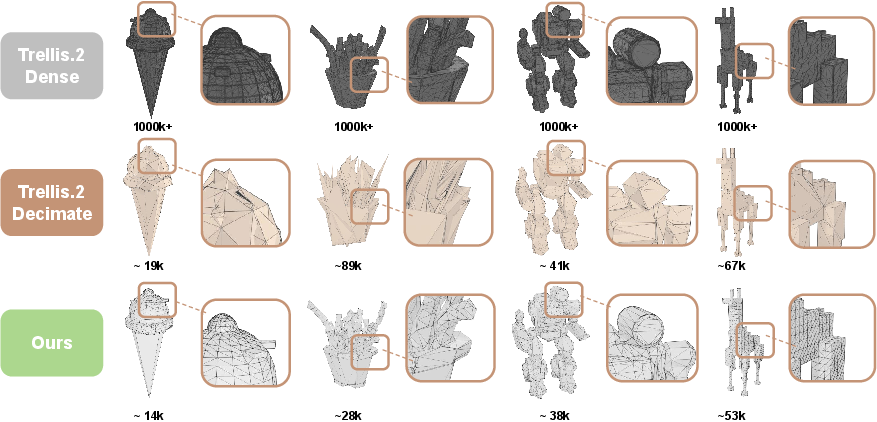
Figure 5: Mesh decimation (left: Trellis.2) degrades surface/topology; BDF method (right) maintains geometric fidelity with optimal face count.
Notably, BDF’s similarity to texture maps enables the first demonstration of fully unified native mesh and PBR texture generation in a single generative pipeline.
Architectural and Loss Function Ablations
The paper conducts detailed ablations to demonstrate that BCE loss, not MSE, is essential for accurate BDF peak sharpening and vertex localization, due to the field’s peaked nature. Moreover, the joint (entangled) VAE architecture substantially impedes BDF’s reconstructive sharpness—manifesting in ambiguous or "muddy" BDF fields. In contrast, decoupled VAEs yield precise spatial localization.
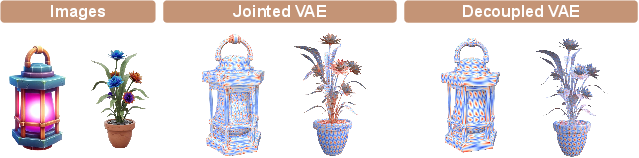
Figure 6: Decoupled VAE design (left) produces crisp and well-localized BDF fields, critical for robust mesh generation; joint VAE (right) introduces field ambiguity.
Implications, Limitations, and Future Directions
BDF bridges a long-standing gap in native 3D mesh generation by providing a mathematically elegant, continuous, and efficiently encoded scalar field, readily processable by diffusion and VAE pipelines. This enables robust, scalable, and unified mesh and texture synthesis, overcoming the brittle, sequential, and discrete limitations of AR models.
Pragmatically, the approach delivers high-quality, topology-explicit meshes suitable for professional graphics pipelines. Theoretically, BDF establishes a meaningful equivalence between discrete mesh structures and continuous neural fields, which may influence further research on unified surface, topology, and attribute generation.
Nevertheless, BDF is presently tied to Dual Contouring and voxel grid resolution, which can occlude extremely fine topological detail. Additionally, propagation can be susceptible to self-intersecting mesh artifacts during decoding. Opportunities exist to explore grid-independent codecs or alternative continuous field representations that further approach information-theoretical limits for encoding mesh topology.
Conclusion
The introduction of the Barycentric Dominance Field advances the state-of-the-art in native 3D mesh generation by reconciling discrete topological mesh structure with continuous generative modeling. The empirical results underline clear gains across scalability, robustness, and quality. BDF’s compatibility with texture representations sets the stage for future research in unified geometric, topological, and multimodal 3D asset creation (2606.31777).