- The paper demonstrates a monolithically integrated InGaAs/GaAs quantum dot on silicon as a viable source for energy–time entangled photon pairs using epitaxial engineering.
- Coherent two-photon excitation and Franson interferometry reveal precise control over the biexciton–exciton cascade and robust interference visibilities (up to 64%).
- Measured short radiative lifetimes and controlled dephasing indicate practical potential for scalable quantum communication and on-chip photonic integration.
Energy–Time Entanglement from a Monolithically Integrated Quantum Dot on Silicon: An Expert Analysis
Integrated III–V Quantum Dots on Si: Epitaxial Engineering
The integration of deterministic quantum light sources into scalable platforms remains a central objective for quantum photonics. This work establishes an epitaxially grown InGaAs/GaAs quantum dot (QD) on a Si substrate as a viable energy–time entangled photon source, addressing the formidable Incompatible lattice constants and polar/non-polar interface complications associated with direct III–V on Si growth.
The heterostructure employs a GaP nucleation layer to mediate the III–V/Si interface, followed by strain- and dislocation-ameliorating AlGaAs, GaAs, and GaInP layers, creating a virtual GaAs substrate with suppressed anti-phase boundaries and reduced threading dislocation density. The active region consists of self-assembled In0.33Ga0.67As QDs within a λ/n GaAs cavity and enhanced out-coupling via a 32.5-pair Al0.90Ga0.10As/GaAs distributed Bragg reflector (DBR). The high optical quality and integrated design directly target the demands of scalable, CMOS-compatible quantum information platforms.
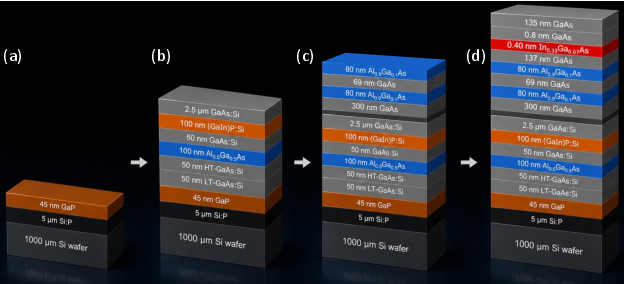
Figure 1: Schematic epitaxial stack, illustrating virtual substrate engineering for III–V QD integration on Si.
Coherent Biexciton–Exciton Control and Biexcitonic Cascade Characterization
The quantum emitter is driven via two-photon resonant excitation (TPE), facilitating precise control over the ground–XX transition. μPL spectra at sub-saturation excitation reveal sharp, well-resolved X and XX emission lines, while increasing excitation uncovers dressed-state splitting attributed to coherent Rabi driving, enabling extraction of the excitation-induced Rabi frequency. Cross-correlation analysis of the XX–X cascade yields the prototypical antibunching/bunching signature, validating the sequential single-photon emission dynamics intrinsic to the cascade. Rapid XX ( (286±12) ps) and X (574±45 ps) radiative lifetimes are attributed to low In-content and are essential parameters for subsequent entanglement and interference analysis, as they dictate the temporal envelope of the biphoton wavepacket.
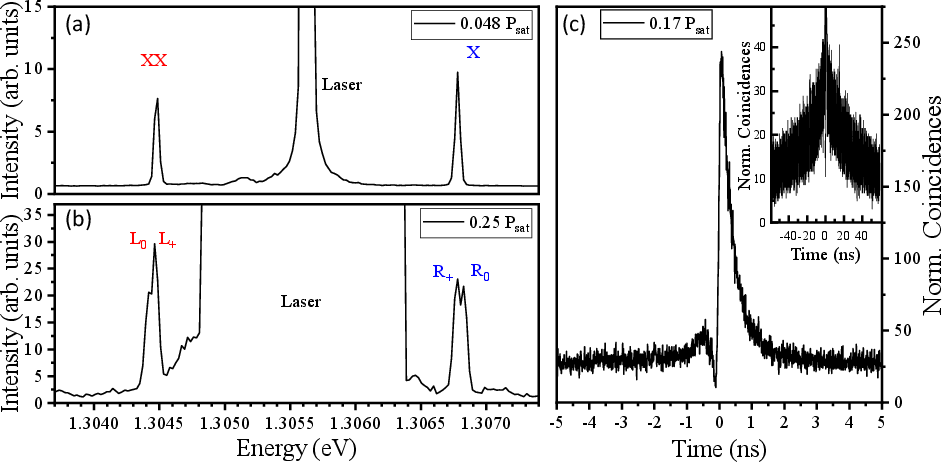
Figure 2: Emission spectra and correlation data under TPE illustrating coherent control, cascade dynamics, and Rabi physics.
Coherence Properties, Cascade Dynamics, and Franson Constraints
The temporal structure and dephasing mechanisms inherent to the radiative cascade directly limit achievable energy–time entanglement. Measured single-photon coherence times, T2,XX=(128±4) ps and T2,X=(91±3) ps, are sub-radiative, indicating non-negligible pure dephasing, exacerbated at high excitation via charge noise, ambient fluctuations, and local heating. Notably, XX coherence is prolonged relative to X, consistent with direct TPE population versus indirect X population through spontaneous emission.
The use of Franson interferometry necessitates interferometer imbalances significantly greater than the XX and X lifetimes to temporally discriminate LL/SS from SL/LS amplitudes, yet short enough to maintain quantum interference. Residual fine structure splitting (FSS) impacts are largely suppressed; limitations on visibility are instead set by the temporal overlap of two-photon amplitudes and practical background/noise considerations.
Franson Interferometric Measurements: Setup and Visibility Outcomes
The experimental realization deploys parallel unbalanced Michelson interferometers for X and XX photons, with automated phase control and active stabilization via an independent reference laser. All-signal and reference paths are fiber-coupled, and spectral separation precedes interferometric splitting, with four-channel SNSPD readout granting maximal detection efficiency and background suppression.
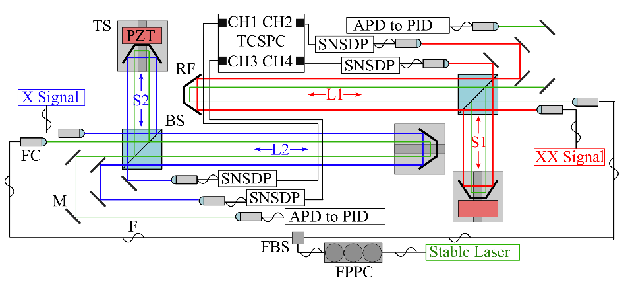
Figure 3: Modular four-channel Franson interferometer with spectrally multiplexed fiber- and phase-stabilized arms.
Temporal coincidence histograms under low-power TPE (0.023 Psat) yield LL/SS two-photon interference visibilities up to (64.0±7.0)% for an 80 ps bin, decreasing to 0.670% for a 1600 ps window. The observed visibilities approach, but do not surpass, the Bell inequality violation threshold (50%), with maximal visibility dependent on careful background subtraction and temporal post-selection. The decrease in visibility with increasing coincidence window duration, even after background subtraction, evidences residual non-interfering contributions inherent to the system, such as long-time blinking/bunching and imperfect spectral filtering.
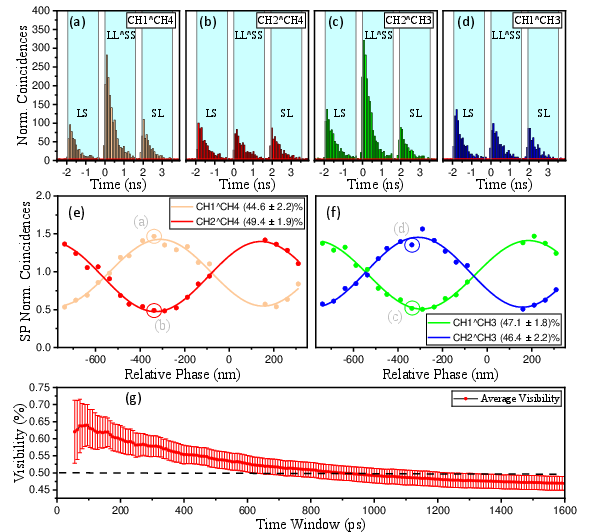
Figure 4: Franson interference phase scans: high-contrast oscillations and window-dependent visibility characterization.
Implications, Comparison with State-of-the-Art, and Prospective Directions
The demonstration of non-classical Franson visibilities from an on-Si III–V QD emitter is a substantial advance toward fully integrated, deterministic entangled photon sources compatible with scalable silicon photonic platforms. Energy–time entanglement intrinsically sidesteps limitations imposed by FSS, positioning this approach favorably against polarization-entangled QD sources—where extensive engineering is required for FSS suppression and emission tunability is constrained.
Reported visibilities, while within the upper performance range for QDs under realistic experimental conditions, remain below those achieved in extensively optimized systems (e.g., 71–84% in InGaAs/GaAs on native substrates [Hohn2023; Gins2021]). This is attributed to (i) enhanced background from integration-induced imperfections, (ii) short lifetimes that constrain biphoton overlap, and (iii) mechanical or optical imbalances in the multi-channel interferometric layout. However, these challenges are primarily technical and are not fundamental limitations of the underlying heteroepitaxial approach.
Future approaches should focus on:
- Enhanced background suppression: via improved growth, etching, and microcavity filtering,
- Precise interferometer engineering: to optimize delay relative to emitter lifetimes,
- Longer 0.671 via optimized charge environment: reducing pure dephasing through passivation, field effect, or advanced buffer design.
The architecture demonstrated is immediately relevant for energy–time encoding-based quantum key distribution and scalable quantum repeater nodes, and compatible with hybrid photonic integration strategies.
Conclusion
This study rigorously demonstrates, for the first time, energy–time entanglement via the XX–X cascade from a monolithically integrated InGaAs/GaAs QD on Si. Achieved Franson visibilities of 0.672% highlight robust two-photon coherence and provide a benchmark for scalable, CMOS-compatible quantum photonic devices. The visibility limitations observed stem from experimental constraints, implying that further engineering can enable QD-on-Si platforms to violate Bell inequalities. These results cement monolithically integrated III–V QDs on Si as a promising technology for future integrated quantum optics, with direct implications for on-chip quantum communication, networking, and distributed quantum computing applications.
References:
"Energy-time entanglement from a monolithically integrated quantum dot on silicon" (2606.31775),
"Energy-time entanglement from a resonantly driven quantum-dot three-level system" [Hohn2023],
"Time-bin entangled photon pairs from quantum dots embedded in a self-aligned cavity" [Gins2021].