- The paper leverages spatial coupling to transform SCMA architectures by creating globally connected factor graphs that enhance the minimum Euclidean distance (MED) and reduce error probabilities.
- It introduces a low-complexity codebook optimization algorithm based on spectral gap maximization that achieves over 99% complexity reduction while maintaining robust distance properties.
- Extensive simulations demonstrate significant BER improvements under various channel conditions, validating the scalability and efficiency of the proposed SC-SCMA approach.
Spatially Coupled SCMA: A Spectral Graph Approach to Scalable Code-Domain NOMA
Introduction and Motivation
The explosive growth of machine-type communications (MTC), characterized by billions of intermittently-active devices, has amplified the need for non-orthogonal multiple access (NOMA) mechanisms with massive connectivity support. Sparse Code Multiple Access (SCMA) is a prominent code-domain NOMA paradigm enabling such overloaded scenarios by mapping user data onto carefully designed sparse multidimensional codebooks, facilitating efficient detection via message passing algorithms (MPA). However, SCMA's error performance and scalability are fundamentally constrained by the minimum Euclidean distance (MED) within the multidimensional superimposed signal space, and existing codebook design strategies mainly target small system sizes due to intractable global optimization in large dimensions.
A critical bottleneck in conventional OFDM-SCMA systems is their block-diagonal factor graph structure, which entails no inter-block user/resource interactions, yielding disconnected global graphs with vanishing spectral gaps and limited coding/diversity gains in large-scale deployments. This paper exploits insights from spatially coupled LDPC codes and spectral graph theory, introducing a spatially coupled SCMA (SC-SCMA) framework to systemically bridge these limitations.
Architectural Innovations: Spatial Coupling and Factor Graph Design
The SC-SCMA approach architecturally departs from classic OFDM-SCMA by introducing structured inter-block connections (spatial coupling). Rather than employing isolated, small-scale codebooks mapped independently on each OFDM block, the authors decompose a prototype factor matrix into several sparse submatrices that realize a controlled overlap between adjacent blocks. This transforms the global factor graph from disconnected block-diagonal to banded block structures with strong local and global connectivity.
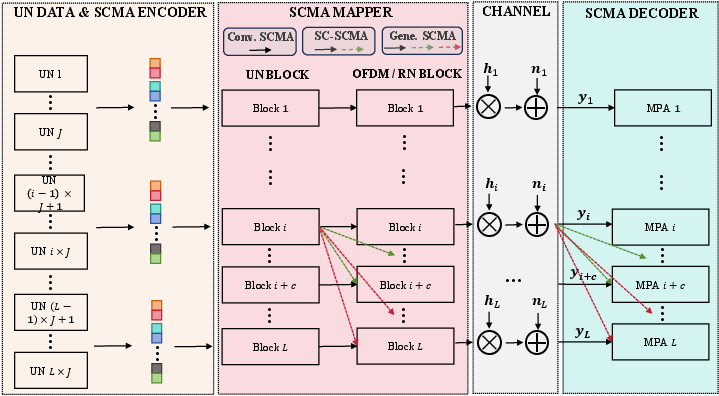
Figure 1: OFDM-SCMA architecture featuring various SCMA mapping strategies and their corresponding coupling-based MPA decoding.
The spatially coupled factor matrix (SCFM) is constructed using a windowed representation, ensuring that each user's resources are spread over multiple adjacent blocks, facilitating both signal-space dimensionality expansion and improved diversity. This windowing mechanism also leads to scalable optimization, as spectral and connectivity properties can be effectively evaluated on local windows instead of the entire graph.
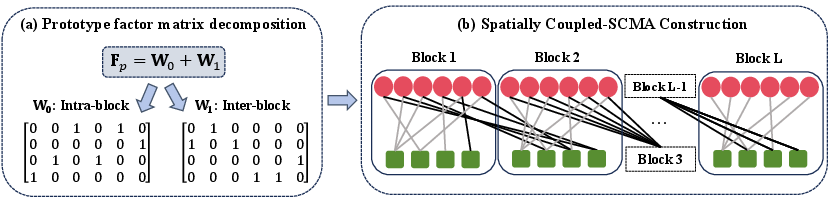
Figure 2: Construction of Spatially Coupled-SCMA via prototype matrix decomposition.
Analytical Framework: From Pairwise Error to Spectral Gap
Central to the analysis is the pairwise error probability (PEP) for multi-user error events, which is tightly governed by the minimum Euclidean distance and the effective access dimensionality (EAD)—the number of non-zero resource nodes involved in a given error event. The authors show that spatial coupling systematically projects the multi-user superposition constellation into a significantly higher-dimensional space, strictly increasing the MED as EAD grows linearly with the coupling width.
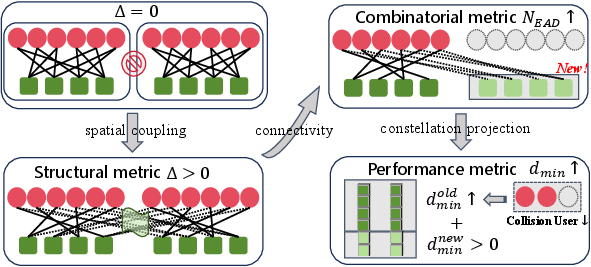
Figure 3: Structural-to-Performance Mapping in SC-SCMA.
A core theoretical contribution is the derivation of a direct, computable lower bound on the EAD via the spectral gap of the associated factor graph. Specifically, spectral graph theory is employed to prove that a larger spectral gap (reflecting stronger graph connectivity) strictly enforces a higher EAD for any non-trivial user group, thereby guaranteeing that spatially coupled SCMA enjoys both superior MED and exponentially decaying error probabilities compared to its uncoupled counterpart.
Codebook Design with Spectral-Gap Optimization and Complexity Reduction
Directly optimizing codebooks for maximized EAD or MED is combinatorially infeasible for large user sets. The paper advances a low-complexity codebook optimization algorithm driven by spectral gap maximization over the windowed SCFM. The key insight is the dominant error-inducing Local User Group (LUG) concept: only a relatively small subset of users/bottleneck error events fundamentally determines the system's distance spectrum. This design shift reduces the parameter search space exponentially (over 99% complexity reduction) without sacrificing structural distance properties.
Empirically, the authors demonstrate that, after spatial coupling, both weak and strong codebooks show marked improvements in MED; for suboptimal codebooks, spatial coupling nearly doubles the MED, while the best-performing codebooks retain their MED unless LUG cardinalities are exceeded.
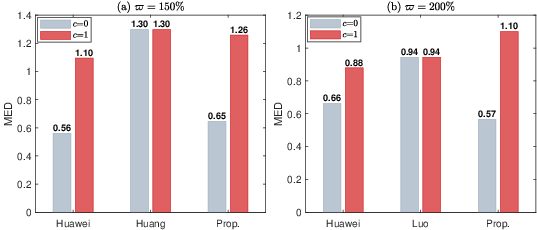
Figure 4: The MED comparison for different codebooks before and after spatial coupling with ϖ=150% and ϖ=200%.
Numerical Results: Error Rate and Robustness
Extensive simulations validate the derived spectral, MED, and BER relations under AWGN and broadband fading (TDL-C and TDL-D) scenarios, with overloading factors ϖ=150% and 200%.
- BER performance improves significantly as spatial coupling is introduced (c=1,2). For example, uncoupled suboptimal codebooks lag the single-user AWGN bound by 3–5 dB, but with c=1 spatial coupling, the gap narrows to 0.5–1.7 dB depending on overloading.
- Codebooks with higher overloading see even greater gains due to stronger spatial connection needs.
- The theoretical advantage persists in harsh frequency-selective channels, with SNR gains of up to 3.8 dB in coded BER at target BER=10−4 and measured over diverse codebook structures and coupling depths.
Theoretical and Practical Implications
The SC-SCMA paradigm establishes a scalable architectural and theoretical code-domain NOMA framework with provable MED and error-rate benefits, driven by a spectral graph mechanism. It demonstrates that the fundamental performance limits in overloaded SCMA are structurally determined by the spectral gap, not merely the local codebook or spreading design. This connection enables:
- Rigorous system analysis based on graph spectra, facilitating structural performance prediction for arbitrary system sizes and codebook choices.
- Efficient design procedures where only local windows and LUGs are optimized—paving the way for massive, low-complexity, and robust access schemes in next-generation IoT scenarios.
- Robustness to channel degradation, as the same design principles yield diversity gains under frequency-selective fading.
Future Directions
While this work develops a unifying AWGN-oriented PEP and design framework, an obvious extension is explicit codebook optimization for minimum product distance in fading channels, potentially leveraging the spectral gap/EAD duality for diversity order control. The spectral gap methodology could further be generalized to analyze/drop seamlessly into other code-domain NOMA or coded random access schemes.
Conclusion
Spatially coupled SCMA, as formalized in this spectral graph approach, overcomes the scalability and performance bottlenecks of conventional SCMA by transforming factor graphs into globally connected structures with enlarged EAD and spectral gaps. This approach provides a foundation for scalable, efficient, and high-reliability code-domain multiple access in dense, overloaded wireless networks, particularly relevant for MTC and IoT applications.

