- The paper demonstrates that extrinsic dynamics impose a hard upper bound (p_C ≤ 1/2) on cooperation in heterogeneous social dilemmas.
- It utilizes rigorous Markov process analysis and extensive numerical simulations to compare extrinsic (Moran, Fermi) versus intrinsic (aspiration, introspection) update rules.
- The study shows that intrinsic dynamics can breach the cooperation ceiling when individual payoffs exceed critical thresholds, suggesting new pathways for decentralized social systems.
The Cooperation Ceiling in Heterogeneous Populations: Extrinsic versus Intrinsic Population Dynamics
Introduction and Framework
This work rigorously addresses how the nature of update rules—specifically, extrinsic versus intrinsic population dynamics—fundamentally constrains the emergence of cooperation in heterogeneous N-player social dilemmas. Framed in the context of evolutionary game theory, the analysis departs from classical homogeneity and systematically delineates the boundaries imposed by extrinsic imitation mechanisms (e.g., Moran, Fermi) relative to dynamics founded on introspective, self-referential updates (e.g., aspiration, introspection).
The state-space is formalized for a population of N ordered individuals, each selecting actions from a common but potentially player-specific set, and payoffs are computed by a vector-valued function accommodating player heterogeneity. State transitions are represented as Markov processes, with ergodicity ensured via action-invariant mutation. This abstraction enables direct comparison between various classes of update rules, setting the stage for subsequent theoretical and numerical analysis.
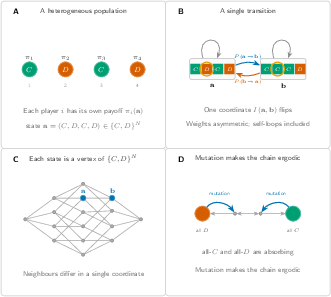
Figure 1: The Markov-chain representation of a heterogeneous population, where states are vertices of an N-dimensional hypercube, and mutation guarantees ergodicity.
Taxonomy of Population Dynamics
The paper introduces a categorical dichotomy between purely extrinsic and purely intrinsic population dynamics:
- Extrinsic dynamics: Strategy updating is based exclusively on payoff comparison with other players in the current state. Two canonical instances are the Moran process (selection-proportional reproduction) and Fermi imitation dynamics (pairwise payoff-based imitation).
- Intrinsic dynamics: Strategy updating is determined by comparing an individual's current payoff with some internal threshold or counterfactual payoff, independent of peer performance. Representative mechanisms include aspiration dynamics (payoff versus aspiration comparison) and introspection dynamics (payoff versus counterfactual under alternative action).
This structural bifurcation is formalized via transition matrix properties for Markov chains, with monotonicity and label-invariance under neutral payoffs rigorously characterized.
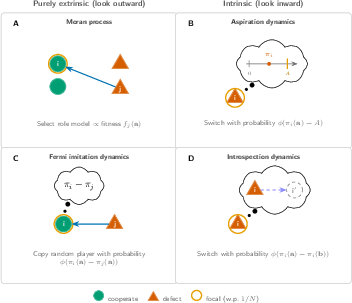
Figure 2: Comparison of four population dynamics—extrinsic (Moran, Fermi) versus intrinsic (aspiration, introspection)—highlighting outward versus inward information sources.
Main Theoretical Result: The Extrinsic Cooperation Ceiling
A central result is that purely extrinsic, neutrally monotone population dynamics are subject to a hard upper bound—termed the "cooperation ceiling"—on the stationary abundance of cooperation in social dilemmas with pointwise dominant defection. Specifically, regardless of payoff structure or parameterization, the mean cooperator abundance pC in such settings cannot exceed the neutral-drift baseline, pC≤21.
The proof leverages the monotone coupling of Markov chains (applying the classic result of Kamae, Krengel, and O'Brien), demonstrates label-invariance in the neutral chain, and constructs a stochastic ordering showing that under domination by defection, all parameter sweeps remain bounded by this ceiling.
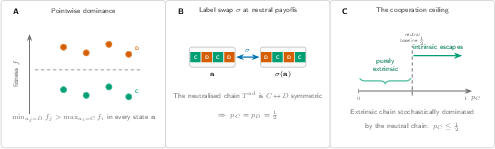
Figure 3: Schematic argument for the inability of extrinsic dynamics to exceed pC=21, even in the presence of strong incentives to cooperate.
This theoretical constraint is further explored in the heterogeneous public goods game, where extensive parameter sweeps across return r, maximum contribution M, mutation rate μ, and selection/choice intensities provide exhaustive empirical confirmation.
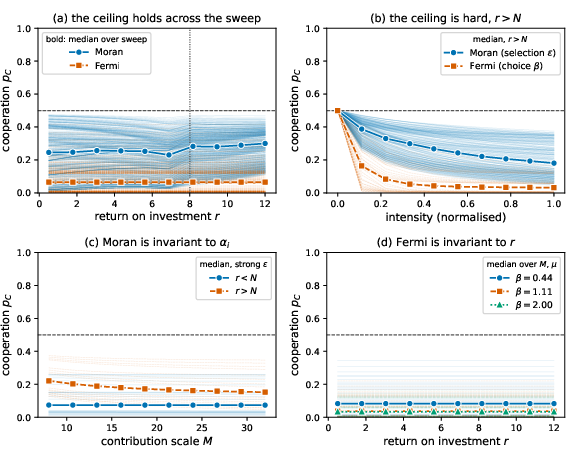
Figure 4: Numerical validation showing that under purely extrinsic dynamics (Moran, Fermi), the stationary cooperation rate never exceeds the neutral-drift ceiling for any parameter set.
Notably, the Fermi process is shown to be invariant to the public good multiplication factor r, while the Moran process is invariant to the player contribution scale N0. These invariances reflect how, for extrinsic dynamics, changes in game parameters often cancel in payoff differences or relative fitnesses, reinforcing the rigidity of the cooperation ceiling.
Intrinsic Dynamics: Escaping the Ceiling
In contrast, intrinsic dynamics can systematically escape the extrinsic cooperation ceiling. Both aspiration and introspection dynamics enable stationary cooperation abundance to exceed N1 once the multiplication factor N2 surpasses the group size N3, i.e., when cooperation becomes individually rational for all agents.
Aspiration dynamics favor strategy update when current payoffs fall below a prespecified aspiration threshold, and introspection dynamics trigger update whenever the counterfactual payoff for an alternative action would exceed the current payoff. Both dynamics rely solely on self-referential information, in stark contrast to the social comparison mechanisms of extrinsic dynamics.
Empirical results from the same high-dimensional parameter sweeps display that the intrinsic processes produce a sharp regime switch: for N4, cooperation remains suppressed, but at N5, N6 climbs steeply and can approach unity depending on aspiration level and contribution heterogeneity.
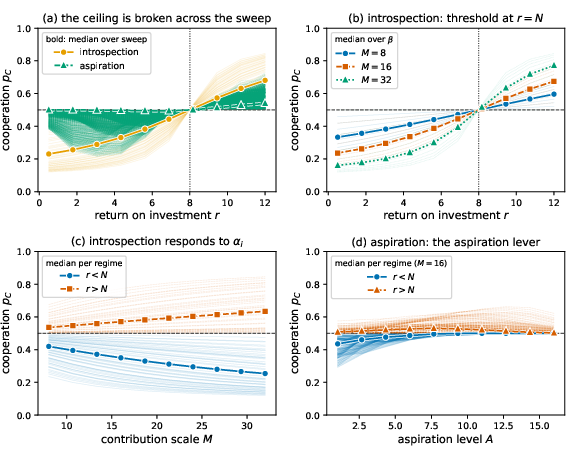
Figure 5: Intrinsic dynamics enable N7 to surpass the extrinsic ceiling; the threshold at N8 is sharply manifested, and the effect of aspiration level N9 is non-monotonic.
Pooling all parameter combinations (Figure 6) highlights the universality of the dichotomy: no extrinsic process ever exceeds the ceiling, whereas a substantial fraction of intrinsic parameterizations achieve N0 when N1.
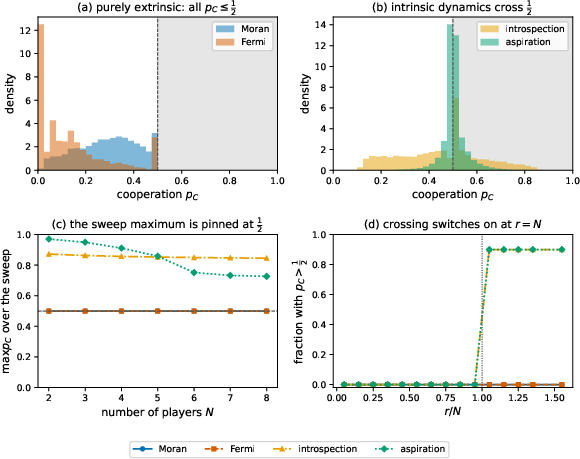
Figure 6: Comparison across all parameters—extrinsic dynamics never breach the ceiling (left), intrinsic dynamics populate higher N2 (middle and right).
Population Size Robustness
A potential concern is whether the cooperation ceiling is an artifact of small system sizes. Direct Markov chain simulations up to N3 confirm that these findings are robust: extrinsic dynamics never surpass the ceiling regardless of N4, while intrinsic dynamics maintain the regime switch and maintain N5 for sufficiently large N6.
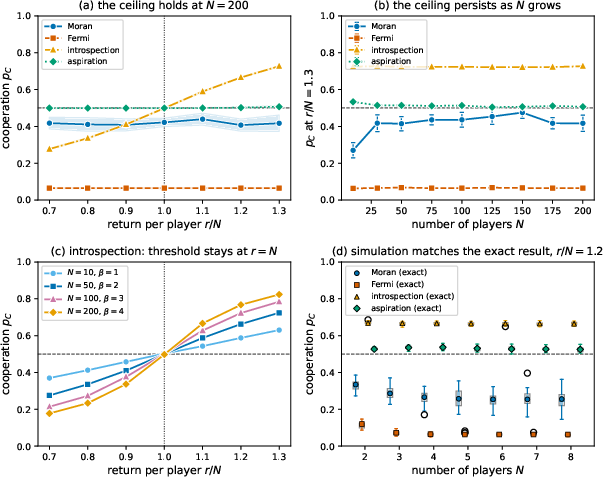
Figure 7: The cooperation ceiling persists in large populations; extrinsic processes remain bounded while intrinsic processes can cross the threshold, with robustness validated across N7 to N8.
Interplay between Dynamics and Further Heterogeneity
The final analysis addresses mixed populations (containing both extrinsic and intrinsic strategy updaters) and heterogeneity in returns, showing the effect of intrinsic dynamics can propagate if their prevalence in the population exceeds a critical mass above the cooperation threshold. The complex interaction between population dynamics, individual returns, and population structure is identified as a fertile area for further research.
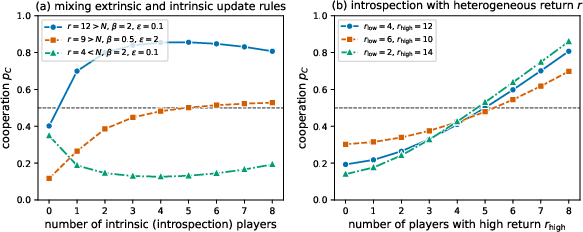
Figure 8: Mixing extrinsic and intrinsic updaters (left) and parametrically heterogeneous returns (right) allows the ceiling to be breached once enough intrinsic or high-return agents are present.
Implications and Future Directions
The work formalizes the intrinsic limitation of extrinsic imitation/selection dynamics for cooperation promotion in heterogeneous social dilemmas, regardless of payoff scaling or agent-specific attributes. In contrast, dynamics informed by self-referential evaluation—especially those akin to counterfactual reasoning or aspiration-based revision—uniquely break this barrier in parameter regimes where cooperation is individually optimal. The results carry implications not just for mathematical evolutionary game theory, but also for the modeling of distributed agent systems, social learning algorithms, and potential design of decentralized mechanisms for collective action in both biological and engineered contexts.
Possible future work includes:
- Analytically characterizing cooperation ceilings in multi-action games and richer state spaces;
- Exploring adaptive mixtures of intrinsic and extrinsic update rules (meta-dynamics);
- Incorporating network structure or dynamic payoffs;
- Formal analysis of stochastic switching and evolutionary stability in mixed-dynamics populations.
Conclusion
This paper establishes a precise theoretical ceiling for cooperative abundance under extrinsic, comparison-based update rules in heterogeneous populations, and fully characterizes the conditions under which intrinsic, self-referential dynamics can overcome this limitation. The findings are robust to heterogeneous contributions, population size, mutation, and parameter sweeps, delineating a fundamental constraint and its escape route in evolutionary models of collective action. This delineation invites richer future investigations at the interface of evolutionary dynamics, population heterogeneity, and algorithmic design of social systems.