Holographic Krylov Complexity with Lifshitz Scaling and Hyperscaling Violation
Published 30 Jun 2026 in hep-th and quant-ph | (2606.31724v1)
Abstract: Following the holographic proposal that identifies the growth rate of Krylov complexity with the proper radial momentum of an infalling massive probe, we study Krylov complexity in Lifshitz and hyperscaling-violating backgrounds. For pure Lifshitz geometries, we derive exact analytic solutions and obtain quadratic complexity growth for all values of the dynamical exponent. For hyperscaling-violating backgrounds, we extract the asymptotic scaling, revealing that the hyperscaling-violating exponent directly controls the late-time growth exponent. In a special limiting case, the complexity exhibits oscillatory behavior with a logarithmic envelope, signaling a transition to a qualitatively distinct regime. Our analysis establishes that the momentum-Krylov correspondence extends naturally to non-relativistic holographic settings and remains well-defined despite the causal pathologies of Lifshitz spacetimes.
The paper extends holographic proposals for Krylov complexity to non-relativistic Lifshitz and hyperscaling-violating geometries using probe particle geodesics.
It demonstrates universal quadratic growth in pure Lifshitz spacetimes and reveals modified power-law, logarithmic, or oscillatory behavior when hyperscaling violation is present.
The analysis links operator dynamics to effective spacetime dimensionality and anisotropic scaling, providing new insights for modeling quantum critical systems.
Holographic Krylov Complexity in Lifshitz and Hyperscaling-Violating Geometries
Introduction and Context
The paper "Holographic Krylov Complexity with Lifshitz Scaling and Hyperscaling Violation" (2606.31724) explores the extension of holographic proposals for Krylov complexity to non-relativistic spacetimes. Krylov complexity, fundamentally a diagnostic of operator growth in quantum many-body systems, offers a granular quantification of information spreading and quantum chaos. The core holographic identification, as formulated in [Caputa:2024sux], equates the rate of Krylov complexity growth in the boundary theory C˙K(t) to the proper radial momentum Pρ of an infalling massive particle in the dual gravitational background:
C˙K(t)=−Pρ.
While prior studies predominantly focused on relativistic, AdS-type geometries, this work systematically explores the influence of both Lifshitz scaling (characterized by a dynamical exponent z) and hyperscaling violation (with exponent θ) on Krylov complexity, opening a window to the operator growth dynamics in a broader class of strongly coupled non-relativistic QFTs relevant to quantum critical phenomena and condensed matter systems.
Framework and Methodology
The primary physical setup involves a probe particle released from the UV boundary at rest. The metric forms analyzed are:
Pure Lifshitz (no hyperscaling violation):
ds2=−r2zdt2+r2dr2+dx2
Lifshitz with Hyperscaling Violation:
ds2=r−2(d−θ)/d(−r2(z−1)dt2+dr2+dx2)
The analysis proceeds by solving the geodesic equations for the probe. The canonical and proper momenta are then extracted, and the time-evolution of CK(t) on the dual field theory side is inferred directly through the holographic dictionary.
Results in Pure Lifshitz Spacetimes
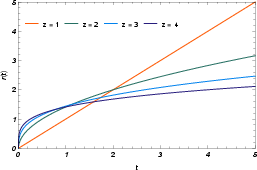
Detailed geodesic analysis in the Lifshitz background yields the following trajectory:
r(t)=(ϵ2z+z2t2)1/(2z)
where ϵ is the UV cutoff, and Pρ0 is the dynamic exponent.
Figure 1: The trajectory Pρ1 of the infalling particle in the Lifshitz geometry for several values of the dynamical exponent Pρ2, with Pρ3. For larger Pρ4, the particle takes longer to reach a given radial coordinate. The slope of the curves indicates power-law decay of the velocity for Pρ5, in contrast to the constant asymptotic velocity observed for Pρ6.
Key features observed:
For Pρ7 (AdS case), the radial velocity quickly asymptotes to a constant, yielding a characteristic linear time-dependence for the radial coordinate at late times.
For Pρ8, the particle approaches the deep interior with a power-law decay in velocity; specifically, Pρ9.
The effect of increasing C˙K(t)=−Pρ.0 is a significant slowdown in approach to the IR, controlled by the anisotropic scaling symmetry.
For the rate of Krylov complexity growth:
C˙K(t)=−Pρ.1
Thus, the time-dependent Krylov complexity is:
C˙K(t)=−Pρ.2
A quadratic complexity growth (C˙K(t)=−Pρ.3) emerges universally for any C˙K(t)=−Pρ.4, with all C˙K(t)=−Pρ.5-dependence manifest only in the prefactor. This mirrors the behavior found via the CV/CA complexity proposals for zero-temperature backgrounds, indicating robustness across different holographic prescriptions.
Extension to Hyperscaling-Violating Geometries
In the more general hyperscaling-violating case, analytic solutions are generally unavailable except for certain asymptotic regimes or special limits. The relevant metric includes the hyperscaling exponent C˙K(t)=−Pρ.6, modifying the effective dimensionalityC˙K(t)=−Pρ.7.
The key results are:
For a probe particle, the canonical momentum at late times behaves as C˙K(t)=−Pρ.8.
The proper momentum (controlling Krylov growth) at late times acquires a C˙K(t)=−Pρ.9-dependent scaling:
z0
leading to a time dependence for complexity:
z1
Special cases are emphasized:
For z2, pure Lifshitz behavior (z3 growth).
For z4, z5 becomes constant, and complexity grows logarithmically.
For z6, the solution is oscillatory with a logarithmic envelope, denoting a qualitative transition in the operator growth regime.
For the unphysical z7, z8 strictly vanishes, i.e., Krylov complexity remains constant.
Asymptotic expansions, both at early and late times, clarify the role of both exponents in modifying the operator growth and, thus, complexity. The analysis confirms the direct control of late-time Krylov growth by the hyperscaling exponent z9, signaling sensitivity to the effective dimensionality in the dual QFT.
Theoretical and Practical Implications
The study carries both conceptual and practical significance:
Universality: Quadratic complexity growth in both relativistic and non-relativistic zero-temperature holographic backgrounds appears to be a robust feature, unaltered by dynamical exponents but susceptible to the hyperscaling-violating parameter.
Operator Dynamics: The result that the rate of operator growth is directly mapped to a local, well-defined proper momentum—even in geometries with causal pathologies (e.g., Lifshitz)—broadens the domain of the momentum-Krylov identification and motivates analogous studies in more complex or higher-curvature setups.
Contrast with Field Theory: Whereas direct field-theoretical calculations in Lifshitz-type models at finite temperature show exponential Krylov growth (with a θ0-dependent timescale but θ1-independent late-time slope) [Vasli:2023, Imani:2025etp], the holographic (zero-temperature) calculations yield power-law (and occasionally logarithmic/oscillatory) growth. This points to the need for further studies bridging the temperature regimes and connecting holographic and microscopic operator spreading characteristics.
Distinguishing Phases: The discovery of oscillatory or logarithmic growth regime signals potential phase transitions in operator dynamics, possibly linked to confinement or reorganization of degrees of freedom in the IR [Fatemiabhari:2025usn].
Model Building: Since Lifshitz and hyperscaling-violating backgrounds are central to holographic approaches to quantum critical matter, understanding complexity here could inform bounds on information processing and chaos in non-relativistic quantum systems, especially in condensed matter contexts.
Conclusion
This work provides a systematic, quantitative framework for evaluating holographic Krylov complexity in non-relativistic backgrounds with Lifshitz scaling and hyperscaling violation. It establishes that the momentum-Krylov proposal extends naturally and with predictive power to such settings, and that the late-time growth of complexity is governed—not just by the dynamical exponent—but crucially by the hyperscaling-violating exponent, allowing for a continuous deformation of operator growth regimes. The analysis circumvents limitations posed by bulk causal pathologies and opens avenues for cross-comparison with direct quantum field theory and condensed matter computations of operator growth and information scrambling.
Future directions include the extension to probes with internal quantum numbers, incorporation of temperature, exploration of finite density and chemical potential deformations, and direct comparison with numerics in lattice models and experimental platforms emulating non-relativistic criticality.