- The paper introduces a novel sequential screening and hierarchical refinement framework to identify near-optimal nitrogen application strategies.
- It demonstrates that the method achieves higher yields and lower nitrogen use, with 49% of decisions within 10 bu/ac of the empirically best arm.
- Empirical results validate that the approach robustly adapts to spatial heterogeneity, offering recommendations that mitigate both environmental and economic risks.
Sequential Screening and Hierarchical Refinement for Precision Nitrogen Management
Overview
The paper "Near-Optimal Nitrogen Recommendations for Precision Agriculture via Sequential Screening and Hierarchical Refinement" (2606.31661) introduces a robust methodological framework tailored to optimizing nitrogen (N) fertilizer recommendations in spatially heterogeneous agricultural settings. The proposed approach explicitly targets the dual objective of maximizing agronomic performance while minimizing excess fertilizer application, thus balancing productivity with environmental and economic considerations. Rather than identifying a single "best" fertilizer regime, the method focuses on identifying a set of near-optimal choices, leveraging both sequential Bayesian screening and hierarchical decision refinement across spatial scales.
Data and Problem Setting
The study is grounded on a multi-state, multi-year dataset from the Midwest Corn Belt, comprising 49 site-year corn trials over 31 sites, with each field trial designed as a randomized complete block design (RCBD).
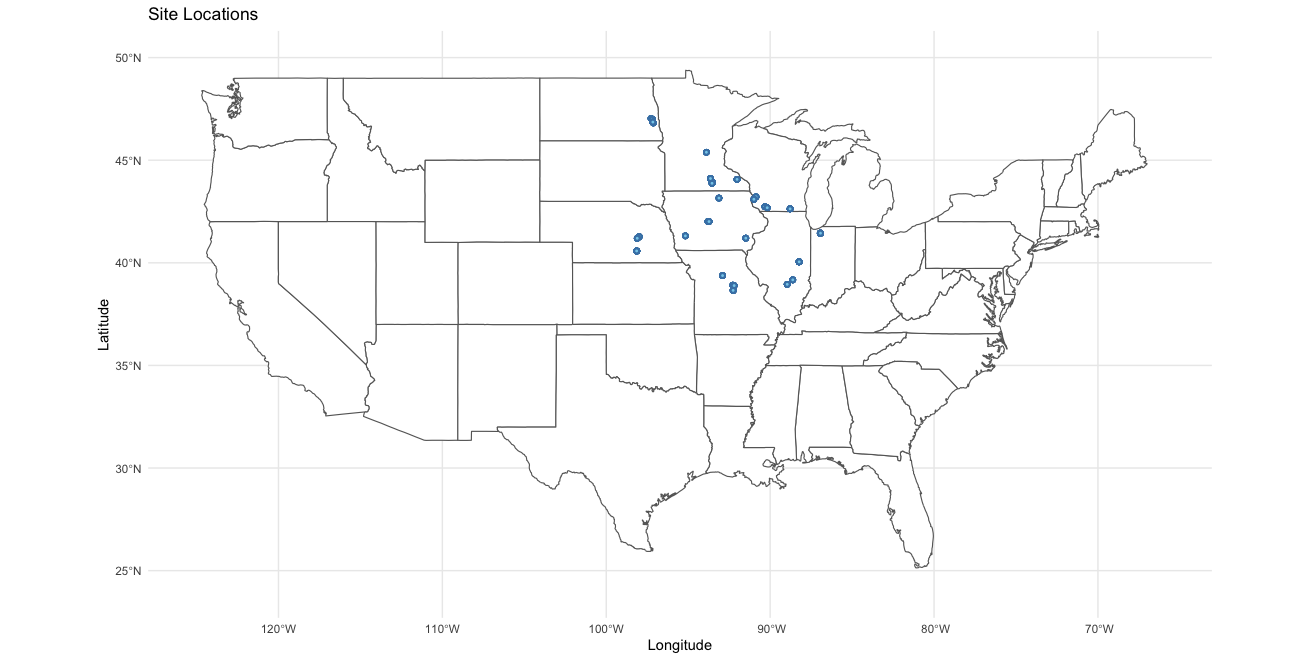
Figure 1: Experimental field sites across the United States' Midwest Corn Belt, capturing spatial heterogeneity for nitrogen response analysis.
Each experimental unit corresponds to a site-year-block combination, allowing analysis at granular spatial scales. Sixteen N treatment arms were available, defined by combinations of planting and sidedress applications. The primary challenge addressed is that response surfaces are highly concave: yield gains plateau at moderate levels of N, causing many treatment arms to be statistically indistinguishable near the optimum, yet their environmental and economic costs may diverge substantially.
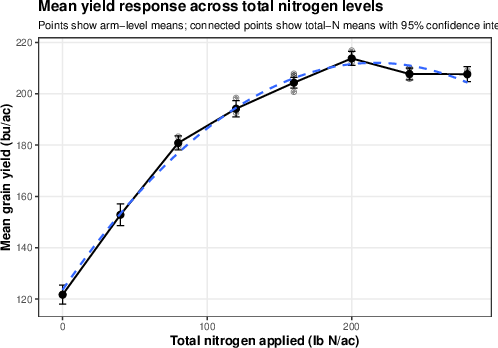
Figure 2: Grain yield exhibits diminishing returns with increasing total N application, motivating the need for near-optimal rather than strictly optimal recommendations.
Methodological Framework
Three classes of methodologies are evaluated:
- Retrospective Recommendation Benchmarks: Utilize the full dataset to provide global, state-level, or site-level policy recommendations, yielding upper-bound performance estimates but are not directly deployable.
- Yearly Adaptive Recommendations: Sequentially update recommendations using only information available up to the previous year, representing more realistic adaptive strategies.
- Sequential Screening and Hierarchical Refinement (Proposed): Core to the contribution of the paper, this approach sequentially eliminates statistically inferior arms via state-level screening, and then applies local (site-level) refinement among the surviving candidates.
Sequential Screening
At each state and batch (year), arms whose upper confidence bounds fall below the lower confidence bound of the best alternative by more than the near-optimality threshold (ϵ) are eliminated. A Bonferroni-adjusted Gaussian quantile ensures simultaneous coverage. This approach is theoretically supported by an asymptotic screening-safety guarantee: with probability at least 1−α, all arms within ϵ of the state-level mean optimal yield are retained.
Hierarchical Refinement
Following state-level screening, site-level refinement restricts attention to the surviving state arms and makes final recommendations by selecting the arm with the lowest N rate among those within ϵ of the local site's best mean yield. This hierarchical process provides robustness to local heterogeneity and prevents premature elimination due to sample variability at small spatial scales.
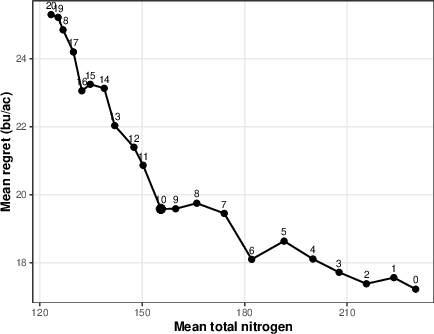
Figure 3: The yield--N Pareto frontier shows that increasing the near-optimality threshold ϵ reduces N recommendations, but overly permissive ϵ increases regret.
Empirical Results
The proposed hierarchical screening-refinement method achieves multiple strong results:
- Yield and Nitrogen Use: Among all deployable strategies, hierarchical refinement attains the highest mean yield (217.4 bu/ac) and lowest mean regret (13.6 bu/ac), while reducing mean N application by 25–28% compared to global or state-specific fixed-arm policies.
- Proportion of Near-Optimal Recommendations: 49% of decisions were within 10 bu/ac of the empirically best arm; this proportion significantly exceeds all other deployable baselines.
- No Single Universal Fertilizer: Across all states, no single N regime is dominant; in most cases, the modal recommendation represents only one-third to one-half of all decision units per state, underscoring profound within-state heterogeneity.
- Sensitivity and Robustness: Leave-one-block-out cross-validation confirms that results generalize out-of-sample, and sensitivity analysis shows that ϵ values near 10 yield favorable tradeoffs between N reduction and regret.
Theoretical and Practical Implications
The approach departs from orthodox yield-maximization or best-arm identification settings frequently used in both classical agronomy and ML-based agricultural optimization. By operationalizing ϵ-near-optimality at multiple spatial scales and always favoring the lowest-N survivor, it provides a principled means to select environmentally and economically preferable programs while protecting against myopic under-application.
This work demonstrates that regression or prediction-based approaches, despite strong R2 in yield prediction, may not translate to effective actionable recommendations—especially when variance and confidence in yield gain is asymmetric around the optimum. The method's safety guarantees ensure that statistical screening does not inadvertently eliminate economically attractive alternatives.
The hierarchical refinement concept can be generalized: in multi-arm, large-scale field trials (or any context with substantial contextual heterogeneity and broad response plateaus), sequential screening can facilitate both statistical efficiency and actionable parsimony, without reliance on strong modeling assumptions or restrictive parametric fits.
Future Directions
Key extensions include the integration of weather covariates, explicit modeling of economic returns (not just yield/N tradeoff), and multi-season learning, as only three years of data were available in the present study. Incorporating remote sensing, real-time in-season data, or domain adaptation/transfer learning models may further refine recommendations at even finer spatial and temporal granularity. The framework also has direct relevance for adaptive experimentation, multi-armed bandit field studies, and Bayesian optimization in other domains where near-optimal set identification and robust local adaptation are preferable to risky single-action selection.
Conclusion
Sequential screening and state-to-site hierarchical refinement provide a robust, theory-backed framework for nitrogen management in precision agriculture. By framing the recommendation task as a near-best-arm multi-scale decision problem and incorporating explicit statistical conservatism, this method achieves improved agronomic outcomes while substantially reducing nitrogen waste, outperforming both global and spatially-naive adaptive policies. The design paradigm convincingly demonstrates the practical benefit of structured, confidence-calibrated, multi-scale experimental design for data-driven sustainable agriculture.