- The paper introduces polynomial-time algorithms that compute the minimum feedback arc set and maximum cycle packing in CM (Möbius-free) tournaments, demonstrating a unique duality.
- The study employs layered dynamic programming and network flow techniques to decompose complex tournament structures into manageable subproblems.
- The paper establishes that in CM tournaments, the minimum FAS weight exactly matches the maximum cycle packing size, offering robust solutions for tournament ranking.
Tournament Ranking: Duality and Efficiency — An Expert Summary
Introduction and Theoretical Foundations
The study investigates the feedback arc set (FAS) problem and its dual, the cycle packing problem, on tournaments—a class of directed graphs where each pair of vertices is joined by a single directed edge. The FAS problem, foundational in combinatorial optimization and relevant for ranking in tournaments, seeks a minimum-weighted set of arcs whose removal renders the digraph acyclic. Its dual, cycle packing, aims for the maximum collection of edge-disjoint cycles such that no edge is overly saturated according to assigned weights.
A central focus is on cycle Mengerian (CM) tournaments, where for every nonnegative integral arc weight, the minimum FAS weight equals the maximal cycle packing size, signifying strong LP integrality and duality properties. The structural characterization of CM tournaments (equivalent to Möbius-free tournaments), established in prior work but nonconstructive, forms the backbone for algorithmic advances presented in this paper.
The authors contribute combinatorial polynomial-time algorithms to compute both minimum FAS and maximum cycle packing exactly in arc-weighted CM tournaments, addressing longstanding algorithmic gaps.
Structural Characterization of CM (Möbius-free) Tournaments
CM tournaments are precisely those that exclude a finite set of forbidden subgraphs (notably K3,3, K3,3′, M5, M5∗). These are depicted in
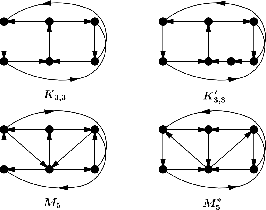
Figure 1: Forbidden subgraphs for the Möbius-free characterization of CM tournaments.
The global structure theorem from Chen et al. [CDZZ3] provides an inductive decomposition of strong Möbius-free tournaments into sequences of “vertical blocks” (Ai), “horizontal blocks” (Bi), and “join vertices” (vi). This layered structure is visualized in

Figure 2: Decomposition of Möbius-free tournaments into vertical and horizontal blocks with join vertices.
Special tournaments F1 and G1 are treated as base cases. Efficient algorithms are provided to exhibit this decomposition in O(n4) time, facilitating reduction of the general problems to well-structured subproblems.
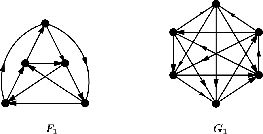
Figure 3: Small, exceptional CM tournaments K3,3′0 and K3,3′1, handled as base cases.
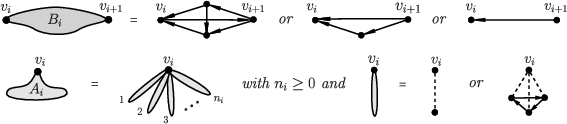
Figure 4: Schematic representation of the global structure and block arrangements in CM tournaments.
Combinatorial Algorithms for FAS: Duality, Cuts, and Flows
For tournaments in the structured class K3,3′2 (where vertical blocks are acyclic), the minimum FAS can be computed via layered dynamic programming and network flow techniques. The main results state:
- Minimum FAS in K3,3′3: Computable in K3,3′4 by recursive decomposition and min-cut computations in a specially constructed network embedding the tournament structure (see Figure 5 below).
- Generalized FAS in Möbius-free tournaments: For all CM tournaments, the algorithm runs in K3,3′5 after appropriate structural reduction and cycle saturating preprocessing.
Key elements include:
- Reduction to network flow models, where the duality between minimum FAS and cycle packing is made explicit.
- Careful handling of horizontal cuts, ensuring that recursive decompositions do not violate integrality or introduce new cycles.
- Use of capacities and path decompositions to maintain correspondence with tournament arcs and cycles.
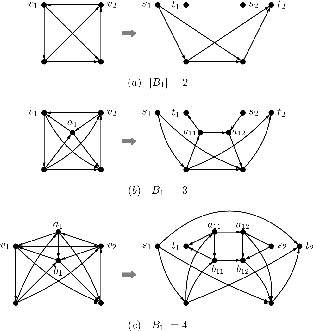
Figure 5: Construction of a network flow instance corresponding to a tournament; arc splitting and capacity assignment encode cut and path constraints for FAS computation.
Combinatorial Algorithms for Maximum Cycle Packing
The algorithm for maximum cycle packing operates in several phases:
- Preprocessing: All horizontal blocks (K3,3′6) are expanded to four vertices, with weights adjusted so that every positive-weight arc is guaranteed to appear in some minimum FAS.
- Lower Segment Packing: Cycles are partitioned into lower and upper segments; packing lower segments is reduced to a flow problem in the constructed network.
- Completion: Each lower segment packing is extended to a full cycle by matching with upper segments via multicommodity flows and path-packing.
- The approach crucially relies on the min-max duality: the size of the maximum cycle packing equals the minimum FAS weight in CM tournaments.
The algorithm achieves K3,3′7 complexity for CM tournaments, with cycle saturating constraints and the lexicographic maximization of packed segments.
Numerical Results and Structural Claims
The authors’ algorithms strongly claim:
- Exact Match of Duals: In Möbius-free tournaments, the minimum FAS and maximum cycle packing coincide for all integral weights, surpassing previous approximation schemes and relaxation bounds.
- Polynomial-time Solvability: Both FAS and cycle packing are efficiently solvable in CM tournaments despite the general K3,3′8-hardness of the problems.
- Robustness to Arc Weights: The algorithms robustly handle arbitrary nonnegative integral arc weights, utilizing preprocessing for arc saturation and integrality.
Practical and Theoretical Implications
Practically, these results enable exact ranking and error minimization in tournament settings where CM structure is prevalent, and provide a constructive path to integrality in scheduling, scoring, and aggregation. From a theoretical perspective, the duality and efficiency established here reinforce the role of structural decompositions in combinatorial optimization, and suggest avenues for extending these approaches to broader classes of digraphs exhibiting similar min-max duality.
Potential future developments in AI and combinatorial optimization include:
- Further generalization of CM tournament algorithms to other directed graph classes with integrality properties.
- Automated recognition and decomposition of tournament structures for real-time ranking and anomaly detection.
- Advances in multicommodity flow algorithms inspired by cycle packing decompositions.
Conclusion
This paper provides a comprehensive structural and algorithmic theory for exact tournament ranking via feedback arc sets and cycle packings in CM (Möbius-free) tournaments. It formalizes duality relations, presents efficient polynomial-time algorithms for both primal and dual problems, and establishes strong structural claims. The results anchor the duality of feedback arc sets and cycle packings in the context of well-characterized tournament classes and offer constructive tools that can extend to other combinatorial optimization domains.