- The paper presents a novel autonomous post-training framework for LLMs that leverages agent-computer interfaces to integrate structured, reusable skills.
- The methodology decomposes the process into planning, data processing, training, evaluation, and logging, significantly reducing human intervention.
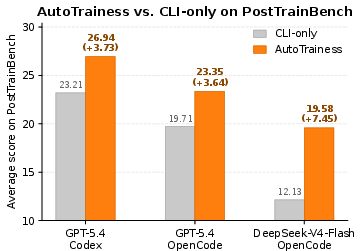
- Empirical results show 15%-25% improvements over CLI-only baselines, validating the approach of using interface-induced inductive bias for robust model enhancement.
Autonomous LLM Post-Training with Agent-Computer Interfaces: An Expert Review of AutoTrainess
Motivation and Problem Setting
Despite substantial recent progress in using LM agents for automating long-horizon tasks such as code generation or scientific discovery, the process of post-training LLMs remains fundamentally human-intensive. Effective autonomous post-training cannot be reduced to generic coding ability: it requires iterative planning, benchmark-aligned data curation, stable reproducibility, experiment tracking, and failure diagnosis, roles that are typically filled by experienced software and ML engineers. The "AutoTrainess: Teaching LLMs to Improve LLMs Autonomously" (2606.31551) addresses the core open question of whether—and how—LLM agents can leverage explicit human priors encapsulated in specialized agent-computer interfaces to structure and optimize the autonomous training process.
Conceptual Framework: AutoTrainess and AutoTrainHub
AutoTrainess operationalizes the core hypothesis that endowing LM agents with structured, reusable training artifacts and workflows (as explicit ACIs) bridges the gap between unconstrained CLI-only code synthesis and human-guided ML pipelines. The central substrate of this approach is AutoTrainHub, a modular agent-computer interface repository that externalizes key training operations as composable, rule-governed skills. Each skill—data processing, training, evaluation, and logging/planning—encapsulates not just executable primitives, but inductive priors about robust workflow design, error handling, and stateful execution, thereby redefining agent-environment interaction as a closed-loop, evidence-driven process.
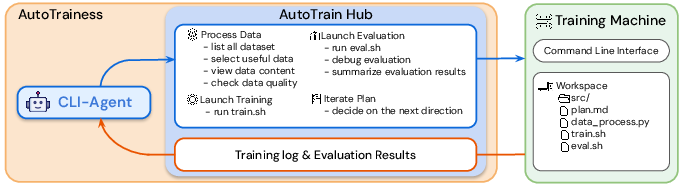
Figure 1: System overview—AutoTrainess uses the AutoTrainHub to interface with Linux-based training environments through specialized skills for each stage of the training loop.
Methodology: Skills, Workflow, and Interface Design
The agent's workflow is strictly stage-structured, decomposing the autonomous training task into sequential, mandatory phases:
- Planning: Iteration-oriented plans are synthesized from empirical evidence (logs, evals, checkpoints), specifying objectives, interventions, and success criteria.
- Data Processing: Explicit skills guide the agent through data selection (failure-driven search for sources), construction (extraction, cleaning, synthesis, transformation for benchmark alignment), and validation (schema, alignment, and quality checks).
- Training: Training is constrained to LlamaFactory, enforcing reproducibility and comparability by eliminating agent-enabled framework drift; both SFT and RL modes are supported under evidence-justified conditions.
- Evaluation: Evaluation runs directly on benchmark pipelines, producing detailed logs, randomized sample summaries, and failure mode classifications; this enforces experiment-grounded learning rather than speculative optimization.
- Logging: Persistent, structured experiment logs track provenance, configuration, results, and rationale at each iteration, forming agent-accessible long-horizon memory.
KEY NUMERICAL CONSTRAINTS: All experimental comparisons are performed under a fixed hardware time budget (H20 GPU over 10 hours), with base models including Qwen3-1.7B, Qwen3-4B, SmolLM3-3B, Gemma3-4B, and agent backbones spanning GPT-5.4 (Codex/OpenCode) and DeepSeek-V4-Flash.
Empirical Results and Ablation Analysis
AutoTrainess yields superior post-training scores relative to state-of-the-art CLI-only baselines across all primary metrics on the PostTrainBench benchmark:
Interface ablations dissect the functional contributions of each specialized skillset:
- Data Processing Ablation: Removing the data interface causes the largest regression in train action failure rate (increase of 5.5 percentage points, up to 12.7%), corroborated by decreased frequency of data-centric preparatory behavior.
- Evaluation and Logging Ablation: Both evaluations (failure rate increases by over 15 points) and logging/planning skills (12-point increase) are critical for stabilizing evaluation execution and maintaining longitudinal state.
- Training Module Ablation: The training interface primarily improves checkpoint provenance and artifact tracking, indirectly reducing evaluation error rates via improved handoff discipline.
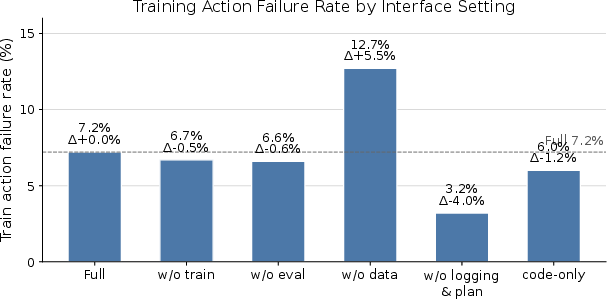
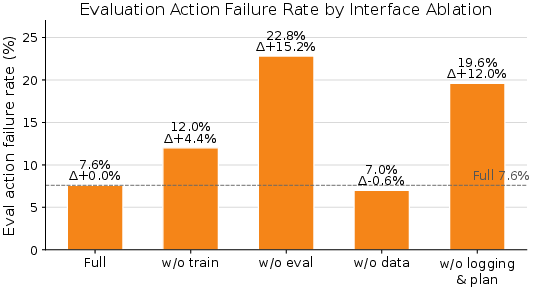
Figure 3: Interface ablation-induced action failure rates, highlighting the protection each interface provides against specific failure classes.
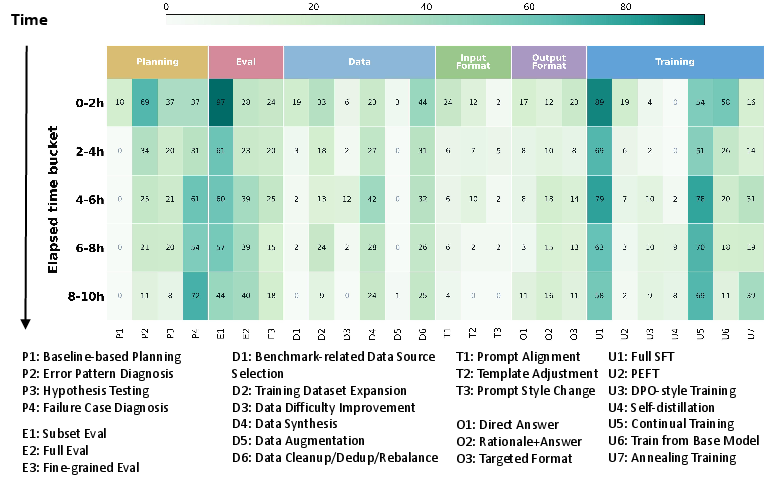
Behavioral analysis of agent trajectories reveals:
Performance correlation analysis identifies behaviors most predictive of improvement—including benchmark-aligned data selection, template adaptation, and self-distillation—while preference-based DPO and annealing data/hyperparam strategies show minimal payoff.
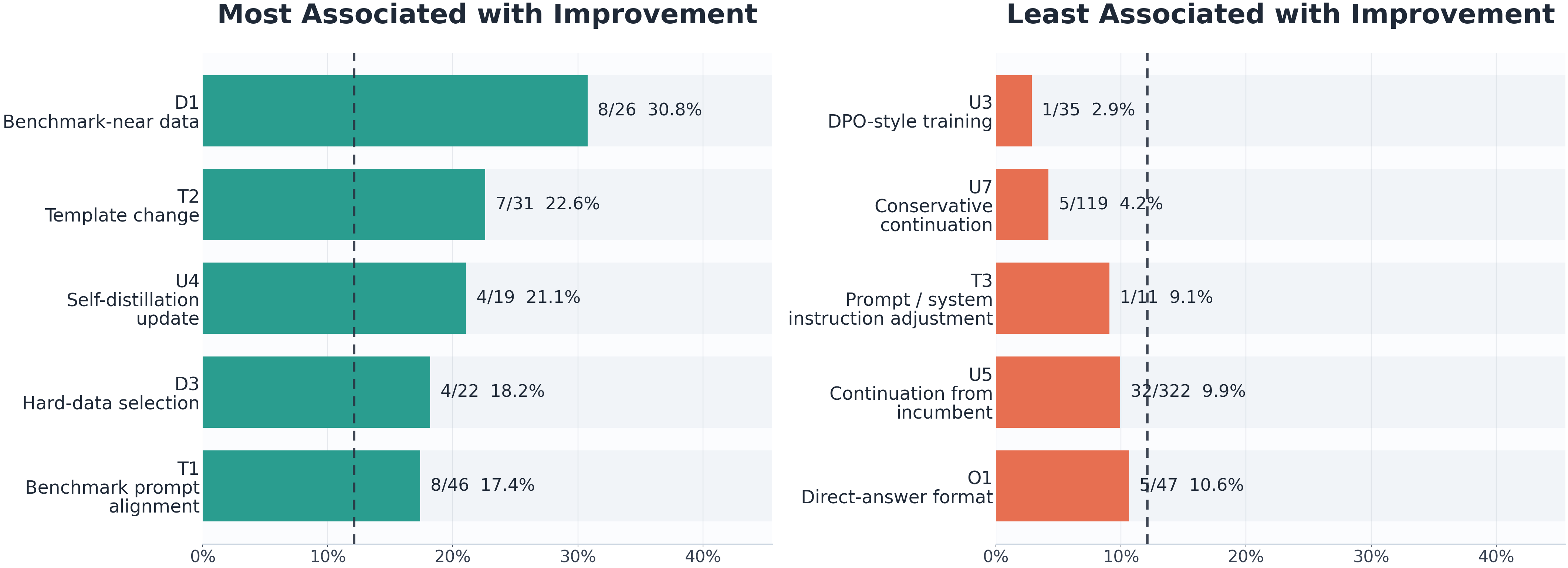
Figure 5: Per-strategy correlation with observed performance improvement or degradation.
Case Studies and Skill Utility
Targeted case analysis (ArenaHard and HealthBench tasks) demonstrates the necessity of domain-aligned data construction (for format and distribution matching) and evidence-guided evaluation (for actionable optimization), further supporting the hypothesis that gains are not solely attributable to increased data or training time, but to the structured translatability of human prior design into agent-acquirable skills.
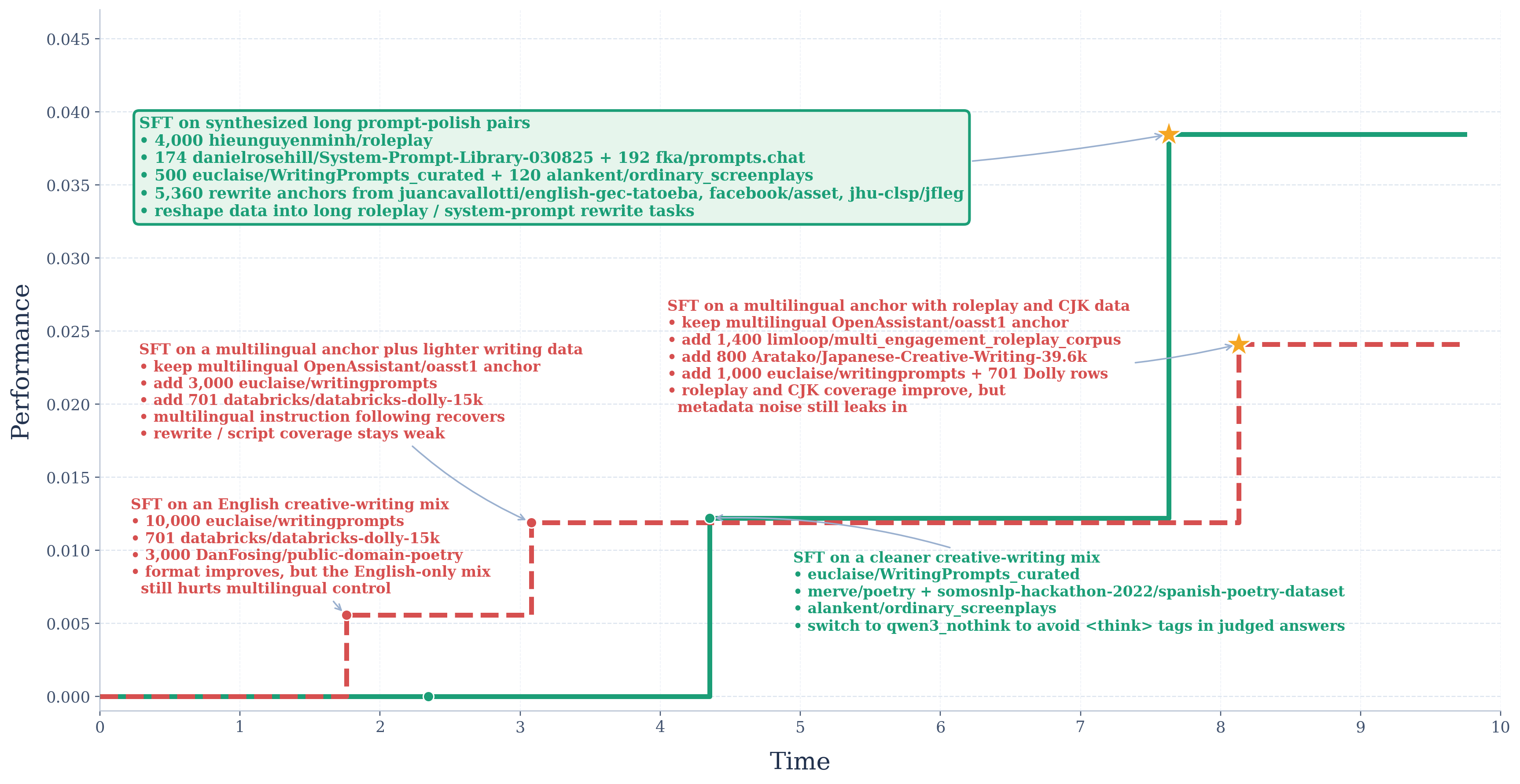
Figure 6: Example—Data skill ablation leads to plateaued performance on ArenaHard as the agent fails to align training data to benchmark format.
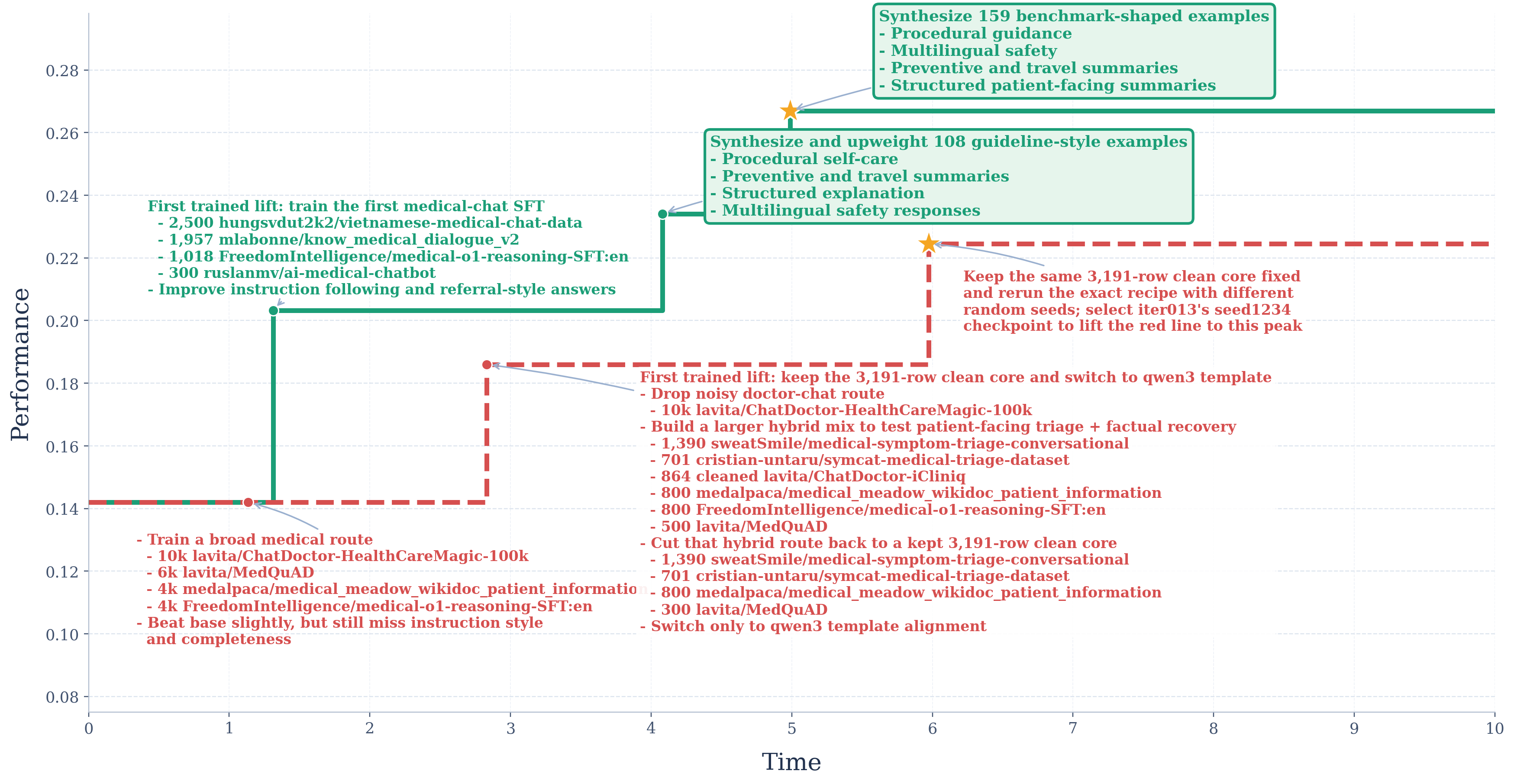
Figure 7: Example—Eval skill ablation on HealthBench inhibits late-stage gains as the agent is unable to exploit evaluation feedback for targeted correction.
Theoretical and Practical Implications
The AutoTrainess approach reframes LLM autonomy in terms of interface-induced inductive bias. By shifting human priors from implicit prompt engineering or fine-tuned weights to explicit, composable ACIs, the study provides evidence that scalable LLM self-improvement algorithms must tightly integrate structural workflow constraints, reusable artifacts, and robust experiment memory. The findings imply that autonomy in post-training—or broader scientific automation—cannot be attained via open-ended coding agents alone, but requires environment-level formalization of process priors.
Practical adoption points towards:
- Reduced requirement for continuous human intervention in post-training,
- Replicable, stable, and portable agent pipelines across model and harness variations,
- Fine-grained ablation-driven benchmarking for future system design.
Theoretically, this work positions agent-computer interface design as a principal axis for generalization and robustness in agentic ML systems.
Future Directions
Future research could extend AutoTrainess by:
- Generalizing ACIs to cover additional workflow steps, including distributed and multimodal training,
- Integrating online learning and resource-aware optimization,
- Formalizing and learning reusable skill libraries from agent trajectories,
- Studying interface alignment and robustness as additional forms of 'capability control' in autonomous agent deployment.
The approach also provides a template for building modular benchmarks and harnesses, promoting credible, interpretable, and safe agent autonomy in LLM training and beyond.
Conclusion
AutoTrainess empirically and structurally demonstrates that explicit, workflow-specialized agent-computer interfaces are essential for robust, scalable, and generalizable autonomous LLM post-training. The explicit externalization and reuse of human artifacts and experiment conventions mitigates the brittleness and trial inefficiency of CLI-only agents, substantiating a new paradigm for agent-based model improvement centered not on raw code synthesis, but on structured, high-level skill orchestration and evidence-dense memory (2606.31551).