- The paper demonstrates that MBH binaries excavate stellar cores via three-body interactions, with SHARP enabling high-resolution IFU detection.
- It details the use of forward modeling and simulation pipelines to quantify core sizes (150–500 pc) and identify tangential velocity anisotropies in elliptical galaxies.
- The study predicts a substantial expansion in accessible survey volume, offering multimessenger synergies with gravitational-wave observatories like LISA and PTA.
The Demographics and Morphology of Galaxy Cores Excavated by Supermassive Black Hole Binaries with SHARP
Context: MBH Binaries and Core Excavation in Elliptical Galaxies
Supermassive black hole (MBH) binaries, which form during the merger of galaxies, play a fundamental role in shaping the central stellar distributions of massive galaxies. Theoretical and computational work shows that during the binary hardening phase, three-body interactions between the binary and surrounding stars lead to the dynamical ejection of stars from the central regions (core scouring). As a result, the stellar density profile in the nucleus of an elliptical galaxy becomes depleted, manifesting as a flattened, low-surface-brightness core whose size typically tracks the binary’s gravitational sphere of influence. In addition to the scoured core, binaries modify the velocity distributions in the core, inducing tangential anisotropy as stars on radial orbits are depleted.
While direct electromagnetic detection of sub-pc MBH binaries remains rare and challenging, the identification of large stellar cores and velocity anisotropies provides robust indirect evidence for past MBH binary evolution. Such features are observed almost ubiquitously in the most massive local elliptical galaxies. However, observational studies have thus far been limited to galaxies within ≈100 Mpc due to strong constraints imposed by spatial resolution.
SHARP, MICADO+MORFEO, and the Expansion of Accessible Core Parameter Space
The commissioning of ELT-class adaptive optics and integral-field spectroscopy with MORFEO+MICADO and the SHARP/VESPER IFU provides a substantial advance in both angular resolution and sensitivity, enabling the identification of scoured cores to significantly higher redshift and in lower-mass galaxies. Notably, the SHARP-VESPER IFU enables linear sampling as fine as 0.031 arcsec, outperforming legacy hardware in both sharpness and field of view.
The paper provides a quantitative assessment of the distances and core sizes over which core scouring features can be robustly detected with SHARP compared to current facilities, focusing on prototypes such as NGC 3091:
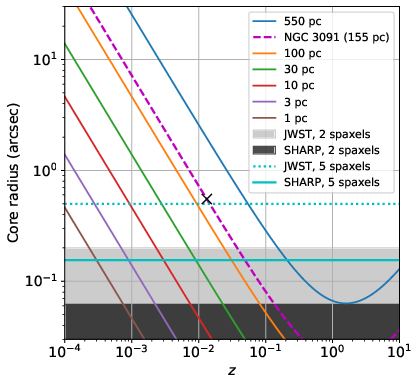
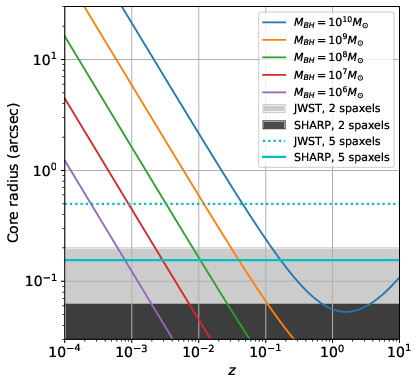
Figure 1: The angular dimensions of galaxy cores resolvable as a function of redshift, with core size in physical units (left) and as a function of MBH mass (right), including SHARP and JWST (NIRSpec) capabilities.
SHARP’s resolution allows for the detection of 150–500 pc cores to z≫0.1, enhancing the spatial volume sampled by a factor of 40–60 over previous surveys for both massive and intermediate-mass MBH hosts. For NGC 3091 (core radius 155 pc), SHARP-VESPER pushes the detection limit from 0.02 Gpc3 to 0.84 Gpc3. For lower-mass MBHs with pc-scale cores, the gain in accessible volume is similarly dramatic, enabling unprecedented population studies.
This spatial resolution also allows for distinguishing between morphological signatures of core-excavating mechanisms: while scouring by binaries depletes the density within the binary influence radius, MBHs experiencing strong gravitational-wave recoil can evacuate even larger and flatter cores, leaving observable imprints in the kinematics and inner surface-brightness slope.
Methodology: Detection and Characterization Strategy
The identification of candidate cores proceeds via high-resolution imaging to find central luminosity deficits, then kinematic confirmation with integral-field spectroscopy to detect the tangential velocity bias. SHARP-VESPER’s large field of view facilitates robust Schwarzschild modeling of the orbital structure within the depleted region. In the context of specific case studies (e.g., NGC 4889), forward modeling and mock observations with AETC and SYNTRA are used to demonstrate the detectability across a range of redshifts and observing conditions.
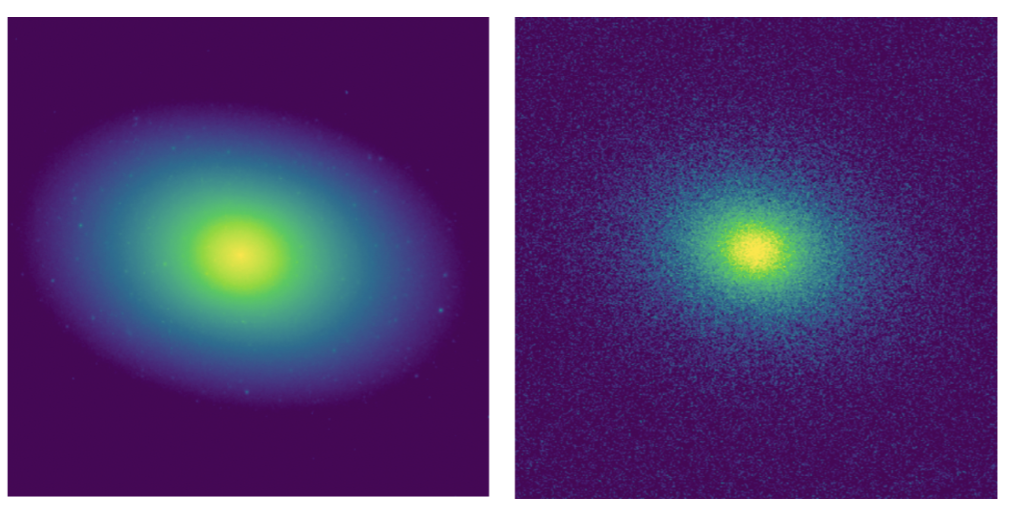
Figure 2: Left—HST imaging of NGC 4889; Right—simulated MICADO imaging at z=2.81, showing that core signatures remain identifiable at high z with ELT-class facilities.
The advent of such simulation pipelines and synthetic spectral cubes affirms the utility of SHARP for detailed kinematic reconstruction, core size measurement, and stellar population decomposition in galaxies across cosmic time.
Implications for MBH Merging History and Gravitational Wave Synergies
The paper highlights two key domains that will be transformed by SHARP observations:
- High-z massive core census: The largest, most luminous cores are associated with the most massive MBHs (M∙≳109−10M⊙), which are also expected sources of nanohertz GW backgrounds probed by PTA campaigns. Detecting and characterizing such cores up to z∼1 informs the prevalence and environments of MBH mergers responsible for the observed stochastic GW background.
- Low-mass core search in the local universe: For MBHs in the 106−107M⊙ regime, SHARP enables the first robust detections of pc-scale depleted cores, probing the progenitor galaxies most relevant for future space-based GW detectors (e.g., LISA) operating at milli-Hz frequencies. Detection of kinematic anisotropies in such galaxies would provide new constraints on the incidence and dynamical timescales of MBH mergers at these masses.
Detection of enlarged or unusually flat cores will also allow statistical discrimination between core scouring and GW recoil mechanisms, with direct relevance for merger kicks and overall MBH occupation fractions (2606.31434).
The combination of EM (SHARP) and GW (LISA, PTA) observations thus enables a true multimessenger approach to the MBH binary population, merging timescales, and the dynamical evolution of galaxy nuclei.
Conclusion
This paper defines the reach of next-generation IFU and AO instrumentation for the study of depleted galaxy cores as fingerprints of MBH binary interactions. Quantitative predictions for the accessible volume and core mass parameter space demonstrate that SHARP+MORFEO/MICADO will increase the accessible sample size for core-hosting galaxies by over an order of magnitude, enabling robust population studies and comparison with GW event rates. The detailed mapping of core sizes, kinematic anisotropies, and inner surface-brightness slopes will break degeneracies in theoretical models for MBH binary coalescence and recoil, establishing firm connections between electromagnetic and gravitational-wave channels in extragalactic astrophysics.

