- The paper demonstrates that signature-linear policies reduce complex, path-dependent stochastic control problems to a tractable quadratic programming model with a closed-form solution.
- It shows that the signature-based framework outperforms traditional strategies by achieving higher return-on-turnover and smoother, more dollar-neutral inventory management.
- Numerical and empirical evaluations on both synthetic benchmarks and real-world equity pairs trading confirm the robustness and practical feasibility of offline calibration and rapid online execution.
Signature-Based Optimal Execution for Statistical Arbitrage with Path-Dependent Trading Signals
This work introduces a unified framework for executing statistical arbitrage strategies in the presence of path-dependent signals by employing path signatures as the common feature space for both alpha generation and trading execution. The path signature—an infinite sequence of iterated integrals of a time-augmented market path—encodes the realized trajectory of market information in a systematic, tractable dictionary.
Both alpha (predictive signal, αt) and trading speed (vt) are modeled as linear functionals over the same truncated signature vector xt at level N, i.e., αt=Kxt and vt=Bxt, for coefficient matrices K and B. Inventory is evolved via Qt=Q0+∫0tvudu. The class of admissible trading strategies is thus reduced to the selection of B, allowing both signal-reactivity and execution frictions to be handled within a single quadratic programming framework. This avoids the necessity of high-dimensional dynamic programming, which is typically required when modeling path-dependent, non-Markovian signals.
The objective balances signal reward, temporary (possibly cross-) impact, inventory risk, terminal liquidation, and dollar-neutrality penalties, as encoded by
vt0
with hyper-parameters vt1 and positive-definite vt2 encoding impact.
The main theoretical result is that, for signature-linear policies, this stochastic control problem admits an explicit quadratic reduction; it is equivalent to maximizing a concave quadratic form in the vectorized policy coefficients vt3: vt4
where vt5, vt6, vt7 are deterministic tensors computable via historical, simulated, or analytical (where tractable) moment evaluation of the signature features.
This static reduction admits a unique closed-form optimizer (subject to appropriate curvature), with operational advantages: calibration is performed offline by matrix inversion, and live execution only requires signature computation and fast matrix-vector multiplication, eliminating any need for online optimization or dynamic programming.
Comparison to Classical Models
The signature-based framework generalizes classical time- and inventory-based execution models (e.g., Almgren–Chriss) by enabling policies to react to temporally extended and path-specific features, rather than limiting responses to clock time or current inventory. When the feature space is restricted to time and/or inventory polynomials, the formulation collapses to deterministic liquidation schedules; as the signature level increases, the feature space strictly enlarges the policy class.
The path signature approach encapsulates both linear and nonlinear history effects—including geometric information such as the Lévy area—without recourse to state augmentation or Bellman recursion, yet retains the analytic tractability of quadratic programming. This leads to a richer and more adaptive repertoire of trading behaviors, including the ability to encode responses to realized path geometry or higher-order lead–lag phenomena.
Numerical and Empirical Evaluation
Synthetic Benchmark: Mean-Reverting Spread
Extensive synthetic experiments use a two-asset model with log-prices driven by a common market component and an Ornstein–Uhlenbeck log-spread. The predictive signal is the rolling vt8-score of the spread, and execution costs include quadratic impact and soft dollar-neutrality constraints.
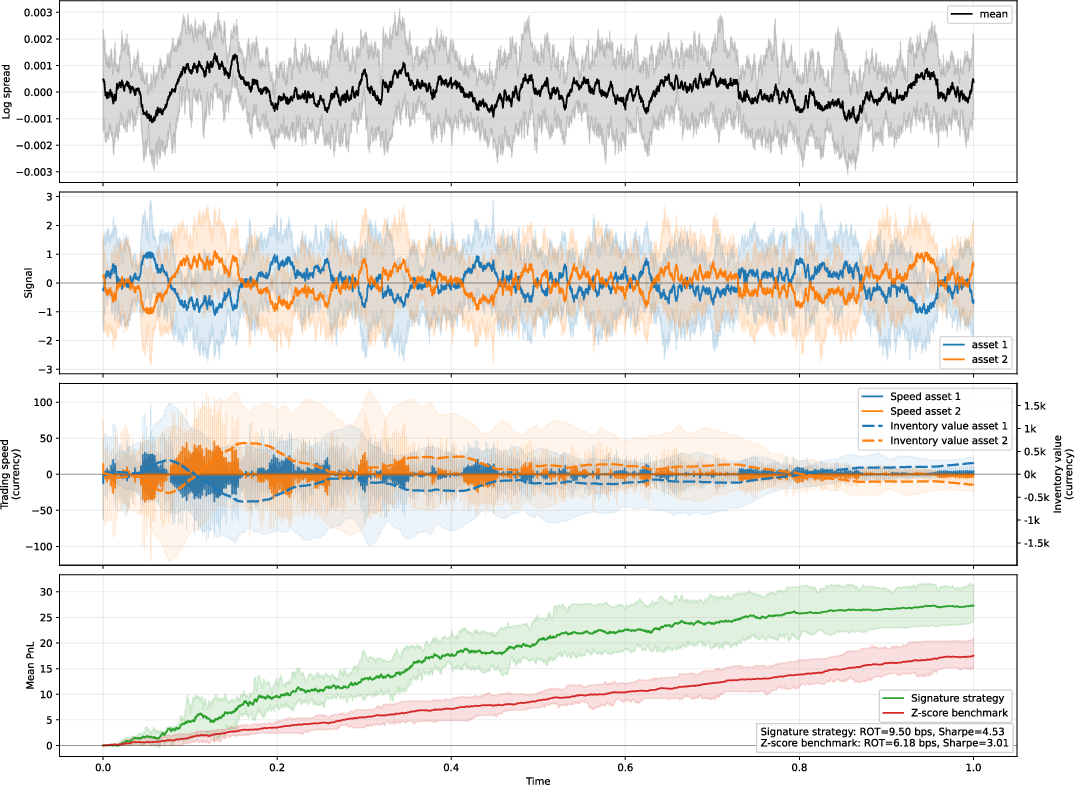
Figure 1: Synthetic benchmark against a classical z-score pairs-trading rule. The assets evolve according to a common-trend log-spread model; the signature-based strategy (using the same vt9-score alpha) learns a continuous path-dependent execution rule.
Key findings include:
- The signature-based policy outperforms the classical xt0-score entry–exit threshold rule in realized return-on-turnover (approx. 9 bps vs 6 bps), utilizing the same alpha but superior adaptivity to the realized path and frictions.
- Inventory management is smoother and more dollar-neutral with signature-derived execution.
- The continuous policy reacts to both signal strength and time-to-horizon, reducing end-of-period exposure, thus internalizing execution and terminal constraints absent from classical strategies.
Real-World Deployment: Equity Pairs Trading
The methodology is deployed on Shell–BP equity pairs, with signatures estimated on rolling four-day windows and policy evaluation in an out-of-sample test window.
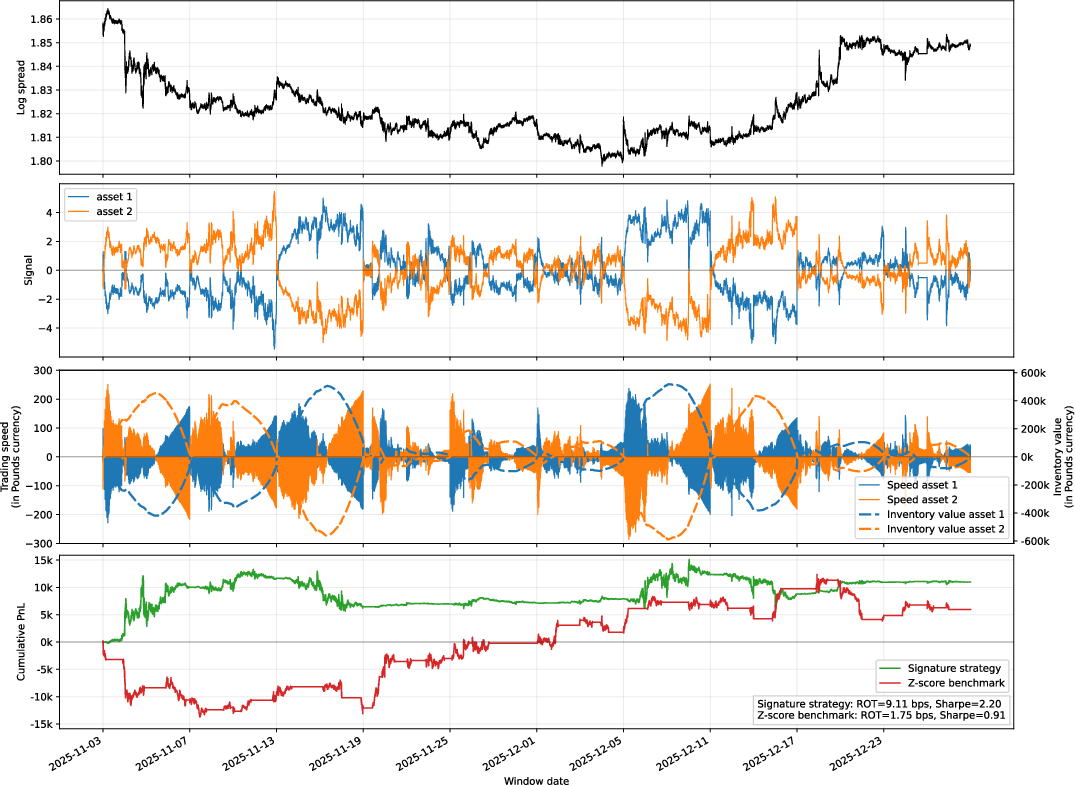
Figure 2: Historical Shell–BP deployment backtest: log spread, z-score signal, policy trading/inventory, and cumulative PnL for signature-based and benchmark strategies, demonstrating accounting outperformance of the signature-based approach.
Notably:
- The empirical signature-based strategy exhibits more consistent outperformance (9 bps versus 2 bps for the classical approach) over the test window.
- The policy displays robust inventory and exposure management during periods of signal instability.
- The methodology generalizes, with no adjustment, from synthetic to real data, supporting the operational feasibility of offline calibration and rapid execution.
Diagnostics and Ablation Analysis
Matrix diagnostics confirm that the induced quadratic forms for realistic calibrations are well-posed and negative-definite after mild Tikhonov regularization—a practical necessity due to collinear signature features and limited data. Closed-form moment calculations for low-dimensional projected bases (e.g., xt1 for OU processes) provide variance reduction benchmarks and validate empirical calibration pipelines.
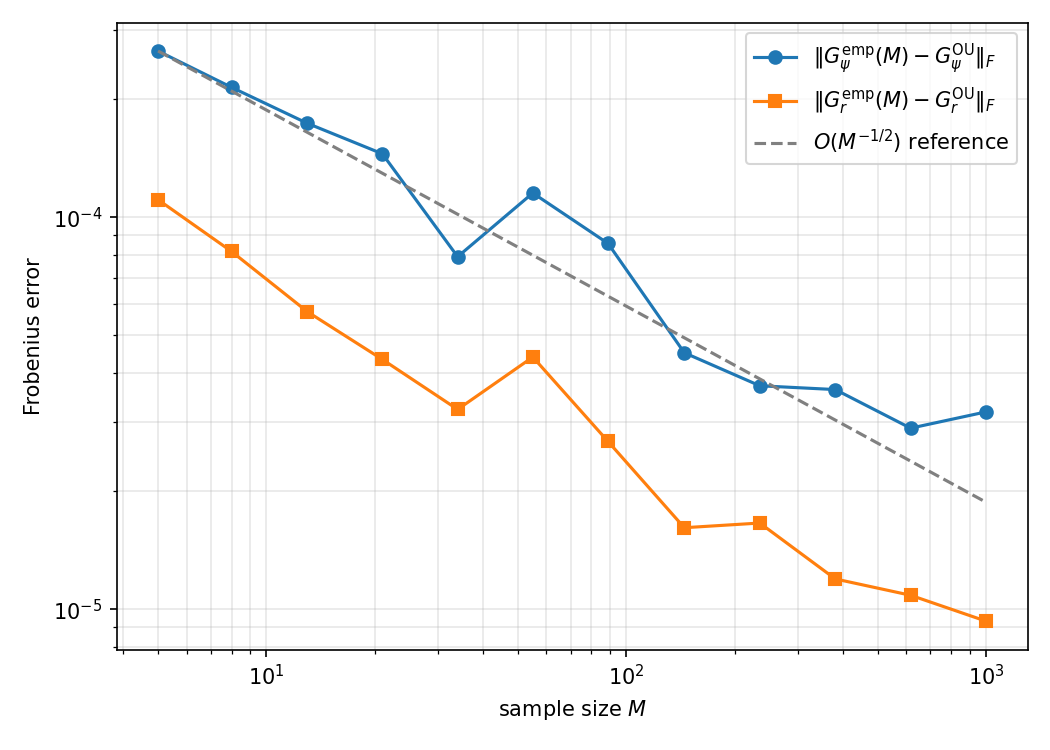
Figure 3: Convergence of empirically estimated Gram matrices xt2 and xt3 to closed-form OU moment targets, quantifying Monte Carlo estimation error.
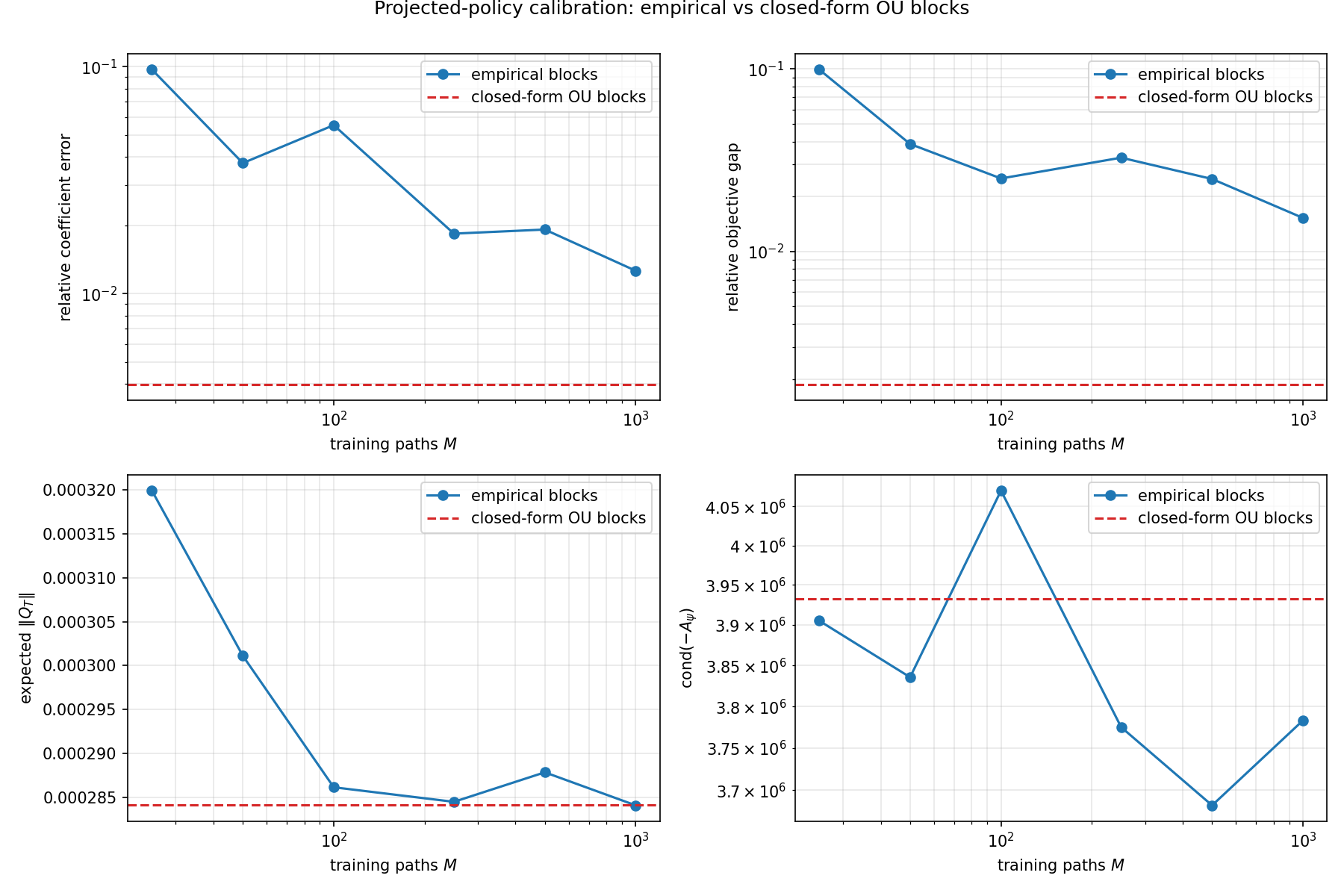
Figure 4: Projected-policy calibration on a reduced basis: analytic moment blocks yield lower finite-sample error and improved solution quality compared to empirical Monte Carlo estimates.
The transition from level xt4 to xt5 signatures (i.e., inclusion of second-order effects such as Lévy area and time-weighted increments) augments tactical information and increases both the quadratic objective and realized PnL, at the controlled cost of higher turnover and slightly greater terminal inventory norms.
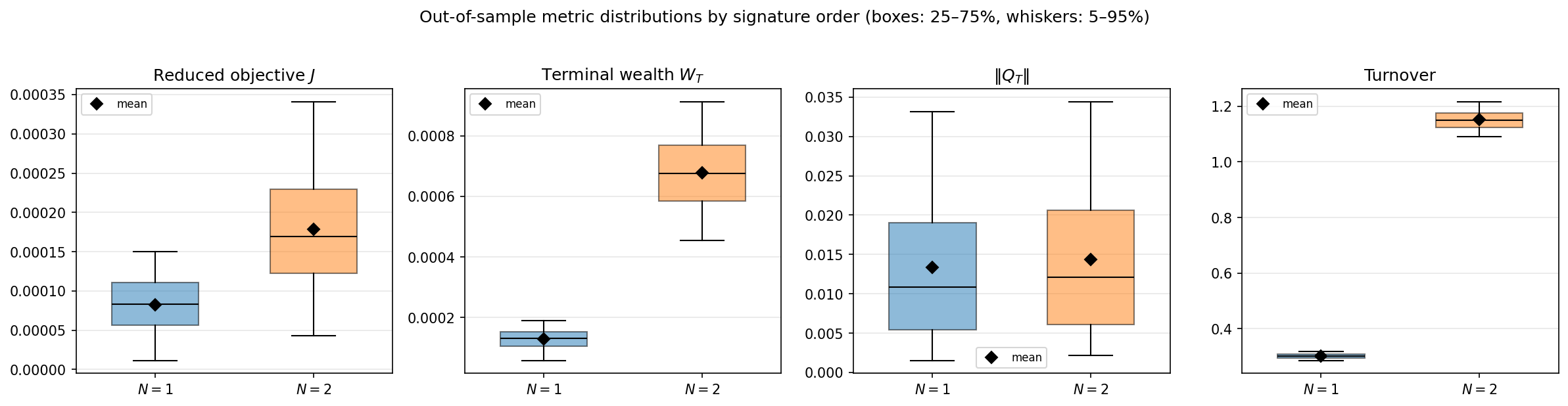
Figure 5: Effect of signature truncation order xt6: level-two policies yield higher objective and terminal wealth, but with greater turnover and inventory dispersion.
Sensitivity analysis reveals strong dependence of realized return-on-turnover to model and regularization parameters, with the ridge penalty on the policy coefficients being especially critical in controlling variance amplification from poorly identified directions in the empirical moment matrices.
Implications and Future Directions
The signature-based reduction to parameter optimization over a fixed, universal path-feature basis offers a principled and computationally efficient route to bridge signal generation and execution—enabling policies with dynamic path-dependent adaptivity while retaining tractability. The framework generalizes classical models and can ingest rich alpha proxies (market microstructure, order flow, deep learned predictors), and is robust to incremental feature enlargement.
The main structural constraints are linear-in-signature policies and quadratic (temporary) impact; nonlinear (e.g., neural) policies or permanent impact would necessitate approximate or reduced-form solutions. The empirical results motivate further validation across broader asset universes, signal classes, and in the presence of full microstructure costs and operational constraints.
Prospective research trajectories include:
- Online and adaptive policy estimation under regime change.
- Extension to multi-asset portfolios and non-Markovian impact models.
- Feature and truncation adaptivity via penalization (xt7 or elastic net), to select effective basis functions.
- Hybrid analytic–empirical calibration leveraging closed-form moments for feature blocks where available.
- Integration with limit-order-book and high-frequency microstructure models for more accurate friction modeling.
Conclusion
This paper rigorously demonstrates that signature-based execution delivers a tractable, flexible, and theoretically principled approach to the optimal execution of statistical arbitrage strategies with path-dependent signals. By leveraging the universal approximation power of signatures and the closed-form reduction to static quadratic programming, it synthesizes signal and execution layers, improves realized accounting performance in both synthetic and real data, and provides a solid foundation for further extended algorithmic trading research and practical deployment (2606.31387).

