- The paper demonstrates that in pure STG with minimal electromagnetic coupling, the Etherington DDR remains intact, preserving the relation Dₗ = (1+z)² D_A.
- It systematically derives the STG field equations and applies a geometric optics framework to trace photon trajectories in a non-Riemannian context.
- The study reveals that nonminimal electromagnetic coupling in f(Q) gravity induces a dynamical DDR violation linked to the evolution of H(z) and fine-structure constant variations.
Distance Duality Relation in Symmetric Teleparallel Gravity: A Technical Analysis
Introduction
The paper "Distance duality relation in symmetric teleparallel gravity" (2606.31299) presents a comprehensive and technically rigorous investigation of the Etherington distance duality relation (DDR) within the framework of symmetric teleparallel gravity (STG), focusing on scenarios where gravity is mediated by nonmetricity and electromagnetic fields may exhibit a nonminimal coupling to the nonmetricity scalar Q. The analysis elucidates both geometric and dynamical origins for potential violations of the DDR, tracing their theoretical implications and observational signatures. This essay provides an in-depth expert summary of the article’s structure, results, and their significance for cosmology and modified gravity.
The work commences with a detailed exposition of STG's geometric structure. In STG, both curvature and torsion vanish identically, and gravitational interaction is encoded purely via nonmetricity. The affine connection is decomposed into a Levi-Civita part and a disformation tensor, capturing the full content of nonmetricity. The authors systematically construct the field equations and discuss the STG superpotential derived from quadratic combinations of the nonmetricity tensor.
Electromagnetic wave propagation is analyzed in metric-affine backgrounds using the geometric optics approximation. At leading order, photon trajectories are shown to be null geodesics of the metric, regardless of nonmetricity, and at the next order, the conservation of the photon number current holds under minimal coupling. Thus, in pure STG with minimal coupling, the kinematical assumptions underlying the Etherington DDR remain robust, and the standard relation between luminosity and angular diameter distances holds, with no geometric source of DDR violation.
Metric-Affine Spacetimes and the Standard DDR
A rigorous treatment of null congruence evolution is provided: the connecting vectors between neighboring null geodesics evolve via the Levi-Civita connection, and the cross-sectional beam area satisfies a conserved antisymmetric scalar Ξ. This leads directly to the standard Etherington formula even in the non-Riemannian setting of STG (provided electromagnetic fields are minimally coupled and photon number is conserved). The result is that DL=(1+z)2DA, independent of the properties of nonmetricity, reaffirming the geometric invariance of the DDR under these assumptions.
Nonminimal Electromagnetic Coupling in f(Q) Gravity
The scenario changes fundamentally with the introduction of a nonminimal coupling between the electromagnetic sector and the nonmetricity scalar in the context of f(Q) gravity. The electromagnetic Lagrangian is extended by a general function I(Q) multiplying the standard FμνFμν term. The equations of motion preserve local U(1) gauge invariance but entail a modified transport equation for the photon-number current: ∇^μ[I(Q)α2kμ]=0,
with α the field amplitude and kμ the null wave vector.
The consequence is a dynamical, rather than geometric, violation of the DDR: the ratio Ξ0 (evaluated at receiver and source) appears as a multiplicative factor in the flux–distance relation. The observed luminosity distance is thus
Ξ1
This effect is not attributable to photon trajectory modification but arises exclusively from non-conservation of the photon number due to the evolving nonmetricity.
Explicit Scenarios and Quantitative Predictions
The analysis is specialized to homogeneous and isotropic FLRW cosmologies in the coincident gauge (where the affine connection vanishes and Ξ2 with Ξ3 the Hubble parameter). The DDR violation parameter is then directly linked to Ξ4: Ξ5
This provides a testable and model-specific prediction for cosmological datasets without resorting to phenomenological DDR parametrizations.
Several representative couplings are examined (power-law, exponential, logarithmic dependence on Ξ6), and the evolution of Ξ7 is calculated for each. In all cases consistent with current constraints on the fine-structure constant Ξ8, the DDR deviation is strictly sub-percent over the entire cosmic history. The connection between the nonminimal coupling and Ξ9 variation is explicitly established, showing that DDR violations and DL=(1+z)2DA0 drift are not independent, but intertwined probes of the DL=(1+z)2DA1 sector.
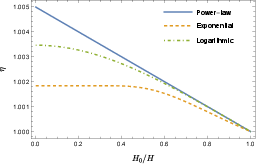
Figure 1: Cosmic evolution of the DDR violation parameter for various electromagnetic couplings, illustrating the degree of deviation from Etherington’s relation as determined by the functional form of DL=(1+z)2DA2. DL=(1+z)2DA3 throughout.
Observational and Theoretical Implications
The paper’s formalism enables the direct use of high-precision astrophysical observations (standard candles, rulers, multi-messenger data) to constrain not just the presence of nonmetricity but also the particular structure of electromagnetic–nonmetricity couplings. The tight connection to cosmological observables such as DL=(1+z)2DA4 underscores that high-precision measurements of distances and redshifts, when combined with limits on the time-variation of DL=(1+z)2DA5, can provide decisive tests of the STG paradigm.
Crucially, the analysis distinguishes geometric (minimal coupling) and dynamical (nonminimal coupling) origins for DDR violation, offering a diagnostic framework to use future data from supernovae, BAO, CMB, and gravitational wave sirens to test or constrain classes of metric-affine theories.
Conclusion
This work delivers a mathematically complete and observationally focused treatment of the DDR in symmetric teleparallel and DL=(1+z)2DA6 gravity. It decisively shows that Etherington’s reciprocity is preserved in pure STG (even though the connection is nonmetric) as long as the electromagnetic field is minimally coupled. The only route to DDR violation is dynamically, through a nonminimal DL=(1+z)2DA7 coupling, leading to sub-percent deviations compatible with current bounds but potentially distinguishable with future surveys. The explicit dependence of the DDR parameter on DL=(1+z)2DA8 and the violation’s connection with fine-structure variation provide robust and theoretically motivated tools for testing the viability of STG-based modified gravity theories. The framework may be extended to other non-Riemannian constructions; systematic confrontation with next-generation data will further elucidate the empirical status of the nonmetric sector in gravitational physics.