- The paper introduces an operator-level renormalization framework for galaxy bias, enabling UV-finite two-loop power spectrum and one-loop bispectrum/trispectrum computations.
- The work constructs a non-redundant set of leading- and next-to-leading-gradient operators up to fifth and third order respectively, ensuring closure under renormalization.
- The framework seamlessly incorporates deterministic and stochastic contributions, paving the way for accurate parameter inference in next-generation large-scale structure surveys.
Galaxy Bias Renormalization at Two-Loops: Operator-Level Renormalization and Stochastic Contributions
Overview and Motivation
This paper presents a comprehensive formalism for renormalizing galaxy bias at the operator level, extending the effective field theory (EFT) of large-scale structure (LSS) to systematically include next-to-leading-gradient (NLG) corrections. By constructing and explicitly analyzing the complete scalar operator basis up to fifth order in perturbations—including NLG bias and stochastic contractions—the authors deliver the machinery necessary for consistent, UV-finite computations of two-loop power spectra, as well as one-loop bispectra and trispectra of generic biased tracers.
The work addresses the critical need for accuracy in theoretical modeling to match the statistical precision of next-generation galaxy surveys (e.g., DESI, Euclid, LSST, Roman, SPHEREx), where percent-level constraints on cosmological parameters are targeted. This necessitates control over all sources of systematics, including correct absorption of UV-sensitive perturbative contributions into counterterms and bias coefficients.
Construction of the NLG Operator Basis
Bias operators are organized via a double expansion: in the number of powers of the linear density contrast δL (perturbative order), and in the number of (spatial) gradients (gradient expansion, counted as powers of kRL with RL the characteristic tracer scale). The NLG sector, requiring two extra gradients, first enters at second order in the expansion and is crucial for two-loop and higher-order predictions.
A thorough analysis yields a minimal non-redundant set of 29 leading-gradient (LG) operators through fifth order, and 20 NLG operators through third order. These include:
- Overall-gradient operators (with two overall derivatives)
- Non-overall-gradient operators (distinct for tracers)
- Backreaction-type (extra) operators: constructed with building blocks such as ∇2∇k∇lΠkl[n]
This construction is required to ensure closure under renormalization, especially for generic N-point function configurations; specific examples and reduction identities among operators are detailed for practical implementations.
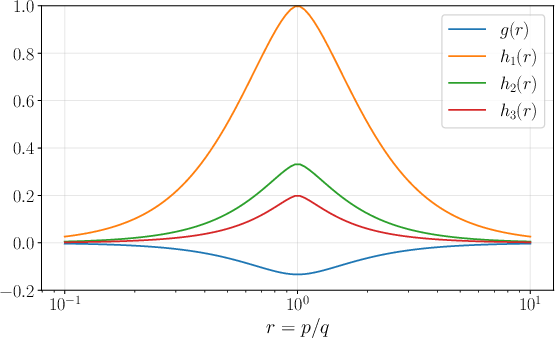
Figure 1: Weight functions g(r) and hi(r) entering the two-loop renormalization, illustrating their vanishing in hierarchical limits and peaking for p∼q.
Operator-Level Renormalization at One- and Two-Loop
Renormalization employs a scheme ensuring that the UV-sensitive pieces of loop integrals (both leading and quadratic-in-k) are absorbed completely into redefinitions of bias coefficients, for both deterministic and stochastic contributions. The renormalization is constructed at the operator level, making use of explicit single- and double-hard expansions of the bias kernels; the counterterms ZAB relate bare and renormalized operators and are determined recursively at each loop order via scaling conditions on correlation functions.
The two-loop regime is characterized by the need to control overlapping UV-divergences in nested hard-momentum regions; this is formalized using intrinsic weight functions in the kernel expansions (see Figure 1), which ensure proper subtraction of double-counted UV pieces and efficient factorization of loop contributions (see Figure 2).
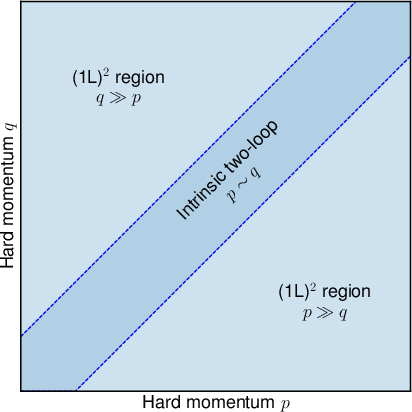
Figure 2: Partition of the two-loop (p,q) momentum plane into diagonal (intrinsic two-loop) and hierarchical (sequential one-loop) regions; essential for UV-finite operator renormalization.
Stochastic Renormalization and Operator Product Expansion
Beyond deterministic bias, mode-coupling loops involving coincident products of bias operators induce stochastic (shot-noise-like) corrections, which must also be renormalized. The analysis extends the operator product expansion (OPE) to products of up to four operators, enabling full control of contact renormalization up to the trispectrum. This formulation recovers and systematizes existing "noise field" stochasticity in a transparent manner, clarifying the relation to the deterministic expansion and the appearance of new counterterms at each N-point order.
RG Evolution of Bias: Mixing and Physical Implications
Physical bias parameters must be cutoff-independent: this requirement leads to coupled renormalization group equations (RGEs) for the bare bias coefficients, incorporating both deterministic and stochastic sectors. A block-diagonal structure emerges, with substantial feedback between LG and NLG sectors induced by the anomalous-dimension matrix. Explicit solutions show that:
- For matter, NLG coefficients acquire scale dependence that can be robustly predicted, and their "physical" values (at kRL0) can, in principle, be measured directly (see Figure 3 and Figure 4).
- For tracers, RG evolution reveals when higher-derivative bias mixing can strongly affect LG coefficients at scales approaching nonlinearity.
- One-loop RG resums the dominant sequential hard region contributions in multi-loop integrals, while intrinsic two-loop terms generate subleading corrections.
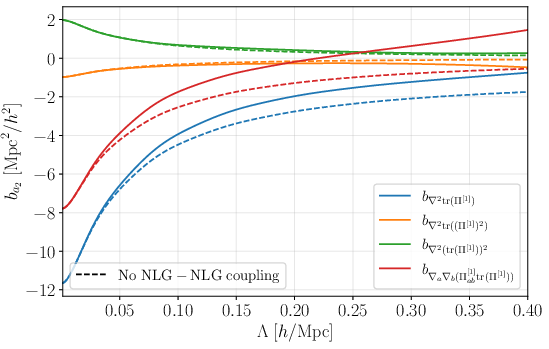
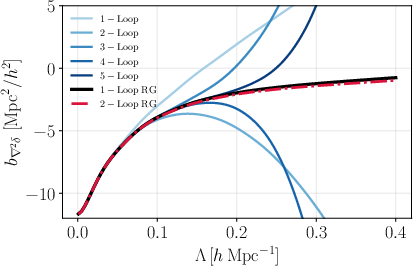
Figure 3: One-loop RG running of NLG bias coefficients for matter operators, showing scale-dependent suppression approaching the non-linear regime.
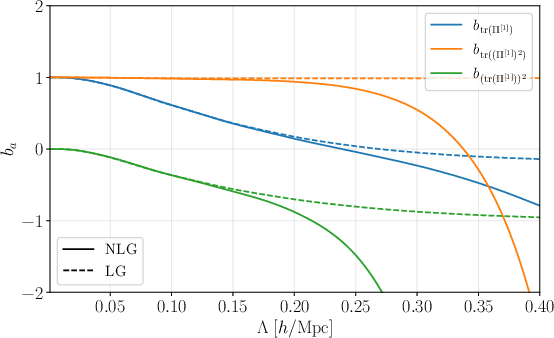
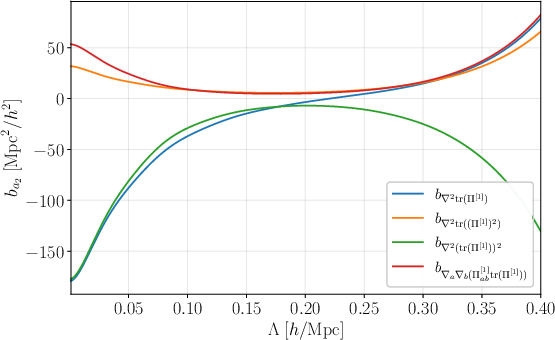
Figure 4: RG flows of LG and NLG coefficients for biased tracers, highlighting significant LG–NLG mixing and onset of strong running at higher cutoffs.
Operator Content for Power Spectrum, Bispectrum, Trispectrum
The formalism allows transparent enumeration of required independent bias and stochastic parameters for any combination of kRL1-point functions and loop order, summarized in detail in the main text and an accompanying operator-counting table. Notably:
- The two-loop galaxy power spectrum in real space requires 17 LG and 9 independent NLG operators (after redundancy analysis).
- Only a single extra NLG (non-overall-gradient) operator is needed relative to the matter case, illustrating the power of operator-level renormalization.
- The framework enables fully consistent joint analyses of kRL2, kRL3, kRL4 using a unified set of bias parameters, with all degeneracies and redundancies correctly managed via operator-level subtraction.
Theoretical and Practical Implications
This operator-level, systematically renormalized EFT framework provides the essential technical infrastructure for confronting high-precision LSS measurements with theory, allowing for:
- Consistent parameter inference across multiple correlated statistics (kRL5, kRL6, kRL7) without double-counting or omission of relevant operators.
- A path toward matching simulation outputs or observational data by fitting only the genuinely physical, finite parts of bias and stochastic coefficients, independent of regularization details.
- Automatic extensibility to higher-order statistics (N-point functions) and higher-loop corrections, as well as field-level analyses.
On the theoretical side, the delineation of all required counterterms at NLG order sets the foundation for symmetry-based "bottom-up" EFT operator classification and motivates further study of time-nonlocality and higher-derivative expansions in LSS.
Conclusion
This work completes the operator-level renormalization program for galaxy bias at NLG order, providing explicit kernel representations, stochastic counterterms, and operator mixing structures necessary for EFT modeling at two-loop and beyond. The operator approach ensures UV-finite, physically interpretable predictions and paves the way for accurate exploitation of forthcoming LSS data.
Further extensions to redshift-space distortions, tensor sectors, and higher-gradient stochasticity are tractable within the same operator-level framework. The explicit RG formalism invites cross-checks and matching to separate universe calibrations and N-body simulations, closing the loop between theory and observation.
This summary is based on "Galaxy bias renormalization: Two-loop Power Spectrum, One-loop Trispectrum and Bispectrum" (2606.31280).