- The paper introduces a novel absorption capacity framework that quantifies the precise point where separable noise mixed with a Bell state becomes entangled and gains teleportation utility.
- It derives closed-form expressions for product and X-state noise families, highlighting how local noise parameters affect both entanglement and fidelity thresholds.
- The study applies these analytic tools to realistic channel dynamics, uncovering transient nonmonotonic behaviors and the gap between entanglement and operational teleportation utility.
Absorption Capacity of Separable Noise: Bell-Mixing Thresholds for Entanglement and Teleportation
Introduction and Motivation
The problem of quantifying the persistence of entanglement under noise is fundamental to quantum information theory. In applications such as quantum teleportation and key distribution, the operational question is not only whether a given quantum channel or process preserves entanglement, but also whether the resulting state enables performance above classical limits, specifically for tasks like teleportation. Standard approaches often analyze fixed entangled states under noise. In contrast, this work introduces a dual perspective: for a fixed separable two-qubit noise state σ, how much maximally entangled Bell reference can be “mixed in” along a line ρλ=λ∣+⟩⟨+∣+(1−λ)σ before the state (i) becomes entangled and (ii) surpasses the classical teleportation fidelity bound. The transitions corresponding to these two criteria are formalized as the entanglement absorption capacity and the fidelity absorption capacity.
Theoretical Framework
The mixture under consideration,
ρλ=λ∣+⟩⟨+∣+(1−λ)σ,
interpolates between a separable noise state (λ=0) and a Bell state (λ=1). The separability threshold, λ∗(σ), is the smallest λ where the mixture becomes entangled (i.e., fails the positive partial transpose, PPT, criterion), while the teleportation threshold, λF(σ), is the minimal λ where the maximal teleportation fidelity exceeds the classical bound ($2/3$ for two qubits).
Both thresholds are encoded via absorption capacities:
- The entanglement absorption capacity ρλ=λ∣+⟩⟨+∣+(1−λ)σ0: the maximal relative Bell weight ρλ=λ∣+⟩⟨+∣+(1−λ)σ1 such that ρλ=λ∣+⟩⟨+∣+(1−λ)σ2, where ρλ=λ∣+⟩⟨+∣+(1−λ)σ3.
- The fidelity absorption capacity ρλ=λ∣+⟩⟨+∣+(1−λ)σ4: the maximal ρλ=λ∣+⟩⟨+∣+(1−λ)σ5 such that the fully entangled fraction of ρλ=λ∣+⟩⟨+∣+(1−λ)σ6 remains at or below ρλ=λ∣+⟩⟨+∣+(1−λ)σ7 (equivalently, teleportation fidelity at or below ρλ=λ∣+⟩⟨+∣+(1−λ)σ8).
Both capacities yield the operational thresholds via the same Möbius map:
ρλ=λ∣+⟩⟨+∣+(1−λ)σ9
This framework provides a unifying and closed-form treatment for the entanglement and teleportation transitions in mixtures of Bell reference and structured separable noise.
Main Results: Product and ρλ=λ∣+⟩⟨+∣+(1−λ)σ,0-State Families
Product Noise
For separable product noise ρλ=λ∣+⟩⟨+∣+(1−λ)σ,1, the capacities admit analytic expressions depending only on local marginals:
- Entanglement absorption capacity:
ρλ=λ∣+⟩⟨+∣+(1−λ)σ,2
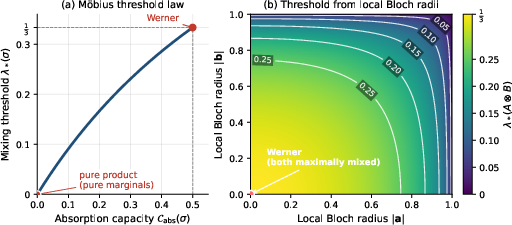
Figure 1: Two complementary views of the product-law threshold, showing the dependence on local Bloch radii and the mapping from capacity to threshold.
- The threshold ρλ=λ∣+⟩⟨+∣+(1−λ)σ,3 saturates the Werner value ρλ=λ∣+⟩⟨+∣+(1−λ)σ,4 only for maximally mixed marginals and is lower otherwise.
- Fidelity absorption capacity further depends on the orientation of the Bloch vectors relative to the Bell frame,
ρλ=λ∣+⟩⟨+∣+(1−λ)σ,5
with ρλ=λ∣+⟩⟨+∣+(1−λ)σ,6 and ρλ=λ∣+⟩⟨+∣+(1−λ)σ,7 for the ρλ=λ∣+⟩⟨+∣+(1−λ)σ,8 reference.
ρλ=λ∣+⟩⟨+∣+(1−λ)σ,9-State Noise
For complex separable λ=00 states (i.e., states with nonzero components only along the diagonal and anti-diagonal in the computational basis):
- Entanglement absorption capacity in the λ=01 frame:
λ=02
where λ=03 is the anti-diagonal coherence, and λ=04 are off-diagonal populations.
- Fidelity absorption capacity in the λ=05 frame:
λ=06
- For general Bell frames, analogous closed forms hold by permuting blocks and coherences. The critical insight is that both capacities, and thus absorptive thresholds, can be expressed in closed-form for any separable λ=07 state.
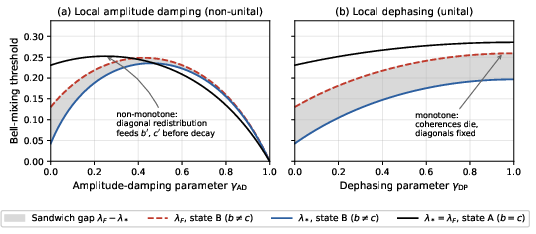
Figure 2: Bell-mixing thresholds as functions of amplitude damping and dephasing channel strength for representative separable λ=08 noise states, showing cases where the thresholds coincide (equal middle populations) and where a nonzero entangled-but-unuseful regime exists.
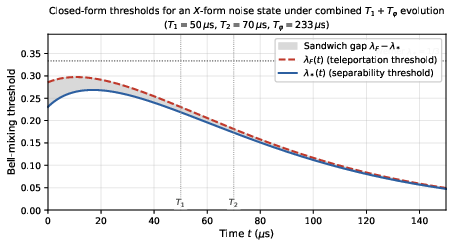
Figure 3: Time evolution of separability and teleportation thresholds for a separable λ=09 state under realistic combined amplitude damping and dephasing, using transmon qubit parameters; the gap between entanglement and teleportation thresholds is transient and vanishes with relaxation.
Channel Dynamics and Threshold Trajectories
The closed-form nature of the capacities enables the analytic tracking of thresholds as the noise state evolves under Markovian decoherence channels:
- Amplitude damping and pure dephasing preserve λ=10 structure, so λ=11 and λ=12 can be evaluated by updating λ=13 state parameters with the channel maps.
(Figure 2 and Figure 3 illustrate threshold curves under local amplitude damping and dephasing, as well as under combined, time-dependent realistic parameters.)
- The analysis reveals, for example, nonmonotonic threshold behavior due to amplitude damping increasing λ=14 transiently, and the closing of the entangled-but-not-teleportable interval as noise equilibrates populations.
Analytical and Conceptual Implications
Directional, Fixed-Reference Perspective
The absorption capacities are explicit, fixed-reference measures. They do not optimize over all possible decompositions but instead quantify how much entanglement can be "absorbed" by a given noise background along a specific mixing line. This directional perspective is closer in spirit to the relative robustness of entanglement [Vidal–Tarrach] than to statewise entanglement measures like concurrence.
- For product noise, the absorption capacity is reference-independent; for λ=15-state noise, it depends on the Bell frame.
- The capacity variable is convenient for decomposition certificates: feasible absorption amounts add linearly under convex combinations, providing certified lower bounds on the absorptive threshold for mixtures.
Teleportation Utility and the Entangled-but-Unuseful Interval
Critical to applications, the framework quantifies λ=16 and λ=17 and thereby the range λ=18 where states are entangled but not useful for (direct) teleportation. For λ=19 states, the size of this interval (threshold gap) is given in closed form, and coincides with the equality condition λ∗(σ)0.
Generalization and Limitations
The absorption capacity construction is analytic on both the product and λ∗(σ)1-state sectors but is not yet fully generalized to arbitrary separable states (summary certificates via decompositions are available). The approach can, in principle, extend to higher-dimensional systems, though in λ∗(σ)2 the positivity of partial transpose is no longer sufficient for separability, and the dependence on the noise state's parameters becomes more intricate.
Numerical Results and Claims
- Strong claim: For every separable two-qubit state, the entanglement and teleportation thresholds along a Bell-mixing line can be expressed as a Möbius transform of a well-defined absorption capacity, with closed forms for product and λ∗(σ)3 families.
- In every tested channel scenario (including realistic transmon parameters), the analytic curves for entanglement and teleportation thresholds accurately predict times and noise strengths for transition, including transient intervals where entanglement is present yet teleportation advantage is lost.
Future Directions
- Beyond Two Qubits: Extending absorption capacity to λ∗(σ)4 systems will require new analytic techniques, as neither PPT nor product impurity laws are generally sufficient.
- Multipartite and Generalized Networks: The fixed-reference approach holds promise for resource characterization in multi-party quantum networks and distributed quantum tasks.
- Optimal Decomposition and Certification: Optimizing decomposition certificates over tractable structured families (product, λ∗(σ)5, etc.) could yield improved analytic lower bounds for general separable states.
Conclusion
This work introduces a concise analytic framework for quantifying the threshold at which separable two-qubit noise states mixed with a fixed Bell reference cross over into entanglement and teleportation utility. Absorptive capacities (entanglement and fidelity) characterize these transitions via Möbius relations. Explicit formulas for product and λ∗(σ)6-state noise yield practical, analytic tools for calibration, benchmarking, and open-system analysis, and clarify the gap between entanglement existence and operational usefulness. The approach enables fine-grained, channel-dependent tracking of quality-of-service thresholds for entangled resources, and serves as a springboard for future generalizations to higher dimensions and more complex quantum networks.
References
Trinh, X. D., Absorption capacity of separable noise: Bell-mixing thresholds on separability and teleportation (2606.31243).