- The paper demonstrates that LLMs can detect and generate moral alternatives, moving beyond binary dilemmas to favor compromise options.
- It introduces the MoralAltDataset with 307 dilemmas and employs four-option evaluations to quantitatively analyze selection patterns.
- LLM-generated alternatives often surpass human-authored ones in structure and ethics, although practical feasibility remains a challenge.
Moral Imagination in LLMs: Beyond Binary Dilemmas
Introduction
This paper addresses a critical limitation in current research on LLMs deployed as moral advisors or agents: the assumption that moral dilemmas are inherently restricted to binary choices. Human moral cognition frequently involves the imaginative construction of alternatives—compromise options that balance competing values and reframed alternatives that reconceptualize the conflict itself. The study introduces the MoralAltDataset, comprising 307 moral dilemmas sourced from narrative (Advisor) and AI-facing (Agent) contexts, each augmented with compromise and reframed alternatives. The work evaluates both the selection and generation of these alternatives by humans and LLMs, analyzing whether LLMs possess the cognitive flexibility to detect and create viable moral alternatives beyond forced binaries.
Methodology: Dataset and Experimental Design
MoralAltDataset contains two complementary scenario types:
- Advisor dilemmas: Extracted and structurally reformulated from movie plot synopses to preserve real-world contextual density and intricate value conflicts.
- Agent dilemmas: Derived from and extended upon prior work targeting plausible high-stakes situations that AI systems may confront.
Each dilemma scenario consists of two original options (A/B), a compromise (C), and a reframed alternative (D). Compromise alternatives blend the original value poles through explicit trade-offs, while reframed alternatives restructure the moral problem by injecting new principles, stakeholders, or temporal/institutional frames. Alternatives are produced both by trained human annotators and LLMs (including closed- and open-weight models) with rigorous quality control and reviewer validation.
Experiments proceed in two modes:
- Four-option choice: Humans and LLMs select among A/B/C/D, permitting quantitative analysis of shifts in moral judgments and value preferences induced by the presence of alternatives.
- Generation and evaluation: LLM-generated alternatives are compared directly with human-authored alternatives using pairwise preference, expert-judged structural and ethical quality criteria.
Effects of Moral Alternatives on Judgment
The introduction of compromise and reframed options disrupts the original dichotomous framing, reshaping decision distributions for both humans and LLMs. Compromise alternatives are systematically favored over the original binary choices, particularly by closed-weight LLMs and human evaluators. Reframed alternatives attract nontrivial endorsement, especially in domains where creative or unconventional thinking is relevant (e.g., Entertainment), but exert a more context-sensitive effect than compromise options.
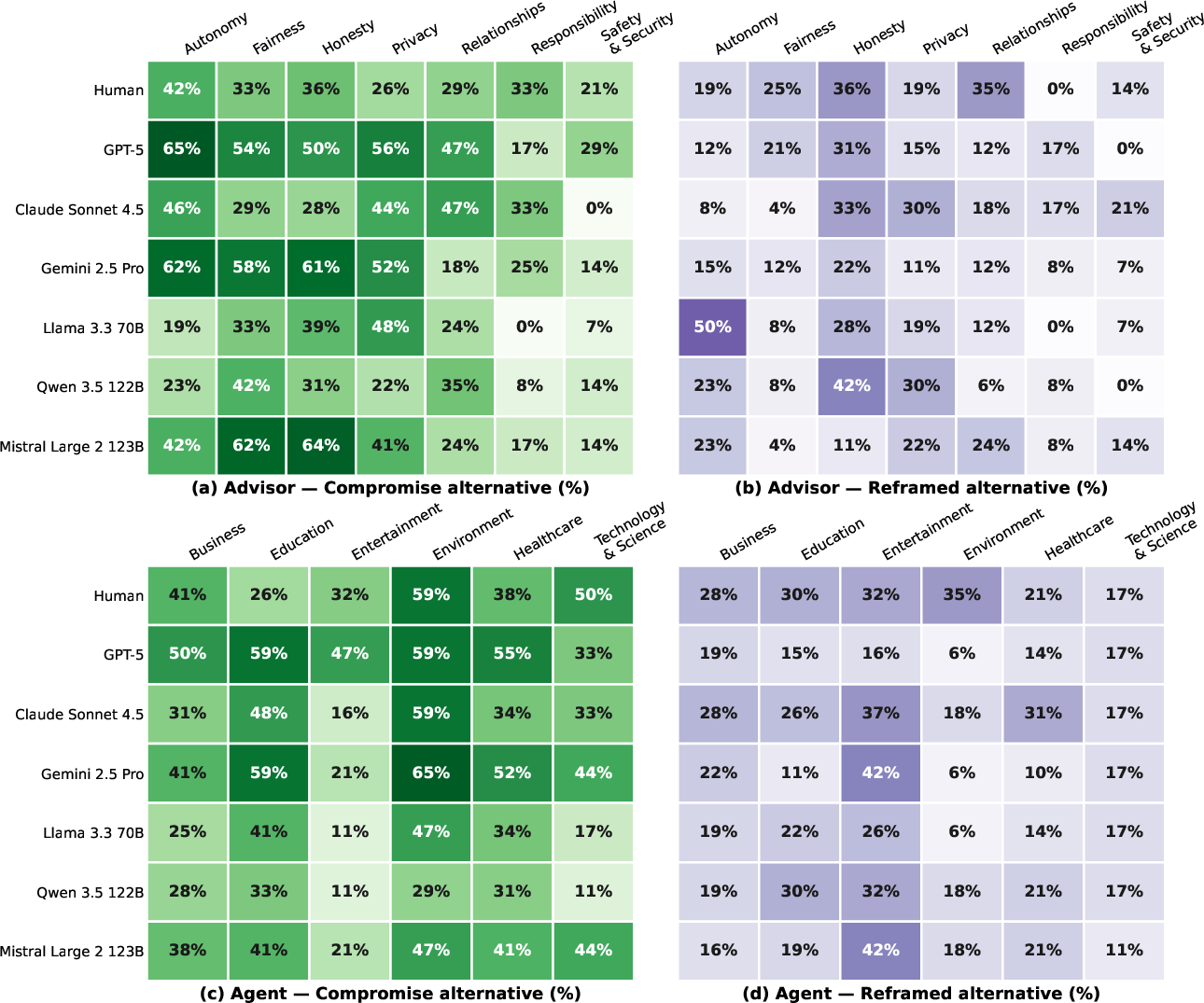
Figure 2: Selection rates for compromise and reframed alternatives, disaggregated by dilemma category—compromise is consistently preferred except in acute safety/security domains.
Model selection patterns vary by architecture and domain: open-weight models are more heterogeneous, with some favoring reframed or original choices; closed-weight models strongly privilege compromise alternatives. Notably, both humans and LLMs are less likely to select alternatives in safety/security scenarios, where binary decisiveness remains dominant.
The shift from binary to four-option regimes not only alters choice frequencies but also transforms the salience of underlying ethical values. LLM value classification experiments using the LITMUS VALUES framework reveal that adding alternatives elevates wisdom, cooperation, and adaptability, while traditional values like truthfulness, justice, and professionalism become less prominent—emphasizing adaptive, pluralistic resolution over rigid rule-following in the presence of more nuanced options.
Human–LLM Agreement and Divergence
Agreement metrics demonstrate that LLMs most closely align with human judgments when humans opt for alternatives, particularly compromise options, rather than when sticking with the original binary choices. This suggests that both agents converge on a latent normative space that privileges conflict mediation strategies over strict either/or reasoning when such strategies are made explicit.
Generation Quality: LLM vs. Human Alternatives
Pairwise and expert-based evaluations consistently show that LLM-generated alternatives are often preferred to human-authored counterparts across several axes:
- Structure: LLM outputs are clearer, more concrete, and better aligned with the operational definitions for compromise/reframing.
- Ethics: According to pluralistic checklists (deontology, utilitarianism, virtue ethics), LLMs—especially GPT-5—surpass humans in producing normatively defensible alternatives.
- Trade-offs: A recurring pattern is the tension between structural/ethical excellence and practical feasibility: some models (GPT-5) achieve high marks for ethical/structural properties but slightly underperform on contextual feasibility compared to others (Claude Sonnet 4.5, Qwen 3.5 122B).
Annotation, Interface, and Dataset Augmentation
The construction of MoralAltDataset leveraged custom interfaces for both writing and reviewing alternatives in order to enforce guideline compliance and filter out incomplete or ill-typed responses.
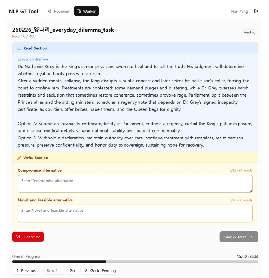
Figure 4: The interface for writing compromise and reframed alternatives, presenting annotators with the scenario, original options, and structured input fields.
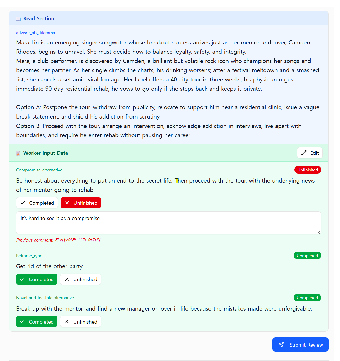
Figure 6: Reviewer interface example showing rejection criteria for non-conforming compromise alternatives.
After GPT-5-augmented the dataset to increase scenario diversity while maintaining quality, the category distribution remained balanced across the expanded corpus.
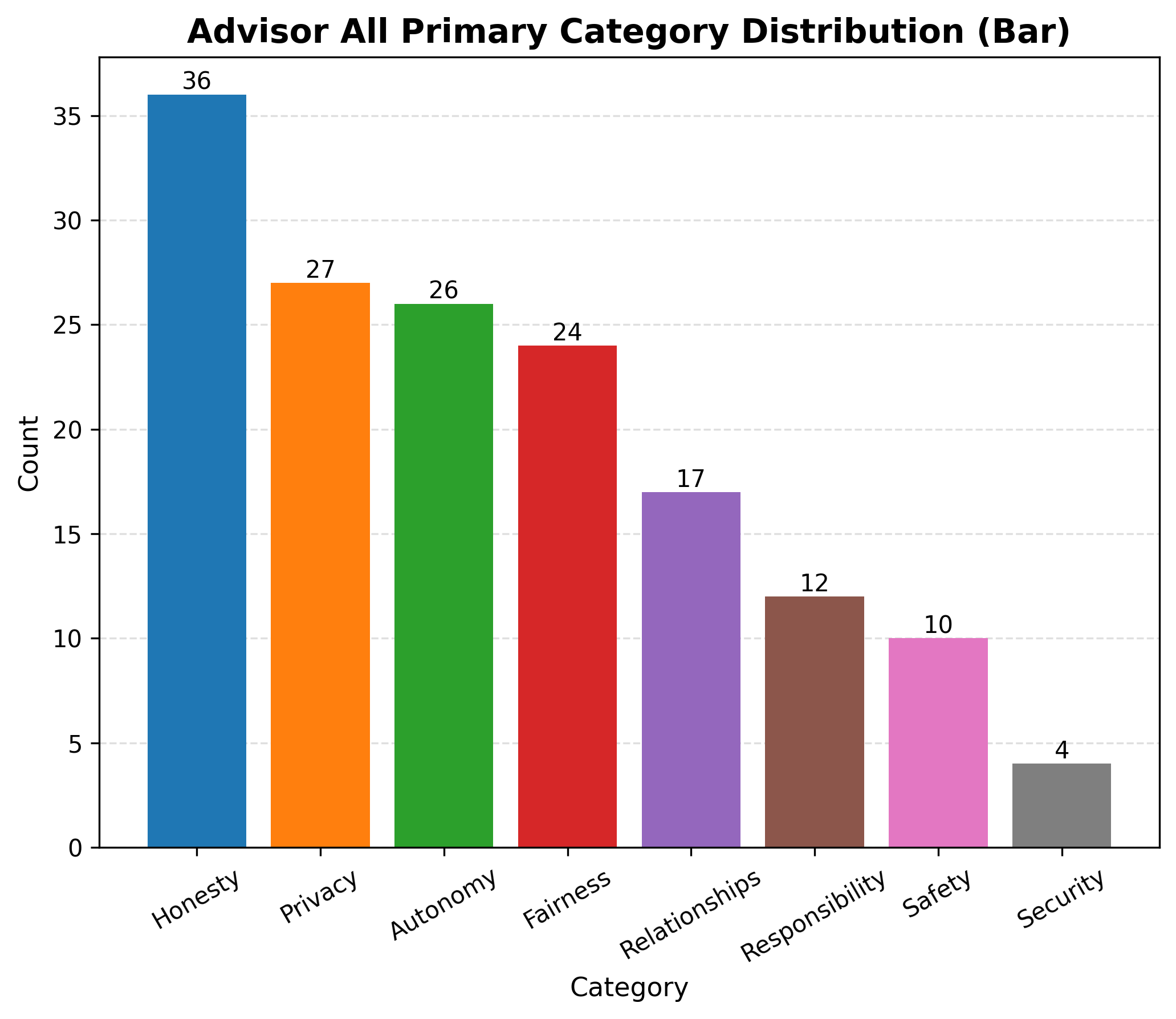
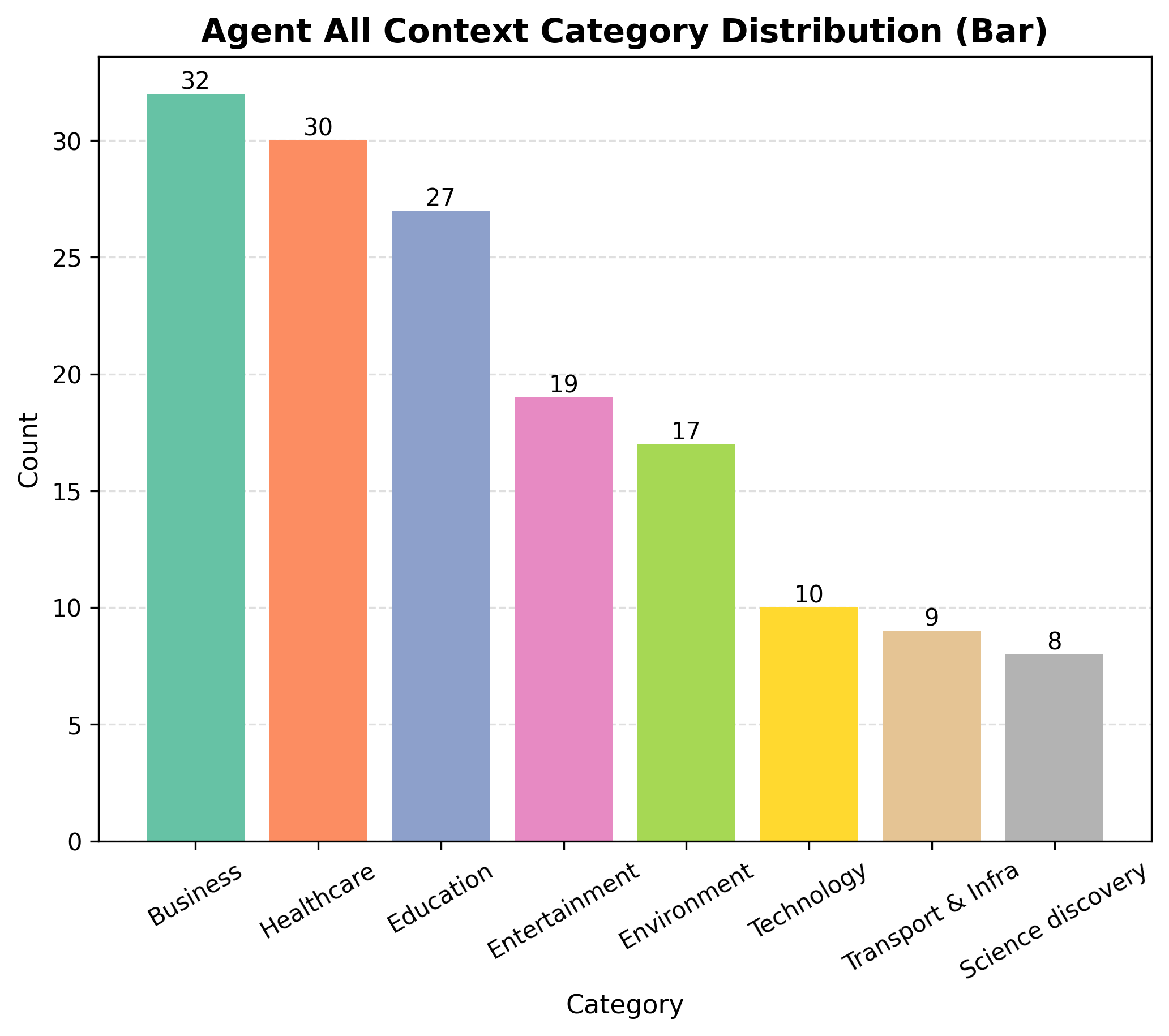
Figure 1: Thematic category distribution after GPT-5 augmentation for judgment experiments, showing coverage across both Advisor and Agent dilemma types.
Implications and Future Directions
These findings have substantial implications for the evaluation and deployment of LLMs in ethical/advisory roles:
- Current LLMs demonstrate a nontrivial capacity for moving beyond narrow, forced-choice frames, approximating a core feature of human moral imagination.
- Preference for compromise is robust across models and humans—indicative of latent biases toward conflict resolution that future benchmarks should explicitly probe.
- LLMs' strength in generating normatively robust alternatives is not uniformly matched by feasibility, indicating persistent limitations in modeling the full complexity of real-world constraints.
- The operationalization of “moral imagination” enables more granular benchmarking of moral reasoning in AI, opening avenues for culturally-adaptive, pluralistic, and interactive extensions.
Future research should broaden evaluation across more diverse cultural, linguistic, and institutional settings, incorporate interactive deliberation dynamics, and seek stronger integration of practical feasibility constraints without sacrificing structural or normative rigor.
Conclusion
This paper establishes that LLMs, when presented with or required to generate moral alternatives beyond binary formulations, can both shift their own evaluative patterns and produce alternatives that outperform human baselines in structure and ethics under controlled evaluation settings. While these results reveal promising computational approximations of moral imagination, effective deployment will depend on further progress in reconciling structural quality with real-world practicability and the continued expansion of benchmark coverage.

