- The paper presents a novel nonsecular Floquet generalized master equation framework that resolves dissipation and dynamics in driven ultrastrong cavity-QED systems.
- It employs a double-dressed basis and Floquet–Liouville modal analysis to decompose emission spectra into microscopically resolved quasienergy transitions.
- Numerical benchmarks reveal that traditional static dissipative models fail, emphasizing the need to include off-diagonal couplings in complex driven scenarios.
Floquet Quasienergy-Resolved Dissipation and Dynamics in Ultrastrong Cavity-QED
Introduction and Motivation
This work addresses the nonequilibrium dynamics of cavity quantum electrodynamics (QED) in the ultrastrong-coupling (USC) regime under strong periodic driving. The primary advancement is the development of a theoretical framework that accurately models driven open quantum systems where the time-dependent Hamiltonian, the nonperturbative light–matter coupling, and environmental dissipation act simultaneously. Traditional master-equation methods—often based on time-independent dressed bases or rotating-wave approximations—are no longer predictive in this challenging regime; instead, a treatment that fully incorporates Floquet quasienergies and their operational role in dissipation and emission processes is required.
The paper introduces a nonsecular Floquet generalized master equation (F-GME) formulated in the dressed-state basis of the quantum Rabi model (QRM), avoids secular truncations, and is applicable to arbitrary spectral environments. By comparing this approach to the widely used time-independent dressed-basis GME (TI-GME), the study systematically benchmarks their range of validity, particularly in predicting frequency-resolved observables such as emission spectra.
Physical Setting and Theoretical Framework
The minimal model under consideration comprises a single-mode cavity of frequency ωc strongly coupled to a two-level system (TLS) of frequency ωa, with interaction strength g. In the USC regime (η=g/ωc≳0.1), counter-rotating and diamagnetic terms become crucial, invalidating the Jaynes–Cummings model and requiring the full QRM Hamiltonian. Periodic driving enters the system in two forms:
(i) Floquet coherent pumping—external coherent drive (Fig. 1a)
(ii) Floquet engineering—parametric modulation of an internal system parameter (e.g., g→g(t)) (Fig. 1b)
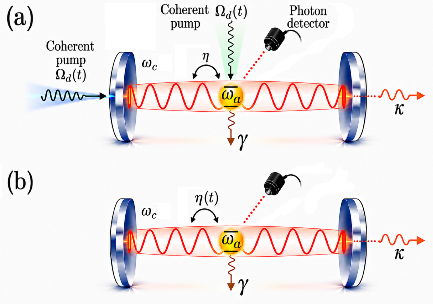
Figure 1: Schematics of driven and dissipative cavity-QED; (a) optically pumped, (b) Floquet-engineered via mechanical modulation.
Floquet theory is essential for a nonperturbative treatment of the driven system, replacing stationary eigenstates with time-periodic Floquet (quasienergy) states. For a complete open-system description, it is necessary to include quasienergy-resolved dissipation, which the developed F-GME achieves by evaluating dissipation channels at all possible Floquet-induced transition frequencies Δαβl=εβ−εα+lωd.
The major theoretical contributions are:
- Construction of a nonsecular F-GME in the double-dressed (Floquet-dressed) basis without approximating away nonsecular (off-diagonal) terms.
- Formulation of a unified Floquet–Liouville (FL) modal analysis that decomposes observable spectra into sums over dissipative eigenmodes, each mapped back to underlying quasienergy transitions, their hybridizations, and decay rates.
Key Numerical Results
Exploiting the developed framework, the study provides a number of detailed simulations for both optical coherent pumping and mechanical Floquet engineering, under a representative set of parameters (ωa=ωc, η=0.5, strong driving). Energy spectra, population responses, and emission spectra are presented, with direct comparisons between F-GME and TI-GME.
Floquet Spectrum Organization and Channel Structure
Periodic drives transform the energy structure from simple static dressed states to a densely packed spectrum of Floquet quasienergies, with allowed transitions organized by selection rules derived from parity and generalized symmetries.
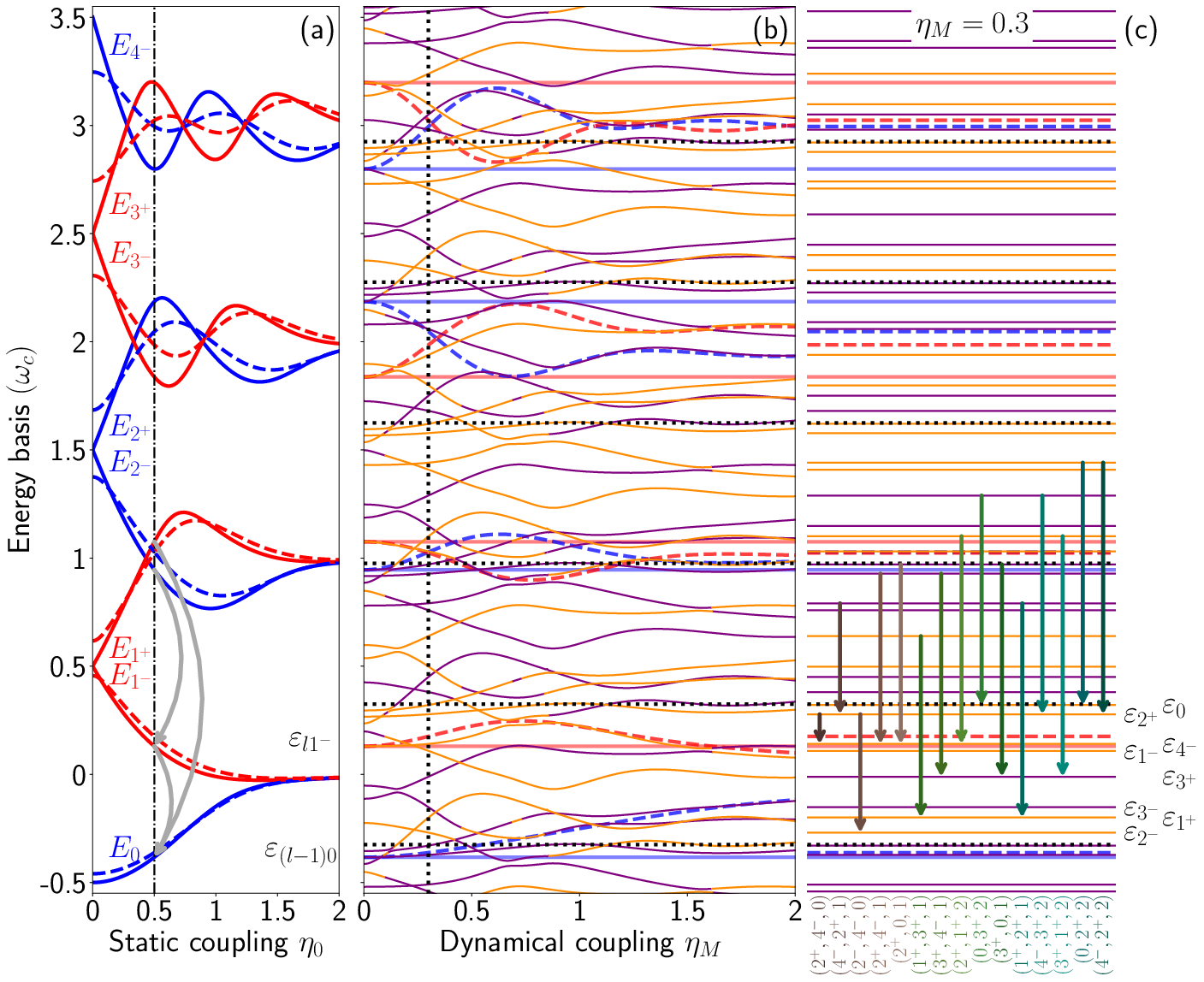
Figure 2: Mechanically driven cavity-QED energy structure; Floquet quasienergy formation from mechanical modulation.
Key findings include:
- Under strong driving, observable decay and emission processes redistribute over a large set of drive-assisted Floquet channels.
- In the optical driving regime and with flat (frequency-independent) baths, time-independent GME and F-GME often agree on integrated populations but can diverge substantially for frequency-resolved observables, especially in structured baths.
- In the mechanically driven system (Floquet engineering), even flat baths require an F-GME for a correct description—static approaches fail in both populations and spectra, due to the fundamentally different nature of excitation pathways.
Emission Spectra and Mode Analysis
Frequency-resolved emission spectra provide stringent benchmarks: differences between F-GME and TI-GME are pronounced, especially with structured (e.g., Lorentzian–Ohmic) environments.
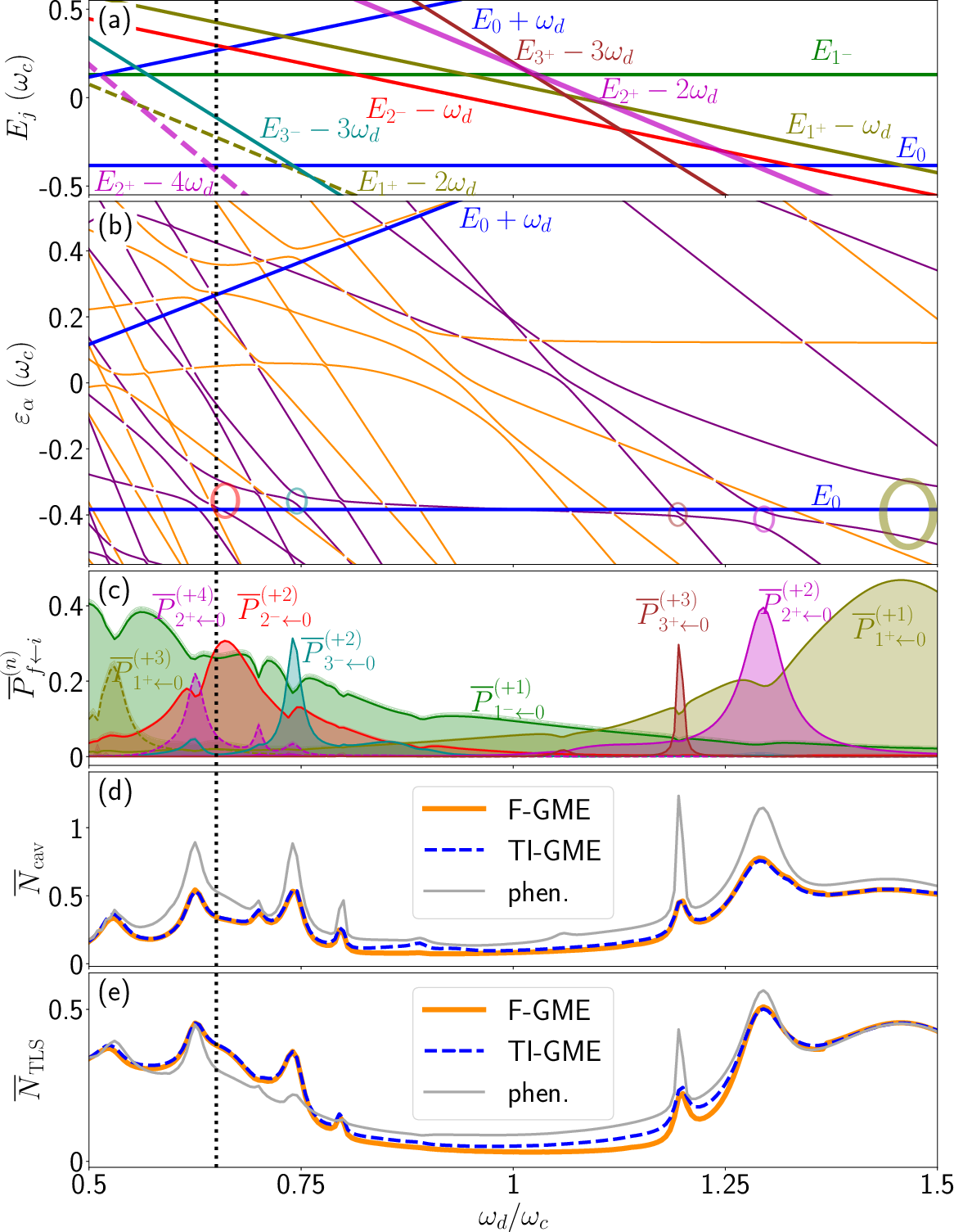
Figure 3: Optically driven system: Floquet quasienergies, transition probabilities, dominant resonances and steady-state populations vs ωd.
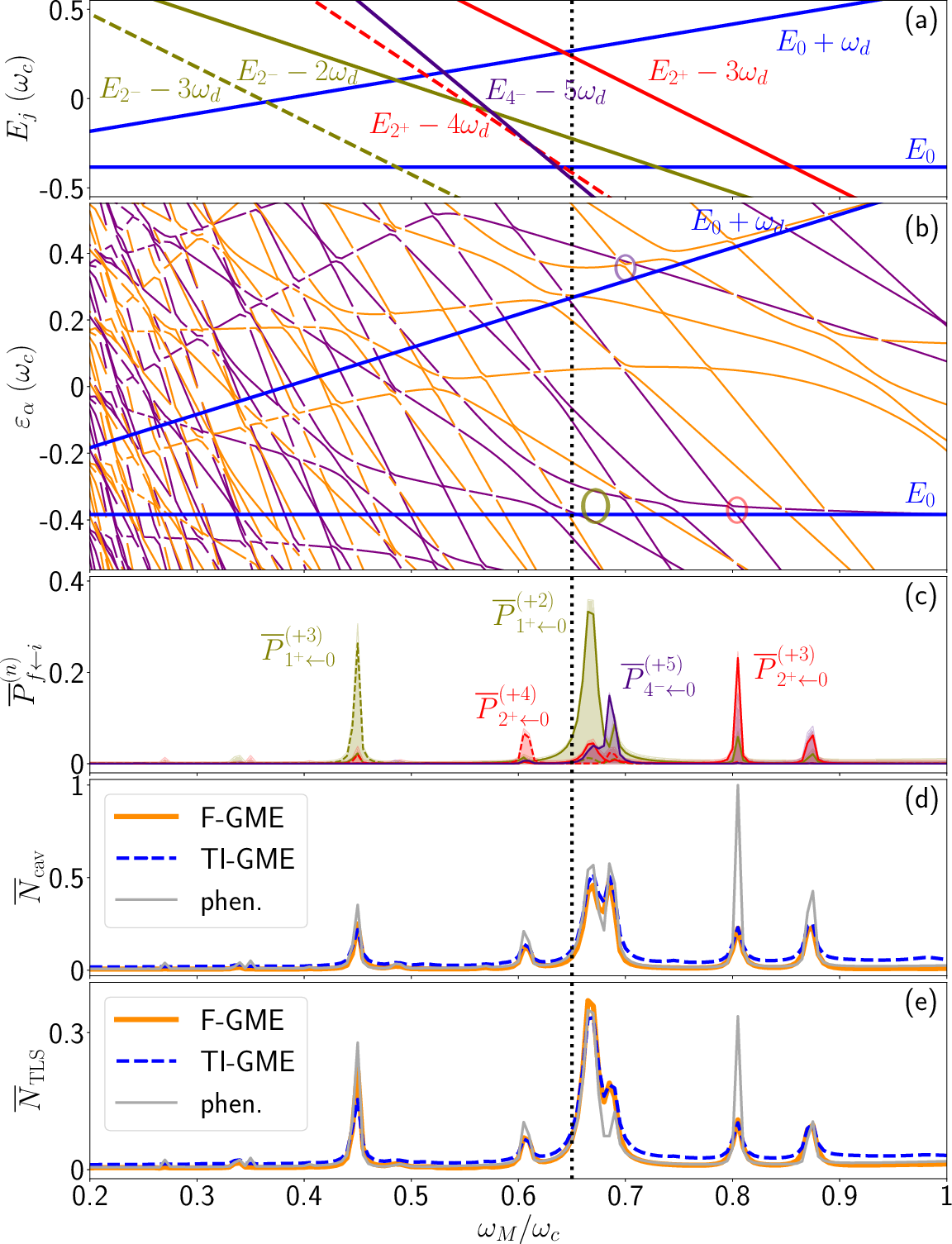
Figure 4: Mechanically driven system: Floquet-engineered transition structure and mode-resolved spectral contributions as a function of ωM.
The FL modal decomposition makes the following evident:
- Even when static approaches reproduce average populations, they misallocate the spectral weight among observable peaks—wrong linewidths, merged or suppressed peaks, and incorrect relative intensities are frequent.
- The FL approach hierarchically decomposes each spectral feature into microscopic transition channels.
- Nonsecular couplings (i.e., off-diagonal dissipator terms retained by the F-GME) are essential when quasienergy manifolds are dense or overlapping, causing hybridization and breakdown of single-channel intuition.
Numerical and Modal Evidence
Tables (not included here) summarize for each spectral peak the associated FL mode, dominant quasienergy channels, and their contribution to observed spectra—providing a diagnostic map of how physical emission processes correspond to drive-dressed and dissipatively broadened channels.
Strong, quantitative differences emerge in cases where:
- Structured reservoirs emphasize sideband selectivity, breaking any accidental agreement between TI-GME and F-GME.
- Floquet engineering makes drive-induced population transfer proceed via operator redistribution rather than direct pumping—a scenario static dissipators cannot model.
Implications and Outlook
The assured gauge invariance of the formulation is specifically highlighted—necessary for any cavity-QED theory in the truncated Hilbert space under physically realistic truncation.
Practical implications include:
- Predictive modeling of strongly driven polaritonic devices, superconducting circuits, and hybrid light–matter systems in quantum optics where drive amplitudes approach system energy scales.
- Enabling simulations of quantum reservoir engineering, control of decay pathways, and preparation of steady states tailored via periodic driving.
- Providing principled criteria to judge the applicability or breakdown of time-independent dissipative treatments, vital for both theory and experimental data analysis.
From a theoretical perspective, this work lines up with recent developments in open-system Floquet theory, offering a nonsecular, double-dressed, fully resolved dissipative treatment applicable to both spectrally flat and structured environments, and extensible to multi-component or more complex models.
Conclusion
The study decisively demonstrates that:
- Floquet quasienergy-resolved dissipation is essential for accurate modeling of strongly driven USC cavity-QED systems.
- Time-independent dissipators suffice only in restrictive settings (e.g., optical driving with a flat bath and well-separated transitions), and otherwise, generically fail—yielding incorrect populations and, especially, spectral lineshapes.
- The Floquet generalized master equation (F-GME), together with FL modal analysis, constitutes the correct theoretical approach for driven dissipative ultrastrong light–matter systems.
Potential future developments include generalization to multi-mode or multi-TLS scenarios, extension to time-dependent and non-periodic drives, and experimental validation of theoretical predictions in controlled quantum-optical and circuit-QED platforms.

