- The paper introduces GPTs, a unifying convex framework capturing classical, quantum, and post-quantum probabilistic models.
- It details how state, effect, and transformation spaces represent physical processes and underpin probabilistic predictions.
- It explores nonlocality, contextuality, and dynamics within GPTs, revealing geometric bounds and operational implications for quantum phenomena.
Generalised Probabilistic Theories: A Unified Framework for Physical Theories
Introduction and Operational Structure
Generalised Probabilistic Theories (GPTs) provide an operationally-motivated, convex-geometry-based framework designed to capture and analyze a vast landscape of physical theories—of which both classical probability theory and quantum mechanics appear as special cases. The fundamental objects in GPTs are the (convex) state spaces, effect spaces, and the transformations connecting them, with all physical predictions reduced to calculations of probabilities via inner products of real vectors. Crucially, GPTs distinguish themselves by their generality: they accommodate any probabilistic model that satisfies convexity and operational consistency, making them an invaluable tool for analyzing the boundary between quantum, classical, and "post-quantum" (or super-quantum) theories.
At the core of the GPT formalism, a state is represented as a real vector—encapsulating probabilities or expectation values for a set of reference (fiducial) measurements. A probabilistic mixture of preparations is described by the convex combination of these state vectors; thus, the framework is sometimes termed the convex framework. Effects are real vectors from the dual space that act on states via the inner product, furnishing the probability of observing specific outcomes under a measurement. Transformations are real-linear maps, typically required to preserve normalization and the validity of states and effects.
This representation, rooted in cones in finite-dimensional vector spaces, provides an algebraic encoding of operational procedures (preparation, transformation, measurement) and underpins a uniform approach to the probabilistic predictions of physical theories.
Embedding of Classical and Quantum Theories
Classical Probability Theory
Classical probability theory manifests in the GPT framework as a simplex state space: the pure states are linearly independent and correspond to deterministic assignments for each measurement. Any mixed state is uniquely expressed as a convex combination of pure states, and all valid transformations are stochastic matrices, ensuring that normalized probability vectors remain within the simplex. The uniqueness of the decomposition of mixed states into pure states is a hallmark classical feature and fails in non-classical cases, directly connecting to phenomena such as the impossibility of universal cloning or broadcasting in quantum theory.
Quantum Theory Representation
Quantum mechanics, while congruent with the convex axioms of GPTs, features a far richer convex geometry. Quantum state space is not a simplex; pure quantum states form an overcomplete set, yielding non-unique decompositions of mixed states—a signature of nonclassicality related to core quantum effects. States are mapped to real vectors (e.g., via Bloch or Pauli representations), effects correspond to POVM elements, and transformations correspond to completely positive maps, all embedded in real vector spaces via systematic basis expansions. For a qubit, the familiar Bloch sphere is recovered as the state space slice at unit normalization. Measurement probabilities are again computable as vector inner products.
The extension to higher-dimensional quantum systems involves density matrices as vectors in a d2-dimensional real vector space, with an operational isomorphism between quantum measurements and effects in the dual space. Notably, the set of quantum effects (i.e., POVMs) is defined by positivity and completeness, matching the GPT generalization of measurement.
Visualization of Wigner Negativity
The nonclassicality of certain quantum states is vividly illustrated through Wigner negativity.
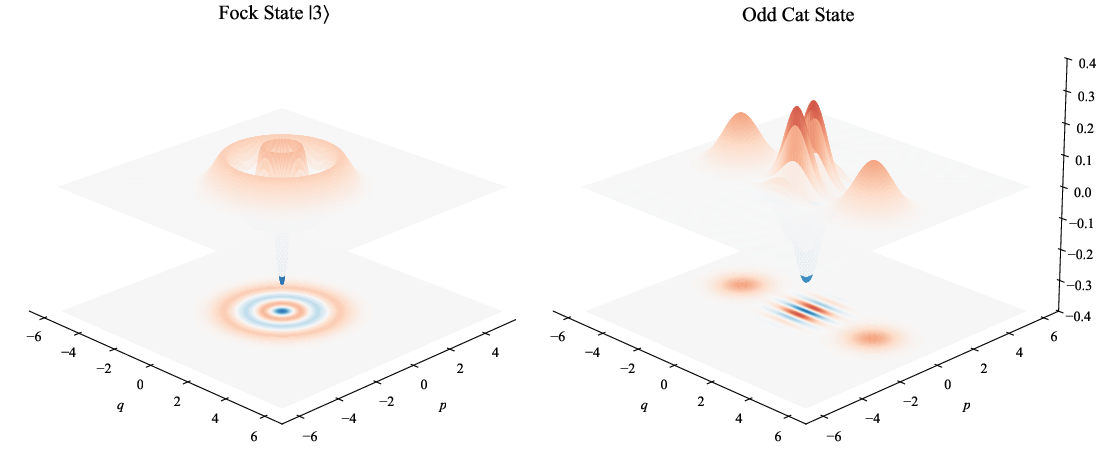
Figure 2: The Wigner quasi-probability distribution W(q,p) for two distinct quantum states. The presence of negative regions (blue) is a direct indicator of nonclassicality, distinguishing these states from classical statistical distributions (red: positive values).
Derivation of Quantum Theory from Operational Axioms
The GPT framework provides the basis for reconstructing quantum mechanics from a concise set of physically motivated axioms [Hardy, 001FivAxi]. Central to Hardy's approach are the notions of the maximal number of distinguishable states N and the number of real parameters (degrees of freedom) K required to specify a state. Imposing constraints such as compositionality, continuity, and simplicity, one rigorously derives that K(N)=Nr for some r∈N+. The exclusion of the simplex (r=1) case via the continuity of dynamics (which a discrete simplex does not allow) yields r=2 as the only viable minimal solution—recovering the quantum scaling, with the qubit Bloch sphere structure emerging for N=2. Extensions to arbitrary N invoke the geometry of formally real Jordan algebras, continuous reversible dynamics, and higher-order interference constraints.
Nonlocality and the Landscape of Physical Theories
GPTs facilitate the systematic comparison of the nonlocal properties of classical, quantum, and post-quantum theories through the lens of Bell-type scenarios.
- Bell and CHSH Inequalities: Classical hidden-variable theories satisfy strict bounds (CHSH W(q,p)0) derived from locality and realism. Quantum mechanics, via operator algebraic constraints (C*-algebraic structure), exceeds this (Tsirelson bound at W(q,p)1), but remains strictly sub-algebraic.
- Box World and PR Box: The GPT formalism admits the construction of "box world," wherein only no-signalling is enforced. Here, extremal correlations (e.g., the PR box) saturate the algebraic CHSH bound (W(q,p)2). The space of allowed correlations is a convex polytope, generalizing classical and quantum sets, and is understood geometrically via the non-signalling polytope.
- Gbit State Space: Exploring a single system with three dichotomic fiducial observables—removing quantum positivity constraints—yields the "gbit." The gbit's state space is a cube, contrasted with the quantum Bloch sphere, and only allows discrete reversible transformations corresponding to cube symmetries.
The contrast in admitted correlations and transformation groups sharply distinguishes classical, quantum, and super-quantum theories, elucidating the role of structure in state and effect spaces in constraining nonlocality.
Dynamics, Hamiltonians, and Phase Space in GPTs
Defining Hamiltonians as generators of time evolution within GPTs is addressed through operational desiderata—recovering quantum and classical behavior as special cases while accommodating generalized state spaces. For 3-dimensional systems, the generator is constructed from real antisymmetric matrices, guaranteeing orthogonality with the Hamiltonian vector and conservation of its expectation value under dynamics. This approach provides a template for defining energy and time evolution in nontraditional structures, including gbits and toy models.
Advanced work generalizes the concept of phase space: GPTs incorporate arbitrary quasi-probability distributions, extending beyond the Wigner function. The phase-space approach reveals that classical and quantum dynamics are specific parameterizations (classical via the Liouville equation, quantum via the Moyal bracket/W(q,p)3-product) within a broader class of possible dynamics characterized by theory-dependent kernels in the evolution equation. This structure unifies classical, quantum, and speculative post-quantum phase-space behavior into a common analytic form.
Signatures of Nonclassicality: Wigner Negativity, Contextuality, and Tunneling
Quantum mechanics transcends classical probability by allowing negative values in phase-space quasi-distributions (Wigner negativity), which underpin various operational anomalies:
- Violations of Classical Bounds: E.g., the Tsirelson bound and related probability bounds (such as the maximum probability for finding a quantum harmonic oscillator in a positive coordinate region) can be violated exclusively due to the presence of negative values in the Wigner function—not possible in any classical probabilistic theory.
- Contextuality Equivalence: Recent developments equate contextuality (resistance to noncontextual hidden variable models) and Wigner negativity [008NegCon, 005SpeCon]. Both reflect a fundamental impossibility of reproducing quantum behavior with positive, noncontextual ontological models. Their operational postulates are now known to be mathematically equivalent.
- Tunneling Phenomena: The GPT phase-space formalism demonstrates that quantum tunneling arises from negativity in either the Wigner representation of the state or the measurement operator, leading to probabilities of observing the system in classically forbidden regions that exceed those permitted by any positive-valued theory.
Implications and Outlook
The GPT framework rigorously exposes and categorizes the structural features that distinguish quantum mechanics from other conceivable probabilistic theories, quantifying the precise boundaries enforced by convex geometry, operational compositionality, and symmetry-requirements. Its utility is manifold:
- Theoretically, GPTs provide templates for reconstructing quantum mechanics from physically intelligible axioms and benchmarking the scope and origin of quantum advantages in information processing.
- GPTs systematically chart the landscape of possible nonlocal or "super-quantum" phenomena, simultaneously clarifying why quantum mechanics sits at a nontrivial, maximally nonclassical—but not maximally nonlocal—point in theory space.
- Practically, developments in GPT-inspired models (e.g., super-quantum resource theories, toy models with operational restrictions) inform experimental approaches to probing the limits of quantum mechanics and guide quantum-inspired algorithms by delineating the role of state and effect structure.
The extension of the GPT program to infinite-dimensional settings, continuous phase space, and novel informational constraints (e.g., those relevant for quantum gravity and black hole information paradox analyses) remains a promising avenue for deepening our understanding of physical law [mueller2012black].
Conclusion
Generalised Probabilistic Theories furnish a comprehensive and rigorous operational scaffold that extends far beyond classical and quantum theories, underpinning foundational inquiries into nonlocality, contextuality, and dynamical principles. Through their unifying language, GPTs demarcate the essential characteristics that set quantum mechanics apart from classical and post-quantum worlds, elucidate the operational origins of interference phenomena and nonclassicality, and provide a formal laboratory for the systematic exploration of alternative theories and their informational consequences. The further development and application of GPTs is poised to yield continued insights into the mathematical, conceptual, and physical frontiers of fundamental theory.
References:
For in-depth mathematical frameworks, discussion of axiomatic reconstructions, and details of the cited results, see (2606.31097) and primary references therein.