- The paper demonstrates that LLM-guided personality prompts significantly modulate agent behaviors, validating trait-dependent responses in evacuation scenarios.
- The study employs a Perceive-Reason-Act pipeline that integrates contextual and personality data to produce heterogeneous, realistic agent actions.
- The results reveal that distinct OCEAN traits influence both evacuation and rescue dynamics, underscoring the potential for advanced, personality-driven simulations.
LLM-Driven Personalities in Emergency Decision-Making Simulations
Introduction
The paper "LLM-Driven Personalities for Decision Making in Emergency Simulations" (2606.31038) presents a systematic approach to embedding OCEAN personality traits within virtual agents for simulating emergency evacuation scenarios. The principal objective is to interrogate whether LLM-powered personality prompts can modulate individual and collective agent behaviors in a manner that yields more heterogeneous, realistic crowd dynamics compared to legacy rule-based architectures. The authors establish two primary hypotheses: (H1) language-based personality descriptions alter agent decision-making, and (H2) agent personalities measurably affect simulation outcomes.
Architecture and Methodology
The proposed method leverages a Perceive-Reason-Act triadic pipeline to coordinate agent responses to simulated fire emergencies. Each agent features a distinct OCEAN personality profile, personal context, memory, and situational awareness. Interaction with the LLM proceeds via context-rich prompts informed by both internal (biographical, personality) and external (scene, alert) factors.
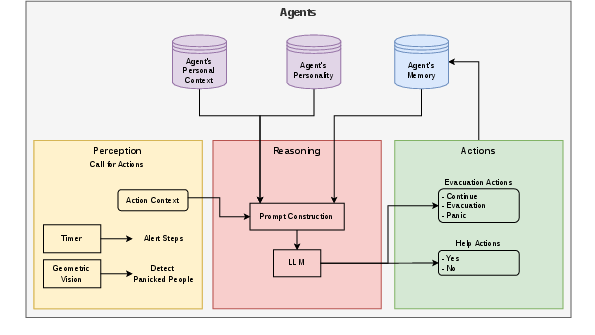
Figure 1: Structure of the agent pipeline highlighting perception, reasoning, and action modules with personality integration.
The personality vector, encoded as high, neutral, or low trait values, is mapped onto descriptive language markers following Serapio-Garcia et al.'s methodology. Prompts are constructed to induce LLM behavioral outputs tailored to specified personality archetypes, producing JSON-formatted answers with explicit rationale. Each agent receives timed alert messages of escalating urgency, iteratively deciding between evacuation, idling, or panicking.
The simulation environment is implemented in Unity 3D and utilizes BioCrowds for pathfinding, with inter-agent coordination optimized via ZeroMQ. Agents distributed across a spatially realistic office layout respond to five graduated hazard alerts.
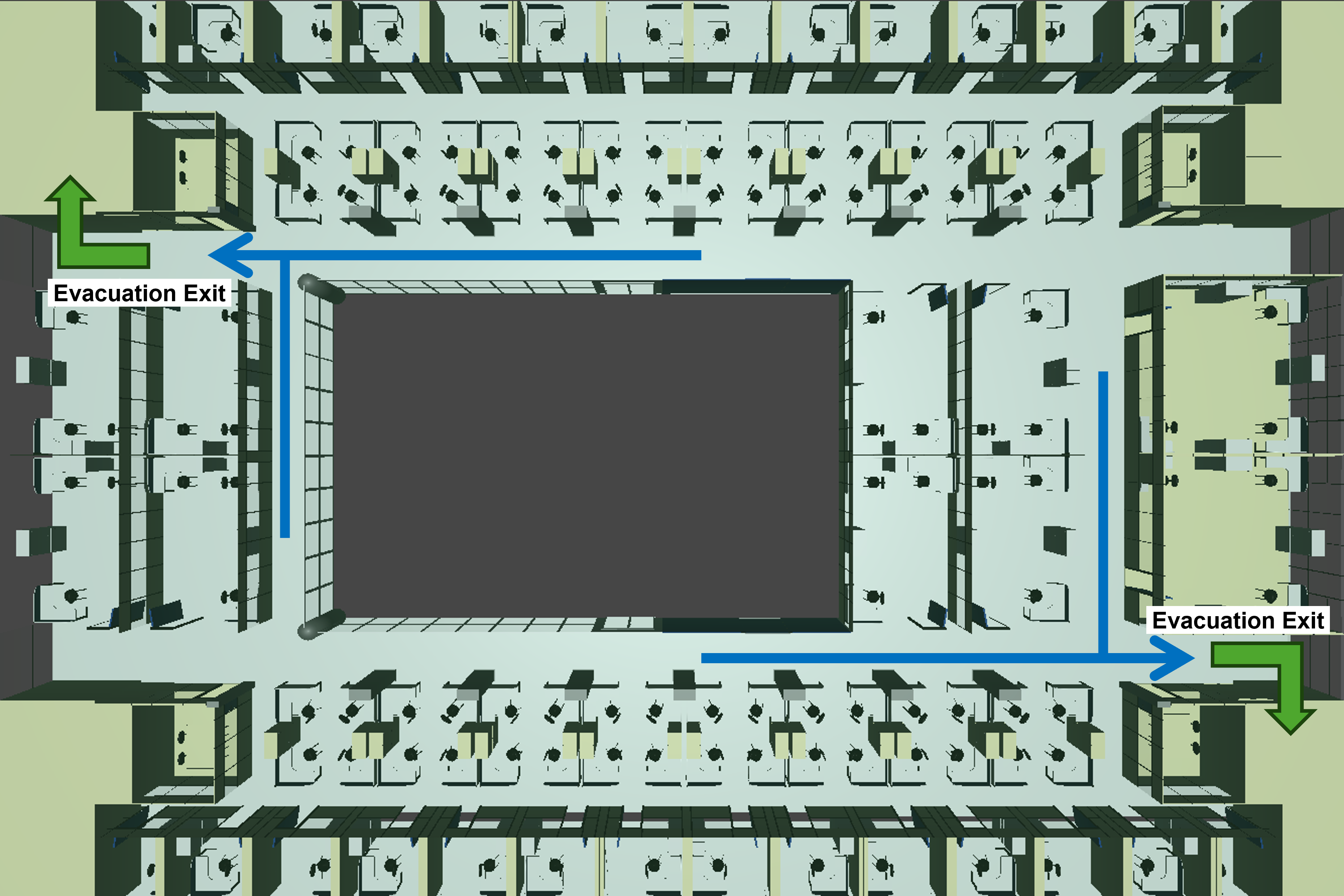
Figure 2: Office layout with designated evacuation routes and exit indicators.
Results
Evacuation Decision-Making
The suite of experiments deployed 600 agents: 100 per prominent OCEAN trait and 100 neutral. LLM parameters (temperature=0.1, top-k=10, top-p=0.1) enforced determinism. Results demonstrate that the majority of agents initiated evacuation after the second or third alert, with a nontrivial fraction neither evacuating nor panicking.
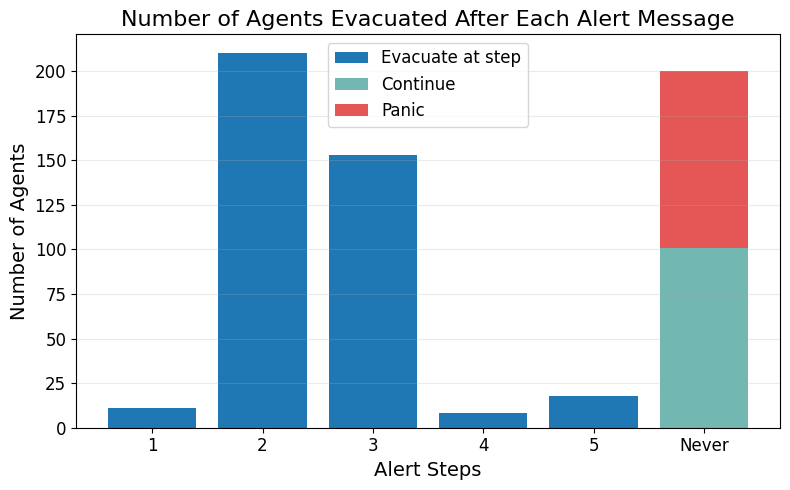
Figure 3: Incremental evacuation statistics as alert severity increases.
Detailed analysis indicates strong trait-dependent behavioral stratification. Conscientious and Neutral agents universally evacuated, reflecting compliance and risk-aversion tendencies. Agreeable agents, similarly, favored evacuation. Open agents exhibited analytical inertia, opting to continue work at high rates until alerted of critical danger. Extraverted agents disproportionately ignored evacuation instructions, aligning with their "bold" and "adventurous" descriptors. Neurotic agents, conversely, were prone to panic.
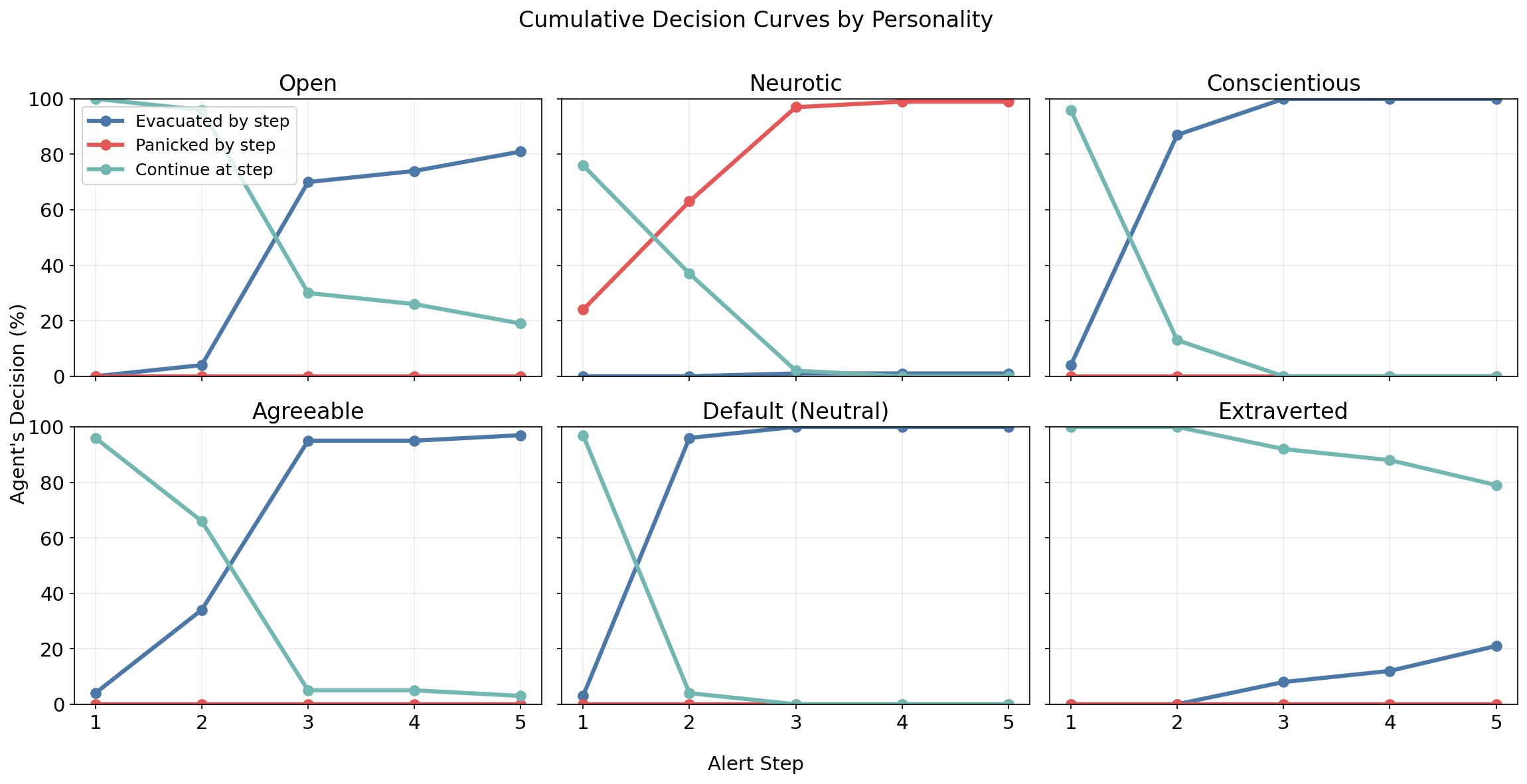
Figure 4: Alert-step decision state evolution stratified by personality.
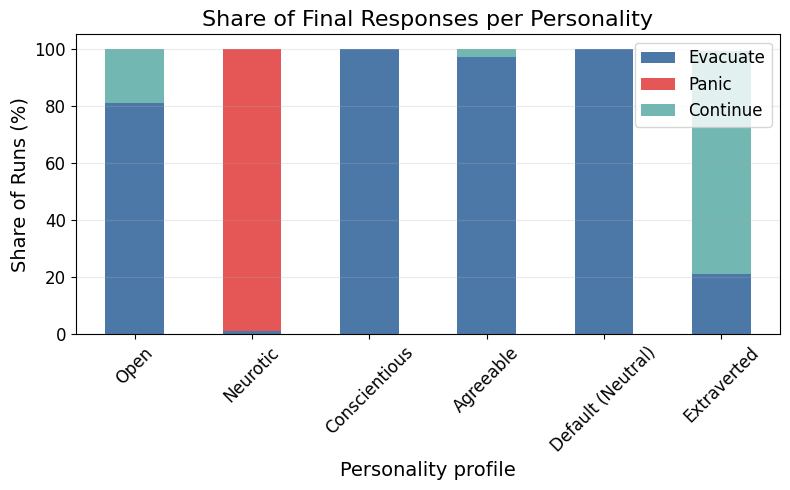
Figure 5: Final evacuation, panic, and continuation ratios by personality; strikingly, neurotic agents predominantly panicked, while extraverted agents rarely evacuated.
Such results empirically validate H1 and H2: personality-controlled LLM prompts robustly direct distinct agent behaviors, yielding marked simulation outcome differences.
Emergent Social and Rescue Dynamics
Beyond evacuation, the study interrogated agent rescue proclivities. Panicked neurotic agents could be rescued if in proximity to potential helpers. Simulations combining neurotic agents with Open, Conscientious, Agreeable, and Neutral helpers revealed substantial trait-controlled altruism. Agreeable and Neutral agents consistently opted to assist panicked agents, correlating with their high agreeableness and altruistic profile, whereas Open and Conscientious agents systematically refused, likely due to their low agreeableness and self-regarding traits.
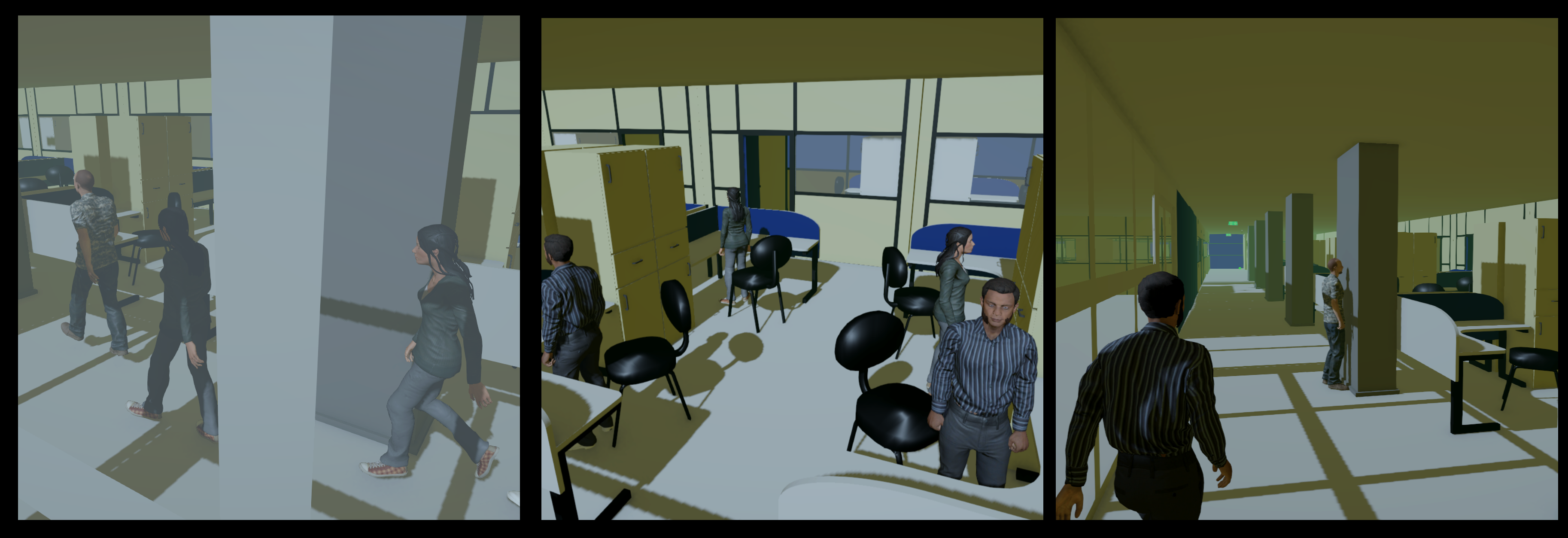
Figure 6: Behavioral examples illustrating evacuate, continue, and panic states during simulation.
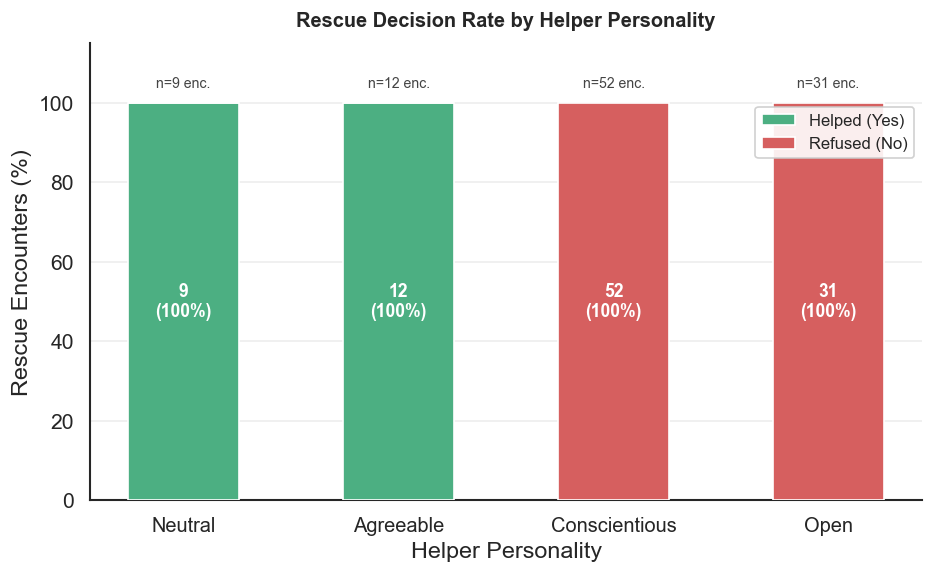
Figure 7: Rescue decision rates; highly altruistic agents (Neutral, Agreeable) help more frequently than self-focused profiles (Open, Conscientious).
Such findings evidence that LLM-driven personality shaping can foster emergent social dynamics and cooperation patterns not achievable via strictly parameterized rule-based systems.
Implications and Future Directions
The demonstrated approach advances practical crowd simulation, providing scalable heterogeneity in behavior without brittle manual tuning. Theoretically, this aligns with agent-based modeling aims to endow agents with realistic, multidimensional behavioral vectors directly interpretable from psychometric frameworks. The principal limitation remains the reliance on prompt-based personality scaffolding, which may not encapsulate deeper neurocognitive or affective processes.
Future research avenues include integrating multimodal (e.g., vision-driven) perceptual inputs, expanding the repertoire of agent actions, and empirically validating emergent behaviors against real-world evacuation datasets. Addressing LLM stochasticity and embedded biases at larger agent scales will be critical for reliability in operational simulations. Potentially, dynamic personality adjustment and context-sensitive learning could enable even richer, adaptive simulation environments.
Conclusion
This work evidences that LLM-driven personality-aware agents produce differentiated, internally consistent decision-making in emergency simulations. Stratification by OCEAN traits yields nontrivial, trait-aligned behaviors in both evacuation and rescue scenarios, reinforcing the utility of LLMs for high-fidelity, heterogeneous crowd modeling. While baseline implementation is prompt-centric and limited to discrete action spaces, the approach constitutes a significant step toward adaptive, personality-driven agent simulation. Scaling, multimodality, and empirical benchmarking are requisite for broader adoption and theoretical refinement.