- The paper develops a Bayesian inference pipeline using multinomial-Dirichlet modeling to quantify winner uncertainty in Ranked Choice Voting polls.
- It introduces a candidate pruning method based on simulation to reduce computational complexity and provide interpretable posterior win probabilities.
- Empirical results demonstrate that Bayesian win probability estimates converge toward true outcomes as poll sample sizes increase.
Bayesian Uncertainty Quantification in Ranked Choice Voting Polls
Introduction
The increasing adoption of Ranked Choice Voting (RCV) in major elections introduces new statistical challenges for election polling. Under RCV, voters rank candidates in order of preference, and a series of elimination rounds reallocates preferences until one candidate secures a majority among active ballots. This process renders classical polling uncertainty quantification methods—long established for first-past-the-post (FPTP) elections—inadequate. The complexity of RCV arises from path-dependent outcomes and multiple interdependent parameters governing elimination order and final victory. "Bayesian Uncertainty Quantification for Ranked Choice Voting Polls" (2606.31022) develops a comprehensive framework that directly targets these complexities via Bayesian inference over the space of ballot orderings.
Challenges in Traditional Uncertainty Quantification for RCV
Unlike binary or plurality elections, where the winner depends on a single, scalar margin, RCV outcomes rely on the entire joint distribution of voters' ordered preferences. This high-dimensional dependence means the identity of the winner is not simply characterized by any univariate statistic or margin of error. Furthermore, the set of paths to victory—combinatorially numerous for all but the simplest elections—amplifies the difficulty of meaningful frequentist inference about winners. This is illustrated in the analysis of cast vote records from high-profile RCV elections such as the 2021 NYC Democratic mayoral primary and the 2022 Alaska U.S. House special.
In practice, pollsters default to simulating instant runoffs on survey data and reporting conservative margins of error computed at an aggregated level or per elimination round. However, empirical analysis shows these methods often fail to provide meaningful winner uncertainty: even "statistically insignificant" elimination margins routinely occur in simulations from real RCV data, and conventional confidence ellipsoids seldom isolate a unique winner—even at large sample sizes. The high-dimensional geometry and partitioning of the parameter space into complex winner regions make classical testing procedures both underpowered and misaligned with practical inferential targets.
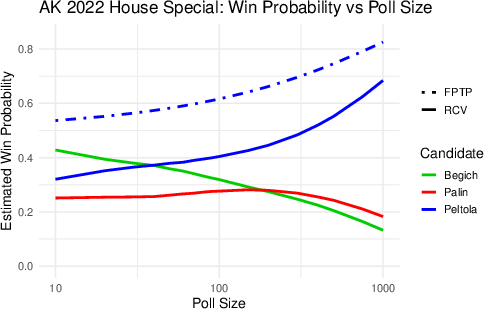
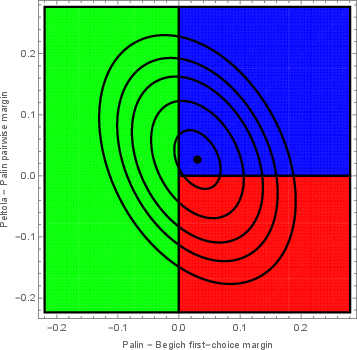
Figure 1: The probability that each candidate wins, in unbiased samples from the 2022 Alaska House special election, demonstrates non-monotonic and counterintuitive sampling behavior under RCV.
Bayesian Approach: Modeling Uncertainty in Ballot Orderings
The authors propose a Bayesian inference pipeline centered on the multinomial-Dirichlet conjugacy for modeling the population distribution of unique ballot types (π) observed in RCV polls. Each sampled ballot is a draw from a multinomial over the space of ballot rankings; the observed data induce a Dirichlet posterior over this space. Repeated posterior sampling yields simulated electorates; RCV tabulation on each yields a distribution of winners, which directly estimates the posterior probability of victory for each candidate.
This approach is robust to the combinatorial complexity and path-dependency intrinsic to RCV. It shifts measurement from elimination margin uncertainty to the probability distribution over possible winner identities, delivering interpretable, actionable uncertainty summaries that directly address the right inferential target for pollsters and analysts.
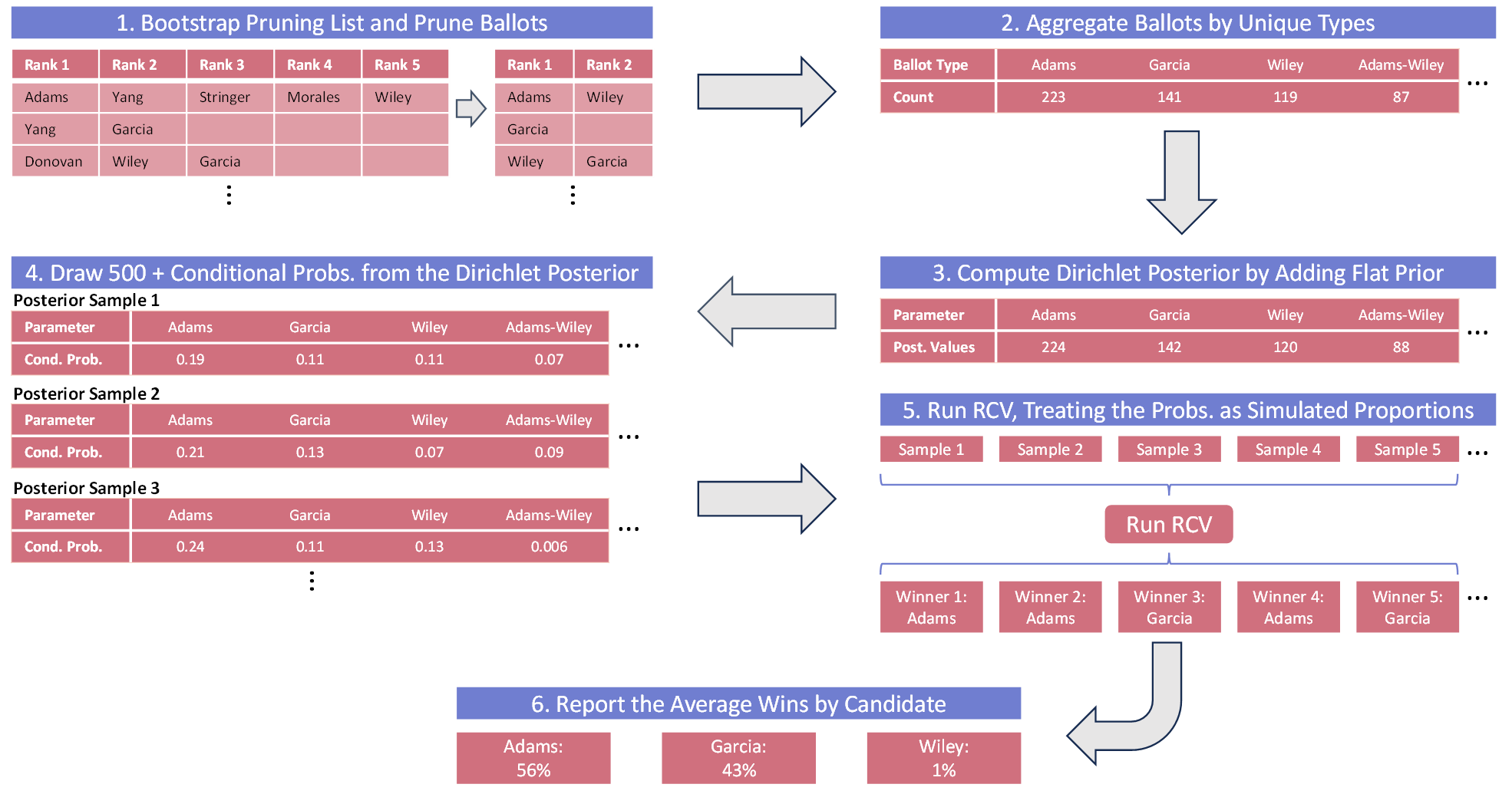
Figure 3: Bayesian simulation pipeline diagram, outlining pruning, aggregation, Dirichlet update, and posterior sampling of winner probabilities.
Crucially, the framework incorporates a principled method for pruning the set of relevant candidates and ballot orderings. Lemma-based ballot pruning leverages simulation or bootstrapping to identify a stable, minimal set of candidates whose final elimination order is likely determinative, significantly reducing the computational complexity and increasing inference stability.
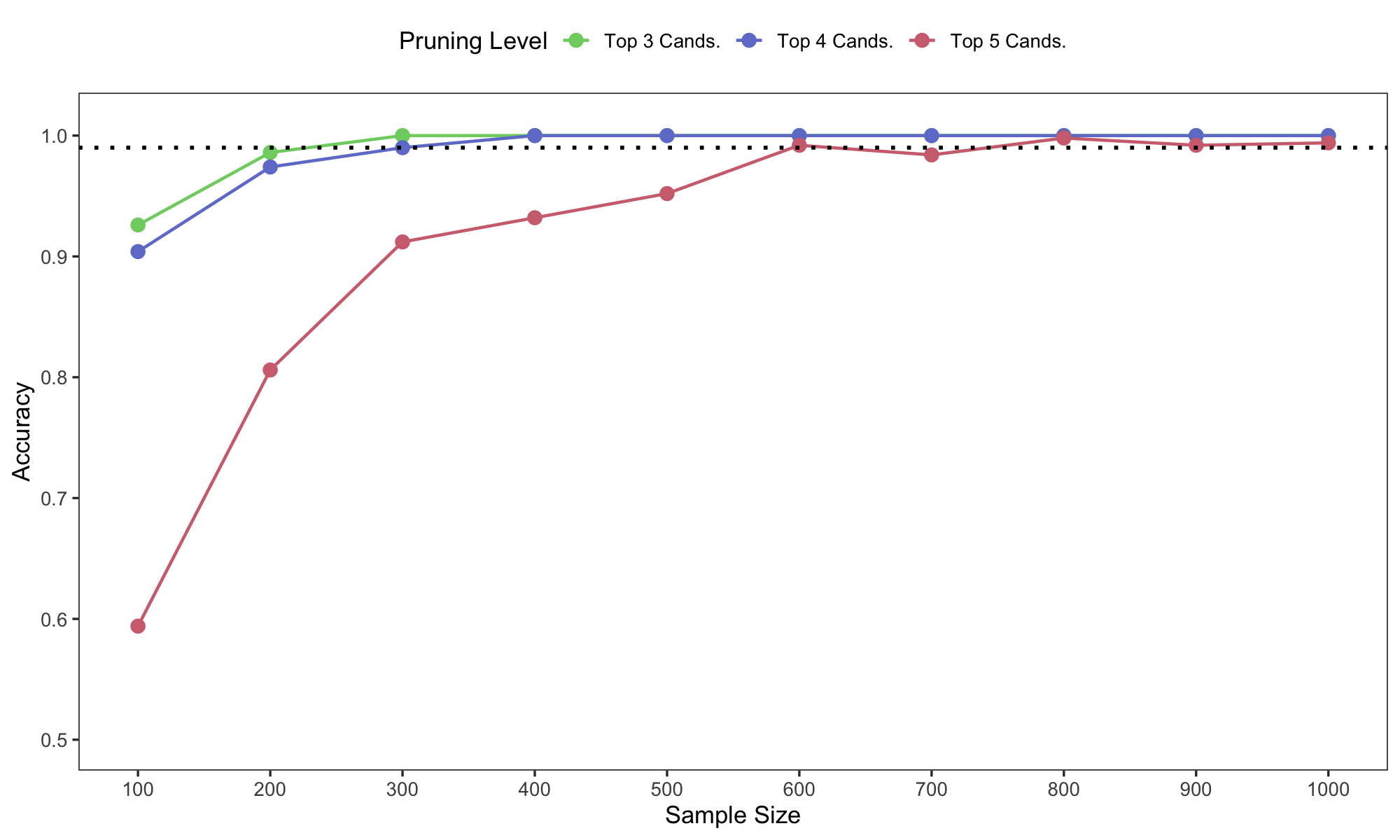
Figure 4: Probability that a poll correctly identifies the final m candidates in the 2021 NYC Democratic mayoral primary, showing high reliability with moderate sample sizes.
Empirical Applications and Results
Applying the Bayesian pipeline to both real pre-election polls (Data for Progress, NYC 2021) and repeated unbiased samples from cast vote records yields detailed, probabilistic assessments of winner uncertainty that match observed electoral volatility. In the 2021 NYC Democratic mayoral primary, pruning reduces the inferential space to Adams, Garcia, and Wiley, discarding candidates with negligible posterior win probability and simplifying pipeline operations.
The output of the Bayesian simulation gives win probabilities—e.g., Adams at 56.4%, Garcia at 42.8%, Wiley at 0.8%—that reflect both the underlying volatility and the stability of the top candidates, offering considerably more detail than binary "within margin of error" metrics. Importantly, these probabilities remain sensitive to close contests (e.g., actual final margin 0.8%), where calling a winner outright lacks statistical justification.
Analysis of repeated samples at varying poll sizes further confirms that Bayesian win probabilities contract towards the true winner as sample size increases, and that the posterior quantifies residual uncertainty even in hard-to-poll elections (such as the Alaska 2022 special, where elimination order drives non-monotonic win probability curves).
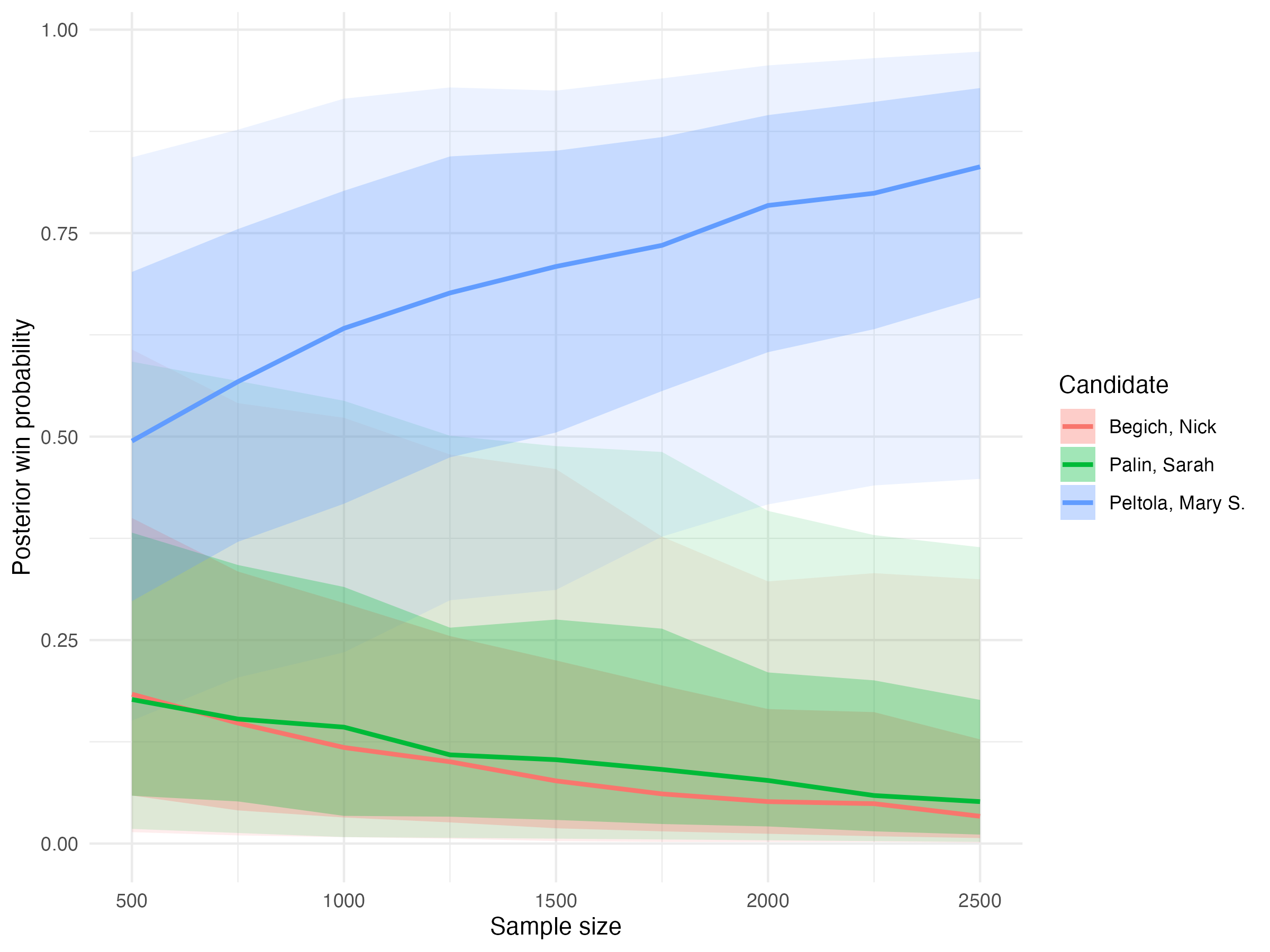
Figure 2: Posterior probability of victory as a function of sample size under the Bayesian polling framework for the 2021 NYC Democratic mayoral primary (top) and 2022 Alaska special election (bottom).
Theoretical and Practical Implications
The Bayesian Dirichlet-multinomial framework for RCV poll inference is compelling both in theory and practice. It provides a direct mapping from observed ballot type frequencies to the posterior probability of candidate victory, accommodates survey weights and real-world polling complexities, and handles the combinatorial structure of RCV without overfitting or infeasible confidence set construction. Contrasting starkly with frequentist ellipsoids or aggregate margins of error, the Bayesian estimates offer detailed, interpretable, and robust quantification of electoral randomness.
Practically, this approach addresses key limitations of existing RCV polling methodologies: it fully internalizes the path dependency of elimination orders, efficiently prunes the state space, and yields actionable probabilistic summaries aligned with user (voter, media, or analyst) needs. Reporting win probability distributions—rather than only "leaders" or binary significance calls—enables more nuanced public communication and election coverage, particularly vital in highly competitive or fragmented races.
Theoretically, this framework should generalize to other contexts where winner identity is sensitive to high-dimensional, path-dependent random structures, and it could motivate analogous approaches in multi-member proportional RCV settings.
Future Directions
Potential extensions include:
- Applying the Bayesian pipeline to multi-winner RCV (proportional representation) with modified elimination and transfer mechanics.
- Integrating richer prior information from historical polling or demographic models into the Dirichlet prior.
- Comparing Bayesian posterior winner probabilities with bootstrap-derived empirical probabilities to benchmark sensitivity and calibration.
- Developing open-source tools or standardized protocols for pollsters to implement the methodology in real-time, with clear reporting templates.
Conclusion
This study establishes a principled, empirically validated Bayesian framework for uncertainty quantification in ranked choice voting polls. By reframing polling inference as estimation of winner posterior probabilities over the ballot ordering space, this approach remedies the core deficiencies of classical methods in high-dimensional, path-dependent election contexts, and supplies practitioners with a robust, interpretable, and actionable toolkit for communicating pre-election uncertainty under RCV.