- The paper demonstrates that quantum heat rectification arises from asymmetric Ohmic coupling, with many-body effects yielding a power-law behavior in the strong-coupling (Kondo) regime.
- It combines analytical perturbative expansions near the IR fixed point with TEMPO tensor-network simulations to accurately benchmark steady-state heat currents.
- Results show robust scaling laws and a quadratic temperature suppression of rectification, offering key insights for quantum thermal device design.
Heat Rectification in Quantum Two-Level Systems: Analysis via the Ohmic Spin-Boson and Anisotropic Kondo Models
Introduction and Motivation
The investigation addresses quantum heat rectification through a quantum two-level system (TLS) asymmetrically coupled to two thermal baths, with the model formalized in terms of the Ohmic spin-boson Hamiltonian. Heat rectification, referring to the direction-dependent magnitude of heat current under reversed temperature gradients, is a paradigmatic nonequilibrium phenomenon driven by system nonlinearity, spatial asymmetry in coupling, and operation beyond linear response. Notwithstanding prior studies that mainly focused on weak-coupling or incoherent regimes, the strongly correlated domain—where dissipation-induced many-body effects are most salient—has remained comparatively underexplored due to methodological constraints.
The paper implements a tensor-network approach (TEMPO algorithm) to compute steady-state heat currents under nonequilibrium for arbitrary system-bath coupling strengths, benchmarking numerical outcomes against analytical solutions in limiting regimes. The analysis identifies scaling laws that interpolate between ultraviolet (UV) and infrared (IR) fixed points demarcated by the Kondo temperature TK. Perturbative expansions around the IR fixed point yield explicit power-law behavior for rectification. The synergy between numerics and analytics elucidates the interplay between quantum many-body physics and nonlinear heat rectification in minimal open quantum systems.
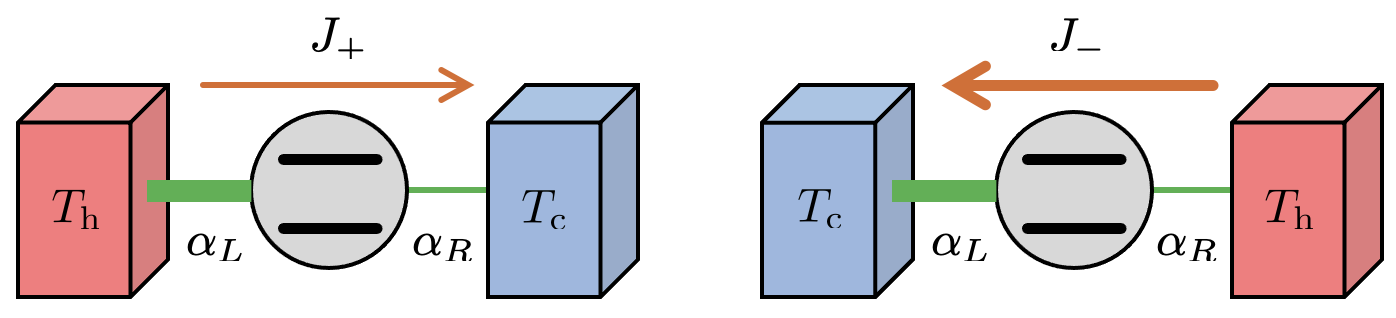
Figure 1: Quantum heat transport through a two-level system coupled to two thermal baths at different temperatures, illustrating the inequivalence of forward and backward heat currents due to coupling asymmetry.
The central system is a TLS described by
H=2Δσx+r=L,R∑[HB,r+HI,r]
where HB,r is the free bosonic bath Hamiltonian and HI,r encodes system-bath couplings parameterized by spectral density Ir(ω)=2αrωe−ω/ωc. The sum of coupling strengths defines α=αL+αR. As established via unitary bosonic basis rotation, the Ohmic spin-boson model is equivalent to the anisotropic Kondo model, with TK serving as a crossover energy scale separating UV and IR regimes.
The heat current is derived from the Meir–Wingreen-type formula,
J=ααLαR∫0∞dωωI0(ω)χ′′(ω)[nL(ω)−nR(ω)]
where χ′′(ω) denotes the imaginary part of the TLS's dynamical susceptibility and nL,R(ω) are Bose distributions of respective baths. The rectification ratio is
H=2Δσx+r=L,R∑[HB,r+HI,r]0
serving as the principal indicator for direction-dependent heat conduction.
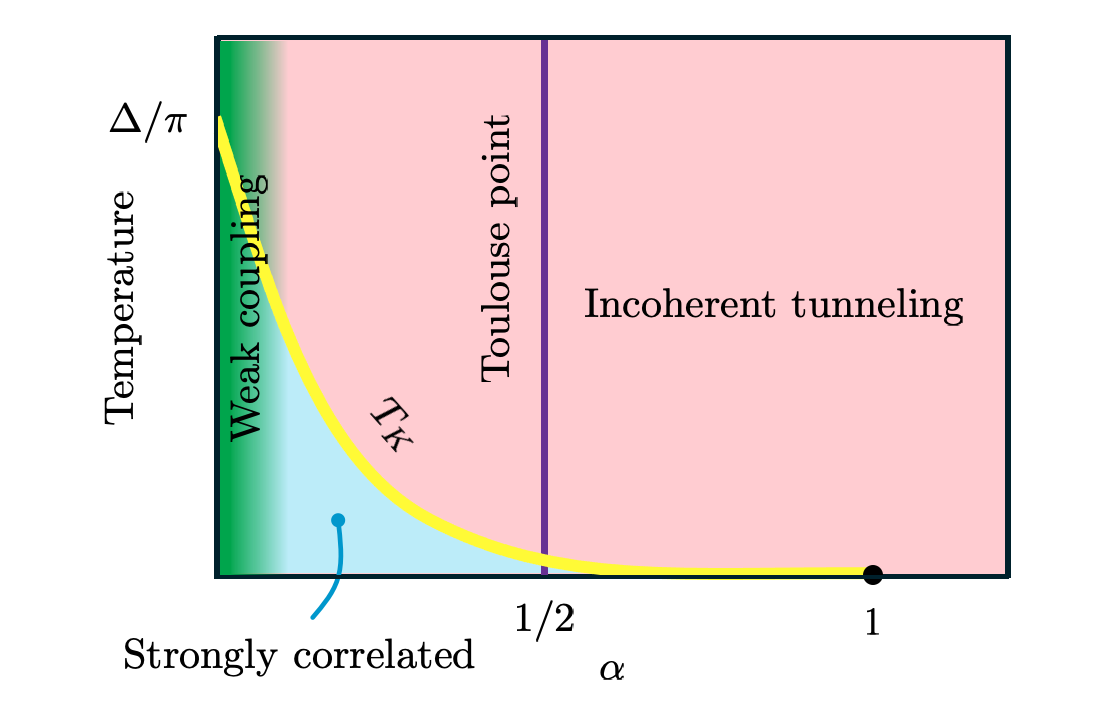
Figure 2: Theoretical landscape of system-bath coupling regimes, demarcated by H=2Δσx+r=L,R∑[HB,r+HI,r]1 and H=2Δσx+r=L,R∑[HB,r+HI,r]2, showing transitions between weak-coupling, incoherent tunneling, the Toulouse point, and strongly correlated (Kondo) regimes.
Analytical Results Across Regimes
Weak Coupling (H=2Δσx+r=L,R∑[HB,r+HI,r]3)
Perturbative analysis yields (at high H=2Δσx+r=L,R∑[HB,r+HI,r]4) a resonant sequential tunneling picture, with H=2Δσx+r=L,R∑[HB,r+HI,r]5 controlled by energy-conserving one-boson processes, leading to
H=2Δσx+r=L,R∑[HB,r+HI,r]6
In the low-H=2Δσx+r=L,R∑[HB,r+HI,r]7 (cotunneling) limit, heat transport symmetry is restored, with H=2Δσx+r=L,R∑[HB,r+HI,r]8 exponentially.
Incoherent Tunneling and Strong Coupling
For H=2Δσx+r=L,R∑[HB,r+HI,r]9 or HB,r0, dissipative incoherence dominates and heat current can be evaluated via NIBA, with temperature-dependent scaling,
HB,r1
In this regime, HB,r2 may exceed unity at sufficiently strong asymmetry, but approaches unity as HB,r3.
Toulouse Point (HB,r4)
At the Toulouse point, exact mapping to a resonant-level model enables analytic computation of thermal conductance, furnishing a rigorous benchmark for numerics in the moderate coupling regime.
Perturbative expansion near the IR fixed point reveals the leading contribution to rectification arises at next-leading order, scaling as
HB,r5
A quadratic temperature suppression of rectification constitutes a sharp signature of underlying many-body entanglement.
Numerical Approach and Benchmarking
The time-evolving matrix product operator (TEMPO) method is employed to compute nonequilibrium correlation functions and, consequently, steady-state heat currents under arbitrary coupling. The correlation function and reduced density matrix evolution are computed via tensor networks, ensuring full inclusion of non-Markovian bath effects.
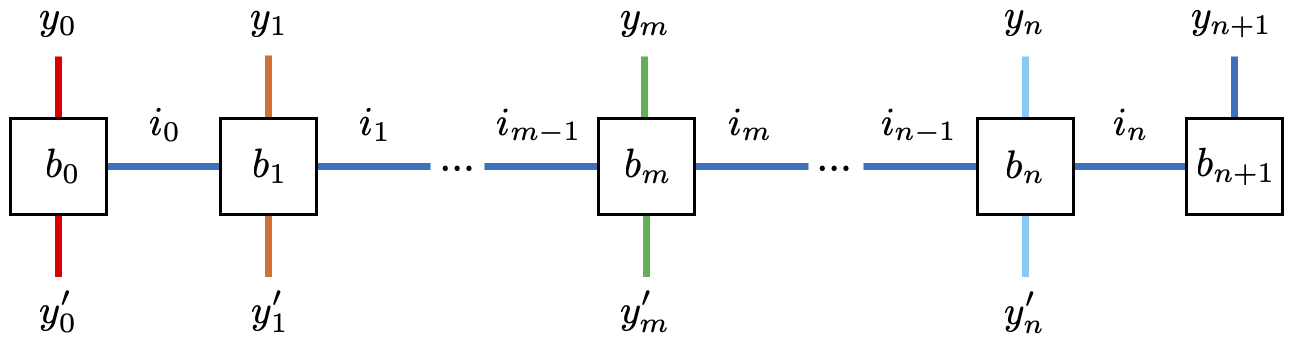
Figure 4: Matrix Product Operator (MPO) representation for the propagator in the TEMPO scheme, facilitating efficient time evolution with controlled memory cutoff.
Numerical results for the linear thermal conductance and rectification ratio across HB,r6 and HB,r7 are quantitatively compared with analytical expressions in various regimes.
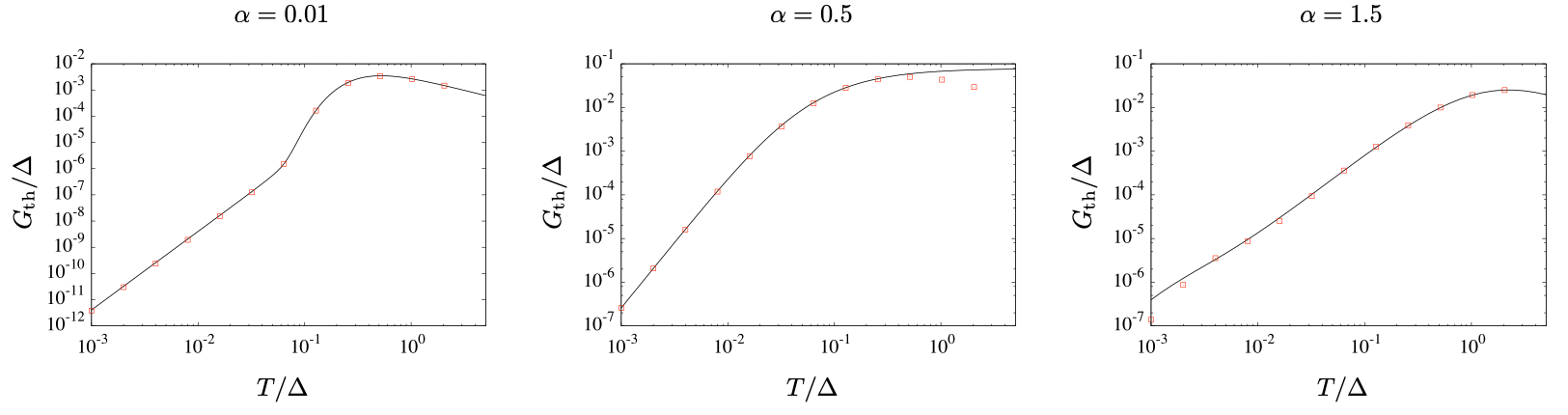
Figure 5: Linear thermal conductance HB,r8 versus HB,r9 for different HI,r0 shows crossover between sequential tunneling, cotunneling, and incoherent regimes; agreement with analytics is robust.
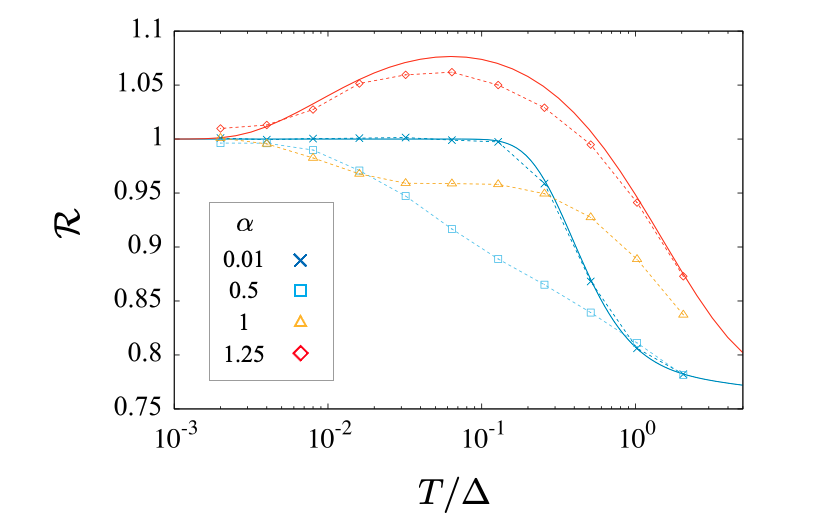
Figure 6: Temperature dependence of the rectification ratio HI,r1 illustrates a minimum for intermediate HI,r2, with analytic curves from weak-coupling and NIBA appropriately bounding the numerical data.
The numerical approach captures the nonmonotonic HI,r3 dependence on HI,r4 in the high-HI,r5 regime and recovers the predicted power-law suppression of rectification at low HI,r6.
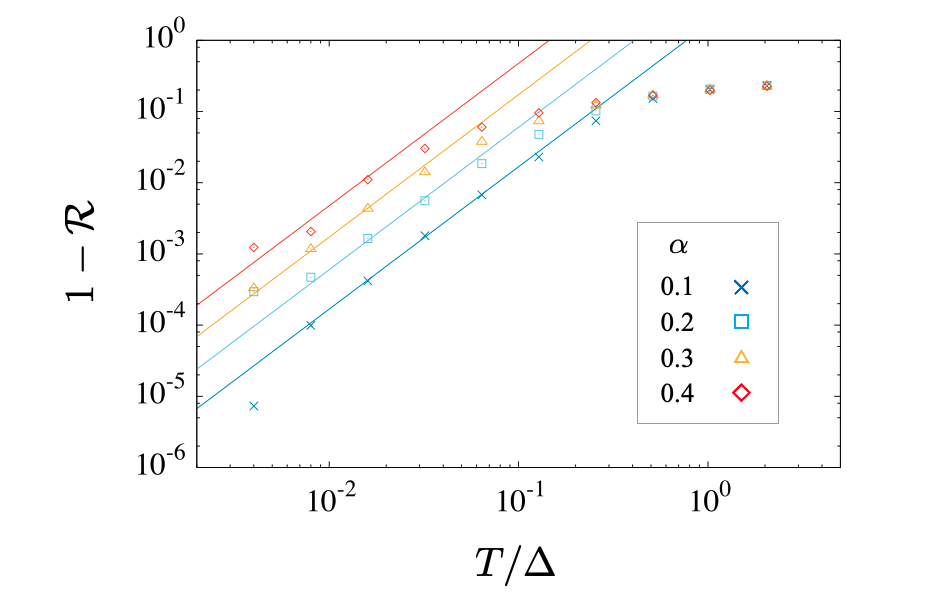
Figure 7: Log-log plot of HI,r7 versus HI,r8 reveals quadratic decay characteristic of IR fixed point behavior.
Discussion and Implications
The main result is the demonstration of a nontrivial, theoretically tractable, and numerically validated link between heat rectification and many-body physics in a minimal open quantum system. Unlike phenomenological approaches, the combination of exact tensor-network simulation and field-theoretic expansion provides rigorous nonperturbative insight into the universal scaling of rectification with temperature and coupling asymmetry. It is shown that rectification persists deep into the strongly correlated Kondo regime, with a universal power-law decay tied to the crossover scale HI,r9 and no evidence of symmetry breaking even for maximal asymmetry.
These findings have direct implications for experimental implementations in superconducting qubits and molecular junctions, where manipulation of energy flow at the quantum level is a foundational requirement for quantum thermal management and quantum thermodynamics applications. The methods and results pave avenues for further studies, including extensions to multi-level systems, time-dependent driving, and exploration of other many-body impurity problems.
Conclusion
This paper offers a comprehensive analytic and numerical study of quantum heat rectification in a paradigmatic two-level system subject to Ohmic dissipation with asymmetric coupling, unifying weak, intermediate, and strong-coupling regimes within a robust theoretical framework. The onset, crossover, and eventual suppression of rectification are mapped in detail, with explicit power-law scaling laws derived from many-body considerations at the IR fixed point. The combination of tensor-network numerics and analytical results sets a benchmark for future investigations of nonlinear energy transport in quantum systems and underpins the ongoing development of quantum thermal devices.