- The paper demonstrates that high-resolution synthetic HRTFs achieve localization performance equivalent to individualized measurements.
- It reveals strong HRTF-dependence on elevation accuracy and front-back confusion, explaining the limitations of generic KEMAR approaches.
- The study validates a robust VR-based paradigm with consistent metrics across sessions, emphasizing the role of anatomical detail in spatial perception.
Evaluation of HRTF Individualisation and Synthesis in Virtual Reality Spatial Localisation
Introduction
Head-Related Transfer Functions (HRTFs) are essential for externalizing and localizing audio sources in three-dimensional auditory environments, such as Virtual Reality (VR). Capturing the interaural time differences, level differences, and elevation-dependent monaural spectral cues, HRTFs are inherently individualized due to morphological idiosyncrasies among listeners. While individualized HRTFs yield superior spatial perception, logistical constraints have prompted wide adoption of generic and synthetic HRTFs. However, the relative perceptual impacts of different HRTF acquisition and synthesis strategies, especially under matched experimental conditions, remain under-explored. The paper "Evaluation of Head-Related Transfer Functions Across Five Levels of Individualisation in Virtual Reality" (2606.30114) addresses this gap by systematically assessing VR-based localization using five HRTF conditions: individually measured, high-resolution synthetic, photogrammetry-derived synthetic, KEMAR generic mannequin, and randomly-selected non-individual measured HRTFs.
Methodology
Nineteen normal-hearing subjects participated in two VR-based sound localization sessions using immersive apparatus that coupled acoustic and visual feedback while minimizing exogenous localization cues.
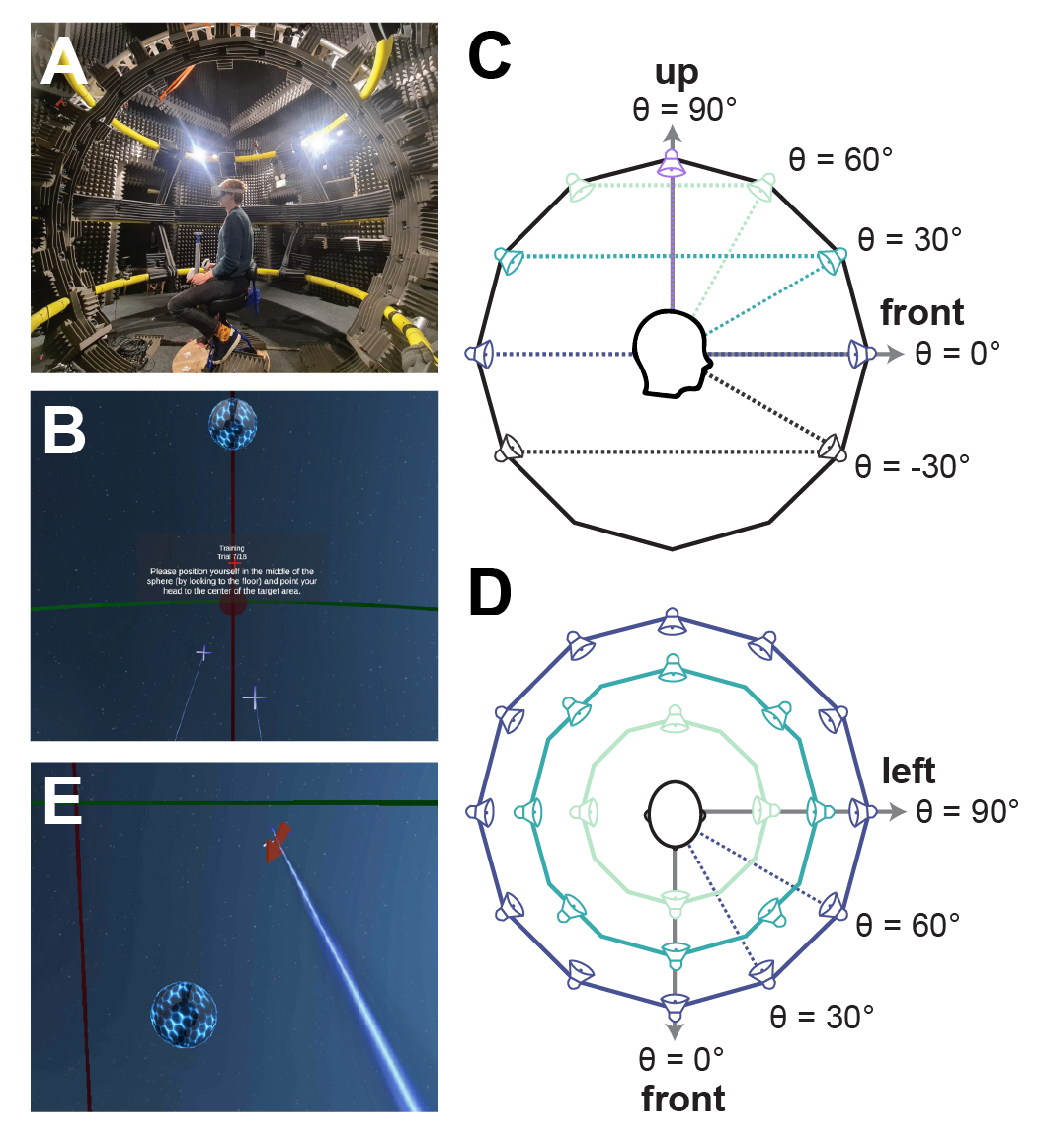
Figure 1: Experimental setup, VR environment, spatial source distributions, and feedback paradigms in the test protocol.
The five HRTF conditions comprised: (1) individualized acoustic measurement, (2) random non-individual from an open dataset, (3) KEMAR mannequin, (4) high-resolution scan-based synthesis, and (5) photogrammetry-based synthesis, all rendered via Mesh2HRTF. Behavioral performance was evaluated using great-circle error, lateral and polar absolute/signed accuracy, polar precision, front-back confusion, and quadrant error rates across trials in randomized interleaved blocks.
Test–retest reliability was rigorously assessed by comparing individualized baseline performance across sessions separated by intervals of up to two years, ensuring validity for within-subject cross-condition analyses.
Reliability of VR Localisation Paradigm
Behavioral results confirmed robust test–retest reliability for the VR-based localization protocol. Across sessions employing individualized HRTFs, metrics such as great-circle error, polar/lateral accuracy, and front-back confusion exhibited no significant differential effects, and strong Pearson correlations across sessions (up to r=0.87 for lateral accuracy) confirmed stability. Only one participant was excluded for pronounced inconsistency.
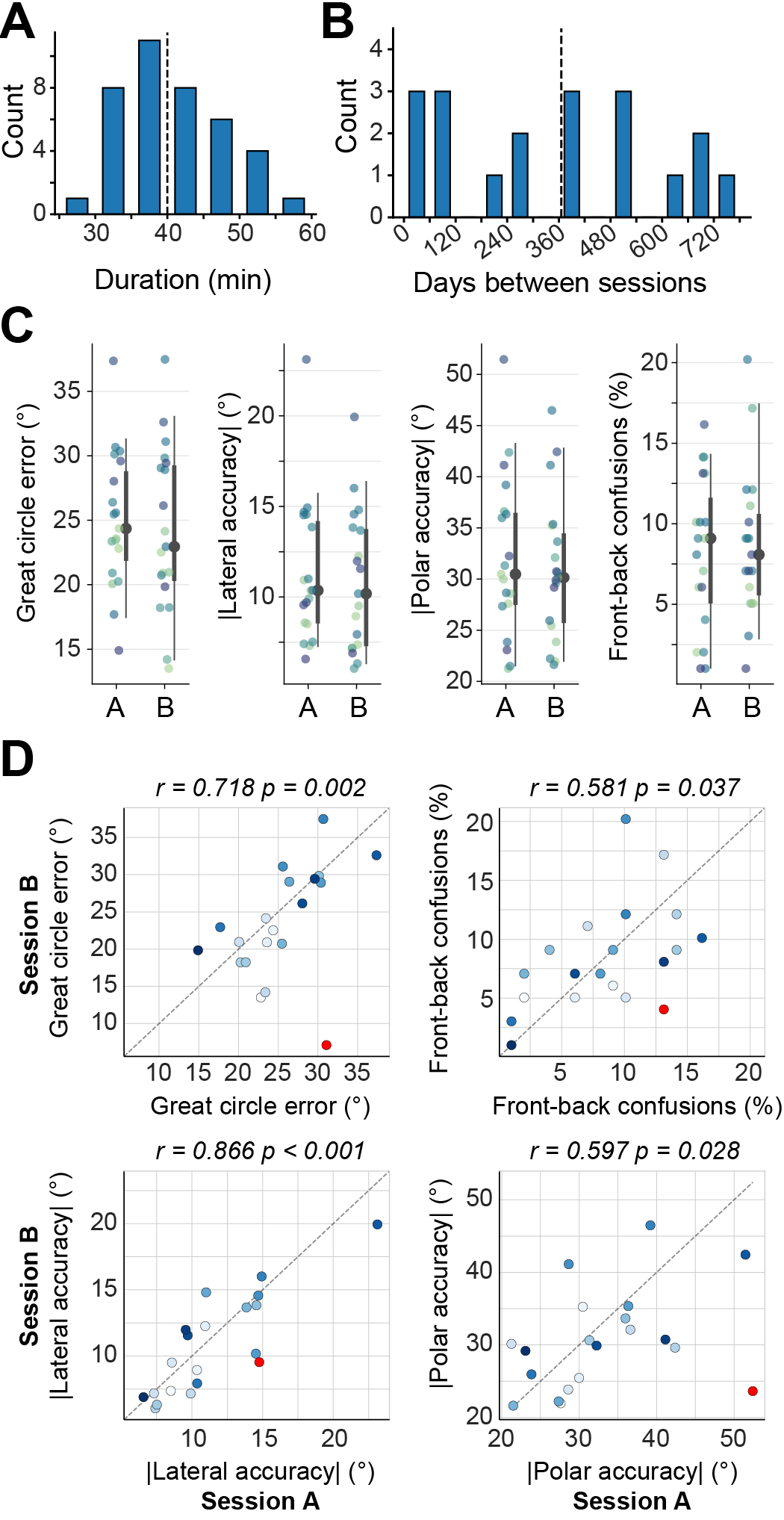
Figure 2: Distributions for session durations, inter-session intervals, and individual consistency in localization metrics between sessions.
This establishes that performance differences arising in cross-condition analyses reflect perceptual effects attributable to HRTF manipulation, rather than protocol or session artifacts.
Strong HRTF-dependency was observed for all elevation metrics and confusion rates, with lateral localization largely invariant across HRTF types.
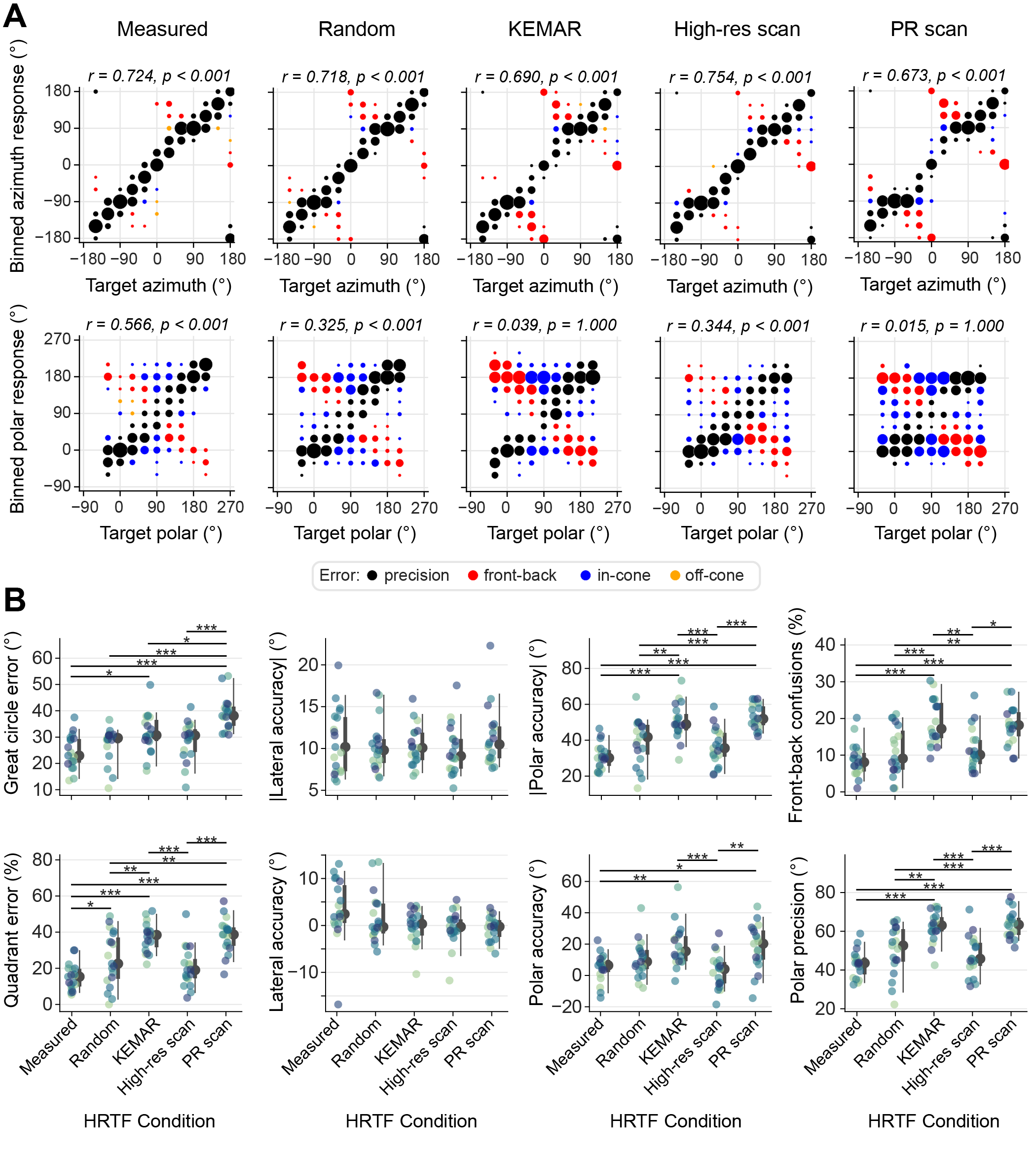
Figure 3: Localization performance (azimuth and elevation correlations, aggregate error statistics, confusion, and quadrant error rates) stratified by HRTF condition.
Marked differences emerged in the polar domain:
- KEMAR Generic HRTF: Produced almost no elevation tracking (r=0.039), highly elevated front-back confusion (17.2%), and the worst polar accuracy (48.8° median error). Systematic rear response bias was evident.
- Random Non-individual HRTF: Intermediate elevation performance (r=0.325), with polar accuracy (41.8°) and confusion rates (9.1%) significantly better than KEMAR but not matching measured HRTFs. Notably, quadrant errors (22.6%) were higher than with individualized HRTFs (15.4%).
- Photogrammetry-based Synthetic (PR): Performance closely mirrored KEMAR across polar metrics and confusion rates, confirming that low-fidelity synthetic HRTFs currently afford no perceptual advantage over generic mannequins.
- High-Resolution Synthetic: Achieved elevation and confusion metrics statistically indistinguishable from individualized measurement; polar accuracy (35.6°), precision, and confusion rates were not significantly different from the measured baseline and outperformed KEMAR and PR across all elevation-associated metrics.
Lateral accuracy and azimuthal target–response correlations remained high (r≈0.7) and statistically invariant across HRTF conditions, reconfirming that lateral spatial cues are robust to HRTF individualisation and acquisition method.
Discussion
Implications for Baseline Selection
The data robustly indicate that the KEMAR mannequin HRTF underestimates non-individualised performance in VR spatial audio, as randomly-selected measured HRTFs (incorporating natural anatomical variance) consistently outperform it in the polar domain. This calls into question the continued use of KEMAR as a universal non-individual baseline. For ecologically valid studies—and for practical VR/AR deployment—using a randomly-selected measured HRTF from large public datasets (e.g., SONICOM) yields measurable improvements in elevation tracking and lower confusion rates, with minimal added methodological complexity.
Synthetic HRTFs and Head Morphology Fidelity
Crucially, the results establish that high-resolution scan-based synthetic HRTFs (via Mesh2HRTF) are perceptually equivalent to individualized acoustic measurement for localization in VR, whereas photogrammetry-derived meshes, at current resolution, fail to preserve monaural pinna cues vital for elevation perception. This finding distinctively quantifies the importance of mesh resolution and morphological detail in numerical HRTF synthesis: reduced geometric fidelity (as in photogrammetry) negates the benefits of individualization for the perceptual tasks tested.
Practical and Theoretical Ramifications
Practically, when individualized measurement is infeasible but high-resolution head scanning is available, synthetic HRTFs can serve as a scalable substitute with negligible perceptual cost. This supports the development of efficient pipelines for individualized spatial audio in consumer VR/AR applications. Theoretically, these results emphasize that spectral cues critical for elevation and front-back discrimination are exquisitely sensitive to anatomical detail—suggesting further attention to mesh acquisition and processing techniques in numerical modeling.
Future Directions
The integration of auditory perceptual models and numerical HRTF metrics with behavioral performance (as targeted in forthcoming work) will elucidate which computational measures most accurately predict localization errors. Additionally, the evaluation of machine learning-based individualization and mesh upsampling methods, as well as real-world VR/AR deployments, will advance individualized spatial audio rendering.
Conclusion
This study delivers a comprehensive, within-subject behavioral assessment of five distinct HRTF acquisition and synthesis strategies under unified VR-based testing. The findings demonstrate that while lateral localization is invariant across tested HRTFs, elevation and confusion metrics are strongly influenced by both individualization and the anatomical fidelity of the mesh. Random non-individual HRTFs offer a practical and perceptually superior baseline over the conventional KEMAR, and high-resolution synthetic HRTFs match individualized measured performance—whereas current photogrammetry methods are inadequate. These conclusions will inform both fundamental spatial audio research and the engineering of perceptually optimized VR/AR auditory systems.