- The paper introduces a hybrid human-in-loop system that captures expert interventions to form a persistent team knowledge base.
- It employs a synchronized workspace and node-intercept mechanism for precise expert reviews in addressing terminology and legal ambiguities.
- The approach reduces duplicated corrections by using an accountability trace and a living memory that ensures consistent translation outputs.
DeepTrans Studio: Operationalizing Team Knowledge through Expert Interventions in Agentic Translation Workflows
Introduction
The paper "DeepTrans Studio: Turning Expert Interventions into Shared Team Knowledge in Agentic Translation Workflows" (2606.29727) addresses the persistent challenge of knowledge silos and coordination inefficiencies in professional, team-based translation settings. Despite the integration of state-of-the-art LLM-based systems in translation pipelines, most workflows remain optimized for single-user scenarios, treating human corrections as ephemeral, session-local events. This compartmentalization leads to recurrent resolution of identical terminology and legal ambiguities, with knowledge often trapped at the individual level. DeepTrans Studio proposes an alternative collaborative paradigm, focusing on transforming individual expert interventions into persistent, auditable, and actionable team assets that propagate throughout complex agentic workflows.
System Architecture and Collaborative Mechanisms
DeepTrans Studio implements a hybrid automation–human-in-the-loop system architecture, comprising four core modules: a synchronized team workspace, an agentic node-intercept mechanism, a living team memory, and an accountability trace system.
The Shared Translation Workspace enables distributed translators, reviewers, and managers to operate on a consistent, versioned document state, with explicit workflow anchoring at key phases (e.g., intercepted, signed-off). This ensures global awareness and workflow traceability without the information fragmentation endemic to local chat histories.
Crucially, the Node-Intercept Layer circumvents the black-box limitations of autonomous pipelines by pausing progression at predefined high-risk nodes, especially for terminology disputes and legal-modal ambiguities. Human experts review intermediate system outputs, inspect supporting evidence, and approve or revise decisions at these junctions, thereby exercising targeted expert agency.
All decisions made at intercept points are written into a Shared Team Memory (conceptualized as a "Living Dictionary"), enabling the reuse of vetted interventions as precedents for subsequent translation tasks. This functionality is central to suppressing terminological drift, reducing duplicated reviews, and turning ephemeral judgments into long-lived team knowledge.
The Accountability Trace maintains detailed provenance logs, capturing the origin and propagation paths of both AI and human-derived interventions. This system-level transparency supports post hoc auditing and verification by reviewers and project managers.
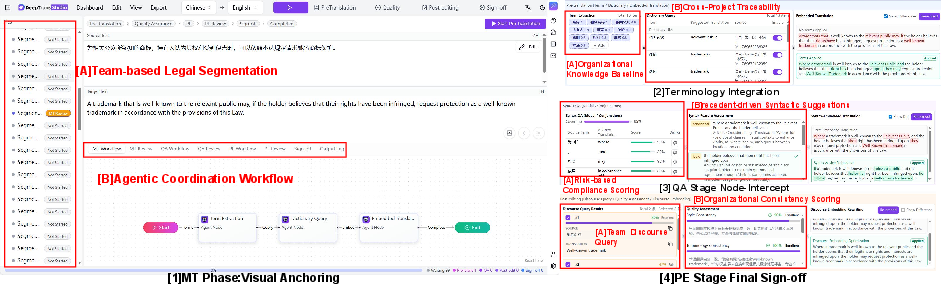
Figure 1: From individual intervention to team-wide propagation — a translator intercepts an AI decision, reviews evidence, approves a terminology choice, and the system reuses the decision in downstream segments and teammate workflows.
Workflow Dynamics: Case Scenario
A detailed collaborative walkthrough is provided, involving three professional roles—senior translator, junior translator, and project manager—engaged in translating sensitive legal documents. The workflow is orchestrated as follows:
- Initial Anchoring and Machine Translation: The senior translator uploads a contract, benefiting from visual context preservation through a multi-panel workspace. This anchoring supports shared context, especially around nested legal constructs.
- Terminology Alignment and Memory Update: Terminology inconsistencies are intercepted and surfaced for review. Upon expert adjudication, the preferred term is committed to the living team memory, along with the decision rationale.
- Legal-Modal Ambiguity Resolution: Ambiguous modals (e.g., "shall" vs. "may") trigger intercepts for expert review. Human revisions at this stage are similarly recorded and propagated forward in the pipeline.
- Downstream Reuse and Accountability: When analogous issues reappear in later segments or are encountered by other team members, the relevant, previously approved intervention is proposed as a precedent, thus catalyzing cross-role consistency. Prior to project completion, the project manager uses the accountability dashboard to audit the decision chain, with full visibility into both machine and human contributions.
Empirical Insights and Preliminary Evaluation
Interactive demonstrations involving professional translators and reviewers suggest that DeepTrans Studio effectively transitions individual corrections from disposable events to systematized, reusable team assets. Formative feedback highlights increased transparency in decision provenance, enhanced ability to document rationale, and pronounced efficiency gains by curtailing cyclical work.
Participants explicitly valued not only the system's capability to intercept and surface high-risk translation decisions but also its support for turning individual expertise into an organization-wide knowledge asset.
Contrasts with Prior Approaches and Theoretical Implications
Whereas previous LLM-based translation frameworks emphasize end-to-end automation or limited human-in-the-loop architectures, DeepTrans Studio enacts a hybrid model situating expert agency as a first-class workflow component. The methodology aligns with recent CSCW and HCI discussions on balancing automation with targeted user control [heer2019agency], and it addresses gaps identified in longitudinal studies of professional translation—specifically, the lack of mechanisms for capturing, surfacing, and propagating expert corrections [freitag2021experts, thai2022exploring, wu2024transagents]. This architecture also supports improved accountability pathways, which are underdeveloped in chat-based or singular editing platforms.
Practical and Theoretical Implications
Practically, DeepTrans Studio introduces mechanisms for reducing duplicative corrections, standardizing translation output across teams, and providing an auditable trail of decision-making. These features are particularly critical in high-stakes domains (e.g., legal, regulatory, or medical translation), where errors can propagate significant risk.
Theoretically, the approach models expert decision-capture and propagation as a reusable team knowledge infrastructure, extending beyond translation into broader multi-agent collaborative work mediating human–AI workflows. The methods outlined may inform the design of similar agentic workflows in other high-accountability contexts, such as clinical documentation, financial analysis, or software requirements engineering.
Future Directions
Possible future developments include adapting the DeepTrans Studio framework for real-time, cross-language collaborative editing in other specialized verticals, expanding the living memory model with adaptive retrieval based on context similarity, and integrating automated assessment of precedent applicability. Augmenting the accountability system with explainable AI modules may also enhance trust and post hoc justification.
Conclusion
DeepTrans Studio operationalizes a novel paradigm for collaborative, agentic translation workflows, in which expert interventions are transformed into persistent, auditable, and reusable team knowledge. This approach addresses core shortcomings of isolated human-AI correction cycles and provides preliminary evidence for improved efficiency, alignment, and consistency within translation teams. The work provides a blueprint for augmenting LLM-driven workflows with structured human agency, with broader implications for complex collaborative work involving high-stakes documentation and decision-making (2606.29727).

