- The paper introduces a uniquely defined quantum formula for local orbital magnetization that satisfies the current-generating constraint and aligns with bulk theories.
- It employs a three-point formula and the Natural Local Marker to rigorously capture multipole moments in both continuum and lattice systems.
- Results from the Haldane model validate the theory’s consistency in describing both bulk magnetization and edge current phenomena in topological regimes.
Introduction and Motivation
The quantum theory of magnetism has long distinguished between spin and orbital magnetization. While local spin magnetization is a well-defined concept at the quantum level, the formulation of a physically consistent local orbital magnetization—an operator whose curl gives the equilibrium current density—has remained fundamentally incomplete. Existing real-space approaches have failed to resolve all physical requirements, notably the current-generating constraint j(x)=∇x×m(x), locality, and consistency with the modern theory of bulk orbital magnetization. This work presents a uniquely defined, quantum-mechanical formula for the local orbital magnetization field applicable to noninteracting electrons in both continuum and lattice models (2606.29330).
The derivation proceeds from a local-flux response of the grand thermodynamic potential Ω with respect to the local magnetic field:
δΩ=−∫ddxˉm(xˉ)⋅δB(xˉ),
leading directly to:
j(x)=∇x×m(x)
within simply-connected systems with open boundary conditions. The resulting three-point formula for local orbital magnetization, applicable for both continuum and lattice Hamiltonians, reads:
morbi(x)=∫r1,r2,r3χr1r2r3i(x)mr1r2r3
where the geometric kernel χ spatially restricts nonzero magnetization contributions to triangles containing x. The magnetization kernel mr1r2r3 incorporates Green's functions, projectors, and Hamiltonian matrix elements.
In two dimensions, this definition is unique up to an additive constant, ensuring that real-space magnetization and the modern quantum theory of bulk orbital magnetization coincide at the unit cell level. In three dimensions, a longitudinal ambiguity remains (a gradient can be added without affecting current), but the construction yields a physically motivated representative.
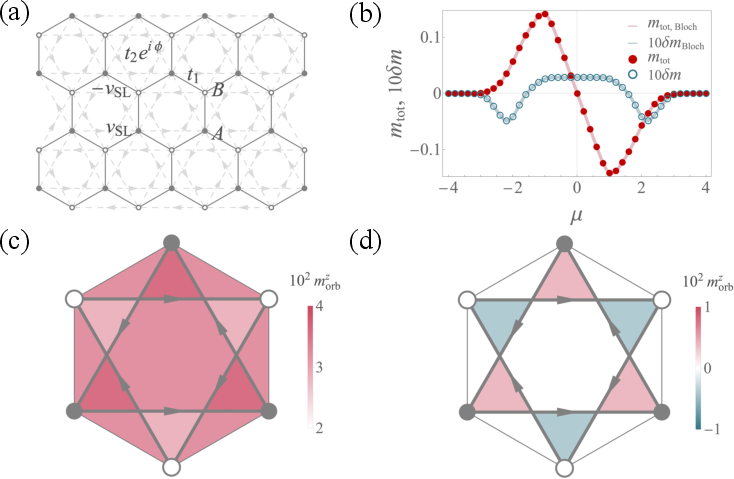
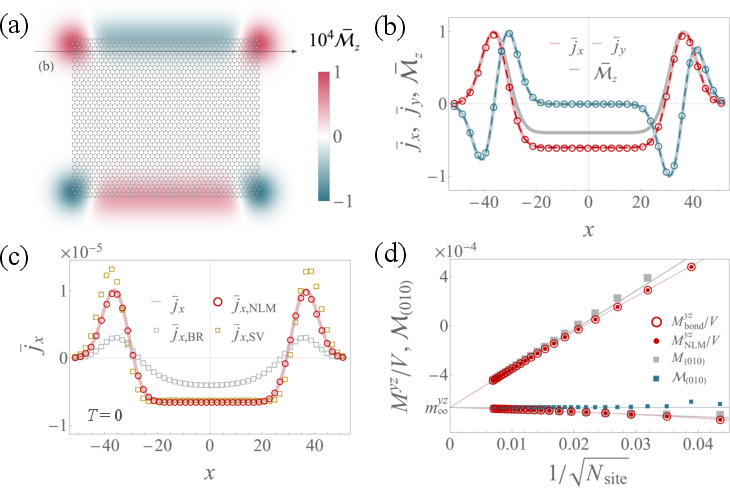
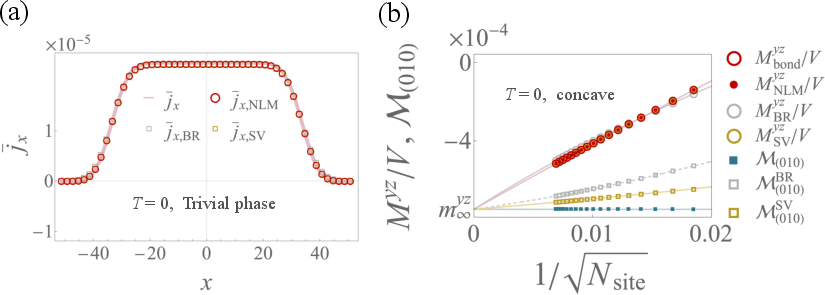
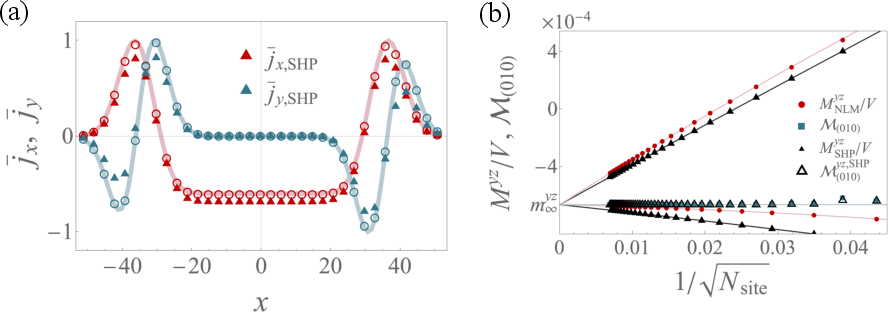
Figure 1: (a) Haldane model flake geometry for OBCs; (b) NLM as a function of chemical potential, including sublattice-resolved values; (c,d) Spatial map of the three-point local orbital magnetization and bond currents for OFM and OQM states.
Application to Lattice Systems and the Natural Local Marker
For lattice models, orbital magnetization is formulated analogously, with the real-space sum replacing spatial integrals. However, physical currents are defined over bonds, not lattice sites. By introducing a smeared charge-density operator with a flexible spatial window W(x−r), the authors construct the smeared current density and establish a lattice version of the current-generating relation via the three-point formula.
To facilitate practical computations and focus on physically relevant (i.e., coarse-grained) current-generating magnetization, the Natural Local Marker (NLM) Mi(r) is introduced via an expansion in local spatial moments. This marker:
- Satisfies the sum rule for the total magnetic moment,
- Is constructed to ensure the correct current-generating property to third derivative order after spatial averaging,
- Is robust to the various ambiguities (e.g., surface vs. bulk contributions) noted for previous local markers.
Bulk, Edge, and Quadrupole Magnetization: Connection to Multipole Theory
An immediate consequence of this construction is a unified quantum theory of not only the local magnetization but also the orbital magnetic quadrupole moment (MQM) and higher multipole moments. The formulas show:
Haldane Model Realizations and Edge Phenomena
The theory is illustrated using the Haldane model on large flakes with OBCs, focusing on two regimes:
- The orbital ferromagnet (OFM), with a net magnetization,
- The orbital quadrupole magnet (OQM), with vanishing net moment but finite quadrupole.
Results reveal:
Comparison with Previous Local Markers
Comprehensive benchmarking against previously proposed local markers—such as the Bianco-Resta (BR), Seleznev-Vanderbilt (SV), and Saati-Hur-Pi
echon (SHP) formulas—shows that:
Practical and Theoretical Implications
The current-generating local orbital magnetization field enables a fully quantum, real-space description of orbital magnetism at all scales, from macroscopic materials to molecular systems. Notable implications include:
- Microscopically rigorous computation of orbital MQMs, pivotal for classifying higher-order topological phases and interpreting hinge/edge current phenomena,
- Applicability to orbitronics, including device-scale engineering and manipulation of orbital degrees of freedom via local perturbations,
- Extension to future correlated electron systems and possible inclusion of electron interactions in a local-flux framework.
The results also clarify the longstanding ambiguities in local orbital magnetization definitions and establish which quantities correspond to observables (e.g., edge currents, MQM) in both trivial and topological regimes.
Conclusion
This work provides a quantum-mechanical, real-space framework for local orbital magnetization that is physically unique in two dimensions and selects a natural representative in three. By building on the local-flux response of the grand potential, both the three-point formula and the derived Natural Local Marker fulfill all required properties: local current generation, boundary insensitivity away from the edge, and agreement with bulk theories in the thermodynamic limit. Applications to the Haldane model illustrate the theory's capacity to capture both bulk and boundary phenomena—validating previous multipole principles in the quantum domain, and laying foundational groundwork for further developments in microscopic orbital magnetism and orbitronics research.