- The paper introduces a new construction of BMS3-like infinite-dimensional Lie algebras using Z_N-graded u(1)^2 Kac-Moody currents and alternative Sugawara methods.
- It employs a novel factorization conjecture that maps the algebraic variety of generalized Virasoro structures onto stratified projective spaces.
- The study reveals new families of nilpotent extensions and central charges, suggesting applications in 3D gravity and advanced conformal field theories.
BMS3-like Algebras from ZN-graded u(1)2 Kac-Moody Algebras
Overview and Motivation
This work systematically investigates the construction and classification of BMS3-like infinite-dimensional Lie algebras via ZN-graded extensions of the u(1)2 Kac-Moody current algebra, focusing particularly on alternative Sugawara-type constructions. The study connects the algebraic classification of Virasoro-like algebras arising from these gradings with the geometry of associated non-compact algebraic varieties, whose projective compactification unveils a rich stratified structure intimately tied to BMS3 and its generalizations.
Construction of ZN-graded Virasoro Algebras
By decomposing the u(1)2 Kac-Moody currents and Virasoro generators into ZN-graded components, the authors construct alternative realizations of the Virasoro algebra. The grading enables new types of current bilinears utilizing both the symmetric ZN0 and antisymmetric ZN1 tensors unique to the ZN2 case in ZN3, vastly enlarging the space of possible quadratic energy-momentum tensors beyond the standard Sugawara construction.
Closure of the Virasoro algebra in this generalized setting imposes polynomial constraints on the coefficients of the generalized Sugawara terms, resulting in an affine algebraic variety parameterizing all inequivalent ZN4-graded Virasoro structures. For each ZN5, the corresponding algebraic variety is non-compact, motivating its projective completion by adjoining points at infinity.
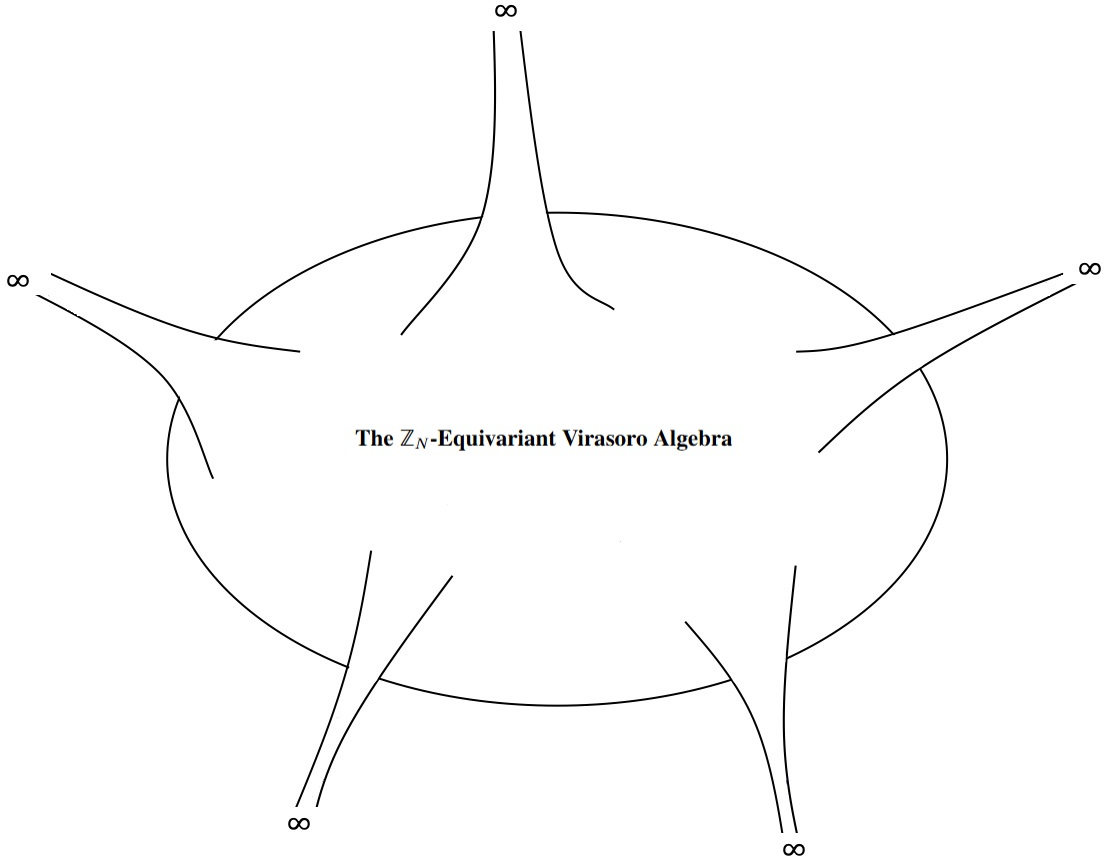
Figure 1: Non-compact algebraic variety corresponding to the ZN6-equivariant construction of the Virasoro algebra in terms of current modes.
The Factorization Conjecture and Projective Geometry
A central conjecture, validated for ZN7, asserts that the projective closure of the parameter variety factorizes completely, taking the form ZN8 in suitable homogeneous coordinates. The loci ZN9 describe the points at infinity; these are unions of u(1)20 projective subspaces which intersect in a hierarchical pattern, such that intersections of u(1)21 divisors correspond to points of higher singularity.
Points at infinity are thus stratified by vanishing order, and their algebraic multiplicity is shown to control the structure of the associated Lie algebra extensions.
Emergence of u(1)22-like and Nilpotent Extension Algebras
At the physical and representational level, points at infinity yield Lie algebras of the form u(1)23, where u(1)24 is a Virasoro subalgebra and u(1)25 is an infinite-dimensional nilpotent Lie algebra whose depth u(1)26 is directly related to the order u(1)27 of vanishing at the singularity: u(1)28. This deep connection between geometry and algebra enables a precise classification:
- For u(1)29, the closure corresponds to two isolated points, each admitting an abelian ideal BMS30, reproducing the BMS31 structure.
- For BMS32, projective strata of higher codimension/intersection order produce nilpotent ideals of varying depth, with explicit commutation relations outlined for the BMS33 and BMS34 cases.
The presence of the BMS35 tensor in these constructions leads to central charge doubling at the closure points, revealing nontrivial consequences for the representation theory of these algebras.
Central Extensions and Algebraic Generalizations
In addition to reproducing known results for the BMS36 algebra (i.e., Virasoro semidirect abelian), this framework uncovers whole families of previously unexplored infinite-dimensional nilpotent Lie algebra extensions for BMS37, including their possible central extensions consistent with conformal primary fields of weight BMS38.
The central extension structure for the general case is specified by symmetric matrices BMS39 and structure constants ZN0, with the BMS sector captured as a truncation for ZN1 and ZN2 abelian—whereas for higher ZN3, ZN4 becomes non-abelian with well-defined nilpotence properties tied to singular strata in the projective variety.
Implications and Future Directions
This paper provides a largely algebraic and geometric foundation for generalizing ZN5-like symmetry algebras, bridging infinite-dimensional Lie algebra theory with singularity theory and algebraic geometry. It enables a functorial construction of new infinite-dimensional algebras with precisely prescribed nilpotent extension structure, suggesting that other integrable systems or problems in three-dimensional gravity may admit similar algebraic symmetry enhancements. Furthermore, the factorization conjecture, if upheld for general ZN6, would yield a complete classification of such ZN7-like algebras arising from ZN8-graded Kac-Moody extensions.
Further research may probe:
- Explicit construction and classification of unitary representations for the new nilpotent-extended algebras,
- Generalization to higher-rank abelian Kac-Moody algebras (ZN9 with u(1)20) and possible new invariants,
- Physical interpretations in the context of asymptotic symmetries in 2+1-dimensional gravity beyond flat space,
- Connections with module categories of vertex operator algebras or new CFT models distinguished by these generalized symmetries.
Conclusion
By mapping the algebraic closure of generalized Sugawara constructions for u(1)21-graded u(1)22 Kac-Moody algebras to explicit projective varieties, this paper demonstrates a geometric mechanism for the emergence and classification of u(1)23-like and more general nilpotent extension algebras. The central role of the factorization of algebraic relations establishes a deep correspondence between singularity theory and infinite-dimensional symmetry algebras in mathematical physics. These results open avenues for further exploration of novel infinite-dimensional Lie algebras with potential applications in new sectors of conformal and gravitational theories.

