- The paper demonstrates that aggressive, resilient control can suppress state deviations but also reduce observable variability, leading to resilience-induced blindness in detecting mode switches.
- It formulates a two-player non-cooperative game where the detector and controller optimize conflicting objectives, highlighting an intrinsic trade-off between regulation cost and information gain.
- Analytical and simulation results on a two-mode linear Gaussian system show that increased controller resilience may degrade overall performance by delaying correct belief adaptation after mode changes.
Detection-Control Games under Hidden Modes: The Resilience-Induced Blindness Phenomenon
The paper introduces a unified game-theoretic framework for resilient control in cyber-physical systems operating under modes that are hidden due to faults, attacks, or system degradation. Classical approaches employ a two-stage design paradigm, separating detection (to infer hidden modes from measurements) and control (to optimize regulation given inferred modes). The authors challenge this separation principle, demonstrating that detection and control are fundamentally coupled: the controller shapes the statistics of system signals observed by the detector, and detection outcomes feed back into the controller's dynamics.
This interdependence reveals an intrinsic tradeoff between regulation and information—the so-called information–regulation tradeoff. Aggressive, resilient controllers suppress state deviations but also reduce the system's observable mode-dependent variability, potentially "blinding" detectors to hidden mode changes. Conversely, controllers that excite more variability facilitate mode discrimination but may incur greater regulation cost.
The authors formalize this dynamic as a two-player non-cooperative game between a detector (minimizing detection cost via belief updates) and a controller (minimizing expected regulation cost). Each optimizes its policy in response to the other, naturally giving rise to Nash equilibria that are consistent for each subsystem but potentially globally inefficient for overall resilience in the face of hidden mode switching.
Technical Framework
The system is described as a discrete-time, mode-dependent stochastic process: xk+1=fθk(xk,uk,wk),yk=hθk(xk,vk)
where θk denotes the (hidden) operational mode, and wk, vk are process and measurement noise, respectively.
The detector maintains a belief πk over modes, using tempered Bayesian updates controlled by sensitivity parameter β: πk(θ)=∑θ′πk−1(θ′)Lk(θ′)βπk−1(θ)Lk(θ)β
A controller responds by solving a belief-dependent LQR problem, computing control policies as a function of both estimated state and current belief: uk=−K(πk)x^k
This establishes closed-loop coupling: belief affects control gains, control actions shape observations, and thus future beliefs.
Analysis in Linear Gaussian Hidden-Mode Systems
The paper specializes its analysis to a two-mode linear Gaussian system, the canonical setup for LQR. Each mode θ∈{0,1} (nominal or compromised) is governed by: xk+1=Aθxk+Bθuk+wk,yk=Cθxk+vk
A key theoretical result (Proposition 1) quantifies the asymptotic convergence of detector beliefs, linking belief certainty to the accumulation of log-likelihood evidence: θk0
If θk1 (θk2), the detector's posterior belief converges to mode 0 (1), ensuring consistency under persistent statistical evidence.
For control, the belief-dependent LQR gain and Riccati solution are computed with matrices interpolated by the current belief, optimizing regulation under the estimated mixed dynamics.
Theoretical Characterization: The Resilience-Induced Blindness Phenomenon
The core technical contribution is a rigorous, quantitative characterization of the resilience-induced blindness phenomenon. The controller's resilience margin, denoted θk3, captures how robustly the belief-dependent LQR stabilizes both modes: θk4
where θk5 quantifies mode mismatch, and θk6 is the closed-loop dynamics.
The authors derive a resilience-to-detection upper bound (Theorem 1), showing that a larger resilience margin (i.e., more aggressive control) leads to faster contraction of the state—reducing output separation between modes and thus shrinking the instantaneous log-likelihood ratio update θk7: θk8
with θk9 determined by wk0. This directly links controller design to the speed and reliability with which the detector can infer the true underlying mode.
Strong empirical and theoretical claim: The paper demonstrates, both analytically and in simulation, that increasing controller resilience can in fact degrade overall performance by blinding the detector to mode switches, causing persistent belief and gain mismatch and degrading closed-loop response under mode changes.
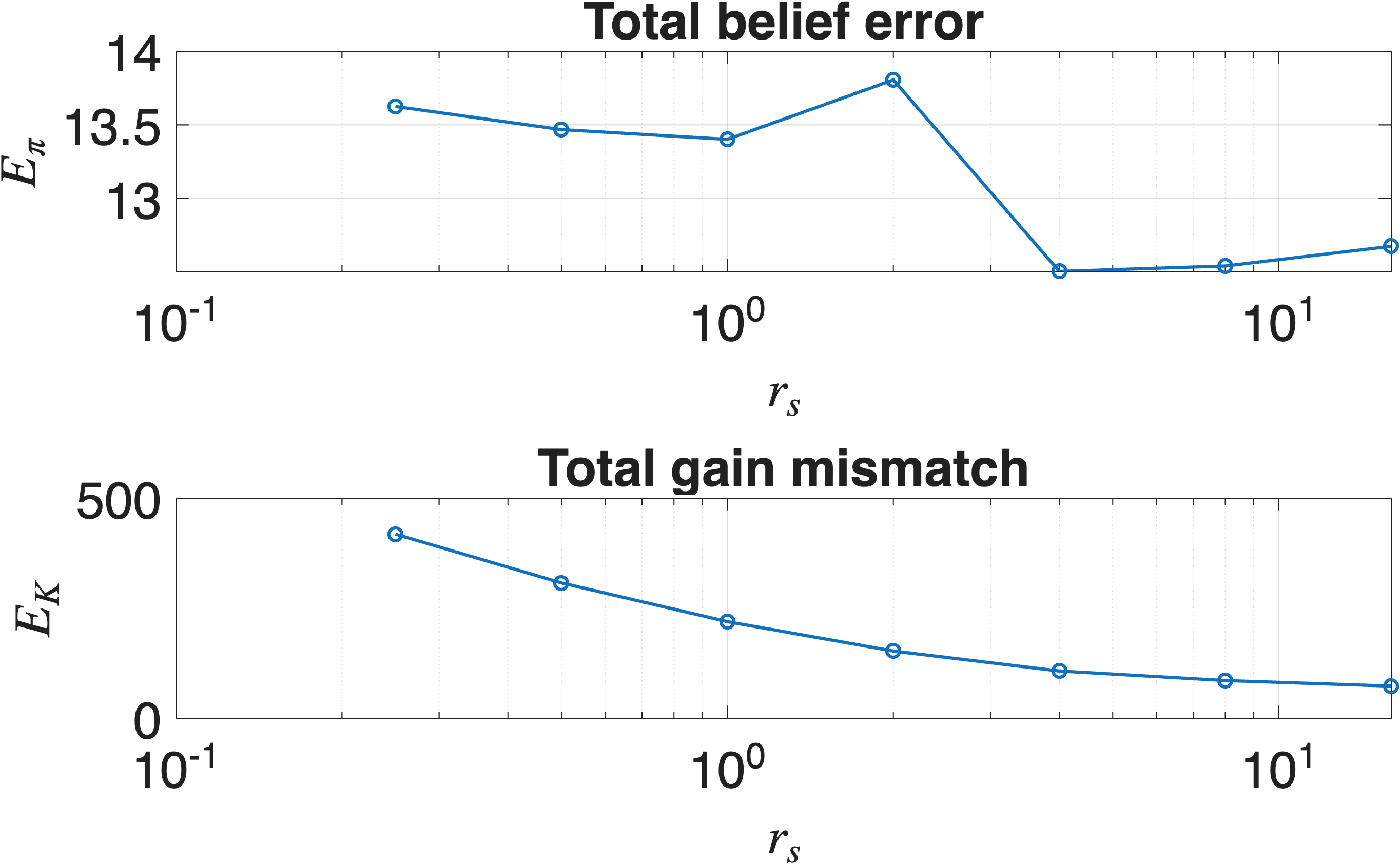
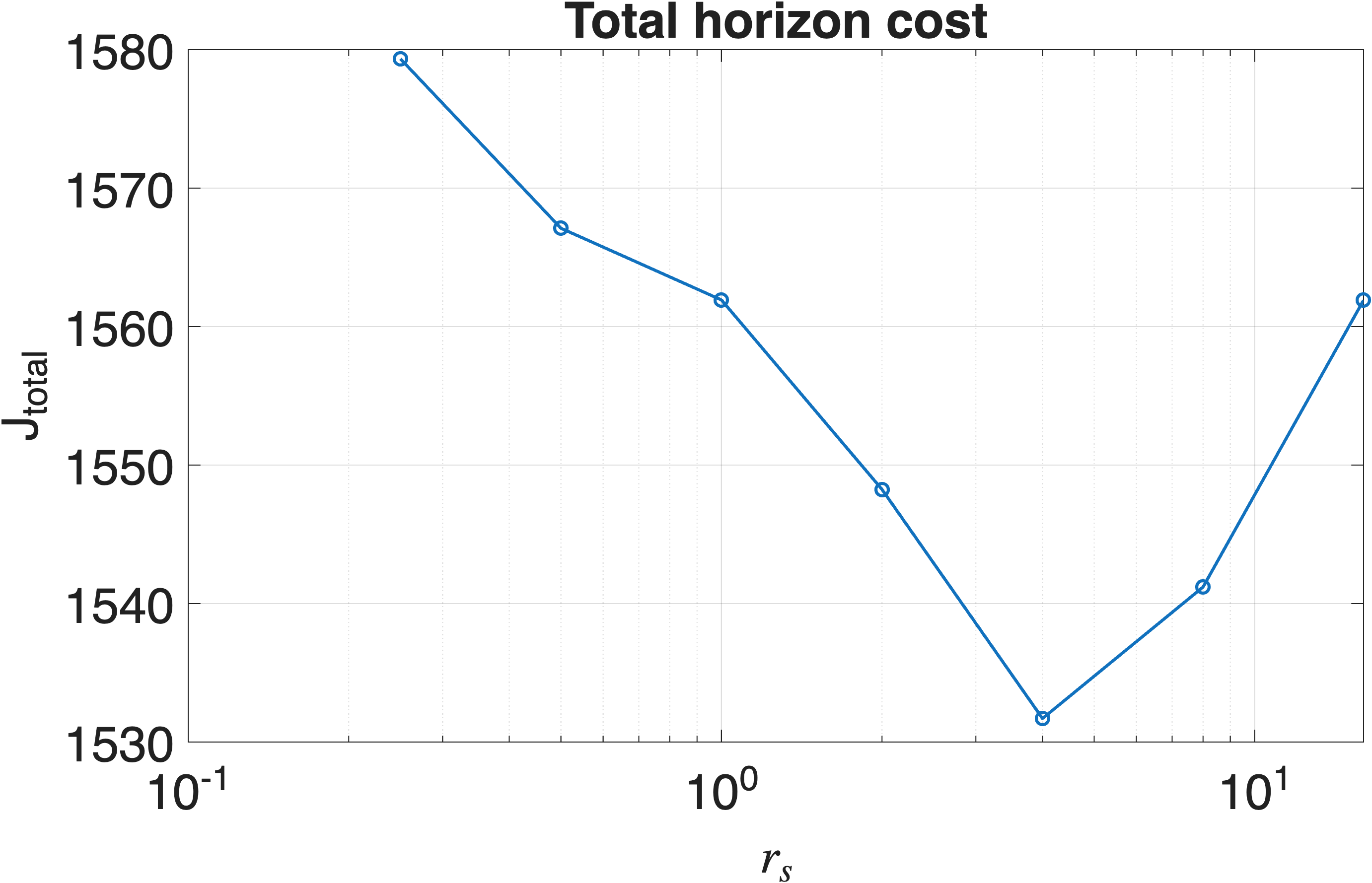
Figure 1: Mode belief error wk1 and control gain mismatch wk2 illustrate the persistence of incorrect beliefs and inappropriate controller gains after mode switches, quantifying the resilience-induced blindness effect.
Empirical Results and Mitigation Strategies
Extensive numerical simulations on a three-state, two-mode linear system confirm the theoretical findings:
- In fixed-mode operation, increasing controller aggressiveness (smaller wk3 in LQR) reduces regulation cost, as expected.
- When modes switch, this trend reverses: highly resilient controllers exhibit higher overall state costs due to sluggish belief adaptation and prolonged use of incorrect feedback gains.
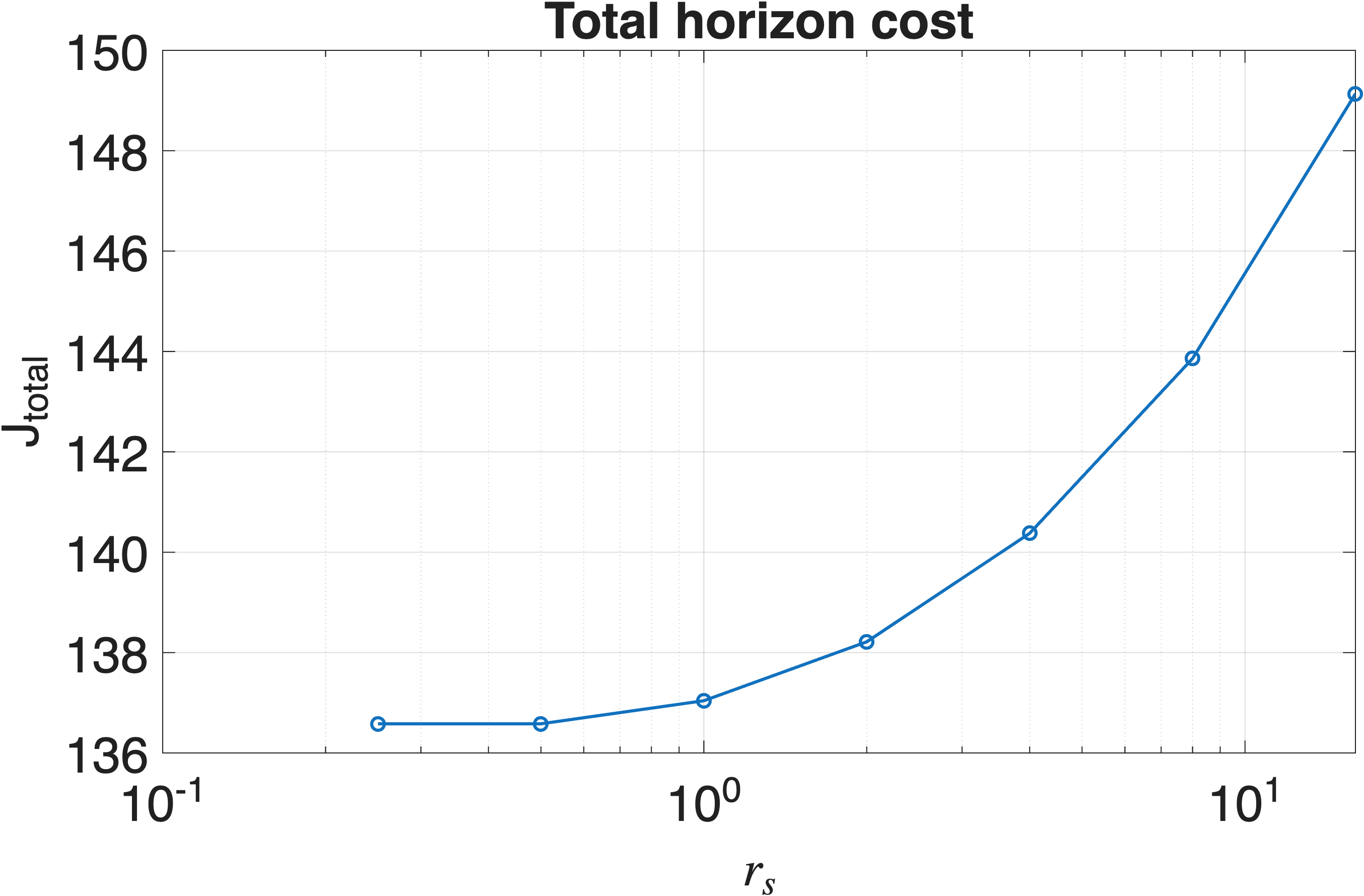
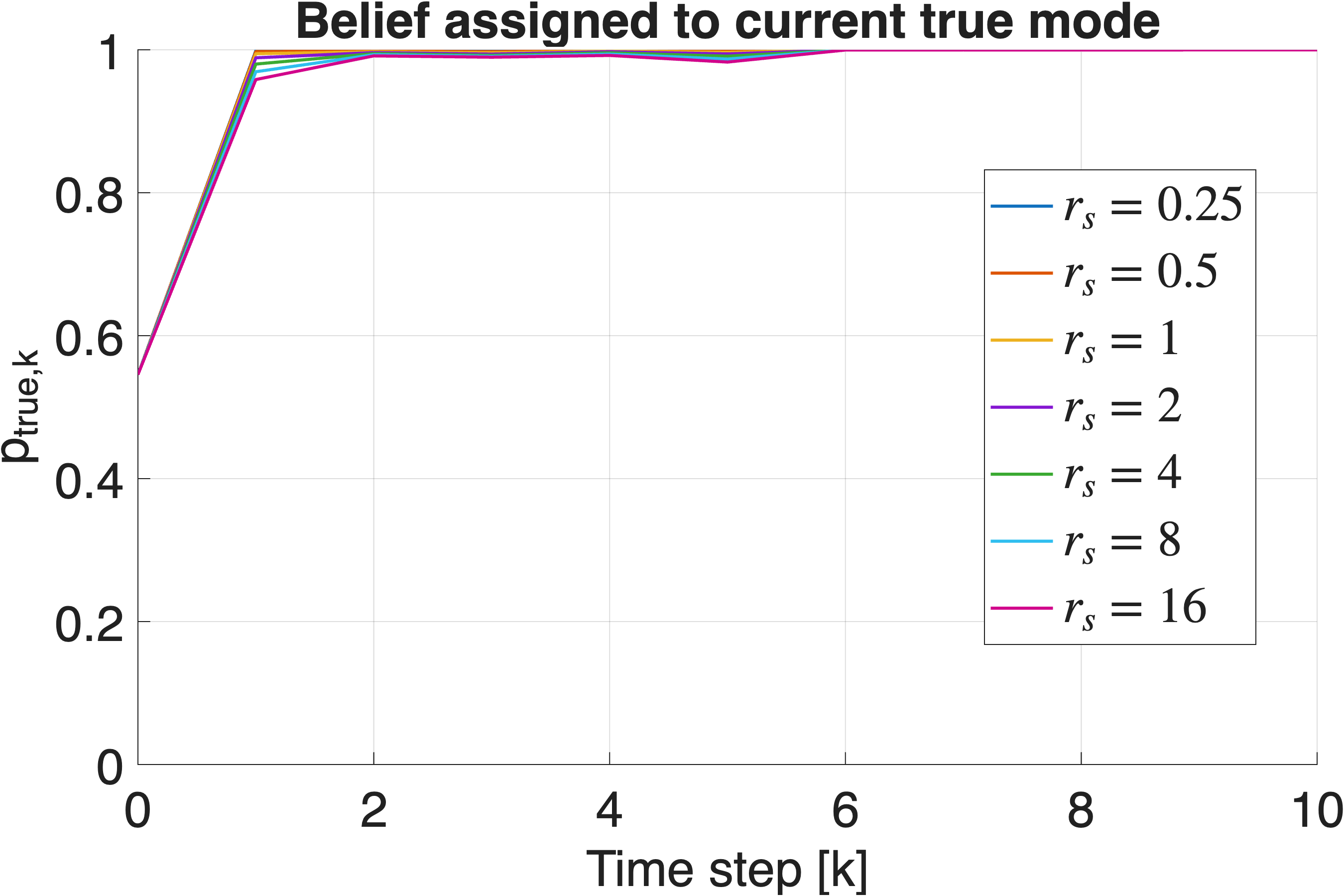
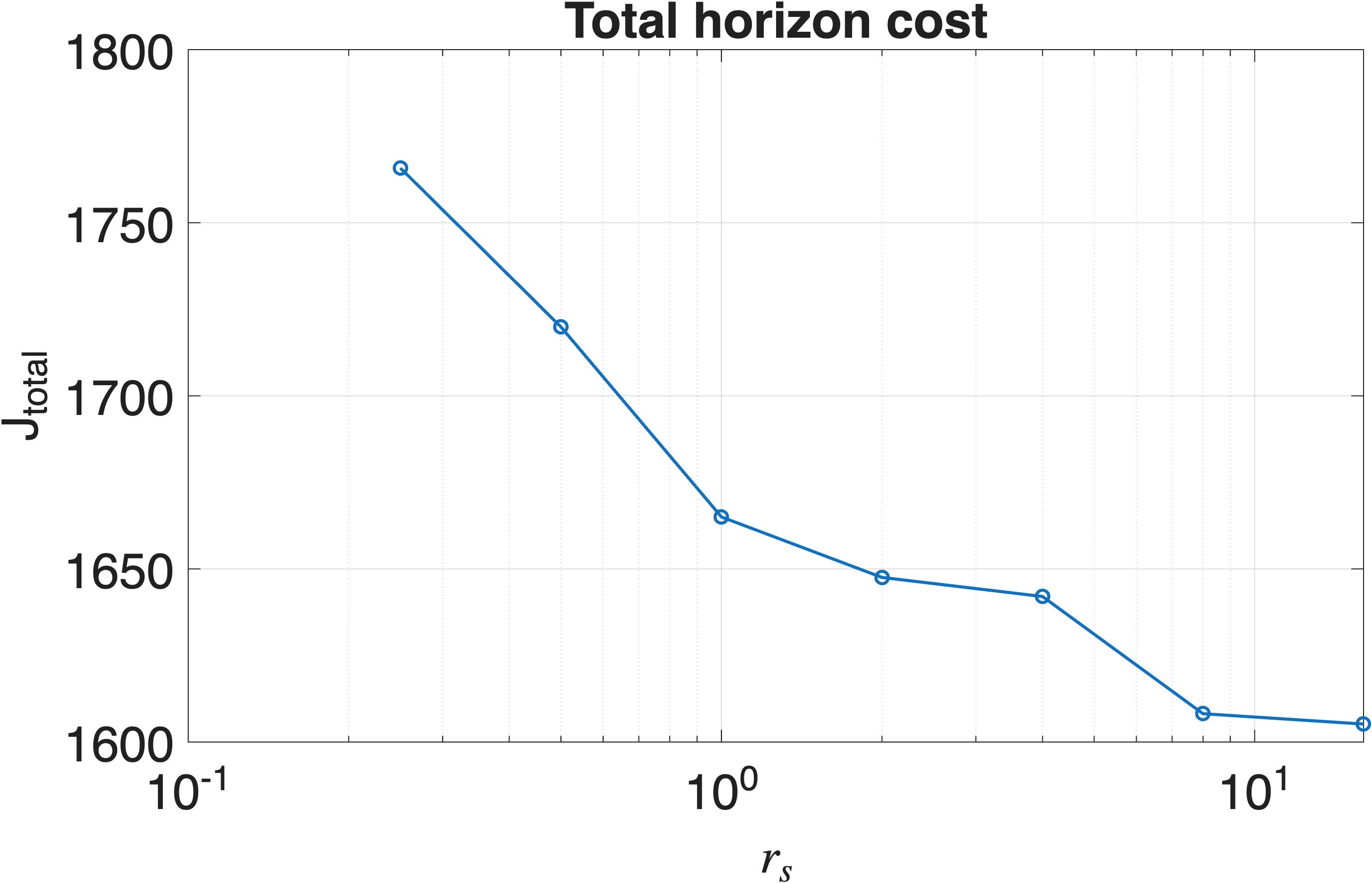
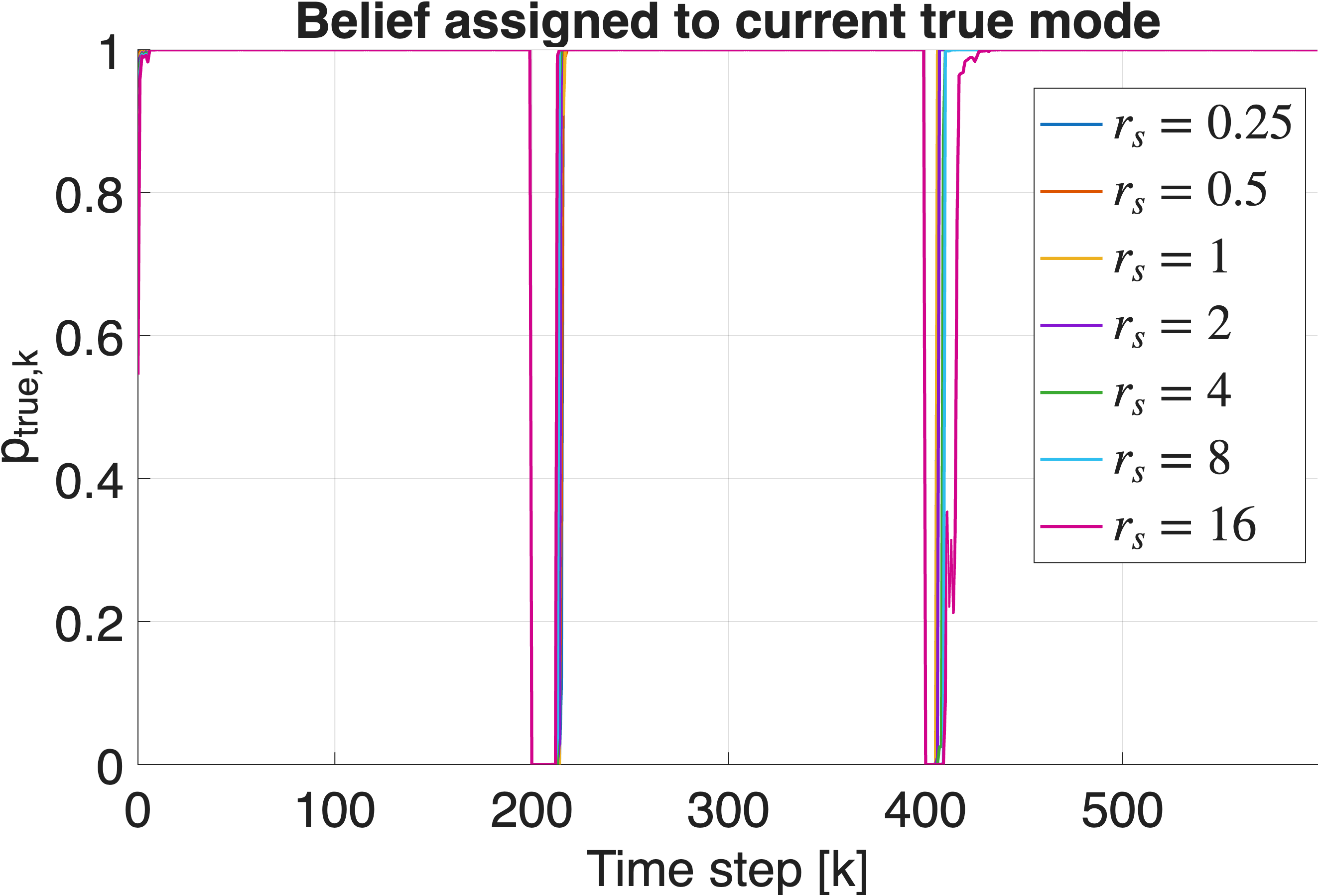
Figure 2: Comparison of fixed-mode (left) and switching-mode (right) performance across different LQR control penalties; the reversal trend under switching demonstrates resilience-induced blindness.
A mitigation strategy is demonstrated by increasing the detector's sensitivity parameter wk4, effectively prioritizing measurement evidence in belief updates. Higher wk5 accelerates belief adaptation after mode changes, reducing both belief error wk6 and gain mismatch wk7, and partially restoring expected regulation performance. However, the effect is only partial; full mitigation would require fundamental co-design of detection and control objectives.
Implications and Future Directions
Theoretically, the analysis parses the limits of the classic separation principle in resilient control architectures. It highlights that optimality in detection or control, in isolation, does not extend to global resilience when these processes are closed-loop coupled via hidden modes.
Practically, the results motivate system designs that explicitly co-optimize regulation performance and measurement informativeness—potentially through joint objective functions, incentive alignment, or integrated co-design paradigms. For LTI systems, adopting variable detector sensitivity or excitation policies may be an effective, computationally tractable intervention. More broadly, these insights can inform architectures in active fault-tolerant control, self-healing CPS, and networked control under adversarial threats.
There are open questions about scalability to higher-dimensional and multi-modal systems, the effect of non-Gaussian disturbances, and the opportunity for learning-based or adaptive schemes that dynamically reconcile the detection-control tradeoff.
Conclusion
This paper presents a formal analysis and demonstration of the resilience-induced blindness phenomenon in hidden-mode resilient control systems. By unifying detection and control as a game, characterizing the nontrivial effects of controller resilience on detectability, and proposing initial mitigation via detector tuning, the results call for integrated co-design approaches in resilient CPS architecture, with broad implications for theory and practice in attack-resilient, fault-tolerant, and adaptive control systems (2606.29080).