- The paper demonstrates that ASKAP J1745-5051 is a magnetic cataclysmic variable exhibiting periodic radio bursts and X-ray emission, uniquely linking LPTs with accreting white dwarf systems.
- The paper employs rigorous SED modeling and precision astrometry to determine a 15,000K white dwarf and a sub-stellar donor, validated through multi-band PSF fitting.
- The paper highlights that the observed WD heating and donor characteristics challenge traditional CV evolution models, suggesting enhanced angular momentum loss or variable accretion dynamics.
A Multi-wavelength Study of ASKAP J1745-5051: Cataclysmic Variable with a 15,000 K White Dwarf and Sub-Stellar Donor
Introduction and Context
The study analyzes the source ASKAP J1745-5051, a long-period radio transient (LPT) and confirmed magnetic cataclysmic variable (mCV), establishing it as a key system linking the previously disjoint populations of periodically radio-bursting white-dwarf binaries and accreting magnetic white dwarfs. LPTs, characterized by highly polarized, periodic radio bursts, had ambiguous physical origins, with previous candidates showing strong associations either with slow-spinning neutron stars or with white-dwarf (WD) binaries. ASKAP J1745-5051 is unique in showing unequivocal signatures of both classes—X-ray emission characteristic of mCVs and periodic radio emission typical of LPTs—thus occupying an evolutionary position of significant theoretical interest.
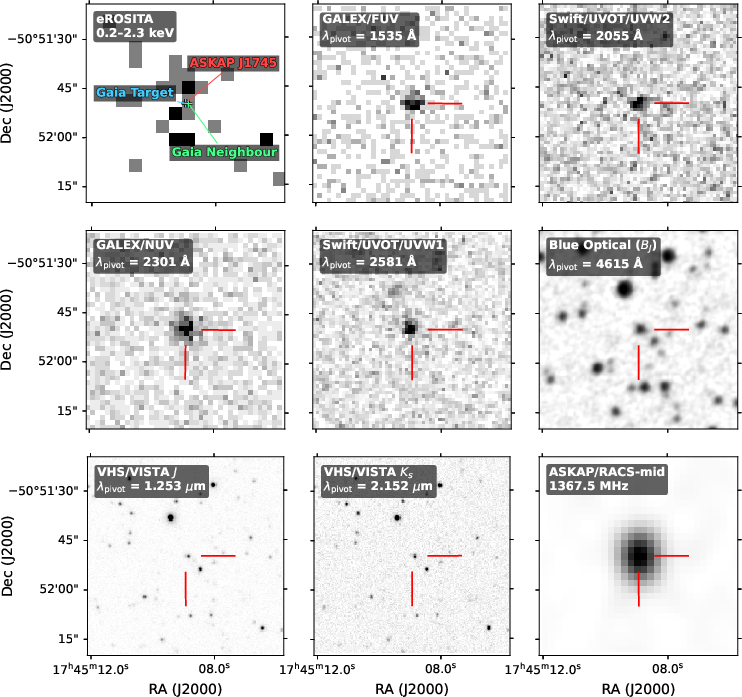
Figure 1: Multi-wavelength finding charts for ASKAP J1745-5051, demonstrating identification across X-ray, optical, and radio bands.
Observational Challenges and Astrometric Identification
The galactic field of ASKAP J1745-5051 is complicated by severe source crowding, particularly due to an interloper located only $0.9$ arcsec from the target, with comparable G-band brightness. Careful astrometry using Gaia DR3 and sub-arcsecond radio positions disambiguates the associations, securing the identification of the correct optical/near-infrared (NIR) counterpart despite blending.
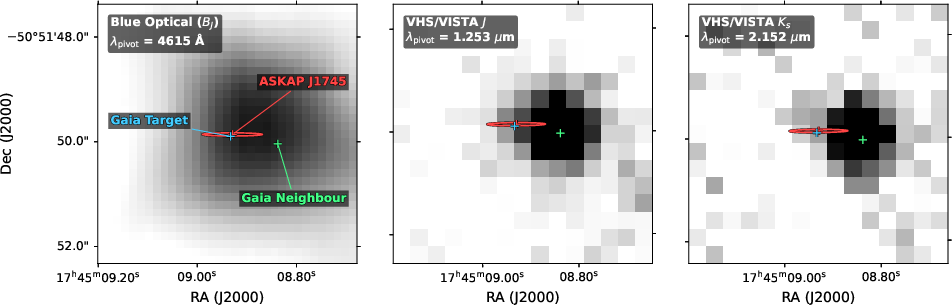
Figure 2: High-resolution finding charts illustrating the close blending between ASKAP J1745-5051 and its optical neighbor at redder bands; precise radio positions allow a unique identification.
A central methodological advance is a meticulous cross-frequency approach: contaminated optical photometry is discarded, and NIR fluxes are extracted using PSF-fitting on VISTA/VHS data, treating the neighboring star explicitly in the photometric model.
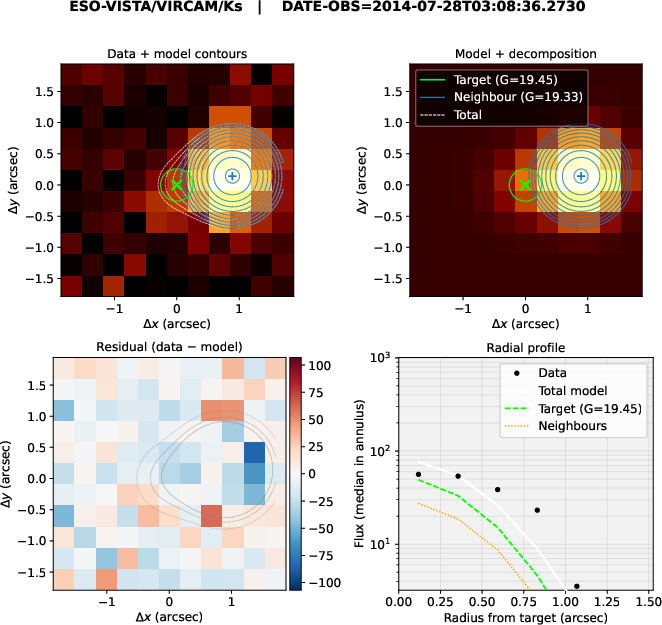
Figure 3: PSF fitting in Ks band data, employing Gaussian decomposition to isolate ASKAP J1745-5051's contribution despite significant blending.
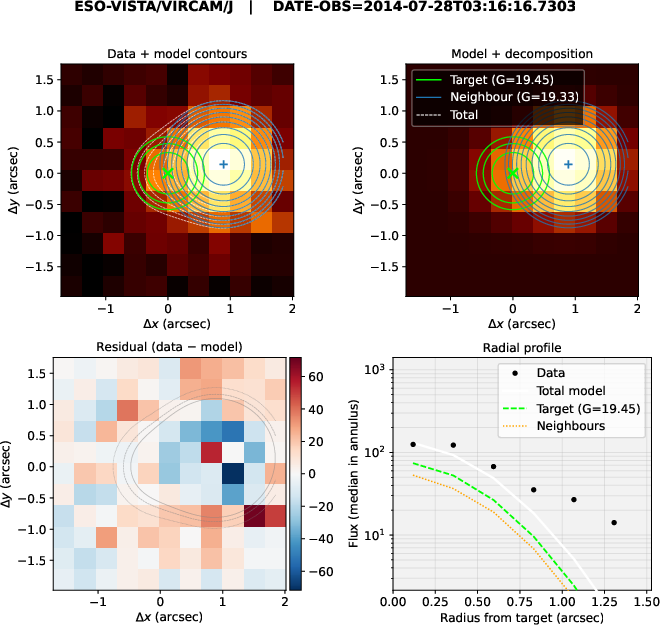
Figure 4: Analogous PSF fitting in the J band, further substantiating the reliability of NIR measurements.
Spectral Energy Distribution Modelling
The spectral energy distribution (SED), constructed from the far-UV to NIR, is modeled as the superposition of two physically motivated components:
- A DA-type white dwarf with synthetic atmospheric models parameterized by Teff and fixed MWD≃0.8M⊙.
- A sub-stellar donor with M2 and T2 constrained to lie on the semi-empirical CV donor sequence (KBP11), consistent with a Roche-lobe filling companion at the observed orbital period (Porb=82.1±3.2 min).
Reddening is co-fitted using the Fitzpatrick extinction law with RV=3.1 and G0 as a free parameter, rather than applying ad hoc corrections to the photometry. The best-fit SED requires the WD to have G1 K—a value substantially hotter than typical LPT associations, and more consistent with accretion-heated WDs in short-period mCVs. The donor is sub-stellar (G2, G3 K), with its contribution emerging only in the G4 and G5 bands.
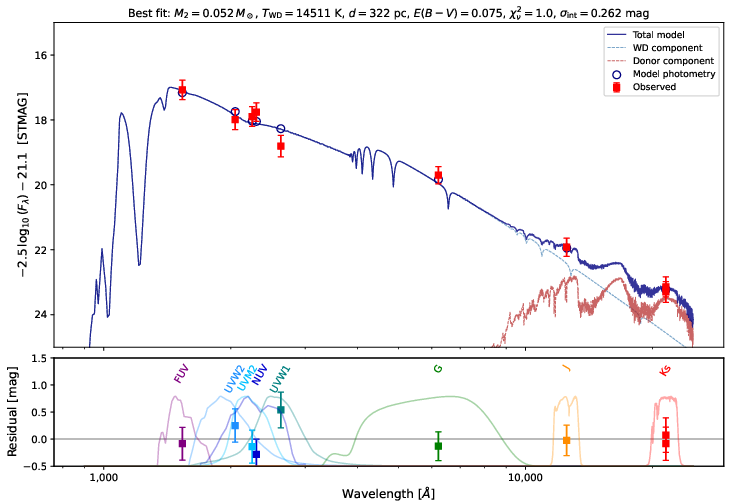
Figure 5: Far-UV to NIR SED of ASKAP J1745-5051, modeled as the sum of DA WD and late-type companion; observed fluxes, model atmospheres, and model photometry in various filters are overplotted.
MCMC posterior analysis indicates small degeneracies—between G6 and G7, and between distance and both G8 and G9. The required intrinsic dispersion to achieve statistically acceptable fits is Ks0 mag, consistent with added photometric uncertainties from variability, blending, or neglected localized cyclotron features.
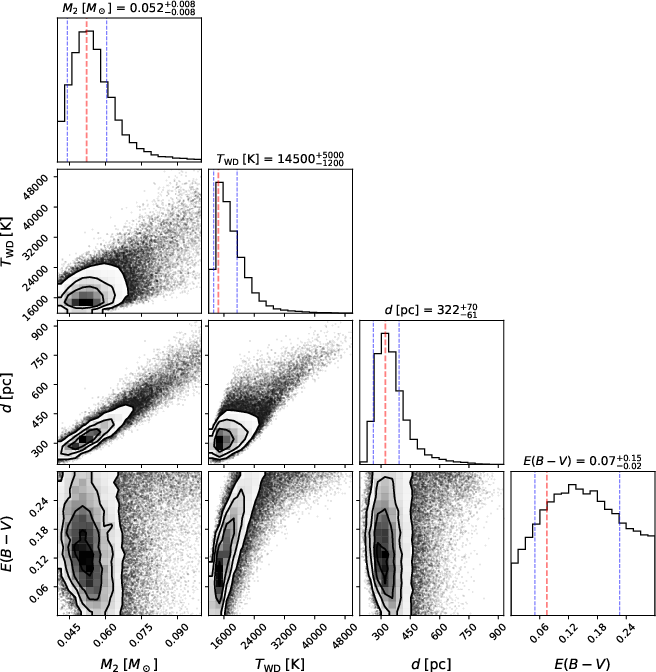
Figure 6: Posterior distributions for SED modeling parameters; clear correlations are present but constraints are robust.
Physical Implications
White Dwarf Heating and Evolution
The white dwarf temperature implies an accretion rate Ks1, broadly consistent with theoretical expectations for post-period-minimum mCVs but exceeding the value predicted for its donor mass if only gravitational radiation drives angular momentum loss. This discrepancy suggests the possible presence of enhanced AML mechanisms or that compressional heating and long-term accretion variability are at play.
The sub-stellar nature of the donor, combined with an orbital period at the minimum of the CV period distribution, identifies ASKAP J1745-5051 as a period-bounce system. Such systems have long been predicted but are observationally rare, particularly among magnetic systems.
The Incidence and Beaming of LPTs
The inferred distance to ASKAP J1745-5051 is Ks2 pc, only Ks3 greater than the nearest confirmed polar, suggesting that the space density of LPTs among mCVs could be non-negligible. However, the detectability of LPTs depends on the radio beaming fraction, which is likely small. For systems with modest magnetic obliquity, the true population of LPTs could be an order of magnitude higher than currently observed, potentially accounting for a significant fraction of the "missing" period-bouncer CVs.
Methodological Rigor and Limitations
The SED decomposition is robust with respect to uncertainties in the NIR measurements and to simplistic additions of accretion flow contributions. Allowing for additional blackbody/disc components does not materially alter Ks4, Ks5, or Ks6 unless constraints are forcibly relaxed, rendering the donor and WD parameters degenerate. Only future UV and NIR spectroscopy will definitively constrain potential accretion flow contributions or variability bias.
Theoretical and Observational Consequences
The secure identification and characterization of ASKAP J1745-5051 provides a rare empirical anchor linking LPTs, mCVs, and the elusive period-bounce phase of compact binary evolution. The hotter WD temperature in this LPT directly contradicts generic claims that LPTs and WD "pulsars" must have cold, non-accreting primaries, thereby challenging simplistic evolutionary scenarios. The presence of a sub-stellar donor at this period supports a scenario in which many mCVs may pass through an LPT phase with radio beaming limiting detectability.
Moreover, the results motivate continuous radio monitoring across wider samples of mCVs and deep photometric/spectroscopic campaigns targeting sub-stellar donors in short-period systems to resolve the outstanding "missing period bouncer" problem in close binary evolution theory.
Conclusion
This study presents a rigorous, physically motivated multi-wavelength analysis of ASKAP J1745-5051, establishing it as an LPT and mCV hosting an accretion-heated (Ks7 K) white dwarf and a sub-stellar (Ks8) donor at a distance of Ks9 pc. Its unique phenomenology and parameter set directly inform models of magnetic field evolution, angular momentum loss, period minimum structure, and the demographics of CVs and LPTs. These findings have significant ramifications for the census and evolutionary modeling of AM CVn- and WD-pulsar-like systems, and call for refined theoretical modeling coupled with broader time-domain surveys to uncover the true parameter space of short-period, low-luminosity interacting binaries.

